
lovethailand home >North Travel Attractions >Chiang Mai Travel Attractions >Chai Prakan >Pong Tam > Wat Mahingsawat
TL;DR: Wat Mahingsawat is located at 274 Moo 3, Ban Pang Khwai, Pong Tam Subdistrict, Chai Prakan District, Chiang Mai 50320, Thailand, open Daily, hours 08.00 – 17.00.

Wat Mahingsawat
Open Days: Daily
Opening Hours: 08.00 – 17.00
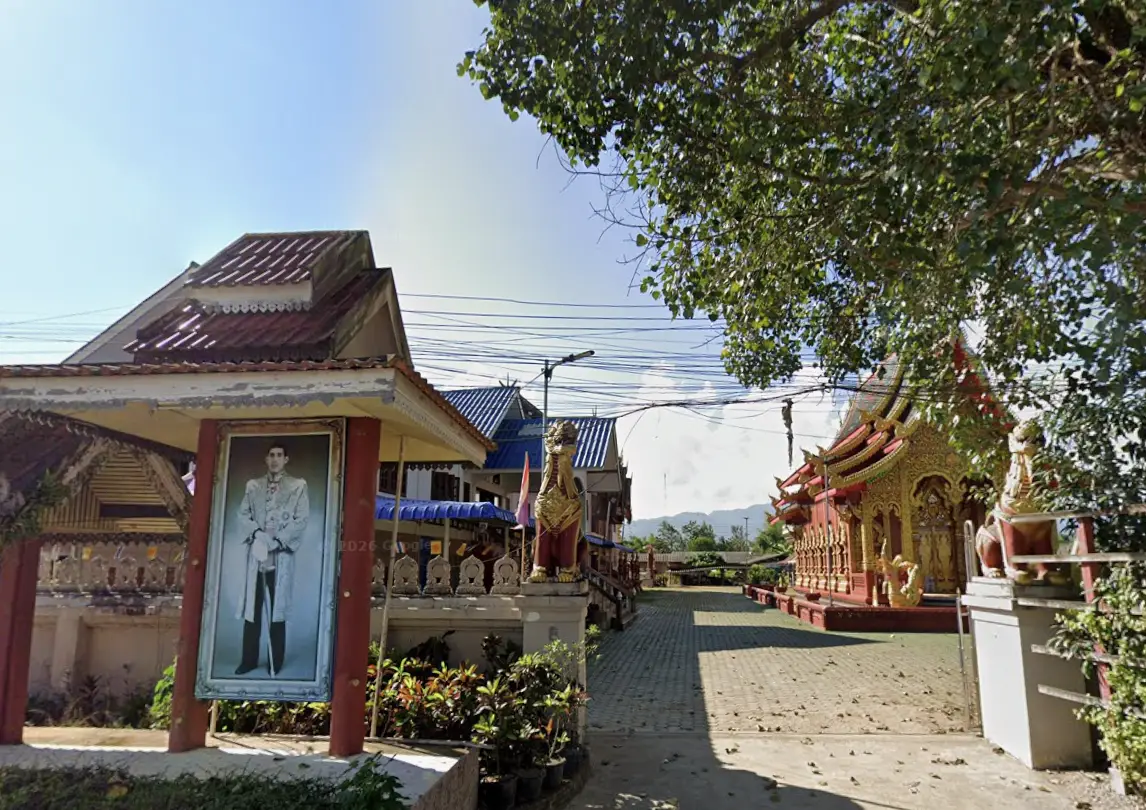
Wat Mahingsawat is a historic community temple in Ban Pang Khwai, Moo 3, Pong Tam Subdistrict, Chai Prakan District, Chiang Mai Province. Affiliated with the Maha Nikaya order, the temple was established in 1917, although its beginnings can be traced to 1912 when a monk known as Phra Ot initiated the construction of a temple for the community. More than a century later, Wat Mahingsawat remains an active Buddhist institution, serving Ban Pang Khwai through religious ceremonies, community activities, education, and the annual bathing ceremony of its sacred chedi.
The temple continues to function as an active place of worship. A clear recent example took place on 2 April 2026, when representatives of Chai Prakan Municipality, local officials, and residents joined the annual merit-making and sacred-relic bathing activities at Wat Mahingsawat, also locally associated with the name Wat Pang Khwai. The event demonstrates that the temple remains an important centre of Buddhist life in the community rather than simply a historic religious site.
Understanding Wat Mahingsawat requires understanding Ban Pang Khwai itself. The temple and village are closely connected through both history and language. Cultural research on local place names in Chai Prakan explains that the community became known as Ban Pang Khwai because early settlers used the area as a camp or resting place for buffaloes. The village name therefore preserved a memory of the livelihood and settlement pattern of the earliest community.
Around 1957, the abbot and local Buddhist supporters jointly adopted the name “Mahingsawat” for the temple while retaining the original meaning associated with Ban Pang Khwai. The new temple name gave the local place name a Pali-derived religious form without erasing the historical meaning behind it. This makes the name of Wat Mahingsawat an important part of the cultural story of the village.
The temple’s documented history begins even earlier. In 1912, Phra Ot initiated construction of the temple, while the formal establishment of Wat Mahingsawat is dated to 1917. During this period, communities in northern Chiang Mai were still strongly organised around agricultural villages, kinship networks, Buddhist monasteries, and local ritual traditions. A village temple therefore served not only as a place for worship but also as a social and educational centre.
With its establishment dating to 1917, Wat Mahingsawat has now served the community for more than a century. During this period, Chai Prakan has undergone major changes in transportation, education, administration, and economic life. Despite those changes, the temple has retained its core role as a Buddhist centre for Ban Pang Khwai.
Wat Mahingsawat occupies 1 rai, 2 ngan, and 63 square wah of titled land. Its northern and southern boundaries measure approximately 1 sen and 4 wa, while the eastern and western boundaries measure approximately 1 sen and 5 wa. The relatively compact grounds are characteristic of a village temple integrated closely into the surrounding settlement.
The principal monastic buildings include an ubosot, monks’ residences, and a merit-making hall. These facilities support both the formal duties of the Sangha and the religious needs of the local community. The ubosot is used for important ecclesiastical ceremonies, while the hall provides a shared space for merit-making and community religious activities.
Wat Mahingsawat received its royal grant of Wisungkhamsima on 24 March 1969. The consecrated boundary measures 20 metres wide and 40 metres long. The grant was an important stage in the development of the temple because the Wisungkhamsima legally defines the sacred boundary used for formal monastic ceremonies within the ordination hall.
Among the temple’s notable sacred objects is a Chiang Saen-style Buddha image in the Mara-Vijaya posture. This seated posture depicts the Buddha at the moment of overcoming Mara before enlightenment, with the right hand reaching toward the earth. The image gives Wat Mahingsawat an important connection with the Buddhist artistic heritage of northern Thailand and is one of the objects visitors should pay particular attention to when visiting the temple.
The temple also contains a chedi, which remains central to religious practice through the annual sacred-relic bathing ceremony. The continuing ceremony gives the structure significance beyond architecture. It acts as a devotional focus linking the temple, local residents, and the annual Buddhist calendar.
The annual relic-bathing tradition remains active today. On 2 April 2026, Chai Prakan Municipality recorded participation in the annual merit-making and relic-bathing ceremony at Wat Mahingsawat. The presence of local officials and community members illustrates the continuing importance of the temple as a shared religious institution.
Relic-bathing ceremonies are deeply associated with Buddhist culture in northern Thailand. They bring together worship of sacred objects, merit-making, community participation, and the renewal of collective relationships. At Wat Mahingsawat, the ceremony demonstrates that Lanna Buddhist traditions remain part of contemporary community life rather than surviving only as historical memory.
The temple also developed a significant educational role. A Buddhist Sunday School was established in 1984, using the temple as a place for children and young people to learn Buddhist teachings, morality, religious practice, and appropriate conduct. This educational role expanded the function of Wat Mahingsawat beyond ritual worship.
The Buddhist Sunday School reflects a long-standing northern Thai tradition in which monasteries serve as community learning centres. Formal schooling may now take place elsewhere, but the temple continues to provide a setting where younger generations can learn Buddhist values and local cultural practices.
Wat Mahingsawat also developed a community project based on the concept of a temple courtyard, spiritual courtyard, and sports courtyard. A sports area was used as part of anti-drug activities, demonstrating how the temple expanded its role into youth development, recreation, and community well-being.
A newspaper reading area was also provided within the temple. Before digital information became widely accessible, this type of public reading space allowed residents to follow news and use the temple as a place for informal learning. Together with the Buddhist Sunday School and sports facilities, it shows how Wat Mahingsawat functioned as a multipurpose community institution.
The relationship between the name Wat Mahingsawat and Ban Pang Khwai is especially important for cultural travelers. Research into northern Thai place names describes Ban Pang Khwai as a settlement whose name developed from an early buffalo camp. When the temple was renamed around 1957, the new Pali-derived name retained that original meaning. The temple therefore preserves local memory not only in its history but also in its name.
This makes a visit to Wat Mahingsawat different from a purely architectural temple visit. The site allows travelers to explore how settlement history, language, Buddhism, and community identity interact. A single place name can preserve information about occupation, migration, local landscape, and cultural change.
The atmosphere of Wat Mahingsawat is that of an active village temple rather than a major commercial attraction. Its relatively compact grounds create a close relationship between the monastery and the surrounding community. Travelers who prefer quiet local temples and deeper cultural context will find the site particularly interesting.
Important features to see include the Chiang Saen-style Buddha image in the Mara-Vijaya posture, the chedi, the ubosot, and the merit-making areas. Visitors should remember that these spaces are still used for active Buddhist worship and ceremonies, especially during the annual relic-bathing festival.
Visiting during the annual festival offers a different experience from an ordinary day. During the ceremony, local residents and officials gather at the temple, making the relationship between Wat Mahingsawat and Ban Pang Khwai especially visible. Visitors seeking a quieter experience may prefer a normal weekday outside major religious events.
The temple also remains a recognised public location within Moo 3, Pong Tam Subdistrict. Local administrative documents continue to identify Wat Mahingsawat as an important community site, reinforcing its role not only as a monastery but also as part of the social infrastructure of Ban Pang Khwai.
Historical religious and local records associate Phra Khru Bandit Chaiwat with Wat Mahingsawat and its Buddhist education activities. Records from 2022 also connect his name with the temple and its Buddhist Sunday School. For present-day visitors, however, the most enduring elements are the temple’s active religious functions, historical structures, educational legacy, and continuing community traditions.
Pong Tam Subdistrict contains several other Buddhist temples, including Wat Pong Tam, Wat Supat Naram, Wat Aranyawasi, Wat Bo Sang, Wat Huai Muang, and Wat Thung Yao. Travelers interested in local religious culture can therefore build an entire temple route within the same subdistrict rather than visiting only one site.
Wat Pong Tam is particularly convenient to combine with Wat Mahingsawat, while Wat Supat Naram and Wat Aranyawasi provide additional examples of village monasteries in Pong Tam. Continuing farther through Chai Prakan can lead to Wat Tham Tab Tao, Wat Pa Mai Daeng, and other attractions in the district.
Travelers seeking variety can also combine the temple route with contemporary and natural attractions. Wat Tham Tab Tao combines religious interest with a cave landscape, while Hinoki Land provides a completely different architectural and recreational experience. Together, these places can create a day itinerary covering religion, local history, culture, and leisure.
Food and drink options are available along Highway 107 and through the main communities of Chai Prakan. Current establishments in the district include local restaurants, noodle shops, cafés, and coffee shops, allowing travelers to combine a temple visit with a meal or coffee stop without returning to Chiang Mai city.
Chai Prakan also has a range of accommodation, including local hotels, homestays, guesthouses, and resorts. Options with publicly listed contact information include Nang Lao Chai Prakan, Thung Bua Din Homestay, Ban Suan Angun Sirisuk Rooms, Pha Daeng Happy House, Ruen Thai Sunicha Resort, and Classic Car Resort.
Visitors should dress respectfully, keep voices low, and avoid disturbing monks or residents engaged in religious activities. During the relic-bathing festival or other ceremonies, parts of the temple grounds may be actively used for worship and community functions. Photography should therefore be approached with discretion and respect.
Current business-directory information lists Wat Mahingsawat at 274 Moo 3, Pong Tam Subdistrict, Chai Prakan District, Chiang Mai 50320, with the telephone number 053-870-375. Geospatial data places the temple at approximately 19.727739 latitude and 99.146311 longitude, which can be used as a navigation reference.
Getting There is easiest by private car or rental vehicle. From Chiang Mai city, follow Highway 107, also known as Chotana Road, north through Chiang Dao toward Chai Prakan District. Continue to Pong Tam Subdistrict and Ban Pang Khwai, Moo 3. The temple is located within the local community near the main northbound route.
A visit to Wat Mahingsawat therefore offers more than an opportunity to worship at an old temple. Travelers can follow a history that begins with Phra Ot’s initiative in 1912, the establishment of the temple in 1917, the royal Wisungkhamsima grant in 1969, the Buddhist Sunday School founded in 1984, and the cultural transformation of the name from the Ban Pang Khwai tradition to Wat Mahingsawat. These layers make the temple a valuable record of the social history of Chai Prakan.
Most importantly, Wat Mahingsawat remains a living temple. More than a century after its establishment, the annual relic-bathing ceremony was still being held in 2026, local residents continued to make merit, and the temple remained connected with community activities. For travelers interested in authentic Lanna Buddhist culture, this continuity is the temple’s greatest strength: Wat Mahingsawat is not simply a preserved monument but a place where history, faith, education, and community life continue to meet.
| Name | Wat Mahingsawat |
| Community-Related Name | Wat Pang Khwai / Temple of Ban Pang Khwai |
| Location | 274 Moo 3, Ban Pang Khwai, Pong Tam Subdistrict, Chai Prakan District, Chiang Mai 50320, Thailand |
| Coordinates | Approximately 19.727739, 99.146311 |
| Buddhist Order | Maha Nikaya |
| Temple Land | 1 rai, 2 ngan, 63 square wah, titled land |
| Early Foundation | Construction initiated in 1912 by Phra Ot |
| Established | 1917 |
| Wisungkhamsima | Granted on 24 March 1969; consecrated boundary 20 metres wide and 40 metres long |
| Name Origin | Around 1957, the temple adopted the name Mahingsawat while preserving the meaning associated with Ban Pang Khwai and its historical buffalo camp |
| Main Structures | Ubosot, monks’ residences, merit-making hall, and chedi |
| Sacred Objects | Chiang Saen-style Buddha image in the Mara-Vijaya posture and the temple chedi |
| Annual Tradition | Annual sacred-relic bathing ceremony; a recorded 2026 ceremony was held on 2 April 2026 |
| Education | Buddhist Sunday School established in 1984 |
| Community Role | Buddhist worship, community traditions, education, youth activities, sports and public learning |
| Current Status | Active Buddhist temple with an annual relic-bathing ceremony recorded in 2026 |
| Open Days | Daily |
| Opening Hours | 08.00 – 17.00 |
| Main Contact Number | 053-870-375 |
| Travel Information | Follow Highway 107 / Chotana Road north from Chiang Mai toward Chai Prakan, then continue to Ban Pang Khwai, Moo 3, Pong Tam Subdistrict. Private car or rental vehicle is most convenient. |
| Nearby Tourist Attractions | 1. Wat Supat Naram, Pong Tam Subdistrict 2. Wat Pong Tam, Pong Tam Subdistrict 3. Wat Aranyawasi, Pong Tam Subdistrict 4. Wat Bo Sang, Pong Tam Subdistrict 5. Wat Thung Yao, Pong Tam Subdistrict 6. Wat Tham Tab Tao, Chai Prakan District |
| Restaurants And Cafés In Chai Prakan | 1. Pizza & View Pang Chai Prakan, Tel. 082-198-8792 2. Ros Nuea Chai Prakan, Tel. 091-840-9200 3. Doi Wiang Coffee, Tel. 053-457-078 4. NARA COFFEE THAILAND, Tel. 081-582-4444 5. MOKACAT COFFEE, Tel. 095-181-7127 |
| Accommodations In Chai Prakan | 1. Nang Lao Chai Prakan, Tel. 053-870-410 2. Thung Bua Din Homestay, Tel. 096-827-1562 3. Ban Suan Angun Sirisuk Rooms, Tel. 092-398-8884 4. Pha Daeng Happy House, Tel. 082-568-9691 5. Ruen Thai Sunicha Resort, Tel. 081-950-9278 6. Classic Car Resort, Tel. 089-667-7085 |
Frequently Asked Questions (FAQ)
Q: Where is Wat Mahingsawat located?
A: Wat Mahingsawat is located in Ban Pang Khwai, Moo 3, Pong Tam Subdistrict, Chai Prakan District, Chiang Mai Province, along the Chotana Road area.
Q: When was Wat Mahingsawat established?
A: Wat Mahingsawat was established in 1917. Its history records that Phra Ot initiated construction of the temple in 1912.
Q: Where does the name Wat Mahingsawat come from?
A: The temple belongs to the Ban Pang Khwai community. Around 1957, the temple adopted the name Mahingsawat while preserving the original meaning connected with the village’s historical buffalo camp.
Q: What are the main sacred objects at Wat Mahingsawat?
A: Important sacred objects include a Chiang Saen-style Buddha image in the Mara-Vijaya posture and the temple chedi, which is associated with the annual relic-bathing tradition.
Q: Does Wat Mahingsawat have an annual festival?
A: Yes. The temple holds an annual sacred-relic bathing tradition. A recorded ceremony in 2026 took place on 2 April.
Q: When did Wat Mahingsawat receive its Wisungkhamsima?
A: The temple received its royal Wisungkhamsima grant on 24 March 1969, with a consecrated area measuring 20 metres by 40 metres.
Q: What role does Wat Mahingsawat play in the community?
A: The temple has served as a centre for Buddhist worship, education and community activity. Its Buddhist Sunday School began in 1984, and the temple also developed sports, anti-drug and public-learning activities.
Q: How do I get to Wat Mahingsawat?
A: From Chiang Mai city, follow Highway 107 or Chotana Road north toward Chai Prakan District, then continue to Pong Tam Subdistrict and Ban Pang Khwai, Moo 3. Private car or rental vehicle is the most convenient option.
 Category: ●Places of Worship
 Group: ●Temple
Last Update : 2 MonthAgo
 Last Update : 2 MonthAgo
 Click to Access the Navigation Map GPS

 Muang Chiang Mai(121)Chom Thong(47)Mae Chaem(25)Chiang Dao(33)Doi Saket(68)Mae Taeng(85)Mae Rim(69)Samoeng(29)Fang(71)Mae Ai(59)Phrao(70)San Pa Tong(103)San Kamphaeng(66)San Sai(73)Hang Dong(73)Hot(32)Doi Tao(22)Omkoi(11)Saraphi(74)Wiang Haeng(15)Chai Prakan(28)Mae Wang(32)Mae On(22)Doi Lo(33)Galyani Vadhana(1)


