
lovethailand home >North Travel Attractions >Chiang Mai Travel Attractions >Chiang Dao >Thung Khao Phuang > Wat Sawang Mongkhon
TL;DR: Wat Sawang Mongkhon is located at Ban Huai Sai Khao, Moo 5, Thung Khao Phuang Subdistrict, Chiang Dao District, Chiang Mai Province, open Daily, hours Daytime Visits Recommended.
Wat Sawang Mongkhon
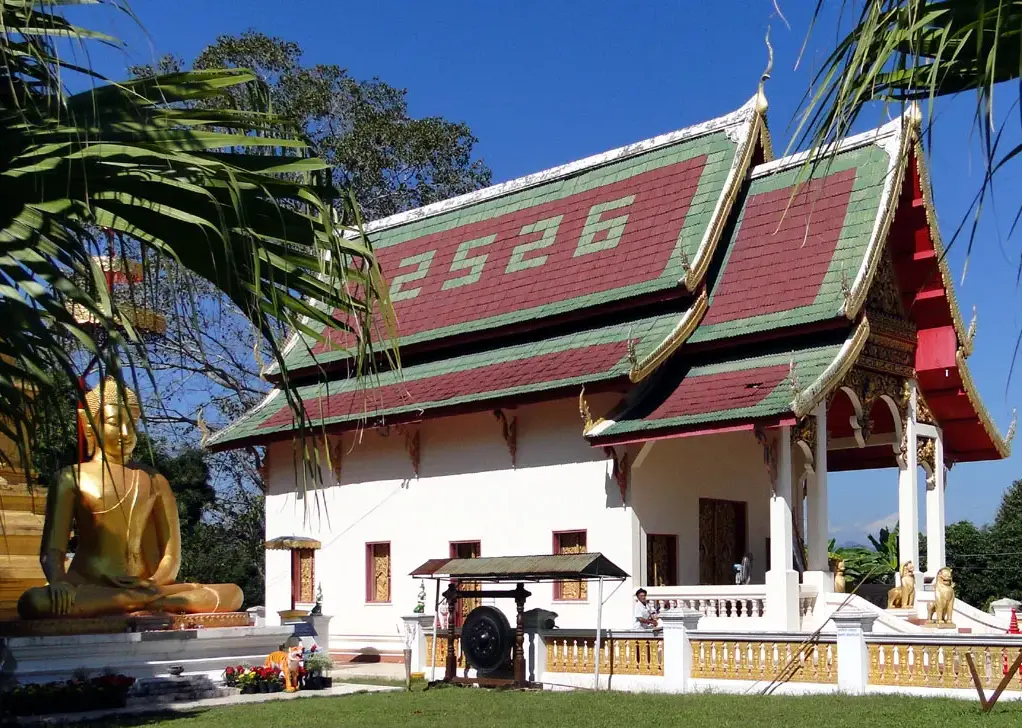
Open Days: Daily
Opening Hours: Daytime Visits Recommended
Wat Sawang Mongkhon in Ban Huai Sai Khao, Thung Khao Phuang Subdistrict, Chiang Dao District, Chiang Mai Province, is a community Buddhist temple under the Maha Nikaya order. It is not a large commercialized tourist temple, but a local religious site with a strong connection to the history of Ban Thung Khao Luang, Ban Huai Sai Khao, and the settlement patterns of communities north of Chiang Dao. The temple is significant because of its history as a restored abandoned temple, its old stupa remains, and its role as a spiritual center for the local village.
Wat Sawang Mongkhon is located in Moo 5, Ban Huai Sai Khao, along Rural Road CM 3002 in Thung Khao Phuang Subdistrict. The temple is suitable for merit-making, quiet cultural visits, and learning about local history in the Chiang Dao area. Its key points of interest are the remains of an old stupa, the story of the former village name Ban Thung Khao Luang, and the revival of the site from an abandoned temple into an active temple officially recognized by the Thai Sangha administration.
The temple stands in Ban Huai Sai Khao, a village that older residents still remember by the former name Ban Thung Khao Luang. This area belongs to Thung Khao Phuang Subdistrict in Chiang Dao District, a rural northern community shaped by agriculture, migration, Buddhist faith, and proximity to the Ping River. In villages like this, a temple is more than a religious building. It is a place where people make merit, gather for ceremonies, preserve shared memory, and pass local stories from one generation to another.
Wat Sawang Mongkhon differs from the better-known tourist temples of Chiang Dao because its value lies in the continuity of village life. The temple is not defined by large-scale architecture or famous tourist imagery. Instead, it reflects the history of local people who restored a sacred site that had once become abandoned. Visitors who come with this understanding will see the temple as a living community space rather than a conventional sightseeing stop.
The history of Wat Sawang Mongkhon begins with an old abandoned temple site where an ancient stupa remained. The exact period of construction is not clearly identified, but the stupa became an important sign that the area had once been a Buddhist sacred site. This visible trace encouraged villagers in later years to restore the place and rebuild it as a functioning temple for the community.
Local tradition links the wider village area to a story about King Naresuan the Great. According to the story, when the king set up his army at Mueang Ngai before marching toward Mueang Hang, he ordered soldiers to search for additional food supplies because provisions were insufficient. The soldiers passed through this area but found only limited supplies. On their way back through the fields, they found a large amount of “mak khao luang,” reported it to the king, and were ordered to bring it back and steam it for the soldiers.
From this story, the area came to be known as Ban Tong Mak Khao Luang, which later changed in pronunciation to Ban Thung Khao Luang. The name carries a sense of fertile fields, local food resources, and the memory of a landscape that supported people during a difficult journey. Although the village is now officially known as Ban Huai Sai Khao, the older name remains meaningful among elderly residents and helps explain why Wat Sawang Mongkhon is important to local identity.
Around 1937, Tai Yai people migrated into the area and settled there for farming and daily life. The location was attractive because it was close to the Ping River and had fertile land. Later, in 1959, villagers from Pa Sang District in Lamphun Province moved into the area, purchased land, and joined together to rebuild the temple after recognizing the site as an old Buddhist place. This period marked the beginning of the revival of Wat Sawang Mongkhon.
Around 1962, more villagers from Hot District and Pa Sang District settled in the area. As the community grew, Wat Sawang Mongkhon became a shared spiritual space for people from different backgrounds, including older local residents, Tai Yai settlers, and migrants from other northern districts. Building the temple was therefore not only a religious act but also a way to form a common center for a newly developing community.
In 1983, Ban Thung Khao Luang was separated from Mueang Ngai Subdistrict and placed under Thung Khao Phuang Subdistrict. The village name was changed to Ban Huai Sai Khao, although older residents continued to use the former name. In the same year, the Department of Religious Affairs officially elevated Wat Sawang Mongkhon from an abandoned temple to a temple with resident monks. The temple later received its Wisungkhamsima on January 22, 2007, an important milestone in its formal Buddhist status.
Today, Wat Sawang Mongkhon is a local Buddhist temple under the Maha Nikaya order. It remains located in Moo 5, Ban Huai Sai Khao, Thung Khao Phuang Subdistrict, Chiang Dao District, Chiang Mai Province. The current abbot is Phra Khru Ophat Mongkhon Kitti, who continues the line of monks who have cared for the temple since its modern restoration period.
The succession of abbots helps trace the development of the temple. The line begins with Phra Saman Inthachoto from 1959 to 1965, followed by Phra Khammun Chantasirō from 1965 to 1969, Phra Kham Khamphirō from 1969 to 1971, Phra Buntha Yatikarō from 1971 to 1978, Phra Duang Dipapadhammo from 1978 to 1982, Phra Khru Ophat Mongkhon Tham, also known as Phinyo, from 1982 to 1995, Phra Kham Pan from 1996 to 1997, Phra Athikan Karan Katasarō from 1997 to 1999, Phra Phrom Phrommachoto from 1999 to 2000, and Phra Khru Ophat Mongkhon Kitti, also known as Korakot, from 2000 to the present.
From a local history perspective, Wat Sawang Mongkhon is evidence of settlement, migration, and community formation in Thung Khao Phuang. Communities made up of people from different origins need a shared place for ceremonies, relationships, and moral grounding. The temple became that shared institution, connecting people with place, faith, history, and village identity.
The old stupa remains are especially important because they connect the present temple with the earlier abandoned site. Although the exact age is not clearly established, the stupa supports the local belief that this area had once been a Buddhist temple before its modern restoration. Visitors should treat this area with care and respect. It is not simply an old structure but a trace of the community’s religious memory.
The atmosphere at Wat Sawang Mongkhon is quiet and local. Travelers should approach it as a living village temple rather than a heavily managed tourist attraction. A visit here is best suited to those interested in community temples, local Chiang Dao history, rural Lanna culture, and slower travel that values context over quick photo stops. The temple offers a way to understand Chiang Dao beyond its famous caves and mountain scenery.
Getting There is most convenient by private car. Travelers should first head to Chiang Dao District in Chiang Mai Province, then continue toward Thung Khao Phuang Subdistrict and Ban Huai Sai Khao using Rural Road CM 3002. A private vehicle is recommended because it allows visitors to combine Wat Sawang Mongkhon with nearby temples, community attractions, and natural sites in the wider Chiang Dao area.
Travelers coming from Chiang Mai city should allow enough time for rural roads and mountain-area driving conditions. During the rainy season, checking road conditions before departure is advisable. Daytime travel is the best option because road signs, local junctions, and village routes are easier to follow. This route is suitable for visitors who want to explore Chiang Dao’s community side rather than only the well-known tourist zone around Chiang Dao Cave.
Wat Sawang Mongkhon can be included in a route through Thung Khao Phuang Subdistrict, together with Wat Phra That Si Sam Rak, Wat Phra Bat Roi Wua, Wat Phra That Doi Mon Ching, Doi Kham Fa, and other local attractions. Travelers can also extend the trip toward Chiang Dao town, Chiang Dao Cave, Wat Tham Pha Plong, and Doi Luang Chiang Dao. This kind of route combines Buddhist culture, village history, rural scenery, and the mountain landscape of Chiang Dao.
Visitors should dress modestly, speak quietly, respect monks’ areas, and avoid entering any restricted parts of the temple. When viewing the old stupa remains or other temple structures, visitors should be careful not to climb, touch, or damage any part of the site. Wat Sawang Mongkhon is still an active community temple, so respectful behavior is essential.
The value of Wat Sawang Mongkhon lies in its transformation from an abandoned temple with an old stupa into an active village temple maintained by local faith. Its story shows how rural communities in northern Thailand preserve sacred places through cooperation, memory, and Buddhist practice. For travelers who want a deeper view of Chiang Dao, this temple offers a meaningful look at the cultural life of Thung Khao Phuang and Ban Huai Sai Khao.
| Name | Wat Sawang Mongkhon |
| Location | Ban Huai Sai Khao, Moo 5, Thung Khao Phuang Subdistrict, Chiang Dao District, Chiang Mai Province |
| Address | Rural Road CM 3002, Thung Khao Phuang Subdistrict, Chiang Dao District, Chiang Mai 50170, Thailand |
| Temple Type | Local Buddhist temple under the Maha Nikaya order |
| Highlights | A restored community temple with old stupa remains, village history, and the story of Ban Thung Khao Luang |
| History | Formerly an abandoned temple site; restored by villagers, officially recognized as a temple in 1983, and granted Wisungkhamsima on January 22, 2007 |
| Name Origin | Connected to the local story of Ban Tong Mak Khao Luang, later known as Ban Thung Khao Luang, before the village became Ban Huai Sai Khao |
| Distinctive Features | A village temple that reflects settlement history in Thung Khao Phuang and preserves the remains of an old stupa |
| Travel Information | Best reached by private car from Chiang Dao District toward Thung Khao Phuang Subdistrict via Rural Road CM 3002 |
| Current Status | An active registered Buddhist temple serving the Ban Huai Sai Khao community |
| Open Days | Daily |
| Opening Hours | Daytime visits recommended |
| Fees | No admission fee information is published |
| Main Areas / Zones | Main temple area for worship and merit-making, community religious spaces, and the old stupa remains |
| Abbot / Caretaker | Phra Khru Ophat Mongkhon Kitti |
| Main Contact Number | 081-950-5782 |
| Nearby Tourist Attractions | 1. Wat Phra That Si Sam Rak, about 9 km 2. Wat Phra Bat Roi Wua, Ban Huai Pao, about 10 km 3. Wat Phra That Doi Mon Ching, about 11 km 4. Doi Kham Fa, about 25 km 5. Chiang Dao Cave, about 19 km |
| Nearby Restaurants | 1. Sanae Doi Luang Chiang Dao, about 8 km, Tel. 081-111-9271, 081-783-1484, 093-618-1469 2. The Terrace, about 8 km 3. Doi Mek Coffee, about 17 km 4. Chiang Dao Nest 1 Restaurant, about 19 km, Tel. 053-456-612 5. The Cave Bar, about 19 km, Tel. 081-892-0531 |
| Nearby Accommodations | 1. Azalea Village Wellness Resort & Residence, about 9 km, Tel. 053-456-168 2. Aurora Resort Chiangdao, about 9 km, Tel. 053-456-928 3. Malee's Nature Lovers Bungalows, about 18 km, Tel. 081-961-8387 4. Chiang Dao Hut, about 18 km, Tel. 086-198-9728 5. Chiang Dao Nest, about 19 km, Tel. 053-456-612 |
Frequently Asked Questions (FAQ)
Q: Where is Wat Sawang Mongkhon located?
A: Wat Sawang Mongkhon is located in Ban Huai Sai Khao, Moo 5, along Rural Road CM 3002 in Thung Khao Phuang Subdistrict, Chiang Dao District, Chiang Mai Province.
Q: What type of temple is Wat Sawang Mongkhon?
A: It is a local Buddhist temple under the Maha Nikaya order and serves as a community temple for Ban Huai Sai Khao.
Q: What is important about the history of Wat Sawang Mongkhon?
A: The site was formerly an abandoned temple with old stupa remains. Villagers later restored it, and it was officially recognized as a temple in 1983 before receiving Wisungkhamsima on January 22, 2007.
Q: Who is the current abbot of Wat Sawang Mongkhon?
A: The current abbot is Phra Khru Ophat Mongkhon Kitti.
Q: What makes Wat Sawang Mongkhon worth visiting?
A: Its value lies in its local history, old stupa remains, the story of Ban Thung Khao Luang, and its role as a quiet spiritual center for the village community.
Q: How can travelers get to Wat Sawang Mongkhon?
A: The most convenient way is by private car from Chiang Dao District toward Thung Khao Phuang Subdistrict, then continuing along Rural Road CM 3002 to Ban Huai Sai Khao.
Q: What kind of travelers is Wat Sawang Mongkhon suitable for?
A: It is suitable for travelers interested in local temples, village history, rural Lanna culture, Buddhist community life, and quieter cultural routes in Chiang Dao.
 Category: ●Places of Worship
 Group: ●Temple
Last Update : 22 HourAgo
 Last Update : 22 HourAgo
 Click to Access the Navigation Map GPS
Wat Sawang Mongkhon Map
Recommend

 Muang Chiang Mai(121)Chom Thong(47)Mae Chaem(25)Chiang Dao(33)Doi Saket(68)Mae Taeng(85)Mae Rim(69)Samoeng(29)Fang(71)Mae Ai(62)Phrao(70)San Pa Tong(105)San Kamphaeng(66)San Sai(73)Hang Dong(74)Hot(32)Doi Tao(22)Omkoi(11)Saraphi(74)Wiang Haeng(15)Chai Prakan(28)Mae Wang(32)Mae On(22)Doi Lo(34)Galyani Vadhana(1)


