
lovethailand home >North Travel Attractions >Chiang Mai Travel Attractions >Doi Tao >Ban Aen > Wat Phingkharam
TL;DR: Wat Phingkharam is located at 226 Moo 1, Ban Wang Mo, Ban Aen Subdistrict, Doi Tao District, Chiang Mai Province 50260, Thailand.

Wat Phingkharam
Operating day: Daily
Operating time: 08.00 - 17.00
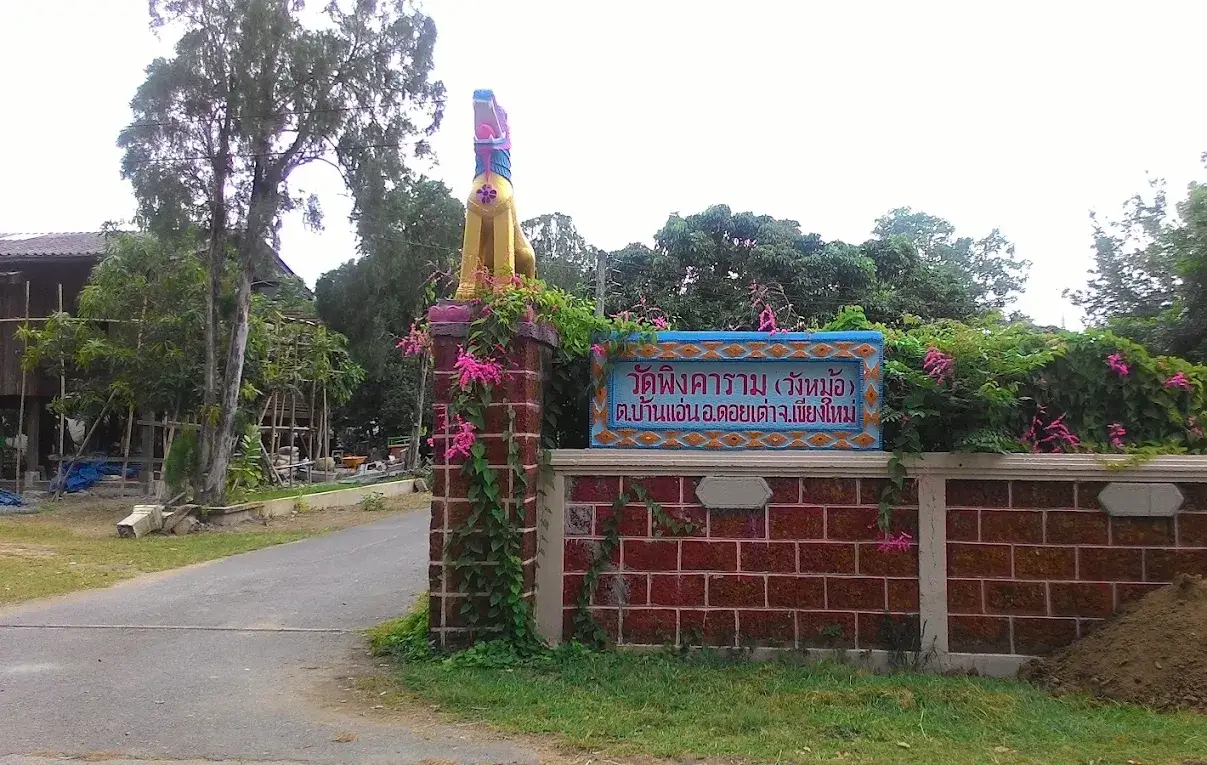
Wat Phingkharam is located at 226 Moo 1, Ban Wang Mo, Ban Aen Subdistrict, Doi Tao District, Chiang Mai Province 50260. It is a local Buddhist temple under the Maha Nikaya order. The temple was officially permitted as a temple in 1878 and received its royal grant of Wisungkhamasima in 1973. According to the temple history used for this article, the abbot is Phra Athikan Somphong Santachitto. Wat Phingkharam serves as an important spiritual center of Ban Wang Mo and is one of the long-established community temples of Ban Aen Subdistrict, connected with religion, culture, tradition, and local learning in Doi Tao District.
The importance of Wat Phingkharam comes from its long history. Since its establishment in 1878, the temple has served the Ban Wang Mo community for more than a century. A village temple with this kind of continuity is more than a place of worship. It becomes part of community identity, supporting merit-making, Dhamma listening, ordination, annual ceremonies, and the relationship between monks, elders, families, youth, and local residents.
Ban Wang Mo is Moo 1 of Ban Aen Subdistrict and one of the important local communities in northern Doi Tao District. Ban Aen Subdistrict is mainly flat, has the Ping River on the western side, and is connected by roads to all villages. The subdistrict lies between Hot and Doi Tao, making it a useful cultural stop for travelers who want to understand Doi Tao through village temples and community life.
Ban Aen Subdistrict covers about 32 square kilometers, or approximately 15,250 rai. It includes four villages: Ban Wang Mo, Ban Aen Mai, Ban Aen Chadsan, and Ban Huai Sai Mun. The local economy is based mainly on agriculture, trade, and general labor, with more than 8,000 rai of agricultural land. Wat Phingkharam therefore stands in a community where everyday life is still closely connected with land, seasonal work, cultivation, and Buddhist merit-making.
The history of Ban Aen and Doi Tao is closely tied to the Ping River basin. Before the landscape changed after the construction of Bhumibol Dam, many communities in Doi Tao used the Ping River for water, agriculture, fishing, travel, and contact with nearby settlements. After the dam changed the river landscape, several riverside communities had to adapt or relocate. Temples in Ban Aen therefore became important spiritual anchors that helped communities preserve memory, faith, and continuity.
The royal grant of Wisungkhamasima in 1973 is an important milestone in the temple’s history. A Wisungkhamasima boundary is used for formal monastic acts under Buddhist discipline and indicates a stable religious role. For Wat Phingkharam, this grant confirms its role as an established Maha Nikaya community temple serving Ban Wang Mo and surrounding residents.
The name Wat Phingkharam is closely associated with Ban Wang Mo. In some local materials, the temple is also referred to together with Wang Mo, showing how closely the temple and village identity are connected. Visiting Wat Phingkharam therefore gives travelers a chance to encounter not only a Buddhist temple but also the cultural identity of Ban Wang Mo itself.
Ban Wang Mo also appears in local learning and wisdom records of Doi Tao. The community is connected with weaving, traditional Lanna lantern-making, bamboo craft, and local religious ceremony knowledge. Wat Phingkharam stands within this wider cultural landscape. It is part of a community where Buddhist practice, local tradition, and village knowledge continue together.
Phra Athikan Somphong Santachitto is listed as the abbot of Wat Phingkharam. In a community temple, the abbot plays a central role in guiding Buddhist activities, maintaining the temple, supporting merit-making, and connecting monks with villagers. The temple’s continuing value depends on both monastic care and the faith of local residents.
Wat Phingkharam is distinctive because it connects religion, culture, and local tradition. Local learning records identify the temple as a religious, cultural, and traditional site of Ban Aen Subdistrict. This shows that the temple is not only a ritual space but also a community learning place. Visitors can understand Ban Wang Mo through Buddhist practice, Lanna customs, and local wisdom.
Religious traditions at Wat Phingkharam follow the rhythm of a northern Thai local temple: Buddhist holy days, Makha Bucha, Visakha Bucha, Asalha Bucha, Buddhist Lent, the end of Lent, Kathin, robe-offering ceremonies, memorial merit-making, and local religious activities. These events bring monks, elders, families, young people, and villagers together and help pass Buddhist values to the next generation.
Wat Phingkharam also belongs to the wider network of temples in Ban Aen Subdistrict, together with Wat Ban Aen, Wat Si Phing Chai, Wat Ban Aen Mai, and Wat Mokkha Wanaram. These temples form the religious landscape of the subdistrict. Each temple serves its own community, while together they preserve the Buddhist and cultural identity of Ban Aen.
The temple grounds of Wat Phingkharam serve the Buddhist activities of Ban Wang Mo. The area includes space for worship, merit-making, religious gatherings, and community ceremonies. The quiet village-temple atmosphere is suitable for visitors who want to experience local Buddhist life rather than a large tourist-oriented temple.
The main appeal of Wat Phingkharam is its peaceful village-temple character. It is a living community temple where local Buddhist life continues. Travelers who enjoy slow cultural routes, village history, and local Lanna atmosphere will find the temple meaningful, especially when combined with nearby temples and Doi Tao’s lake landscape.
For travelers interested in local culture, Wat Phingkharam can be connected with the wisdom traditions of Ban Wang Mo. The area is known in local learning records for textile-related knowledge, Lanna lantern-making, bamboo craft, and religious ceremony knowledge. A visit can therefore begin with worship at the temple and continue into a wider understanding of local village life.
Getting There is easiest by private car, rental car, or local hired transport. From Chiang Mai city, travel south on Highway 108 through Hang Dong, San Pa Tong, Chom Thong, and Hot District. From Hot, continue toward Doi Tao and Ban Aen Subdistrict. Once in Moo 1, Ban Wang Mo, use the names Wat Phingkharam, Ban Wang Mo, Ban Aen Subdistrict, and Doi Tao District together in a navigation app for better accuracy.
A meaningful cultural route can begin at Wat Phingkharam for worship and community history, then continue to Wat Ban Aen, Wat Si Phing Chai, Wat Ban Aen Mai, or Wat Mokkha Wanaram in the same subdistrict. With more time, travelers can continue to the Doi Tao Lake grassland area, Doi Tao Lake, Wat Ban Noi, Wat Ban Thong, or Phra Borommathat Doi Koeng. This route works well for a half-day or full-day trip focused on temples, villages, and the quiet landscape of Doi Tao.
Visitors should dress modestly, keep noise low, and respect monks and local residents. If a merit-making event or ceremony is taking place, local worshippers should be given priority. Photography should be done respectfully. Wat Phingkharam is a living community temple, so a meaningful visit should respect both the sacred space and the community that maintains it.
Overall, Wat Phingkharam is a historic Maha Nikaya community temple of Ban Wang Mo, Ban Aen Subdistrict, Doi Tao District, Chiang Mai Province. It was officially established in 1878 and received its Wisungkhamasima in 1973. Its value lies in its continuing role as a center of religion, culture, tradition, and community learning. For travelers seeking a quieter and deeper cultural route in southern Chiang Mai, Wat Phingkharam is a meaningful stop that reveals the living Buddhist life of Ban Aen.
| Name | Wat Phingkharam |
| Type | Local Buddhist Temple, Maha Nikaya Order |
| Location | 226 Moo 1, Ban Wang Mo, Ban Aen Subdistrict, Doi Tao District, Chiang Mai Province 50260, Thailand |
| Temple Code | 350170402 |
| History | Officially established in 1878 and granted Wisungkhamasima in 1973. The temple is a long-standing community temple of Ban Wang Mo in Ban Aen Subdistrict. |
| Abbot | Phra Athikan Somphong Santachitto |
| Contact Number | 090-463-4094 |
| Related Communities | Ban Wang Mo, Moo 1, Ban Aen Subdistrict, And Communities In Ban Aen Subdistrict |
| Highlights | Historic temple of Ban Wang Mo, connected with religion, culture, tradition, and local community learning in Ban Aen Subdistrict |
| Distinctive Features | Peaceful village temple suitable for worship, merit-making, and learning about Ban Wang Mo’s community history |
| Community Role | Spiritual center for Ban Wang Mo, used for Buddhist ceremonies, Dhamma listening, Kathin, robe offerings, annual merit-making, and local Buddhist activities |
| Area Context | Ban Aen Subdistrict is mainly flat, has the Ping River on the west, and is connected by roads to all villages. It lies between Hot and Doi Tao and forms part of the wider Doi Tao cultural landscape. |
| Travel Information | From Chiang Mai, take Highway 108 through Hang Dong, San Pa Tong, Chom Thong, and Hot, then continue toward Doi Tao and Ban Aen Subdistrict, Moo 1, Ban Wang Mo. |
| Current Status | Active local Buddhist temple appearing in temple databases of Ban Aen Subdistrict, Doi Tao District, Chiang Mai Province |
| Facilities | Temple grounds, courtyard, worship area, and spaces for community Buddhist activities |
| Nearby Tourist Attractions | 1. Wat Ban Aen, about 3 km 2. Wat Si Phing Chai, about 4 km 3. Wat Mokkha Wanaram, about 6 km 4. Doi Tao Lake Grassland Area, about 18 km 5. Wat Ban Noi, about 20 km 6. Doi Tao Lake, about 22 km |
| Nearby Restaurants | 1. Check In Doi Tao Cafe’ And Resort, about 22 km, Tel. 062-969-8264 2. Krua Than Thip And Ruean Pha Than Thip, about 22 km, Tel. 091-026-4970 3. Ruean Pha Luk Mae Ping, about 22 km, Tel. 081-993-4162, 081-724-5470 4. Ruean Pha Doi Tao Rim Ping, about 22 km, Tel. 081-961-1854, 084-885-5982 5. Bandin In The Doi, about 26 km, Tel. 087-951-6778, 084-810-5058 |
| Nearby Accommodations | 1. Check In Doi Tao Cafe’ And Resort, about 22 km, Tel. 062-969-8264 2. Ruean Pha Than Thip, about 22 km, Tel. 091-026-4970 3. Ruean Pha Luk Mae Ping, about 22 km, Tel. 081-993-4162, 081-724-5470 4. Ruean Pha Doi Tao Rim Ping, about 22 km, Tel. 081-961-1854, 084-885-5982 5. The Creek Resort, about 32 km, Tel. 097-282-8982 |
Frequently Asked Questions (FAQ)
Q: Where Is Wat Phingkharam Located?
A: Wat Phingkharam is located at 226 Moo 1, Ban Wang Mo, Ban Aen Subdistrict, Doi Tao District, Chiang Mai Province 50260, Thailand.
Q: When Was Wat Phingkharam Officially Established?
A: Wat Phingkharam was officially established in 1878 and received its Wisungkhamasima in 1973.
Q: Who Is The Abbot Of Wat Phingkharam?
A: The abbot is Phra Athikan Somphong Santachitto.
Q: Why Is Wat Phingkharam Important To The Local Community?
A: It serves as the spiritual center of Ban Wang Mo, supporting Buddhist ceremonies, merit-making, Kathin, robe offerings, and local religious activities.
Q: What Makes Wat Phingkharam Special?
A: Its value lies in its long history, peaceful village-temple character, and connection with the religious, cultural, and traditional life of Ban Wang Mo.
Q: How Do Travelers Get To Wat Phingkharam?
A: From Chiang Mai, travel through Hot District and continue toward Doi Tao and Ban Aen Subdistrict, heading to Moo 1, Ban Wang Mo.
Q: What Nearby Places Can Be Visited With Wat Phingkharam?
A: Nearby places include Wat Ban Aen, Wat Si Phing Chai, Wat Mokkha Wanaram, the Doi Tao Lake grassland area, and Doi Tao Lake.
 Category: ●Places of Worship
 Group: ●Temple
Last Update : 2 MonthAgo
 Last Update : 2 MonthAgo
 Click to Access the Navigation Map GPS

 Muang Chiang Mai(121)Chom Thong(47)Mae Chaem(25)Chiang Dao(33)Doi Saket(68)Mae Taeng(85)Mae Rim(69)Samoeng(29)Fang(71)Mae Ai(59)Phrao(70)San Pa Tong(103)San Kamphaeng(66)San Sai(73)Hang Dong(73)Hot(32)Doi Tao(22)Omkoi(11)Saraphi(74)Wiang Haeng(15)Chai Prakan(28)Mae Wang(32)Mae On(22)Doi Lo(33)Galyani Vadhana(1)


