
lovethailand home >North Travel Attractions >Chiang Mai Travel Attractions >Doi Tao >Bong Tan > Wat Tha Duea (Doi Tao)
TL;DR: Wat Tha Duea (Doi Tao) is located at 168 Moo 4, Ban Nong Phak Bung, Bong Tan Subdistrict, Doi Tao District, Chiang Mai Province 50260, Thailand.

Wat Tha Duea (Doi Tao)
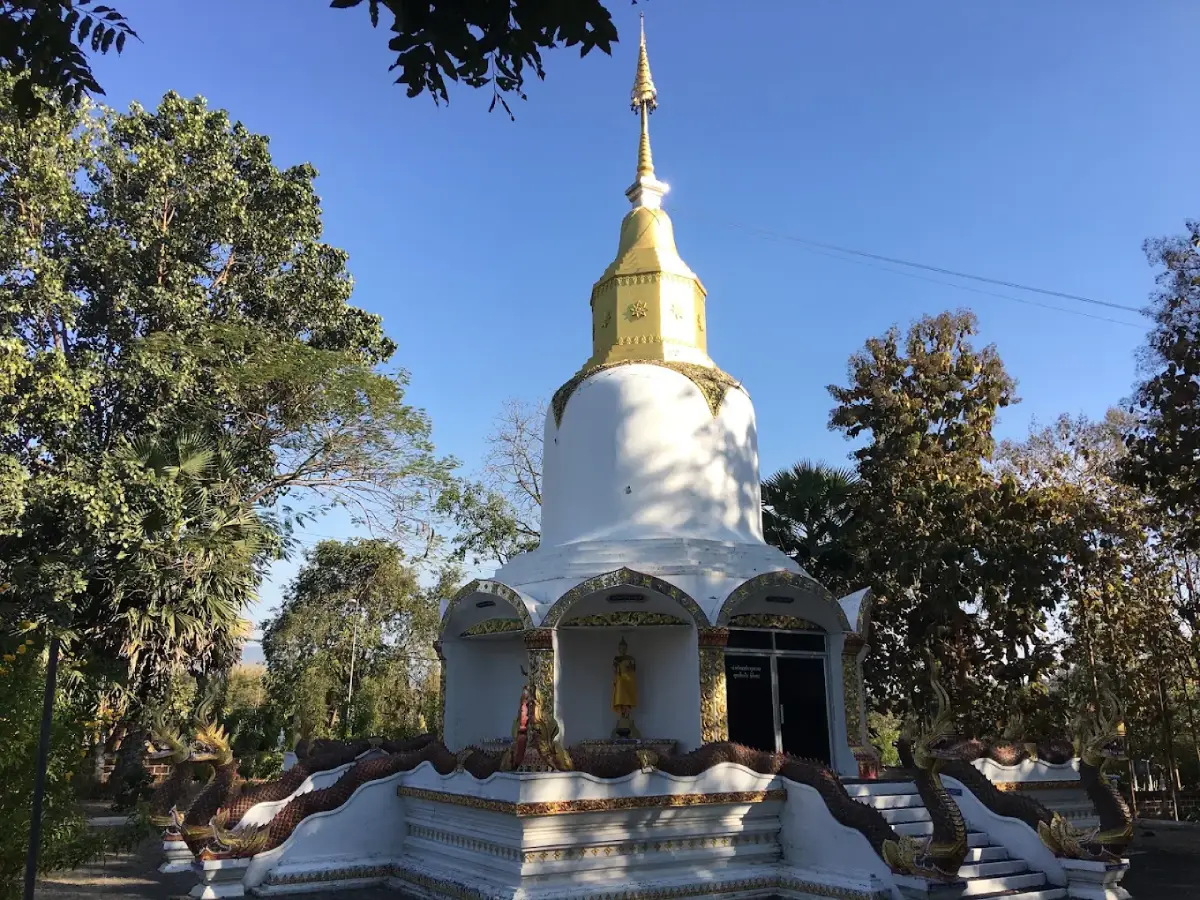
Operating day: Daily
Operating time: 08.00 - 17.00
Wat Tha Duea is located at 168 Moo 4, Ban Nong Phak Bung, Bong Tan Subdistrict, Doi Tao District, Chiang Mai Province 50260. It is a local Buddhist temple under the Maha Nikaya order and appears in the temple registry under code 350170501. This temple is deeply connected with one of the most important community changes in Doi Tao: the flooding of old riverside settlements after the construction of Yanhee Dam, now known as Bhumibol Dam. The original Wat Tha Duea and the old Ban Tha Duea village once stood near the Ping River. When the rising water covered the old settlement in 1964, villagers relocated and rebuilt their temple in the present area. Wat Tha Duea is therefore not only a village temple of Ban Nong Phak Bung, but also a living memorial to relocation, resilience, and the continuity of faith.
The former site of Wat Tha Duea was about 4.8 kilometers west of the present temple. That older site was connected with Ban Tha Duea, a village along the Ping River. The name Tha Duea itself evokes an old riverside way of life, where the river was a route for travel, livelihood, community contact, and local identity. Before Bhumibol Dam changed the landscape, riverside communities along the Ping lived closely with the water. Temples were part of this riverine world. When the reservoir expanded, the old temple and village became part of the community’s memory rather than its daily landscape.
In 1964, the construction of Yanhee Dam, later known as Bhumibol Dam, in Sam Ngao District, Tak Province, caused the water level above the dam to rise and flood parts of the old Ping River settlements. Old Ban Tha Duea and Wat Tha Duea were directly affected. Villagers scattered to several new areas. Some followed Khru Ba Khao Pi to establish a community at Ban Pha Nam in Li District, Lamphun Province. Others moved to Chom Thong District in Chiang Mai, Mae Sariang District in Mae Hong Son, and resettlement areas such as Ban Plaeng Ha in Tha Duea Subdistrict, Doi Tao District. This migration made the name Tha Duea a powerful memory of a community displaced by water but still bound together by faith.
The main group of Tha Duea villagers preserved their shared religious identity. Phra Maha Thong Yamathewi, also known as Thong Pansiri and later as Phra Khru Siri Thammachari, became an important religious leader. Nai Peng Muen Yaeng, the former village headman of Ban Tha Duea, also played a key role on the community side. Together with local devotees, they helped establish a new temple about 3.9 kilometers from the old site, near an old village pathway once used by pack animals. This detail reflects an older transport landscape before modern roads became dominant.
In the same year, 1964, the community moved again to the present temple site. Nai Paeng Thikantha donated 2.4 rai of land, formerly a cornfield purchased from Karen villagers for 500 baht, to build the new Wat Tha Duea. This land donation was a decisive moment. It gave the community a permanent religious center after the loss of the old temple and village. The present Wat Tha Duea was therefore born from sacrifice, faith, and the determination of displaced villagers to rebuild their spiritual home.
Phra Maha Thong Yamathewi, or Phra Khru Siri Thammachari, was the leading figure in the development of the new temple. His role was not limited to construction. He helped gather the faith of a community that had been dispersed by flooding and relocation. In this context, the temple was more than a religious building. It became a place where villagers could hold on to their shared history, continue Buddhist practice, and rebuild community confidence in a new location.
On 1 January 1968, a new sala was renovated and a principal Buddha image was created inside a wooden hall. This principal image is known as Luang Pho Thong Kham. The ceremony involved important monks from the Doi Tao and nearby areas, including Phra Khru Adunyanasunthon, also known as Tu Chan of Wat Ban Chang Plot 8 and former ecclesiastical head of Doi Tao District; Phra Khru Ba Jina of Wat Chai Chana, Tha Kham Tai; and Phra Khru Panya Phrommakhun, also known as Tu Kham Puan, a former ecclesiastical head of Doi Tao. Their participation shows that the rebuilding of Wat Tha Duea was supported by a wider network of respected monks.
In 1972, monks’ residences and other temple facilities were built. This development was important because a temple with proper monks’ quarters could support continuous Buddhist life. Monks could reside at the temple, villagers could make merit, listen to Dhamma, and organize religious events more regularly. Wat Tha Duea gradually grew from a relocated community shrine into a functioning village temple.
The village also went through the process of naming and rebuilding its identity. After relocation, several names were proposed, including Ban Dong Sak Ngam, Ban Pa Sat, Ban Sombun Phatthana, and the old name Ban Tha Duea. Later, when a school was established, the school principal, Khru Inpan Asana, asked village elders what the school should be called. The elders suggested Ban Nong Phak Bung because south of the village there was a pond where water morning glory grew abundantly. From then on, the name Ban Nong Phak Bung became widely used for the present village.
This naming story is important because it shows how the community balanced memory and renewal. The temple preserved the old name Tha Duea, keeping the memory of the riverside village alive. The village name Nong Phak Bung reflected the new landscape where people rebuilt their homes. Together, the two names express two layers of community identity: the old home by the Ping River and the new settlement in Bong Tan Subdistrict.
In 1980, a temple wall was built. In 1982, a new base for the principal Buddha image was constructed in the new hall, and a Poi Luang celebration was held for the temple wall. Poi Luang is a major Lanna merit-making celebration, usually connected with the completion of important temple construction or renovation. This event shows how the community celebrated the growing stability of the temple after years of relocation, rebuilding, and collective effort.
Wat Tha Duea serves as the spiritual center of Ban Nong Phak Bung and the descendants of old Ban Tha Duea. It supports Buddhist holy days, Makha Bucha, Visakha Bucha, Asalha Bucha, Buddhist Lent, the end of Lent, Kathin, robe-offering ceremonies, memorial merit-making, and local community activities. These events are not only religious ceremonies. They also keep relationships strong among monks, elders, families, young people, and villagers.
The main highlight of Wat Tha Duea is its relocation story. It is a temple shaped by the flooding of an old village and the community’s determination to rebuild. For travelers interested in Doi Tao history, Wat Tha Duea offers a deeper understanding of how Bhumibol Dam affected communities along the Ping River. The temple is not simply a Buddhist site; it is a place where the memory of displacement, faith, and community rebuilding remains visible.
Wat Tha Duea is also connected with the broader context of Bong Tan Subdistrict. The subdistrict covers about 41.63 square kilometers and includes seven villages, with Ban Nong Phak Bung as Moo 4. The area includes both local northern Thai communities and Karen communities in some villages. Its history is linked with old Doi Tao, the Mae Hat basin, the Ping River basin, and landscape changes after Bhumibol Dam. Wat Tha Duea stands within this diverse cultural and historical setting.
Visitors should pay respect to Luang Pho Thong Kham, the principal Buddha image associated with the temple’s post-relocation rebuilding, and observe the sala, courtyard, and temple areas that reflect community effort. The value of the temple is not only in individual structures but in the history behind them. Each part of the temple represents the work of villagers who rebuilt their religious center after losing the old one to the rising water.
Wat Tha Duea is suitable for travelers interested in community temples, Doi Tao history, Lanna culture, and the story of old Ping River communities. It is not a crowded tourist attraction. It is better appreciated as a quiet village temple with deep local memory. A visit of about 30 minutes to 1 hour is suitable for paying respect, walking around the temple, and understanding the connection between the old Tha Duea village, the present Ban Nong Phak Bung, and Doi Tao Lake.
Getting There is most convenient by private car, rental car, or local hired transport. From Chiang Mai city, travel south on Highway 108 through Hang Dong, San Pa Tong, Chom Thong, and Hot District. At Hot, continue onto Highway 1103, the Hot – Doi Tao – Mae Tuen route, then proceed into Bong Tan Subdistrict and Ban Nong Phak Bung, Moo 4. The temple is located at number 168 in the village area. Using the names Wat Tha Duea, Ban Nong Phak Bung, and Bong Tan Subdistrict together in a navigation app is recommended.
A meaningful cultural route can begin at Wat Tha Duea, then continue to Wat Bong Tan, Wat Lai Kaeo, Wat Ban Noi, or Wat Ban Thong to understand the temple network of Bong Tan Subdistrict. Travelers can then continue to Doi Tao Lake, Phra Borommathat Doi Koeng, and lakeside restaurants in Tha Duea Subdistrict. With more time, the route can include the Ban Chang Plot 8 weaving learning area or temples in Doi Tao Subdistrict. This route combines Buddhism, relocation history, community culture, and lake scenery in one trip.
Visitors should dress modestly, keep noise low, avoid disturbing monks or villagers, and respect the sacred area. If a merit-making event or ceremony is taking place, local worshippers should be given priority. Photography should be done respectfully, especially during ceremonies. Since Wat Tha Duea carries deep meaning for community memory, a good visit should respect both the religious space and the people whose history is tied to it.
Overall, Wat Tha Duea is a Maha Nikaya local temple of Ban Nong Phak Bung, Bong Tan Subdistrict, Doi Tao District, Chiang Mai Province. Its value lies in its history of relocation after the 1964 flooding caused by Bhumibol Dam, its preservation of the old Tha Duea name, and its role as the spiritual center of the present community. For travelers who want to understand Doi Tao beyond the lake scenery, Wat Tha Duea is one of the most meaningful cultural and historical stops in the district.
| Name | Wat Tha Duea |
| Type | Local Buddhist Temple, Maha Nikaya Order |
| Location | 168 Moo 4, Ban Nong Phak Bung, Bong Tan Subdistrict, Doi Tao District, Chiang Mai Province 50260, Thailand |
| Temple Code | 350170501 |
| Related Community | Ban Nong Phak Bung, Moo 4, Bong Tan Subdistrict, and the old Tha Duea riverside community |
| Highlights | Community temple rebuilt after flooding caused by Bhumibol Dam, preserving the old Tha Duea identity and serving as the spiritual center of Ban Nong Phak Bung |
| History | The former temple was about 4.8 km west of the present site. In 1964, the old temple and village were flooded after the construction of Bhumibol Dam, leading villagers to rebuild the temple at the present location. |
| Important Historical Figures | Phra Maha Thong Yamathewi / Phra Khru Siri Thammachari, Nai Peng Muen Yaeng, Nai Paeng Thikantha, Phra Khru Adunyanasunthon, Phra Khru Ba Jina, and Phra Khru Panya Phrommakhun |
| Present Temple Land | Nai Paeng Thikantha donated 2.4 rai of former cornfield land for the present Wat Tha Duea. |
| Principal Buddha Image | Luang Pho Thong Kham, created in the wooden hall during the renovation on 1 January 1968 |
| Important Developments | Wooden hall, principal Buddha image, monks’ residences, temple facilities, temple wall, new Buddha image base, and Poi Luang celebration for the temple wall |
| Village Name Origin | Ban Nong Phak Bung was named after a pond south of the village where water morning glory grew abundantly. |
| Community Role | Spiritual center of Ban Nong Phak Bung and descendants of old Ban Tha Duea, used for Buddhist ceremonies, Kathin, robe offerings, Poi Luang, and community religious activities |
| Travel Information | From Chiang Mai, take Highway 108 through Hang Dong, San Pa Tong, Chom Thong, and Hot, then continue on Highway 1103, the Hot – Doi Tao – Mae Tuen route, toward Ban Nong Phak Bung in Bong Tan Subdistrict. |
| Current Status | Active local Buddhist temple listed in the temple registry of Bong Tan Subdistrict, Doi Tao District, Chiang Mai Province |
| Facilities | Temple grounds, courtyard, sala, worship area, and spaces for community Buddhist activities |
| Nearby Tourist Attractions | 1. Wat Bong Tan, about 5 km 2. Wat Lai Kaeo, about 6 km 3. Doi Tao Lake, about 8 km 4. Phra Borommathat Doi Koeng, about 12 km 5. Ban Chang Plot 8 Weaving Learning Area, about 16 km |
| Nearby Restaurants | 1. Check In Doi Tao Cafe’ and Resort, about 8 km, Tel. 062-969-8264 2. Ruean Pha Than Thip, about 8 km, Tel. 091-026-4970 3. Ruean Pha Luk Mae Ping, about 8 km, Tel. 081-993-4162, 081-724-5470 4. Ruean Pha Doi Tao Rim Ping, about 8 km, Tel. 081-961-1854, 084-885-5982 5. Bandin in the Doi, about 12 km, Tel. 087-951-6778 |
| Nearby Accommodations | 1. Check In Doi Tao Cafe’ and Resort, about 8 km, Tel. 062-969-8264 2. Ruean Pha Than Thip, about 8 km, Tel. 091-026-4970 3. Ruean Pha Luk Mae Ping, about 8 km, Tel. 081-993-4162, 081-724-5470 4. Ruean Pha Doi Tao Rim Ping, about 8 km, Tel. 081-961-1854, 084-885-5982 5. The Creek Resort, about 18 km, Tel. 097-282-8982 |
Frequently Asked Questions (FAQ)
Q: Where is Wat Tha Duea located?
A: Wat Tha Duea is located at 168 Moo 4, Ban Nong Phak Bung, Bong Tan Subdistrict, Doi Tao District, Chiang Mai Province 50260, Thailand.
Q: Where was the original Wat Tha Duea located?
A: The original temple site was about 4.8 kilometers west of the present location, connected with the old Ban Tha Duea riverside community along the Ping River.
Q: Why was Wat Tha Duea relocated?
A: The old temple and village were flooded in 1964 after the construction of Yanhee Dam, now known as Bhumibol Dam, causing villagers to relocate and rebuild the temple.
Q: Who played important roles in rebuilding Wat Tha Duea?
A: Phra Maha Thong Yamathewi, also known as Phra Khru Siri Thammachari, and Nai Peng Muen Yaeng played key roles, while Nai Paeng Thikantha donated land for the present temple.
Q: What is the important principal Buddha image at Wat Tha Duea?
A: The important principal Buddha image is Luang Pho Thong Kham, created in the wooden hall during the temple renovation on 1 January 1968.
Q: What is the origin of the name Ban Nong Phak Bung?
A: The name came from a pond south of the village where water morning glory grew abundantly. The name later became associated with the school and the present village.
Q: What nearby places can be visited with Wat Tha Duea?
A: Nearby places include Wat Bong Tan, Wat Lai Kaeo, Doi Tao Lake, Phra Borommathat Doi Koeng, and the Ban Chang Plot 8 weaving learning area.
 Category: ●Places of Worship
 Group: ●Temple
Last Update : 2 MonthAgo
 Last Update : 2 MonthAgo
 Click to Access the Navigation Map GPS
Wat Tha Duea (Doi Tao) Map
Recommend

 Muang Chiang Mai(121)Chom Thong(47)Mae Chaem(25)Chiang Dao(33)Doi Saket(68)Mae Taeng(85)Mae Rim(69)Samoeng(29)Fang(71)Mae Ai(59)Phrao(70)San Pa Tong(103)San Kamphaeng(66)San Sai(73)Hang Dong(73)Hot(32)Doi Tao(22)Omkoi(11)Saraphi(74)Wiang Haeng(15)Chai Prakan(28)Mae Wang(32)Mae On(22)Doi Lo(33)Galyani Vadhana(1)


