
lovethailand home >North Travel Attractions >Chiang Mai Travel Attractions >Muang Chiang Mai >Suthep > Wat Mai Huai Sai
TL;DR: Wat Mai Huai Sai is located at Huai Sai community, near the irrigation canal, Suthep Subdistrict, Mueang Chiang Mai District, Chiang Mai Province, open Daily, hours 08.00 – 17.00.
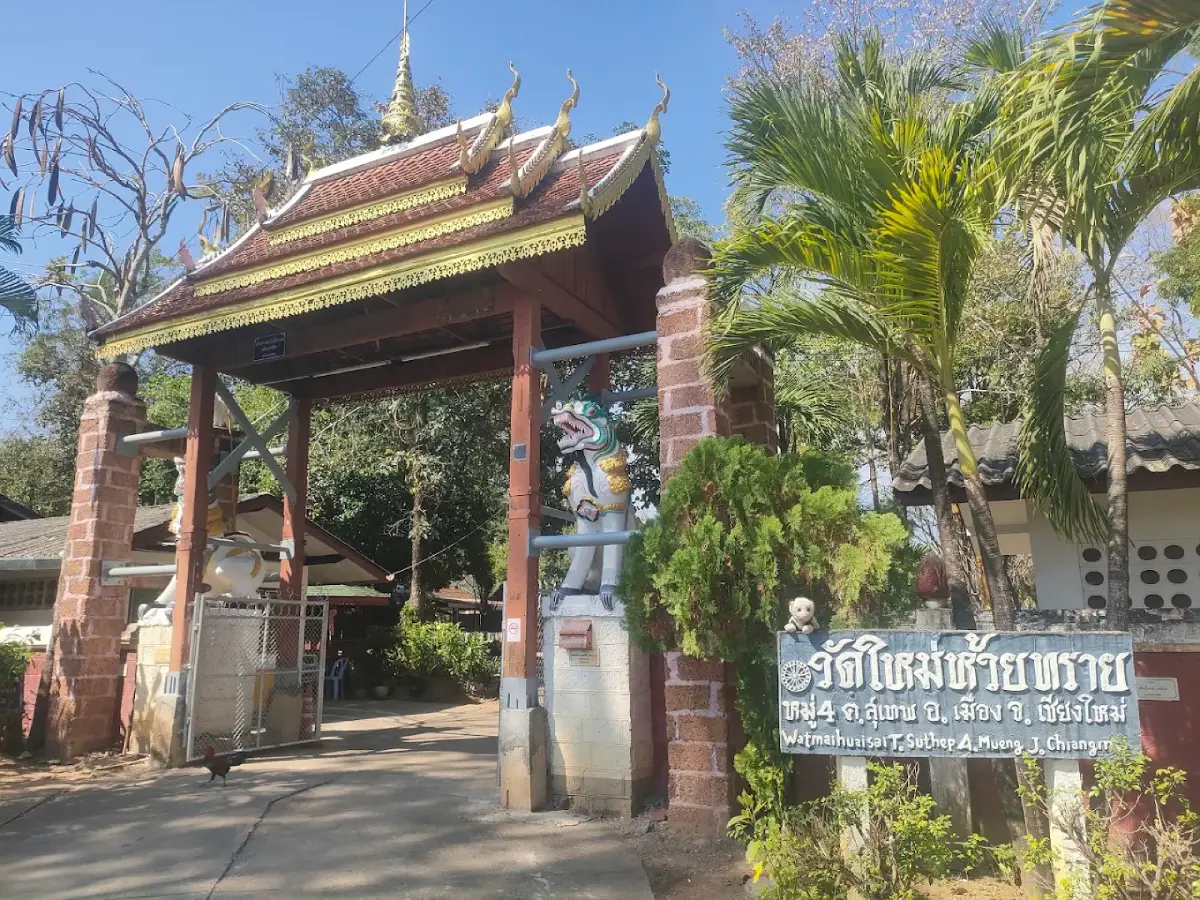
Wat Mai Huai Sai
Open Days: Daily
Opening Hours: 08.00 – 17.00
Wat Mai Huai Sai is a local Buddhist temple under the Maha Nikaya order, located at 55 Moo 4 in the Huai Sai community near the irrigation canal in Suthep Subdistrict, Mueang Chiang Mai District, Chiang Mai Province. The temple serves as a religious and community center for residents in the western side of Chiang Mai, an area connected with Suthep, Mae Hia, Chiang Mai University, the canal road, and several cultural attractions outside the old city moat.
Wat Mai Huai Sai is suitable for travelers who want to visit a quiet Chiang Mai temple without the crowds usually found at major landmarks. Its value lies not in monumental scale, but in its role as a living community temple. The temple covers 6 rai, 2 ngan, and 20 square wah. It was officially registered as a Buddhist temple on 30 June 1994 and later received its royal consecrated boundary in 1995, marking its religious status as a functioning monastery for important Buddhist ceremonies.
The name “Wat Mai Huai Sai” reflects the identity of the local area. “Huai Sai” connects the temple with the surrounding community in Suthep Subdistrict, while “Wat Mai” indicates that the temple is newer than many ancient temples in Chiang Mai, such as Wat Umong, Wat Ram Poeng, Wat Suan Dok, and Wat Phra That Doi Suthep. This newer history is part of the temple’s significance. Wat Mai Huai Sai shows how Chiang Mai’s expanding communities continue to create religious spaces for merit-making, ceremonies, and local gatherings.
The temple’s location is useful for planning a cultural route around western Chiang Mai. It is close to the canal road and not far from several temples, residential areas, educational zones, and routes leading toward Mae Hia and Hang Dong. Travelers with private cars or rental vehicles can include Wat Mai Huai Sai in a same-day itinerary with Wat Pong Noi, Wat Ram Poeng, Wat Umong, Wat Pa Chi, Wat Phra That Doi Kham, and Royal Park Rajapruek.
The area around Wat Mai Huai Sai feels different from the old city temple zone. Instead of heavy tourist traffic, the surroundings are shaped by local housing, community roads, education-related areas, and daily neighborhood activity. This gives the temple a modest and grounded atmosphere. Visitors can experience a temple as part of everyday life, not only as a sightseeing stop. For travelers interested in cultural context, this makes Wat Mai Huai Sai a useful place to understand how Buddhism remains embedded in Chiang Mai’s local communities.
The history of Wat Mai Huai Sai is closely tied to the development of the Suthep area in modern Chiang Mai. The temple was officially established on 30 June 1994, during a period when communities around the western edge of the city were expanding. As residential areas grew along the canal road and surrounding neighborhoods, a local temple became important for residents who needed a nearby place for Buddhist ceremonies, merit-making, listening to Dhamma, and community activities.
Receiving a royal consecrated boundary in 1995 was a key step in the temple’s development. In Thai Buddhism, a consecrated boundary is significant because it allows a temple to conduct formal monastic acts within a defined sacred area, especially ordination ceremonies. This status shows that Wat Mai Huai Sai developed beyond a simple community worship space and became a recognized temple with a more complete religious function.
The abbot recorded in temple information is Phra Athikan Bunpeng Piyadhammo. In a community temple, the abbot’s role is central. The abbot is not only responsible for religious ceremonies, but also for maintaining the temple grounds, guiding local Buddhist activity, coordinating with lay supporters, and preserving the temple’s relationship with the surrounding community. This role gives Wat Mai Huai Sai a living function beyond physical buildings.
As a local temple, Wat Mai Huai Sai is closely connected with residents. Temples of this type often support daily merit-making, Buddhist holy day observances, ordinations, funerals, memorial ceremonies, and community events. Wat Mai Huai Sai should therefore be understood as a living cultural space. It is not a large commercial tourist attraction, but a place where Buddhism continues to support the rhythm of local life in Chiang Mai.
Visitors should explore Wat Mai Huai Sai respectfully and at a calm pace. The temple is not designed primarily as a tourist complex, so its atmosphere is best appreciated through quiet observation. Pay respect to the Buddha image, walk through the temple grounds with care, and notice how the temple functions within the local neighborhood. This kind of visit gives travelers a more grounded view of Chiang Mai than a route focused only on famous temples and photo stops.
For cultural travelers, Wat Mai Huai Sai helps complete the picture of Suthep Subdistrict. Suthep is home to many important temples and cultural sites, including Wat Umong, Wat Ram Poeng, Wat Pong Noi, and the road leading up to Wat Phra That Doi Suthep. Wat Mai Huai Sai represents the community-temple layer of this landscape. It helps visitors see the difference between ancient temples, meditation temples, mountain pilgrimage temples, and neighborhood temples that serve local residents.
The temple’s position near the irrigation canal is also important. Unlike temples inside Chiang Mai’s old city, Wat Mai Huai Sai belongs to a later urban and community setting. Old city temples are often known for historic chedis, ancient viharns, and walkable heritage routes. Wat Mai Huai Sai reflects another side of Chiang Mai: the religious life of communities that grew around newer roads, local housing areas, and the western expansion of the city.
Morning and late afternoon are the most comfortable times to visit. Morning is suitable for merit-making and for beginning a cultural route around Suthep and Mae Hia. Late afternoon is suitable for travelers returning from nearby temples or the canal road area. Visitors should dress modestly, keep their voices low, avoid intrusive photography, and be mindful that the temple is a place of worship used by local residents.
Wat Mai Huai Sai can be included in a slow temple route on the western side of Chiang Mai. A useful itinerary can begin at Wat Mai Huai Sai, then continue to Wat Pong Noi, Wat Ram Poeng, Wat Umong, Wat Pa Chi, and Wat Phra That Doi Kham. This route is suitable for travelers interested in northern Thai temples, community life, Lanna religious culture, meditation traditions, and local beliefs connected with the Mae Hia area.
When Wat Mai Huai Sai is connected with Wat Pa Chi and the Mae Hia cultural area, visitors can better understand that temples in Chiang Mai do not all serve the same role. Some temples are meditation centers, some are ancient monuments, some are linked with local rituals, and some are community temples for everyday Buddhist practice. Wat Mai Huai Sai belongs to the latter group. It shows the relationship between Buddhism and daily community life in contemporary Chiang Mai.
The temple’s compact area of 6 rai, 2 ngan, and 20 square wah makes it suitable for a short but meaningful visit. Travelers should not overlook it simply because it has less tourist publicity than better-known temples. Many neighborhood temples carry cultural value precisely because they remain close to real local life. Wat Mai Huai Sai offers a chance to see a quieter and more practical side of Buddhist Chiang Mai.
Getting There is convenient by private car, motorcycle, rental vehicle, red songthaew, or ride-hailing service. From central Chiang Mai, travelers can use Suthep Road, Huai Kaew Road, or the canal road to reach Suthep Subdistrict and the Huai Sai community. For navigation, set the destination as Wat Mai Huai Sai, Suthep, or use the plus code QW6V+X2W. The temple is located near the canal road and the Ban Sai Kham community area.
Travelers coming from Chiang Mai International Airport can use Mahidol Road or the canal road to reach the Suthep and Mae Hia side of the city without passing through the entire old city. This makes the temple convenient for visitors who rent a car at the airport and want to begin with attractions around Doi Kham, Mae Hia, and Suthep. Those staying around Nimmanhaemin or Chiang Mai University can also reach the temple by using the back routes around the university area and connecting to the canal road.
For travelers using red songthaews or local transport, it is best to tell the driver that the destination is Wat Mai Huai Sai in Suthep Subdistrict, near the Huai Sai community and the canal road. Agree on the fare before departure. If you plan to visit several sites in one day, such as Wat Umong, Wat Ram Poeng, Wat Pong Noi, Wat Phra That Doi Kham, and Royal Park Rajapruek, hiring a vehicle or using a rental car will be more practical because the attractions are spread across smaller roads.
A visit to Wat Mai Huai Sai normally takes around 30 minutes to 1 hour, depending on your purpose. A short visit is enough for merit-making and quiet worship. Those who are studying local temples, writing cultural travel content, or exploring the community structure of Suthep may want to allow more time to observe the surrounding roads, nearby temples, and the way the temple connects with the local neighborhood.
Because Wat Mai Huai Sai is a community temple rather than a major tourist attraction, visitors should be especially respectful. Do not block local access roads when parking. Avoid loud behavior, drone use without permission, and entering areas not open to the public. Respecting the temple and neighborhood helps preserve a good relationship between travelers and residents.
Overall, Wat Mai Huai Sai is a meaningful place for travelers who want to understand Chiang Mai beyond its landmark temples. It has verified basic information, a clear community role, a recorded establishment date, a royal consecrated boundary, and a convenient location for exploring the western side of the city. When combined with Wat Umong, Wat Ram Poeng, Wat Pong Noi, Wat Pa Chi, Wat Phra That Doi Kham, and Royal Park Rajapruek, the temple helps create a fuller cultural route through Suthep and nearby areas.
Wat Mai Huai Sai should not be overlooked by travelers interested in local temples in Chiang Mai. It offers a quiet atmosphere, a connection with community life, and practical access to other cultural sites nearby. For those who prefer less crowded temples and want to see Buddhism as part of everyday life in Chiang Mai, Wat Mai Huai Sai is a worthwhile stop on the Suthep and canal road route.
| Name | Wat Mai Huai Sai |
| Location | Huai Sai community, near the irrigation canal, Suthep Subdistrict, Mueang Chiang Mai District, Chiang Mai Province |
| Address | 55 Moo 4, Huai Sai, Irrigation Canal Area, Suthep Subdistrict, Mueang Chiang Mai District, Chiang Mai 50200, Thailand |
| Coordinates | QW6V+X2W, Tambon Su Thep, Mueang Chiang Mai District, Chiang Mai 50200, Thailand |
| Temple Type | Local Buddhist temple under the Maha Nikaya order |
| Highlights | Quiet community temple in Suthep, close to the canal road and suitable for a western Chiang Mai temple route |
| History | Officially registered as a temple on 30 June 1994 and received its royal consecrated boundary in 1995 |
| Temple Area | 6 rai, 2 ngan, 20 square wah |
| Name Origin | The name is connected with the Huai Sai community in Suthep and reflects the temple’s role as a local Buddhist center for residents in the area |
| Distinctive Features | Compact community temple, quiet local atmosphere, convenient access from the canal road, and easy connection to nearby temples in Suthep and Mae Hia |
| Travel Information | From central Chiang Mai, use Suthep Road, Huai Kaew Road, or the canal road toward Suthep Subdistrict. Set the destination as Wat Mai Huai Sai or QW6V+X2W. Access is possible by private car, motorcycle, rental vehicle, red songthaew, or ride-hailing service. |
| Current Status | Open as a local Buddhist temple in Suthep Subdistrict and listed in recent temple community improvement activity records for Mueang Chiang Mai District |
| Open Days | Daily |
| Opening Hours | 08.00 – 17.00 |
| Abbot / Caretaker | Phra Athikan Bunpeng Piyadhammo |
| Nearby Tourist Attractions | 1. Wat Pong Noi, about 2 km 2. Wat Ram Poeng, about 3 km 3. Wat Umong Suan Phutthatham, about 4 km 4. Wat Pa Chi, about 4 km 5. Wat Phra That Doi Kham, about 5 km 6. Royal Park Rajapruek, about 6 km |
| Nearby Restaurants | 1. Chafae Him Tang 1 Ban Sai Kham Suthep, about 1 km, Tel. 080-081-5239 2. Kru Toi Made-To-Order Food Suthep, about 2 km, Tel. 084-486-0621, 089-559-9487 3. Tam Loei by Sis Na Khan Khlong, about 3 km, Tel. 092-917-8857 4. My Vietnam Khan Khlong Chonlaprathan, about 4 km, Tel. 053-892-355, 080-449-3596 5. Hello Solao, about 4 km, Tel. 053-270-190, 089-850-9343 6. Han Thueng Chiang Mai, about 5 km, Tel. 093-970-6885, 091-076-6100 |
| Nearby Accommodations | 1. ChiangMai Castle, about 0.5 km 2. Catnap Homestay, about 0.5 km 3. Baan Ton Kwen Villa, about 0.5 km, Tel. +66-86-979-6727 4. Doi Khum Place, about 1 km, Tel. +66-99-240-4238 5. Family Room, about 1 km, Tel. +66-92-263-7152 6. Stay in Style at Nimman Homestay, about 4 km, Tel. +66-81-020-3559 |
Frequently Asked Questions (FAQ)
Q: Where is Wat Mai Huai Sai located?
A: Wat Mai Huai Sai is located at 55 Moo 4, Huai Sai, near the irrigation canal in Suthep Subdistrict, Mueang Chiang Mai District, Chiang Mai 50200, Thailand.
Q: What are the opening hours of Wat Mai Huai Sai?
A: Wat Mai Huai Sai is open daily from 08.00 to 17.00.
Q: What type of temple is Wat Mai Huai Sai?
A: Wat Mai Huai Sai is a local Buddhist temple under the Maha Nikaya order in Suthep Subdistrict, Mueang Chiang Mai District.
Q: What is important about the history of Wat Mai Huai Sai?
A: The temple was officially registered on 30 June 1994 and received its royal consecrated boundary in 1995. It covers 6 rai, 2 ngan, and 20 square wah.
Q: Who is the abbot of Wat Mai Huai Sai?
A: The abbot recorded in temple information is Phra Athikan Bunpeng Piyadhammo.
Q: How can travelers get to Wat Mai Huai Sai?
A: Travelers can use Suthep Road, Huai Kaew Road, or the canal road from central Chiang Mai, then set the destination as Wat Mai Huai Sai or QW6V+X2W.
Q: What nearby attractions can be visited with Wat Mai Huai Sai?
A: Nearby attractions include Wat Pong Noi, Wat Ram Poeng, Wat Umong Suan Phutthatham, Wat Pa Chi, Wat Phra That Doi Kham, and Royal Park Rajapruek.
Q: What should visitors keep in mind when visiting Wat Mai Huai Sai?
A: Visitors should dress modestly, speak quietly, avoid blocking local roads, respect areas not open to the public, and behave respectfully because the temple is an active community religious site.
 Category: ●Places of Worship
 Group: ●Temple
Last Update : 4 DayAgo
 Last Update : 4 DayAgo
 Click to Access the Navigation Map GPS
 Muang Chiang Mai(121)Chom Thong(47)Mae Chaem(25)Chiang Dao(33)Doi Saket(68)Mae Taeng(85)Mae Rim(69)Samoeng(29)Fang(71)Mae Ai(62)Phrao(70)San Pa Tong(105)San Kamphaeng(66)San Sai(73)Hang Dong(74)Hot(32)Doi Tao(22)Omkoi(11)Saraphi(74)Wiang Haeng(15)Chai Prakan(28)Mae Wang(32)Mae On(22)Doi Lo(34)Galyani Vadhana(1)


