
lovethailand home >North Travel Attractions >Chiang Mai Travel Attractions >Muang Chiang Mai >Suthep > Wat Pha Lat
TL;DR: Wat Pha Lat is located at Ban Huai Pha Lat, Moo 1, Suthep Subdistrict, Mueang Chiang Mai District, Chiang Mai Province, open Daily, hours 06.00 – 18.00.

Wat Pha Lat
Open Days: Daily
Opening Hours: 06.00 – 18.00
Wat Pha Lat, also known as Wat Sakithaka or Wat Sakadagami, is a forest temple in Chiang Mai located at 101 Ban Huai Pha Lat, Moo 1, Suthep Subdistrict, Mueang Chiang Mai District. It sits on the Doi Suthep route before Wat Phra That Doi Suthep and is one of Chiang Mai’s most atmospheric temples for travelers who want to combine Buddhist history, Lanna culture, old architecture, forest scenery, a stream, waterfalls, and quiet meditation spaces. The temple is known for its connection with the legend of the sacred relic procession to Doi Suthep during the reign of King Kuena, as well as its viharn, Burmese-style chedi, Hall of the Buddha by the Waterfall, cliffside Buddha images, sacred well, King Kuena viharn remains, Sam Yop viharn remains, and shaded meditation areas.
The special appeal of Wat Pha Lat lies in the way its religious buildings merge with the forest of Doi Suthep. The temple does not stand prominently beside the main road like many tourist temples. Instead, it is tucked down below Sriwichai Road, reached from an upper entrance marked by small pavilions and a red temple sign. After descending about 200 meters by car or on foot, visitors enter a different world: cool shade, flowing water, mossy stones, old religious structures, and the sound of Huai Pha Lat running through the temple grounds. This atmosphere makes Wat Pha Lat one of the most peaceful temple experiences near Chiang Mai city.
Wat Pha Lat was founded during the reign of King Kuena as a memorial site on the route used to bring sacred Buddhist relics to Doi Suthep. According to the legend, King Kuena and Phra Maha Sumana placed the relics on the back of a sacred elephant and prayed that the elephant would lead them to the proper place for enshrinement. The elephant left Chiang Mai through the northern city gate and walked toward Doi Suthep. Along the way, it stopped and rested at several places, including the Huai Pha Lat area, before continuing upward to the summit where Wat Phra That Doi Suthep now stands.
The relationship between Wat Pha Lat and Wat Phra That Doi Suthep is therefore very close. Wat Pha Lat is not simply a small temple on the way up the mountain. It is part of the sacred geography of the Doi Suthep relic legend and one of the historical markers along the old pilgrimage route. After Wat Phra That Doi Suthep was established, King Kuena ordered the creation of memorial temples along the relic procession route. Wat Pha Lat preserves this role while retaining the quiet feeling of a forest monastery along an ancient path.
The name “Wat Pha Lat” comes from the natural character of the site. “Pha Lat” refers to sloping rock and the slanted waterfall-rock landscape around the temple. Local elders also connect the name with “Pha Loet,” meaning slippery, because the rocky stream area caused both people and elephants to slip while traveling up the mountain. The temple later became known as Wat Pha Lat after the Huai Pha Lat stream that flows through the grounds. The name therefore records the actual terrain of the temple rather than an abstract religious phrase.
The temple’s other name, Wat Sakithaka or Wat Sakadagamiwanaram, gives the place a doctrinal dimension. Sakadagami refers to the Once-Returner, one of the stages of spiritual attainment in Theravada Buddhism. In this sense, “Pha Lat” describes the physical landscape, while “Sakadagami” adds a Buddhist spiritual meaning. The temple’s identity is therefore built from both nature and Dhamma: a sloping forest rock shaped by water, and a sacred place associated with the path of Buddhist practice.
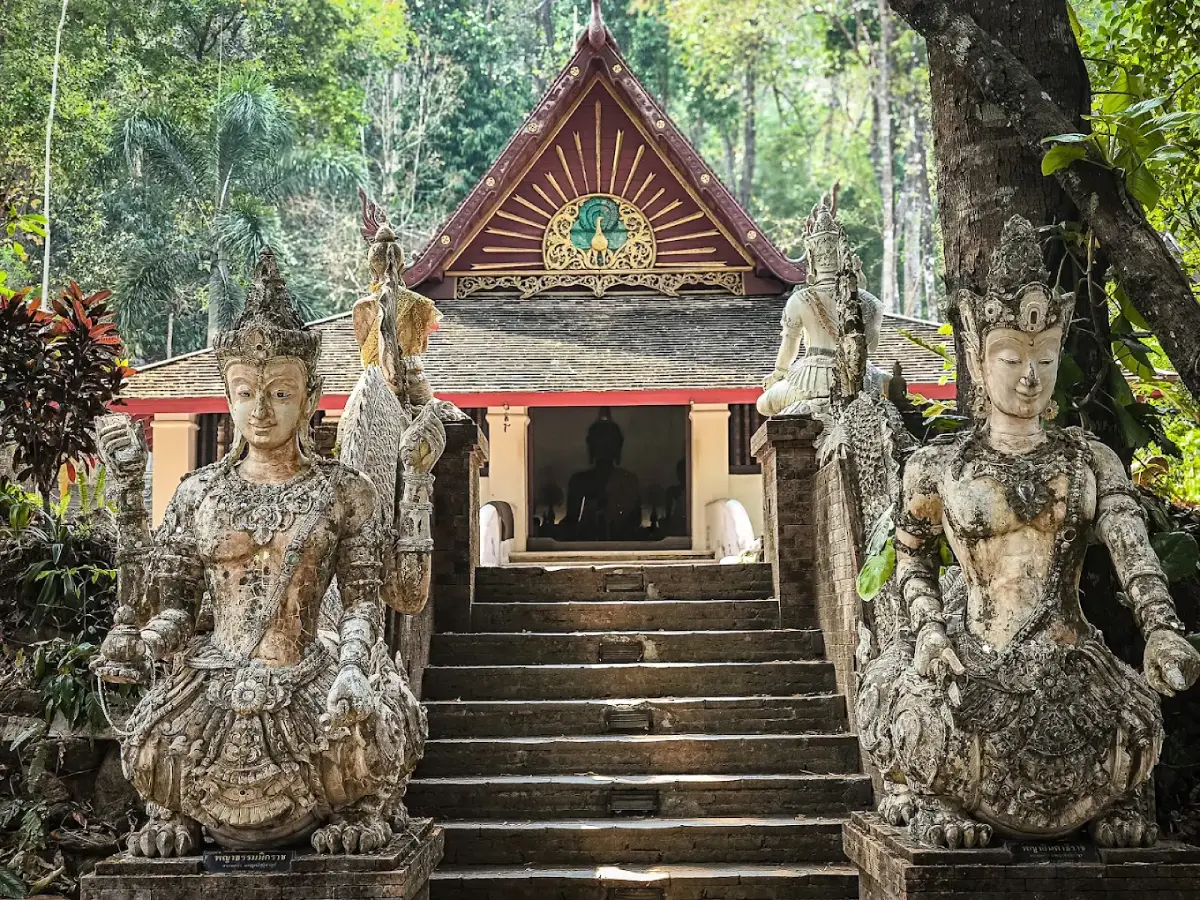
The main viharn of Wat Pha Lat stands near the middle of the temple compound. It is a masonry building combining Lanna and Burmese architectural influences. The original viharn is associated with the King Kuena period, but that structure collapsed and left only its foundation. A new viharn was later built during the period when Khruba Sriwichai led the construction of the road up to Doi Suthep. The new building was positioned away from the original foundation so that it would not cover the earlier remains. The viharn seen today is therefore an important record of the temple’s revival in the Khruba Sriwichai period.
The viharn pediment is one of the key details to observe. The front features carved wooden peacock decoration with blue and green glass ornamentation, while the rear includes a rabbit motif. These motifs are not only decorative; they express Burmese artistic influence and the presence of diverse patronage and craftsmanship in Chiang Mai. The peacock design gives the viharn a distinctive identity different from more conventional Lanna temple façades, making it especially important for travelers interested in temple art.
Inside the viharn is a Buddha image in the Mara-vijaya posture, associated with local Lawa artistic influence. The Mara-vijaya posture represents the Buddha’s victory over Mara before enlightenment. It conveys firmness, spiritual triumph, and inner steadiness. Within the forest setting of Wat Pha Lat, this image deepens the temple’s atmosphere of quiet reflection and disciplined calm.
Behind the viharn stands the temple’s main chedi. It is a Burmese-style chedi built by Burmese craftsmen during the same restoration period as the viharn. Its square base supports multiple recessed tiers, rising to an inverted-bell-shaped body decorated with stucco guardian motifs. The pointed upper section does not have an umbrella canopy. The chedi’s form feels solid, old, and contemplative, and during the rainy season moss and small plants often make it appear even more integrated with the humid forest environment of Doi Suthep.
In the past, the chedi was damaged after treasure hunters dug into it and caused part of the structure to collapse. It was later restored and strengthened, allowing it to remain one of the principal sacred monuments of the temple. Visitors should approach the chedi with respect because it represents not only beauty and antiquity, but also loss, recovery, and the continuing effort to protect Chiang Mai’s religious heritage.
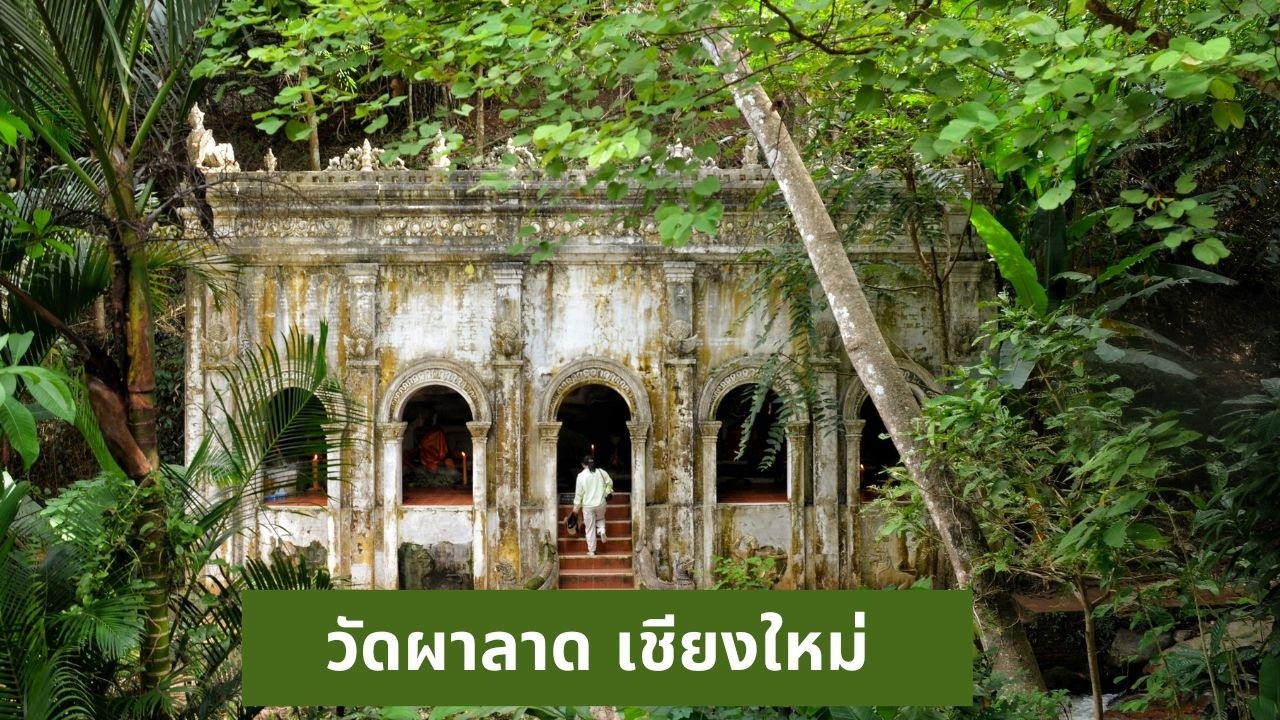
The Hall of the Buddha by the Waterfall is one of the most distinctive features of Wat Pha Lat. This long white masonry structure runs parallel to the stream, with a row of rounded arches opening toward the water. Its façade includes attached columns, stucco ornamentation, and flowing decorative patterns. Inside, the rear wall is not a conventional built wall; it is a natural rock overhang that becomes part of the sacred interior. Buddha images are placed along the rock face, making the building a rare example of religious architecture that embraces the natural cliff rather than replacing it.
The beauty of the Hall of the Buddha by the Waterfall comes from the balanced relationship between building and nature. Old plaster, moss, water sound, shade, stone, and Buddha images create a deeply contemplative atmosphere. This is one of the best places in the temple to pause quietly. It expresses the essence of Wat Pha Lat: a sacred place where architecture does not dominate the forest, but becomes part of it.
The Viharn of the Five Buddhas is a contemporary structure within the temple compound. It is built of brick, with a three-tiered roof and painted guardian deities at the front doors. Inside are images of the Five Buddhas. The concept of the Five Buddhas is connected with Buddhist ideas of time, continuity, and the unfolding of the Dhamma across different eras. This hall adds another layer of Buddhist meaning to the temple and provides visitors with a quiet space for worship.
The cliffside Buddha image area is another site with a strong local story. It is believed to have once been the location of a Burmese-style cliff viharn. Today, only parts of the base remain. In the past, Chiang Saen-style Buddha images were enshrined here, including a sacred image called Phra Lai Ka. Local tradition says this image was empowered so that crows, birds associated with misfortune in the story, would not fly past the temple. The original images were later destroyed during conflict with Burma, and Shan people who had taken refuge in the area later created new Buddha images in Shan style.
The cliffside Buddha area therefore contains many layers of history: Burmese artistic influence, Chiang Saen Buddha images, the legend of Phra Lai Ka, protective beliefs, wartime loss, and the later presence of Shan communities. This makes Wat Pha Lat more than a temple linked only to the Doi Suthep elephant legend. It is also a place where memories of many communities and historical periods overlap.
The sacred well of Wat Pha Lat is another important feature. It shows evidence of construction and restoration across several periods, including the time associated with the relic procession to Doi Suthep, the period of Burmese influence in Chiang Mai, and the period of Khruba Sriwichai. A well in a forest temple was practical as well as symbolic. Water was necessary for monks, pilgrims, and meditators, and the well reflects older methods of collecting and filtering water in a natural mountain setting.
The remains of King Kuena’s viharn should be understood together with the temple’s origin story. The old foundation and brick remains near the stream mark the earlier religious structure associated with the King Kuena period. A protective pavilion now covers part of the area, but the old base can still be understood as an important layer of the temple’s past. This site reminds visitors that Wat Pha Lat includes not only later restored buildings, but also older remains linked to its Lanna foundation legend.
The Sam Yop viharn remains and meditation mound are connected with Wat Sotapannaram, or Sam Yop, another memorial site on the relic route. Today the area appears as a raised mound with traces of brick and stucco fragments. These remains help visitors understand that the old Doi Suthep route was not defined by only one temple, but by a sacred landscape of rest points, worship sites, and forest monasteries connected with the relic procession.
The meditation areas at Wat Pha Lat fit naturally with its forest setting. Shade, stream sounds, cool air, and the gentle slope of the land make the temple suitable for quiet contemplation. Visitors should remember that Wat Pha Lat is not only a sightseeing site. It is an active monastery and a place of practice. Silence, modest behavior, and respect for monastic areas are especially important here.
The Wat Pha Lat Nature Trail is a major way to experience the temple. The trail begins near the Channel 7 television station area at the foot of Doi Suthep and runs about 2 kilometers through forest before reaching the temple. This is an old path once used by monks and lay Buddhists walking up to worship at Doi Suthep before the modern road existed. The trail gives visitors a direct experience of the temple as part of a mountain pilgrimage landscape.
Those who choose the trail should wear suitable shoes, carry drinking water, dress modestly, and begin in the morning. The route is not as demanding as continuing all the way to Wat Phra That Doi Suthep, but it is still a natural forest path with soil, stone, roots, and slippery sections during or after rain. The walk is best suited to travelers who want to approach Wat Pha Lat as a forest temple and spiritual rest point, not simply as a roadside attraction.
Travelers who do not want to hike can reach Wat Pha Lat by car, motorbike, red songthaew, taxi, or ride-hailing service along Sriwichai Road, the same road that leads to Wat Phra That Doi Suthep. The temple entrance is on the left side before the Doi Suthep temple area. From the main road, visitors descend about 200 meters to the temple. This option is suitable for families, older visitors, or those with limited time, but drivers should use caution because the road up Doi Suthep includes curves and steady traffic.
Wat Pha Lat itself does not charge a temple entrance fee for visitors arriving by the main road. However, the Wat Pha Lat Nature Trail is part of the Doi Suthep-Pui National Park visitor service area, and trail users are charged according to the national park fee schedule. Visitors using the trail should carry cash and check the posted information at the trailhead. This fee is a national park service fee, not a Wat Pha Lat temple admission charge.
One of the temple’s major annual traditions is the Duean 5 Peng Wat Pha Lat festival, also known as the ceremony of following the path of Khruba, paying homage to Phra That Saen Suk, carrying sacred relics, and offering Lanna flower images. The event links Wat Pha Lat with the old faith route from Wat Fai Hin to Wat Pha Lat. Activities include processions, bathing Phra That Saen Suk, demonstrations of Lanna devotional crafts, floral offerings, and traditional incense-making. This tradition shows that Wat Pha Lat remains a living cultural site, not only an old forest monument.
The Duean 5 Peng event also reflects the temple’s role as a meeting point for religion, culture, education, and community. Monastic organizations, the provincial Buddhist office, universities, Suthep Municipality, cultural networks, and local Buddhists participate in the event. Visitors who come during the festival can see another dimension of the temple: a forest monastery filled with processions, Lanna flowers, devotional objects, and people walking the natural trail to continue the Doi Suthep faith tradition.
Another important issue at Wat Pha Lat is responsible tourism. The temple has become increasingly popular with both road visitors and trail walkers, but the area is also an active monastery, a natural site, and a fragile heritage landscape. Visitors should help protect it by keeping quiet, taking their rubbish out, staying out of monastic residential areas, and avoiding climbing on or touching old monuments, Buddha images, and fragile sculptures.
The best time to visit Wat Pha Lat is from early morning to late morning, when the air is cooler, the light is soft, and the temple is usually less crowded. Hikers should start early enough to visit the temple and return before late afternoon. Evening visits are possible by road, but descending the forest trail in low light is not recommended. During the rainy season, the temple becomes especially green and beautiful, but visitors should be careful of slippery stone, stronger stream flow, and wet trail conditions.
Visitors should dress modestly when entering Wat Pha Lat. Shoulders should be covered, shorts and skirts should be of appropriate length, and shoes should be removed before entering sacred buildings. Even though the temple is located in a forest and feels like a nature destination, it remains an active monastery with resident monks and meditation spaces. Visitors should speak softly, move calmly, and avoid disturbing worshippers or meditators.
Getting There from Chiang Mai city is straightforward. Take Huay Kaew Road past Chiang Mai University, Chiang Mai Zoo, and the Khruba Sriwichai Monument, then continue along Sriwichai Road toward Wat Phra That Doi Suthep. Wat Pha Lat is about 4.5 kilometers from the Khruba Sriwichai Monument, on the left side of the road before Doi Suthep temple. The entrance has a temple sign and pavilions. Visitors can drive down toward the temple parking area or park above and walk down where appropriate.
Travelers without a private vehicle can use a red songthaew, taxi, or ride-hailing service from Chiang Mai city. It is best to arrange the return pickup in advance, as transport from the temple may not always be easy to find. Those continuing to Wat Phra That Doi Suthep can use Wat Pha Lat as a peaceful mid-route stop before proceeding to the summit temple and returning to the city by the same road.
A practical travel route is to begin at the Khruba Sriwichai Monument, visit Wat Pha Lat, and continue to Wat Phra That Doi Suthep. Travelers who want a slower cultural and nature route can combine Wat Pha Lat with Huay Kaew Waterfall, Chiang Mai Zoo, Wat Umong, and Baan Kang Wat. This route gives a broad view of Chiang Mai through Lanna faith, mountain forest, meditation temples, creative community spaces, and natural scenery close to the city.
Most restaurants and accommodation options near Wat Pha Lat are located around the foothill area, Suthep Road, Huay Kaew Road, Chiang Mai University, and Nimmanhaemin. The temple itself is in a forest setting and does not function as a dining area. Visitors should plan meals before going up the mountain or after returning from the temple. Nearby options include scenic Thai restaurants, cafés, vegetarian restaurants, local food shops, and accommodation in the Suthep and Nimman areas.
In summary, Wat Pha Lat is one of Chiang Mai’s most meaningful temples for travelers interested in old temples, Lanna history, forest scenery, and the Doi Suthep pilgrimage route. It contains the legend of King Kuena’s sacred elephant, a Lanna-Burmese viharn, an old forest chedi, the Hall of the Buddha by the Waterfall, cliffside Buddha images, a sacred well, King Kuena viharn remains, Sam Yop viharn remains, meditation areas, and the flowing Huai Pha Lat stream. A visit here is not merely a stop on the way to Doi Suthep; it is an encounter with a sacred landscape where nature, history, and Buddhism remain deeply intertwined.
| Name | Wat Pha Lat / Wat Sakithaka |
| Location | Ban Huai Pha Lat, Moo 1, Suthep Subdistrict, Mueang Chiang Mai District, Chiang Mai Province |
| Address | 101 Ban Huai Pha Lat, Moo 1, Suthep, Mueang Chiang Mai District, Chiang Mai 50200, Thailand |
| Coordinates | 18.800545, 98.934083 |
| Temple Type | Local Buddhist Temple Under The Maha Nikaya Order |
| Highlights | Forest temple on the Doi Suthep route, with a stream and waterfall, Lanna-Burmese viharn, Burmese-style chedi, Hall of the Buddha by the Waterfall, cliffside Buddha images, and nature trail |
| History | Founded during the reign of King Kuena as a memorial temple on the sacred relic procession route to Doi Suthep; later restored significantly during the Khruba Sriwichai period |
| Name Origin | The name Pha Lat refers to the sloping rock and waterfall landscape of the site and is connected with Huai Pha Lat, the stream that runs through the temple |
| Other Name | Wat Sakithaka / Wat Sakadagamiwanaram |
| Distinctive Features | Lanna and Burmese architectural influence integrated with Doi Suthep forest, stream, waterfall, walking trail, old ruins, and meditation spaces |
| Important Sacred Objects And Structures | Viharn, chedi, Hall of the Buddha by the Waterfall, Viharn of the Five Buddhas, cliffside Buddha images, sacred well, King Kuena viharn remains, Sam Yop viharn remains, Buddha image pavilions, meditation areas, and Huai Pha Lat stream |
| Traditions / Annual Activities | Duean 5 Peng Wat Pha Lat festival, following the Khruba trail, paying homage to Phra That Saen Suk, carrying sacred relics, offering Lanna flower images, and bathing Phra That Saen Suk |
| Main Areas / Zones | Upper entrance, temple courtyard, viharn, chedi, Hall of the Buddha by the Waterfall, cliffside Buddha image area, sacred well, King Kuena viharn remains, Sam Yop viharn remains, meditation mound, stream, and Chiang Mai viewpoint |
| Abbot / Caretaker | Phra Khru Thirasuttaphot, Dr. / Phra Maha Sa-ng Theerasangwaro |
| Travel Information | From Chiang Mai city, take Huay Kaew Road past Chiang Mai University, Chiang Mai Zoo, and the Khruba Sriwichai Monument, then continue on Sriwichai Road toward Wat Phra That Doi Suthep. The temple is on the left before Doi Suthep temple. Visitors may also hike the Wat Pha Lat Nature Trail from the Doi Suthep foothill area, about 2 km |
| Current Status | Open to visitors and worshippers; it remains an active forest monastery and a religious, natural, and historical attraction on the Doi Suthep route |
| Open Days | Daily |
| Opening Hours | 06.00 – 18.00 |
| Entrance Fee | No temple admission fee when arriving by the main road; the Wat Pha Lat Nature Trail is subject to Doi Suthep-Pui National Park service fees according to the posted rate |
| Main Contact Number | 087-645-4390 |
| Nearby Tourist Attractions | 1. Khruba Sriwichai Monument, about 4.5 km 2. Huay Kaew Waterfall, about 5 km 3. Chiang Mai Zoo, about 5 km 4. Wat Umong, about 6 km 5. Baan Kang Wat, about 6 km 6. Wat Phra That Doi Suthep, about 6 km |
| Nearby Restaurants | 1. Palaad Tawanron, about 3 km, Tel. 053-216-576 2. Basecamp Coffee House, about 4 km, Tel. 094-618-9090 3. No.39 Cafe, about 6 km, Tel. 086-879-6697 4. Food4Thought, about 7 km, Tel. 053-217-395 5. Anchan Vegetarian Restaurant, about 7 km, Tel. 083-581-1689 6. Khao Soi Mae Sai, about 8 km, Tel. 053-213-284 |
| Nearby Accommodations | 1. Villa Mahabhirom, about 6 km, Tel. 053-281-599, 098-747-3366 2. TUCK Me iN, about 6 km, Tel. 089-990-9949 3. Four O’Clock Hotel, about 6 km, Tel. 061-790-4446 4. The Core Gallery Hotel, about 7 km, Tel. 053-218-163 5. Hotel MAYU Chiang Mai, about 8 km, Tel. 098-806-5896 |
Frequently Asked Questions (FAQ)
Q: Where is Wat Pha Lat located?
A: Wat Pha Lat is located at 101 Ban Huai Pha Lat, Moo 1, Suthep Subdistrict, Mueang Chiang Mai District, Chiang Mai 50200, on Sriwichai Road before Wat Phra That Doi Suthep.
Q: Why is Wat Pha Lat important?
A: Wat Pha Lat is an old forest temple associated with the sacred relic procession to Doi Suthep during the reign of King Kuena. It preserves important religious structures and a strong connection with the historic pilgrimage route up Doi Suthep.
Q: What are the main highlights of Wat Pha Lat?
A: Highlights include the Lanna-Burmese viharn, Burmese-style chedi, Hall of the Buddha by the Waterfall, Huai Pha Lat stream, cliffside Buddha images, sacred well, King Kuena viharn remains, Sam Yop viharn remains, and meditation areas.
Q: What are the opening hours of Wat Pha Lat?
A: Wat Pha Lat is open daily from 06.00 to 18.00.
Q: Is there an entrance fee at Wat Pha Lat?
A: There is no temple admission fee for visitors arriving by the main road. The Wat Pha Lat Nature Trail is subject to Doi Suthep-Pui National Park service fees according to the posted rate.
Q: Can visitors hike to Wat Pha Lat?
A: Yes. Visitors can hike the Wat Pha Lat Nature Trail from the Doi Suthep foothill area. The route is about 2 km and follows an old forest path connected with the historic pilgrimage route to Doi Suthep.
Q: What nearby attractions can be visited with Wat Pha Lat?
A: Nearby attractions include the Khruba Sriwichai Monument, Huay Kaew Waterfall, Chiang Mai Zoo, Wat Umong, Baan Kang Wat, and Wat Phra That Doi Suthep.
Q: What should visitors wear when visiting Wat Pha Lat?
A: Visitors should dress modestly, cover shoulders, wear appropriate-length clothing, remove shoes before entering sacred buildings, keep quiet, and avoid disturbing monks, worshippers, or meditation areas.
 Category: ●Places of Worship
 Group: ●Temple
Last Update : 2 MonthAgo
 Last Update : 2 MonthAgo
 Click to Access the Navigation Map GPS
Wat Pha Lat Map
Recommend

 Muang Chiang Mai(121)Chom Thong(47)Mae Chaem(25)Chiang Dao(33)Doi Saket(68)Mae Taeng(85)Mae Rim(69)Samoeng(29)Fang(71)Mae Ai(59)Phrao(70)San Pa Tong(103)San Kamphaeng(66)San Sai(73)Hang Dong(73)Hot(32)Doi Tao(22)Omkoi(11)Saraphi(74)Wiang Haeng(15)Chai Prakan(28)Mae Wang(32)Mae On(22)Doi Lo(33)Galyani Vadhana(1)


