
lovethailand home >North Travel Attractions >Chiang Mai Travel Attractions >Muang Chiang Mai >Si Phum > Wat Pha Bong (Mangkhalaram)
TL;DR: Wat Pha Bong (Mangkhalaram) is located at Singharat Road, Si Phum Subdistrict, Mueang Chiang Mai District, Chiang Mai Province, open Daily, hours 06.00–17.00.
Wat Pha Bong (Mangkhalaram)
Open Days: Daily
Opening Hours: 06.00–17.00
Wat Pha Bong, also known as Wat Pha Bong Mangkhalaram, is a historic private Buddhist temple under the Maha Nikaya order in Si Phum Subdistrict, Mueang Chiang Mai District, Chiang Mai Province. Located on Singharat Road inside Chiang Mai Old City, close to Wat Prasat and Wat Phra Singh, the temple is notable for its old name Wat Pha Bong Prasat, its connection with Shan or Tai Yai migrants from Mae Hong Son, its Lanna-style viharn, castle-shaped chedi with Buddha niches on all 4 sides, bronze Buddha image, Buddha-image-base inscription dated 1535, and sacred well used by local people for Buddhist rituals, life-prolonging ceremonies, holy water, and protective rites.
Wat Pha Bong is an old Buddhist temple in Chiang Mai Old City with significance in religion, community history, Lanna art, and local belief. The temple is located on Singharat Road in Si Phum Subdistrict, Mueang Chiang Mai District, Chiang Mai Province. It is a private temple under the Maha Nikaya order and occupies an area of about 2 rai. Although the compound is modest in size, it contains several important features: a Lanna-style viharn, a castle-shaped chedi, a bronze Buddha image, an inscription on a Buddha image base, and a sacred well that remains meaningful to local faith.
Wat Pha Bong was formerly known as “Wat Pha Bong Prasat” because its land is adjacent to Wat Prasat. The supporters of both temples belonged to the same family line, and in the past there was a small gate that allowed people to move between the 2 temple compounds. This history shows that Wat Pha Bong was not an isolated temple but part of an old temple cluster around Inthawarorot Road, Singharat Road, and the area near Wat Phra Singh, one of the important historical zones of Chiang Mai Old City.
The history of Wat Pha Bong appears in several chronological layers. One source gives 1472 as the year of establishment. Temple tradition places the temple within the period around 1424–1487. Another source says it was built in 1492 by Shan or Tai Yai people who had lived around Wat Pha Bong in Mae Hong Son before moving to Chiang Mai and naming the temple after their former village. When this historical tradition is read together with the Buddha-image-base inscription dated 1535, Wat Pha Bong clearly belongs to the wider religious and cultural world of the 15th and 16th century Lanna period.
The name “Pha Bong” carries several layers of meaning. In one tradition, the old name Wat Pha Bong Prasat is linked to the temple’s location beside Wat Prasat. Another explanation connects “Pha” with “Phaya,” meaning a lord or noble figure, while “Bong” is understood as a personal name. A further layer connects the name with migrants from Ban Pha Bong in Mae Hong Son. These explanations make the temple name valuable not only as a place name but also as a record of geography, ethnic movement, community memory, and local identity.
One of the most distinctive features of Wat Pha Bong is its sacred well. Local people have long regarded the well as spiritually important and have used its water in Buddhist and protective rituals. Water from the well is associated with merit-making, misfortune-clearing rites, life-prolonging ceremonies, holy water, drinking for auspiciousness, and rites intended to dispel harmful influences. This makes the well much more than a physical water source. It is a living focus of community belief within the temple compound.
The legend of the sacred well tells that the Buddha once came to the area of Wat Prasat, which appeared as a mountain with his disciples. Indra then created a palace for him to stay in. Later, Ananda went to look for water and reached another hill, now associated with Wat Pha Bong, but found no water. The Buddha instructed him to return to the same place and concentrate his mind in prayer. Water then miraculously burst from a large rock. The place was remembered as a site that would become a prosperous monastery and a center of people’s faith.
In Chiang Mai’s urban history, Wat Pha Bong also helps show the movement of people and cultures across northern Thailand. The connection with Shan or Tai Yai migrants from Mae Hong Son gives the temple a broader cultural dimension. It reflects historical links between Chiang Mai, Mae Hong Son, and communities that moved, settled, and rebuilt religious life in new places. Naming a temple after an earlier village was a way to preserve memory while establishing a new spiritual home.
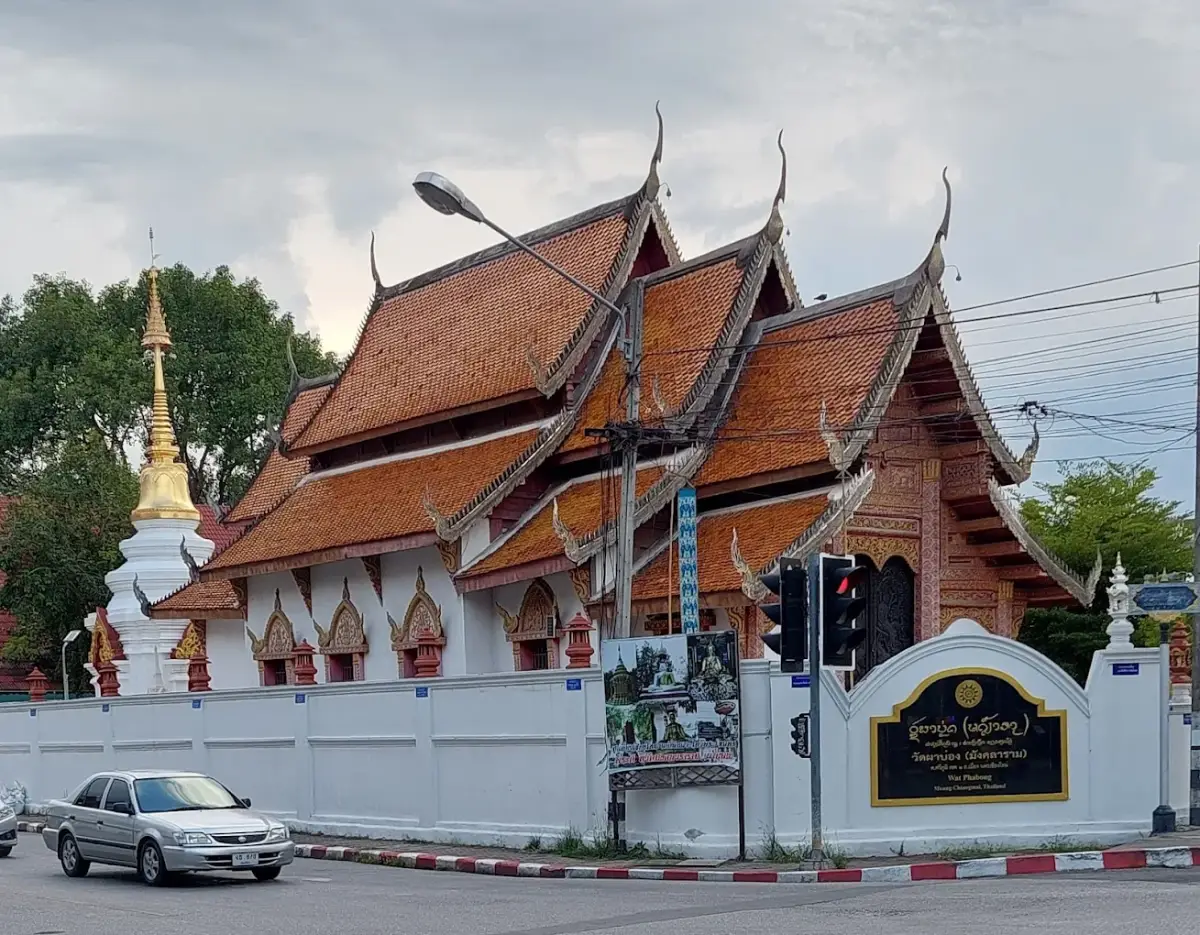
The temple’s key building is the Lanna-style viharn, which has a projecting porch extending to the north of the chedi. The viharn reflects Lanna architectural taste and the organization of sacred space in Chiang Mai temples. The gable and supporting brackets are known for their graceful Lanna-style ornamentation. This building deserves careful viewing from both the front and the side, because its value lies not only in overall form but also in the rhythm of detail, decoration, and spatial relationship with the chedi behind it.
A visit to the viharn is best approached slowly. First observe the building as a whole, then look at the projecting porch, roof lines, decorative wooden elements, and the relationship between the viharn and the chedi. A viharn in an old Lanna temple is not merely a beautiful building. It is a place of worship, a setting for community devotion, and a container of artistic memory preserved by generations of monks and local supporters.
Another major feature is the castle-shaped chedi with Buddha niches on all 4 sides. This gives the chedi strong architectural and symbolic presence. It is not only a structure behind the viharn but a sacred monument anchoring the temple compound. The 4 Buddha niches allow devotional attention from multiple directions and create a sense of movement around the monument. Visitors interested in Lanna religious architecture should walk around the chedi to appreciate its form and placement.
The chedi at Wat Pha Bong is especially useful for understanding variations in Chiang Mai temple architecture. Its castle-like form and 4 Buddha niches differ from a plain bell-shaped chedi. The structure combines stupa symbolism, chedi devotion, and architectural imagery associated with sacred palatial forms. Walking around the chedi helps visitors see how the building relates to the viharn, the courtyard, and the rest of the temple compound.
One of the most important sacred and historical objects associated with Wat Pha Bong is the bronze Buddha image with an inscription on its base dated 1535. The inscription is written in Fak Kham script, uses Pali and Thai, and appears on the base of a bronze Buddha image in the Mara-subduing posture. The inscription is currently kept at Wat Pha Bong in Si Phum Subdistrict, Mueang Chiang Mai District, Chiang Mai Province. It is highly valuable because it links a sacred object with a specific date, script tradition, religious act, and historical setting.
The inscription refers to Maha Thera Yanatana Chao, Mae Chao Ha Sip Kaeo, Chao Nai Ya Bandit, donations of money, merit-making, and the creation of a Buddha image at Wat Mangkhalaram Khi Lek before the image became associated with Wat Pha Bong today. It belongs to the Lanna period during the reign of King Mueang Ketklao in Chiang Mai. This makes the Buddha image not only an object of worship but also a historical document recording donors, time, intention, and a network of Buddhist faith in the past.
The bronze Buddha image at Wat Pha Bong is therefore important both spiritually and historically. Worshippers may approach it as a sacred image for calmness, merit, and auspiciousness. Historians and cultural travelers can understand it as evidence of Lanna religious life. This combination of devotion and documentation is one of the strongest qualities of old temples in Chiang Mai, where sightseeing can become a deeper encounter with time, people, and belief.
Other sacred objects and worship areas inside the temple also support the devotional character of Wat Pha Bong. Visitors come to pay respect to Buddha images, make merit, and walk through the compound while observing Lanna religious art. The temple atmosphere is simple and calm, making it suitable for those who want a quiet pause within the Old City without traveling far from the moat area.
Wat Pha Bong is particularly meaningful because it stands close to several major cultural landmarks, especially Wat Prasat and Wat Phra Singh. Its location next to Wat Prasat makes it ideal for a continuous walking route through old temples. Visitors can begin at Wat Phra Singh, continue to Wat Pha Bong and Wat Prasat, then move on to Wat Chedi Luang, the Three Kings Monument, Chiang Mai City Arts & Cultural Centre, and the Lanna Folklife Museum within the same day.
Getting There is straightforward because Wat Pha Bong is on Singharat Road inside Chiang Mai Old City. Travelers staying inside the moat can reach the temple on foot, by bicycle, or by local transport. From Wat Phra Singh, it is only a short walk. Travelers coming from outside the Old City can use a red songthaew, tuk-tuk, taxi, rental car, or ride-hailing service by setting the destination to Wat Pha Bong Mangkhalaram on Singharat Road in Si Phum Subdistrict.
Visitors arriving by private car should allow extra time for parking. Streets in Chiang Mai Old City are narrow and can become busy, especially on weekends, in the evening, and during festival periods. For those planning to visit several temples nearby, it is usually more practical to park once and continue on foot. Walking also allows visitors to notice the atmosphere of Singharat Road, small lanes, old houses, cafés, restaurants, and other temples in the same neighborhood.
The best time to visit Wat Pha Bong is from morning to late afternoon before closing. These hours are suitable for worship, viewing the viharn, walking around the chedi, and visiting the sacred well. Morning light gives the temple a calm atmosphere and is good for photography, while late afternoon softens the details of the buildings and chedi. Visitors should enter religious buildings politely and avoid disturbing worshippers or monks carrying out temple duties.
Temple etiquette is important at Wat Pha Bong. Visitors should dress respectfully, remove shoes before entering the viharn or other sacred buildings, keep voices low, avoid touching Buddha images, inscriptions, or old objects unnecessarily, and stay out of monastic areas that are not open to the public. Anyone wishing to take or use water from the sacred well should do so calmly and respectfully, keeping the area clean and avoiding disturbance to others.
For travelers interested in historic temples, Wat Pha Bong is a strong example of a private community temple with multiple layers of meaning. Its value does not come only from the beauty of its viharn or chedi. It also comes from migration history, its relationship with Wat Prasat, the legend of the sacred well, the Buddha-image-base inscription, and its location in Chiang Mai Old City. To understand Wat Pha Bong well, visitors should read the temple through its buildings, art, legends, and surrounding community together.
Wat Pha Bong is best suited to travelers who enjoy walking through the Old City slowly rather than collecting only major photo stops. A general visit usually takes about 30 to 45 minutes. Visitors who want to study the viharn, chedi, inscription, and sacred well in more detail should allow about 1 hour. Spending more time reveals how a small temple in Chiang Mai can hold cultural depth comparable to larger sites, because every feature has a role in telling the story of place and people.
For a 1-day cultural route, Wat Pha Bong fits well with Wat Phra Singh, Wat Prasat, Wat Chedi Luang, Wat Phan Tao, the Three Kings Monument, and the museums in Chiang Mai Old City. This route is ideal for travelers who want to understand Chiang Mai through temples, Buddha images, chedis, inscriptions, and communities rather than only through famous landmarks. Wat Pha Bong adds the perspective of a quieter local temple with strong historical substance.
Overall, Wat Pha Bong is an old Chiang Mai temple with value in faith, art, history, and local belief. Its key features include the former name Wat Pha Bong Prasat, its link with Wat Prasat, the story of Shan or Tai Yai migrants from Mae Hong Son, the Lanna viharn, castle-shaped chedi, 1535 Buddha-image-base inscription, and sacred well that continues to hold local religious meaning. For visitors who want a deeper view of Chiang Mai Old City, Wat Pha Bong deserves a place in the itinerary.
| Name | Wat Pha Bong |
| Other Names | Wat Pha Bong Mangkhalaram / Wat Pha Bong Prasat |
| Temple Type | Private Buddhist Temple Under The Maha Nikaya Order |
| Location | Singharat Road, Si Phum Subdistrict, Mueang Chiang Mai District, Chiang Mai Province |
| Address | 1/3 Singharat Road, Si Phum Subdistrict, Mueang Chiang Mai District, Chiang Mai 50200, Thailand |
| Coordinates | 18.789620, 98.982340 |
| Temple Area | About 2 Rai |
| Highlights | Lanna-style viharn, castle-shaped chedi with Buddha niches on 4 sides, bronze Buddha image, 1535 Buddha-image-base inscription, and sacred well |
| History | Connected with the 15th–16th century Lanna period, with establishment dates appearing as 1472 and 1492 in different sources, and a 1535 inscription from the reign of King Mueang Ketklao |
| Name Origin | The former name Wat Pha Bong Prasat reflects its location beside Wat Prasat; other traditions connect the name with Phaya Bong and migrants from Ban Pha Bong in Mae Hong Son |
| Distinctive Features | Lanna viharn with a projecting porch north of the chedi, graceful gable and bracket decoration, and a castle-shaped chedi with Buddha niches on all 4 sides |
| Important Objects And Areas | Viharn, chedi, bronze Buddha image, Buddha-image-base inscription, sacred well, and worship areas inside the temple compound |
| Traditions / Rituals | Local people use water from the sacred well for Buddhist rituals, misfortune-clearing rites, life-prolonging ceremonies, holy water, auspicious drinking, and protective rites |
| Travel Information | Accessible on foot, by bicycle, red songthaew, tuk-tuk, taxi, rental car, or ride-hailing service; set the destination to Wat Pha Bong Mangkhalaram on Singharat Road in Chiang Mai Old City |
| Current Status | Active Buddhist temple with resident monks, open for worship, merit-making, and cultural visits |
| Open Days | Daily |
| Opening Hours | 06.00–17.00 |
| Fees | Free Entry |
| Facilities | Worship area, viharn and chedi viewing area, temple courtyard, sacred well, and parking within or near the temple area depending on Old City conditions |
| Main Areas / Zones | Viharn, chedi, Buddha image area, sacred well, courtyard, and inscription / historical-object area |
| Abbot / Caretaker | Phra Kru Methee Sutakon |
| Main Contact Number | 053-210-962 |
| Nearby Tourist Attractions | 1. Wat Prasat, about 0.1 km 2. Wat Phra Singh Woramahawihan, about 0.2 km 3. Wat Chedi Luang Worawihan, about 0.5 km 4. Wat Lok Moli, about 0.7 km 5. Three Kings Monument, about 1 km 6. Chiang Mai City Arts & Cultural Centre, about 1 km 7. Lanna Folklife Museum, about 1 km 8. Tha Phae Gate, about 1.2 km |
| Nearby Restaurants | 1. Kuay Tiao Namchai In Front Of Wat Pha Bong, about 0.02 km 2. Pasto Restaurant, about 0.05 km 3. Seven Slash Two, about 0.1 km, Tel. 090-891-5756 4. Chum Northern Kitchen Old City, about 0.2 km, Tel. 085-524-1424 5. Akha Ama Phrasingh, about 0.2 km 6. Fern Forest Cafe, about 0.6 km, Tel. 053-416-204 7. Its Good Kitchen, about 0.9 km, Tel. 089-432-2323 |
| Nearby Accommodations | 1. De Charme Hotel Chiang Mai, about 0.2 km, Tel. 053-416-799 2. De Lanna Hotel, about 0.4 km, Tel. 053-326-266, 053-326-278, 053-326-279 3. The Inside House, about 0.6 km, Tel. 053-904-699 4. Buri Gallery House, about 0.8 km, Tel. 053-416-500 5. Le Naview Phrasingh, about 0.8 km, Tel. 052-087-686, 096-807-3081 6. Rachamankha Hotel, about 1 km, Tel. 053-904-111 7. Cheeva Dee Hotel, about 1 km, Tel. 053-283-959 |
Frequently Asked Questions (FAQ)
Q: Where is Wat Pha Bong located?
A: Wat Pha Bong is located at 1/3 Singharat Road, Si Phum Subdistrict, Mueang Chiang Mai District, Chiang Mai Province, inside Chiang Mai Old City near Wat Prasat and Wat Phra Singh.
Q: What are the opening hours of Wat Pha Bong?
A: Wat Pha Bong is open daily from 06.00 to 17.00. Morning and late afternoon are suitable times for worship, viewing the viharn and chedi, and visiting the sacred well.
Q: Is there an admission fee for Wat Pha Bong?
A: No. Wat Pha Bong has free entry. Visitors can enter for worship, merit-making, and cultural sightseeing while observing proper temple etiquette.
Q: Why is Wat Pha Bong historically important?
A: Wat Pha Bong is an old temple in Chiang Mai that was formerly known as Wat Pha Bong Prasat. It is linked with Wat Prasat, Shan or Tai Yai migration from Mae Hong Son, and a Buddha-image-base inscription dated 1535 from the Lanna period.
Q: What are the main highlights of Wat Pha Bong?
A: The main highlights are the Lanna-style viharn, the castle-shaped chedi with Buddha niches on 4 sides, the bronze Buddha image, the Buddha-image-base inscription, and the sacred well associated with local rituals and beliefs.
Q: Why is the sacred well at Wat Pha Bong important?
A: The sacred well is an important local faith site. Its water is used for Buddhist rituals, misfortune-clearing rites, life-prolonging ceremonies, holy water, auspicious drinking, and protective rites.
Q: How long should visitors spend at Wat Pha Bong?
A: A general visit usually takes about 30 to 45 minutes. Visitors who want to study the viharn, chedi, inscription, and sacred well in detail should allow about 1 hour.
Q: What nearby places can be visited with Wat Pha Bong?
A: Nearby places include Wat Prasat, Wat Phra Singh, Wat Chedi Luang, Wat Lok Moli, Three Kings Monument, Chiang Mai City Arts & Cultural Centre, Lanna Folklife Museum, and Tha Phae Gate.
 Category: ●Places of Worship
 Group: ●Temple
Last Update : 6 DayAgo
 Last Update : 6 DayAgo
 Click to Access the Navigation Map GPS
Wat Pha Bong (Mangkhalaram) Map
Recommend

 Muang Chiang Mai(121)Chom Thong(47)Mae Chaem(25)Chiang Dao(33)Doi Saket(68)Mae Taeng(85)Mae Rim(69)Samoeng(29)Fang(71)Mae Ai(62)Phrao(70)San Pa Tong(105)San Kamphaeng(66)San Sai(73)Hang Dong(74)Hot(32)Doi Tao(22)Omkoi(11)Saraphi(74)Wiang Haeng(15)Chai Prakan(28)Mae Wang(32)Mae On(22)Doi Lo(34)Galyani Vadhana(1)


