
lovethailand home >North Travel Attractions >Chiang Mai Travel Attractions >Muang Chiang Mai >Wat Ket > Wat Mueang Kai
TL;DR: Wat Mueang Kai is located at Wat Ket Subdistrict, Mueang Chiang Mai District, Chiang Mai Province, open Daily, hours 08.00 – 17.00.

Wat Mueang Kai
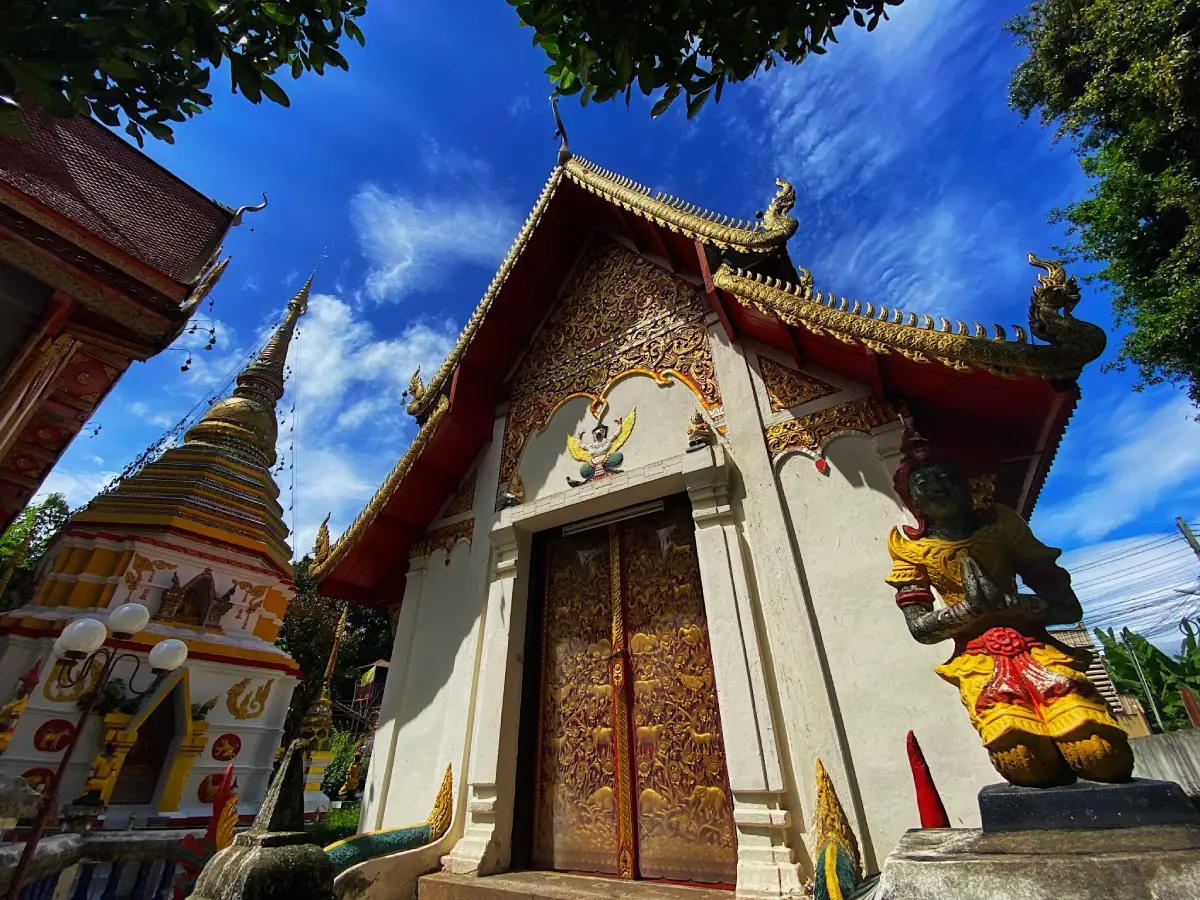
Open Days: Daily
Opening Hours: 08.00 – 17.00
Wat Mueang Kai is an old community Buddhist temple in Wat Ket Subdistrict, Mueang Chiang Mai District, Chiang Mai Province. Located at 37 Rat Uthit Road on the east side of the Ping River, the temple is a Wat Rat under the Maha Nikaya order. It was established in 1802 and later received its Wisungkhamsima boundary in 1916. The temple is important for its role in the Wat Ket and San Pa Khoi neighborhood, its ordination hall, viharn, chedi, principal Buddha image, Buddha statues, scripture hall, and continuing function as a living religious space for the local community.
For travelers who want to experience Chiang Mai beyond the most visited old-city temples, Wat Mueang Kai offers a quieter and more local perspective. The temple stands in an urban community connected with Rat Uthit Road, Charoen Mueang Road, Chiang Mai-Lamphun Road, the railway station area, riverside neighborhoods, old markets, and the east bank of the Ping River. This makes Wat Mueang Kai a useful stop for visitors who want to understand how temples, roads, schools, markets, and neighborhoods form the cultural fabric of Chiang Mai.
The history of Wat Mueang Kai begins in 1802, during the early Rattanakosin period. This was an important era for Chiang Mai and northern Thailand, as communities around the city gradually regained stability after long periods of political change and conflict. In this context, a temple was not simply a religious building. It was a social anchor, a place for merit-making, Buddhist ceremonies, community gatherings, moral instruction, and the continuity of local identity.
Wat Mueang Kai was officially established as a temple in 1802 and received its Wisungkhamsima in 1916. The Wisungkhamsima boundary measures 73 meters wide and 81.5 meters long. In Thai Buddhism, this consecrated boundary is significant because it defines the area for formal monastic acts, including important Sangha ceremonies. This status shows that Wat Mueang Kai has held a recognized religious role in the local Buddhist community for more than a century.
The temple land covers 5 rai, 3 ngan, and 21 square wah. Its northern boundary adjoins Phadungsil School and a public lane, while its southern and eastern sides connect with Rat Uthit Road. The temple also has one plot of monastic land measuring 26 square wah. These boundary details show that Wat Mueang Kai is deeply embedded in a working urban neighborhood. It is surrounded by roads, schools, lanes, homes, and community activity, which gives the temple a strong sense of place.
The location on Rat Uthit Road makes Wat Mueang Kai accessible without the heavy crowds found at many landmark temples. From the old city, visitors can cross the Ping River and continue toward the Wat Ket, San Pa Khoi, Charoen Mueang, or Chiang Mai-Lamphun Road areas. The temple can be combined with local food stops, old market areas, the Ping River, Chiang Mai Railway Station, Warorot Market, Iron Bridge, and Wat Ket Karam, making it suitable for a half-day cultural route.
The temple’s main structures include an ordination hall, five monks’ residences, a viharn, a two-storey multipurpose hall, a merit-making hall, a scripture hall, and a sala bat. These buildings reflect the many roles of a Thai community temple. The ordination hall supports formal monastic ceremonies, the viharn serves as a devotional and teaching space, the monks’ residences support monastic life, and the halls provide space for community merit-making, funerary rites, meetings, and religious activities.
The ordination hall at Wat Mueang Kai is a brick-and-plaster building with a tiered roof and corrugated roof tiles. Its practical construction reflects the character of many community temples that have been maintained and repaired across generations. Rather than presenting itself as a monumental tourist attraction, the ubosot expresses stability and continuity. Visitors should observe its roofline, walls, entrances, decorative details, and relationship with the surrounding temple compound.
The key sacred objects within the temple include the principal Buddha image, other Buddha images, and the temple chedi. The principal Buddha image functions as the devotional center of the temple, while the additional Buddha images reflect the accumulated faith of the community over time. The chedi is an essential Buddhist monument, symbolizing reverence for the Triple Gem and helping define the temple as a complete sacred space.
A visit to Wat Mueang Kai is best approached slowly. Start from the entrance area, then move toward the ordination hall, viharn, chedi, and surrounding halls. The temple’s value does not come from overwhelming scale, but from its role as a working community temple. It is a place still used by monks and local residents, so its atmosphere is calm, practical, and grounded in everyday religious life.
The principal Buddha image and Buddha statues are the main points for respectful worship. Visitors can pay respect, sit quietly, and take a short pause from the traffic and activity of the surrounding city. Because the temple is close to San Pa Khoi, Charoen Mueang Road, and the railway station area, it offers a peaceful contrast to the busy urban environment nearby.
The chedi at Wat Mueang Kai gives the temple an additional architectural and symbolic layer. In northern Thai temples, a chedi often functions as a key focus of devotion and remembrance. When seen together with the ordination hall, viharn, Buddha images, monks’ residences, and community halls, the chedi helps visitors understand the structure of a complete Buddhist temple compound.
The two-storey multipurpose hall and the merit-making hall show how Wat Mueang Kai continues to serve the neighborhood. These spaces support Buddhist ceremonies, community gatherings, funerary rites, and merit-making activities. In Thai society, a temple often accompanies people through many stages of life, from family merit-making to rites of remembrance. Wat Mueang Kai preserves this community role in a compact urban setting.
The scripture hall is also important because it represents the preservation of Buddhist teaching. Even when visitors do not enter or use this space directly, its presence shows that the temple is connected not only with ritual and worship, but also with the safeguarding of the Dhamma. For travelers interested in northern Thai Buddhist culture, this is one of the details that helps explain how a temple supports both devotion and learning.
The sala bat is linked to the daily relationship between monks and laypeople. Giving alms, offering food, supporting monastic life, and participating in Buddhist ceremonies are all part of the relationship between a temple and its community. Wat Mueang Kai is therefore valuable not only as a set of buildings, but also as a place where faith is practiced through daily and seasonal religious activity.
The current abbot of Wat Mueang Kai is Phra Athikan Chanta Charuwanyo, and the temple has five resident monks. This confirms the temple’s continuing life as an active Buddhist institution in Wat Ket Subdistrict. Visitors should remember that Wat Mueang Kai is not a preserved monument separated from local life; it is a working temple where monks live, worshippers come to make merit, and community activity continues.
As a travel destination, Wat Mueang Kai is suitable for visitors interested in Chiang Mai temples, northern Thai Buddhist culture, community temples, and the historic east-bank neighborhoods of the Ping River. It can be visited with Chiang Mai Gymkhana Club, Chiang Mai Foreign Cemetery, Wat Chai Mongkhon, Mae Ping River Cruise, Iron Bridge, Warorot Market, Wat Ket Karam, and the San Pa Khoi food area. This route combines religion, local history, riverside culture, markets, and food in one practical itinerary.
Chiang Mai Gymkhana Club, located nearby, adds another historical layer to the area. Founded in 1898 during the reign of King Rama V, the club is connected with the history of teak traders, diplomats, expatriate communities, and Chiang Mai’s transformation in the late 19th and early 20th centuries. When visited together with Wat Mueang Kai and the Chiang Mai Foreign Cemetery, it helps travelers see how Thai Buddhist communities and international histories exist side by side in this part of the city.
Warorot Market, also known locally as Kad Luang, can be included in the same route. It is one of Chiang Mai’s best-known traditional markets, offering local food, snacks, textiles, everyday goods, and northern Thai products. A route from Wat Mueang Kai to Warorot Market allows travelers to experience the shift from a quiet community temple to a busy old market, then onward to the Ping River and the bridges that connect both sides of the city.
The food scene near Wat Mueang Kai is another reason to explore the area slowly. Wat Ket, San Pa Khoi, Tha Satoi, and Thongkham Market have many local eateries, including northern Thai food, khao soi, kanom jeen, rice dishes, and casual neighborhood restaurants. Visitors can worship at the temple in the morning or late morning, then continue to a nearby local restaurant without leaving the area.
Most visitors can spend around 30 to 60 minutes at Wat Mueang Kai for worship and a careful look at the main temple buildings. Travelers who want a deeper neighborhood route can plan a half-day itinerary starting at Wat Mueang Kai, continuing to Chiang Mai Gymkhana Club or the Foreign Cemetery, then moving on to Wat Chai Mongkhon, Mae Ping River Cruise, Iron Bridge, or Warorot Market. This style of travel suits people who want to understand Chiang Mai through real neighborhoods rather than only major landmarks.
Getting There is straightforward by private car, motorcycle, red songthaew, local transport, or ride-hailing service. From the old city, cross the Ping River via Nawarat Bridge or a nearby bridge, then continue through Charoen Mueang Road, Chiang Mai-Lamphun Road, or Rat Uthit Road. From Chiang Mai Railway Station, the temple is only a short local ride away. Since the temple is located in an active urban neighborhood, visitors should allow time for traffic and parking.
Travelers using public transport can get off near Chiang Mai Railway Station, Charoen Mueang Road, San Pa Khoi Market, Thongkham Market, or Chiang Mai-Lamphun Road, then continue by red songthaew or ride-hailing service. Visitors staying around Night Bazaar, Iron Bridge, Warorot Market, or Wat Ket can include Wat Mueang Kai as a quiet cultural stop during the day.
Temple etiquette is important at Wat Mueang Kai. Visitors should dress modestly, remove shoes before entering sacred areas, keep voices low, avoid touching Buddha images and sacred objects, and respect areas used by monks. During religious ceremonies or community events, visitors should avoid intrusive photography and give space to worshippers and participants.
Photography should be done respectfully. Suitable subjects include the ubosot, viharn, chedi, roof details, decorative elements, and the general atmosphere of the temple compound. Flash photography inside sacred buildings should be avoided, and close photographs of monks or worshippers should not be taken without permission. Respectful behavior helps preserve the quiet dignity of a living community temple.
Wat Mueang Kai is also useful for understanding the structure of a Wat Rat in northern Thailand. The temple’s information clearly records its land area, boundaries, monastic land, religious buildings, sacred objects, and ecclesiastical status. These details help visitors understand how a temple functions as a religious, social, and spatial institution in a city neighborhood.
From a local history perspective, Wat Mueang Kai is part of the east-bank cultural landscape of Chiang Mai. Wat Ket and San Pa Khoi have long been connected with transportation, trade, riverside life, rail access, and residential communities. The temple’s position on Rat Uthit Road, near schools, lanes, and community roads, shows how Buddhist temples grow within the everyday life of the city.
The value of Wat Mueang Kai lies in its status as an old, active, and well-rooted community temple. It was established in 1802, received its Wisungkhamsima in 1916, has a complete set of religious structures, and remains connected with local Buddhist life. It is not a large-scale tourist attraction, but it is a meaningful place for travelers who want to see Chiang Mai through its working neighborhoods.
To appreciate Wat Mueang Kai fully, visitors should begin with the principal Buddha image, then observe the ordination hall, viharn, chedi, halls, scripture hall, and surrounding neighborhood. The temple and the city should be seen together. Roads, schools, markets, homes, and religious spaces all form part of the same urban story. This is what makes Wat Mueang Kai a rewarding stop for cultural travelers.
In summary, Wat Mueang Kai is an old community temple in Mueang Chiang Mai that is suitable for cultural and spiritual travel. Its key points include its establishment in 1802, Wisungkhamsima in 1916, temple land of 5 rai, 3 ngan, and 21 square wah, ordination hall, viharn, monks’ residences, multipurpose hall, merit-making hall, scripture hall, sala bat, principal Buddha image, Buddha images, and chedi. Travelers who want to explore the east side of Chiang Mai through Wat Ket, San Pa Khoi, Thongkham Market, Warorot Market, and the Ping River should include Wat Mueang Kai in their route.
| Name | Wat Mueang Kai |
| Location | Wat Ket Subdistrict, Mueang Chiang Mai District, Chiang Mai Province |
| Address | 37 Rat Uthit Road, Wat Ket Subdistrict, Mueang Chiang Mai District, Chiang Mai 50000, Thailand |
| Coordinates | 18.77436, 99.00816 |
| Type | Wat Rat; Maha Nikaya Buddhist temple |
| Temple Land Area | 5 rai, 3 ngan, and 21 square wah, with one additional monastic land plot of 26 square wah |
| Highlights | Old community temple in Wat Ket, with ubosot, viharn, chedi, principal Buddha image, Buddha images, scripture hall, and a calm urban temple atmosphere |
| History | Established in 1802 and granted Wisungkhamsima in 1916 |
| Wisungkhamsima Boundary | 73 meters wide and 81.5 meters long |
| Distinctive Features | A living community temple in an urban neighborhood, connected with Wat Ket, San Pa Khoi, local roads, markets, and the east bank of the Ping River |
| Main Areas / Zones | Ubosot Five monks’ residences Viharn Two-storey multipurpose hall Merit-making hall Scripture hall Sala bat Chedi |
| Important Sacred Objects | Principal Buddha image, Buddha images, and Wat Mueang Kai chedi |
| Abbot / Caretaker | Phra Athikan Chanta Charuwanyo |
| Resident Monks | 5 monks |
| Travel Information | Accessible by private car, motorcycle, red songthaew, local transport, or ride-hailing service via Charoen Mueang Road, Chiang Mai-Lamphun Road, or Rat Uthit Road, near Wat Ket, San Pa Khoi, and Chiang Mai Railway Station |
| Current Status | Open to visitors and remains an active community temple in Wat Ket Subdistrict, Mueang Chiang Mai District |
| Open Days | Daily |
| Opening Hours | 08.00 – 17.00 |
| Main Contact Number | 053-249-022 |
| Nearby Tourist Attractions | 1. Chiang Mai Gymkhana Club, about 0.7 km 2. Chiang Mai Foreign Cemetery, about 0.9 km 3. Mae Ping River Cruise, about 1.8 km 4. Wat Chai Mongkhon, about 1.8 km 5. Iron Bridge Chiang Mai, about 2.1 km 6. Warorot Market, about 2.7 km 7. Wat Ket Karam, about 3.1 km |
| Nearby Restaurants | 1. Miang Zaap Wat Mueang Kai, about 0.3 km, Tel. 064-534-6454, 062-869-7989 2. Cook With Love Chef’s House Branch, about 0.8 km, Tel. 085-616-3966 3. Khao Soi BusCoffee Tha Satoi, about 1.5 km, Tel. 098-262-7963 4. Kanomjeen San Pa Khoi at Thongkham Market, about 1.7 km, Tel. 061-301-8000 5. Khao Ngiao Khun Yai at Trok Lao Jo, about 1.8 km, Tel. 086-671-6215 6. Aroi Tum Yum Zap Charoen Mueang, about 2.2 km, Tel. 052-002-181, 095-964-4397 |
| Nearby Accommodations | 1. Rimping Village Chiang Mai, about 2.2 km, Tel. 053-243915, 053-243916 2. Puripunn Hideaway, about 2.4 km, Tel. 053-244-567 3. Gategaa Village, about 2.5 km, Tel. 088-894-4777 4. Ketawa Pet Friendly Hotel and Cafe, about 3.2 km, Tel. 09-9191-9426 5. 137 Pillars House Chiang Mai, about 3.5 km, Tel. 053-247-788 |
Frequently Asked Questions (FAQ)
Q: Where is Wat Mueang Kai located?
A: Wat Mueang Kai is located at 37 Rat Uthit Road, Wat Ket Subdistrict, Mueang Chiang Mai District, Chiang Mai Province, near Wat Ket, San Pa Khoi, and Chiang Mai Railway Station.
Q: What are the opening days and hours of Wat Mueang Kai?
A: Wat Mueang Kai is open daily from 08.00 to 17.00.
Q: Why is Wat Mueang Kai historically important?
A: Wat Mueang Kai was established in 1802 and received its Wisungkhamsima in 1916, making it an old recognized Buddhist temple in Chiang Mai’s east-bank community area.
Q: What can visitors see inside Wat Mueang Kai?
A: Visitors can see the ubosot, viharn, monks’ residences, multipurpose hall, merit-making hall, scripture hall, sala bat, principal Buddha image, Buddha images, and the temple chedi.
Q: Who is the abbot of Wat Mueang Kai?
A: The abbot of Wat Mueang Kai is Phra Athikan Chanta Charuwanyo.
Q: How can travelers get to Wat Mueang Kai?
A: Travelers can reach the temple by private car, motorcycle, red songthaew, local transport, or ride-hailing service via Charoen Mueang Road, Chiang Mai-Lamphun Road, or Rat Uthit Road.
Q: What nearby attractions can be visited with Wat Mueang Kai?
A: Nearby places include Chiang Mai Gymkhana Club, Chiang Mai Foreign Cemetery, Mae Ping River Cruise, Wat Chai Mongkhon, Iron Bridge, Warorot Market, and Wat Ket Karam.
Q: What should visitors keep in mind when visiting Wat Mueang Kai?
A: Visitors should dress modestly, remove shoes before entering sacred areas, keep quiet, avoid touching Buddha images or sacred objects, and respect monks and local worshippers.
 Category: ●Places of Worship
 Group: ●Temple
Last Update : 2 MonthAgo
 Last Update : 2 MonthAgo
 Click to Access the Navigation Map GPS
Wat Mueang Kai Map
Recommend

 Muang Chiang Mai(121)Chom Thong(47)Mae Chaem(25)Chiang Dao(33)Doi Saket(68)Mae Taeng(85)Mae Rim(69)Samoeng(29)Fang(71)Mae Ai(59)Phrao(70)San Pa Tong(103)San Kamphaeng(66)San Sai(73)Hang Dong(73)Hot(32)Doi Tao(22)Omkoi(11)Saraphi(74)Wiang Haeng(15)Chai Prakan(28)Mae Wang(32)Mae On(22)Doi Lo(33)Galyani Vadhana(1)


