
lovethailand home >North Travel Attractions >Chiang Mai Travel Attractions >Muang Chiang Mai >Phra Sing > Wat Pha Khao
TL;DR: Wat Pha Khao is located at Phra Sing Subdistrict, Mueang Chiang Mai District, Chiang Mai Province, open Daily.
Wat Pha Khao
Open Days: Daily
General Visiting Hours: 08.00 – 17.00
Wat Pha Khao is an old Buddhist temple in Chiang Mai’s historic old city area. It is located at 36 Ratchamankha Road, Phra Sing Subdistrict, Mueang Chiang Mai District, Chiang Mai Province, close to the old city moat, Loi Kroh Road, Tha Phae Gate, Wat Chedi Luang, Wat Phan Tao, and the eastern walking routes of the old city. Although the temple is compact and quiet, it carries a deep cultural story through its name, its legends, its viharn, its stupa, its white-robed figure, and its historical inscription connected with a Buddha image inside the temple.
Wat Pha Khao is suitable for visitors who want a peaceful temple stop within Chiang Mai’s old city without spending a long time traveling. From the temple, it is easy to walk east toward the moat, continue toward Loi Kroh Road, or connect with the Night Bazaar area. Its location on Ratchamankha Road also makes it convenient for a walking route that includes Tha Phae Gate, Wat Chedi Luang, Wat Phan Tao, Wat Chang Taem, cafés, restaurants, and small boutique accommodation around the old city.
The value of Wat Pha Khao comes from its long history. Local temple records and Chiang Mai historical sources suggest that the temple may be around 600 years old. The exact date of its foundation is not clearly recorded, but the temple is believed to have existed before the period associated with Pho Chao Maha Chiwit, the son of Pho Chao Chiwit Ao. The temple was abandoned for a long time before being restored and returned to active Buddhist use. This history reflects a common pattern in Chiang Mai, where many temples passed through periods of abandonment, repair, revival, and renewed community worship.
The original site of Wat Pha Khao was once a dense and overgrown area with ruined remains of an ordination hall, viharn, pavilions, and other religious structures. Later restoration brought the temple back into use as a place where monks could reside and where worshippers could make merit. This gives Wat Pha Khao special meaning as a revived temple. Visitors should see not only the buildings that stand today, but also the deeper story of an older sacred site that was repaired and preserved by later generations.
One major legend explains the origin of the name Wat Pha Khao. The temple area was once a khuang, or open community ground, used for public gatherings, processions, and ceremonial preparations. According to the story, a royal son of the ruler of Nopburi Si Nakhon Ping Chiang Mai was preparing to ascend the throne. A procession was arranged at this site, and everyone taking part wore white clothing. The prince also dressed completely in white. When a large number of people gathered in white dress, the area appeared to be covered in white cloth. The people called out in recognition of that sight, and the name Wat Pha Khao, or “White Cloth Temple,” became attached to the place.
This coronation-procession legend makes Wat Pha Khao meaningful beyond its role as a neighborhood temple. It suggests that the site was once connected with city-level ritual movement and royal ceremony. The procession is said to have moved northward from this area toward Wat Chiang Man for the coronation rite. The story helps visitors understand Wat Pha Khao as part of Chiang Mai’s older ceremonial landscape, where temple spaces, open grounds, processions, royal symbolism, and auspicious color were closely connected.
Another tradition links Wat Pha Khao with the story of Wat Suan Dok during the reign of King Kue Na. When the king invited Phra Sumanathera from Sukhothai, two white-robed lay religious figures named Chi Pa Khao Ngoen and Chi Pa Khao Thong were involved in the mission. After the invitation succeeded, the king rewarded them with wealth. They then used what they received to build two temples known as Wat Pha Khao Noi and Wat Pha Khao Yai. Only the present Wat Pha Khao remains today, while the other temple no longer survives as a visible temple site.
The presence of more than one origin story gives Wat Pha Khao strong cultural depth. One legend connects the name with people dressed in white during a royal procession. Another connects it with white-robed religious figures and merit-making associated with the spread of Buddhism in Chiang Mai. Both traditions share the same symbolic core: whiteness, purity, auspiciousness, and devotion. The temple name is therefore not a simple label but a meaningful cultural memory.
Wat Pha Khao stands in Phra Sing Subdistrict, one of the most important areas within Chiang Mai’s old city. Ratchamankha Road links many temples, restaurants, small guesthouses, and walking routes. From Wat Pha Khao, visitors can quickly reach the old city moat to the east, Loi Kroh Road, Tha Phae Gate, Wat Chedi Luang, Wat Phan Tao, and Wat Chang Taem. This makes the temple highly useful for travelers planning a walkable old-city itinerary.
The main areas inside Wat Pha Khao include the viharn, stupa, ordination hall, pavilions or religious activity spaces, the white-robed figure, and worship areas. The viharn is an important focus of the temple. It is recorded as measuring about 20 sok wide, 28 sok long, and about 25 sok high. Inside the viharn are many Buddha images of different sizes. This space functions as the spiritual center of the temple, where visitors can pay respect and experience the quiet devotional atmosphere of a local Chiang Mai temple.
The Buddha images inside the viharn are especially important because Wat Pha Khao is connected with a recorded inscription at the base of a Buddha image. The Thai inscription database lists the Wat Pha Khao Buddha image base inscription, written in the Lanna Dhamma script with Thai and Pali content. The inscription is on the base of a Buddha image in the Mara-vijaya posture and is dated to 2016 B.E., during the reign period of King Tilokaraj of the Mangrai Dynasty. This gives the temple significant documentary and art-historical value.
The inscription contains a concise reference to the Four Noble Truths in Pali and includes a date that helps establish the age of the object. This is important because Wat Pha Khao is not supported only by legend or local memory. It also preserves physical evidence connected with Buddhist art, Lanna script, and religious dedication. For travelers interested in history, the temple should therefore be understood as a small but meaningful site within Chiang Mai’s Buddhist heritage.
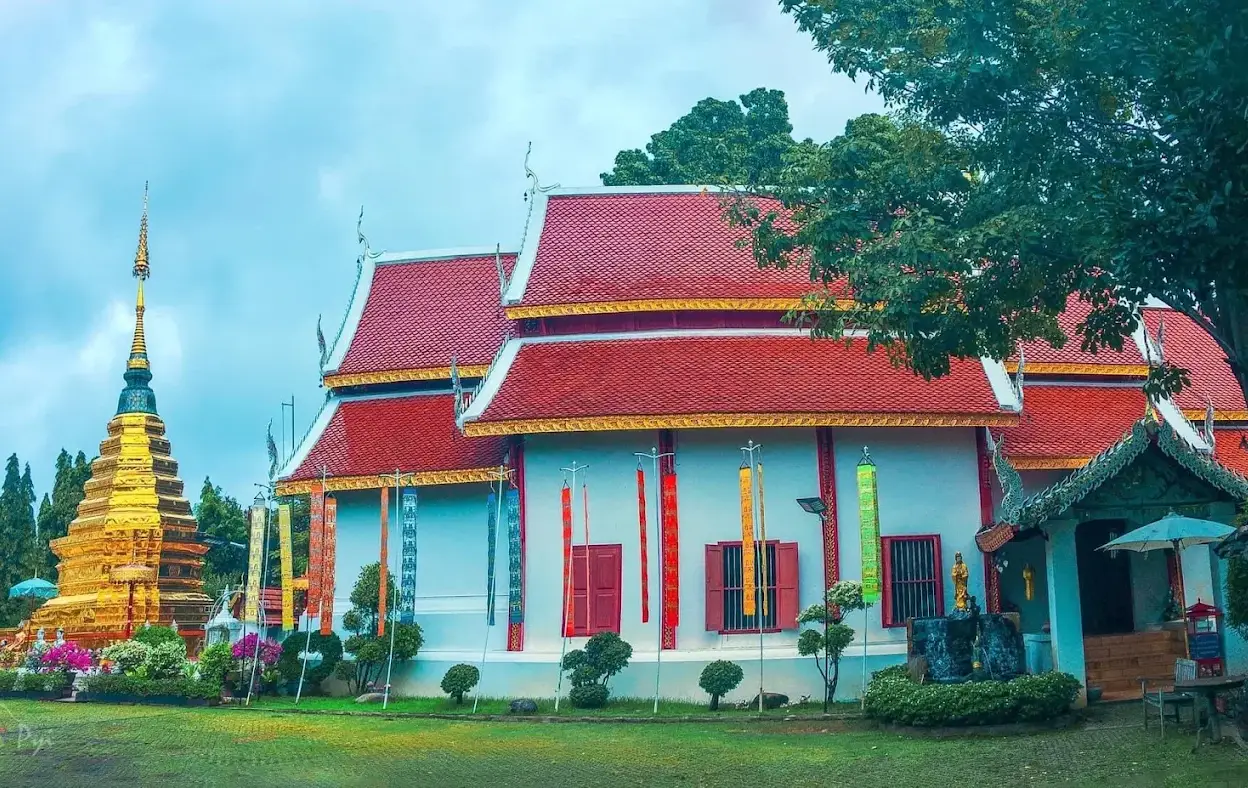
The stupa is another important feature. It is a brick-and-plaster stupa with a square base and is about 25 sok high. Its form is described as being modeled after Wat Phra That Doi Suthep, the sacred mountain temple that is one of Chiang Mai’s most important religious symbols. The presence of a Doi Suthep-inspired stupa in a small old-city temple shows how local devotion can connect a neighborhood monastery with a major sacred landmark of the wider Lanna religious landscape.
Wat Pha Khao also has a white-robed figure near the southern wall of the viharn. This figure is meaningful because it connects the visible temple space with the legends of Chi Pa Khao Ngoen and Chi Pa Khao Thong. For visitors, the figure works as a cultural marker. It reminds them that the story of the temple is tied not only to monks and buildings, but also to lay religious figures, public ritual, and acts of merit-making.
Another local feature is the suea wat, a small protective shrine-like structure on the northern side near the temple wall. In local Lanna belief, this element is associated with protecting the temple space. Such features show how Buddhist practice and local guardian beliefs often coexist in northern Thai temple compounds. Wat Pha Khao therefore contains both formal Buddhist architecture and local protective symbolism within a compact temple setting.
Wat Pha Khao remains open to worshippers and visitors today. It appears in current tourism and map databases and is listed as a temple attraction within Chiang Mai’s old city. Published visitor information commonly gives daily opening and general visiting hours from 08.00 to 17.00. Some travel listings show longer hours, but the 08.00 to 17.00 period is a suitable and practical visiting window for travelers who want to visit respectfully during normal daytime temple hours.
Older local sources identify Phra Khru Mongkhon Rattanophat, also known as Phra Ajahn Inkaeo Aphaso, as an important abbot in the temple’s modern history. He was associated with repair and development work, including restoring damaged structures, building a water tank, strengthening the temple wall, and improving needed temple facilities. Because current abbot information from recent official sources is not consistently available, the temple’s older abbot record is best understood as part of its historical development rather than presented as a current administrative listing.
The charm of Wat Pha Khao lies in its calm, compact character. It is not as crowded as Chiang Mai’s best-known landmark temples, yet it offers a strong sense of place. Visitors can observe the temple sign, entrance area, viharn, stupa, white-robed figure, and courtyard without feeling rushed. For many travelers, the temple works well as a quiet pause between the busy areas of Tha Phae Gate, Loi Kroh Road, the Sunday Walking Street route, and the Night Bazaar.
For photography, Wat Pha Khao offers several attractive details: the red-and-gold temple sign, the viharn set within a small garden atmosphere, Lanna-style roof elements, the stupa, the white-robed figure, and the calm courtyard. Photography should be done respectfully. Visitors should avoid disturbing worshippers, blocking entrances, using loud voices, or taking intrusive photos during religious activity.
Getting There is very convenient. From Tha Phae Gate, visitors can walk into Ratchamankha Road. From Wat Chedi Luang or Prapokklao Road, the temple can be reached by walking through the old city lanes. Travelers staying near Loi Kroh Road, the Night Bazaar, Tha Phae, or the eastern side of the old city can easily walk to Wat Pha Khao or use a red songthaew, tuk-tuk, motorcycle taxi, or private car.
Visitors driving to Wat Pha Khao should plan carefully because the temple is in the old city, where roads can be narrow and parking is limited. Parking may be more difficult in the evening, on weekends, and on Sundays when the old city becomes busy with walking street activity. Walking from a nearby hotel or using local transport is often the easiest way to visit the temple and continue to nearby attractions.
Wat Pha Khao can be included in several walking routes. A temple route can connect it with Wat Chedi Luang, Wat Phan Tao, Wat Chang Taem, Wat Chet Lin, Wat Muen Larn, and Wat Inthakhin Sadue Mueang. A city walk can begin at Tha Phae Gate, continue along Ratchamankha Road, stop at Wat Pha Khao, and then continue to Wat Chedi Luang or the Sunday Walking Street area. For an evening route, visitors can connect the temple area with Loi Kroh Road and the Night Bazaar after visiting during daytime hours.
The best time to visit Wat Pha Khao is in the morning or late afternoon. The weather is usually more comfortable, and the atmosphere is better for quiet worship and observation. Visitors who want to continue to Tha Phae Gate, Wat Chedi Luang, or nearby cafés can easily arrange a short walking route around the temple.
Visitors should follow normal Thai temple etiquette. Dress modestly, speak quietly, remove shoes before entering designated sacred spaces, do not touch Buddha images or old objects without permission, and avoid entering restricted or restoration areas. Since Wat Pha Khao is a functioning Buddhist temple, respectful behavior helps preserve the calm atmosphere for monks, worshippers, local residents, and travelers.
Wat Pha Khao is a strong example of a small Chiang Mai temple with a deep story. It brings together local legend, royal ceremonial memory, the symbolism of white clothing, the story of white-robed religious figures, a viharn, a Doi Suthep-inspired stupa, a protective local shrine element, and an important Buddha image base inscription dated to 2016 B.E. A visit does not need to be long, but it becomes much more meaningful when travelers understand these layers.
In summary, Wat Pha Khao is a worthwhile stop for visitors interested in old Chiang Mai temples, Ratchamankha Road, temple legends, Lanna Buddhist history, and quiet cultural walks inside the old city. Located at 36 Ratchamankha Road in Phra Sing Subdistrict, the temple is close to Tha Phae Gate, the old city moat, Loi Kroh Road, Wat Chedi Luang, and many restaurants and accommodations. Its main value lies in its name, legends, viharn, stupa, white-robed figure, and inscription evidence. For travelers seeking a quieter and more detailed side of Chiang Mai, Wat Pha Khao is a meaningful place to include in an old-city route.
| Name | Wat Pha Khao |
| Temple Type | Local Buddhist temple in Chiang Mai’s old city area |
| Location | Phra Sing Subdistrict, Mueang Chiang Mai District, Chiang Mai Province |
| Address | 36 Ratchamankha Road, Phra Sing Subdistrict, Mueang Chiang Mai District, Chiang Mai Province 50200 |
| Coordinates | Latitude 18.78568, Longitude 98.99140 |
| Highlights | Old Chiang Mai temple, White Cloth Temple legend, viharn, Doi Suthep-inspired stupa, white-robed figure, protective local shrine element, and Wat Pha Khao Buddha image base inscription |
| History | An old temple believed to be around 600 years old; it was once abandoned before being restored and returned to active Buddhist use |
| Name Origin | The name is linked with a legend of a white-clothed royal procession and another tradition involving Chi Pa Khao Ngoen and Chi Pa Khao Thong, white-robed religious figures connected with temple building |
| Distinctive Features | A compact and peaceful temple on Ratchamankha Road, easily connected with the old city moat, Loi Kroh Road, Tha Phae Gate, and the Night Bazaar area |
| Important Sacred Objects / Areas | Viharn, Buddha images inside the viharn, stupa, ordination hall, white-robed figure, protective local shrine element, courtyard, and worship areas |
| Key Evidence | Wat Pha Khao Buddha image base inscription in Lanna Dhamma script with Thai and Pali content, dated to 2016 B.E. during the period of King Tilokaraj |
| Stupa | Brick-and-plaster stupa with a square base, about 25 sok high, described as being modeled after Wat Phra That Doi Suthep |
| Travel Information | Accessible from Tha Phae Gate, Ratchamankha Road, Loi Kroh Road, Wat Chedi Luang, and the Night Bazaar area by walking, red songthaew, tuk-tuk, motorcycle taxi, or private car |
| Current Status | Open to worshippers and visitors; it remains a listed old-city temple attraction in Chiang Mai |
| Open Days | Daily |
| General Visiting Hours | 08.00 – 17.00 |
| Facilities | Viharn, worship areas, temple courtyard, pavilion or religious activity area, and limited parking depending on old-city conditions |
| Main Areas / Zones | Entrance area, viharn, stupa, ordination hall, white-robed figure, protective local shrine element, temple courtyard, and worship areas |
| Nearby Tourist Attractions | 1. Tha Phae Gate, about 0.3 km 2. Wat Muen Larn, about 0.3 km 3. Wat Chedi Luang, about 0.5 km 4. Wat Phan Tao, about 0.5 km 5. Wat Chang Taem, about 0.6 km 6. Sunday Walking Street, about 0.6 km 7. Loi Kroh Road, about 0.6 km 8. Wat Inthakhin Sadue Mueang, about 0.8 km |
| Nearby Restaurants | 1. Tiny Coffee, about 0 km, Tel. 063-446-4823 2. Kat's Kitchen, about 0.2 km 3. Poppy's Kitchen, about 0.3 km, Tel. 084-043-3144 4. Bodhi Tree Cafe, about 0.3 km, Tel. 085-708-4998 5. Taste From Heaven, about 0.4 km, Tel. 089-951-1167 6. Mr. Kai Restaurant, about 0.4 km 7. Dash Teak House, about 0.7 km, Tel. 053-279-230 |
| Nearby Accommodations | 1. La Maison Verte Hostel, about 0.1 km, Tel. 099-395-5228 2. Somwang Boutique Hotel, about 0.1 km, Tel. 094-630-0007 3. The Chimes Chiangmai Old City, about 0.1 km, Tel. 085-623-4554 4. Bodhi Serene Chiang Mai, about 0.2 km, Tel. 053-903-900 5. Makka Hotel, about 0.4 km, Tel. 053-281-636 6. Tamarind Village Chiang Mai, about 0.5 km, Tel. 053-418-896 |
Frequently Asked Questions (FAQ)
Q: Where is Wat Pha Khao located?
A: Wat Pha Khao is located at 36 Ratchamankha Road, Phra Sing Subdistrict, Mueang Chiang Mai District, Chiang Mai Province, close to the old city moat, Tha Phae Gate, Loi Kroh Road, and Wat Chedi Luang.
Q: Is Wat Pha Khao open daily?
A: Wat Pha Khao is open daily. The general visiting period is 08.00 to 17.00, which is suitable for worship and quiet observation.
Q: What is the origin of the name Wat Pha Khao?
A: The name is linked with a legend of a royal procession in which people wore white clothing until the area appeared covered in white cloth. Another tradition connects the temple with Chi Pa Khao Ngoen and Chi Pa Khao Thong.
Q: How old is Wat Pha Khao?
A: Wat Pha Khao is believed to be around 600 years old. It was once abandoned and later restored into an active Buddhist temple.
Q: What are the important features inside Wat Pha Khao?
A: Important features include the viharn, Buddha images inside the viharn, stupa, ordination hall, white-robed figure, protective local shrine element, courtyard, and Wat Pha Khao Buddha image base inscription.
Q: Why is the Buddha image base inscription important?
A: The inscription is written in Lanna Dhamma script with Thai and Pali content and is dated to 2016 B.E. during the period of King Tilokaraj. It is an important piece of Buddhist and Lanna historical evidence.
Q: How can visitors get to Wat Pha Khao?
A: Visitors can reach the temple from Tha Phae Gate, Ratchamankha Road, Loi Kroh Road, Wat Chedi Luang, or the Night Bazaar area by walking, red songthaew, tuk-tuk, motorcycle taxi, or private car. Parking in the old city can be limited.
Q: What nearby places can be included in the same route?
A: Nearby places include Tha Phae Gate, Wat Muen Larn, Wat Chedi Luang, Wat Phan Tao, Wat Chang Taem, Sunday Walking Street, Loi Kroh Road, and Wat Inthakhin Sadue Mueang.
 Category: ●Places of Worship
 Group: ●Temple
Last Update : 2 WeekAgo
 Last Update : 2 WeekAgo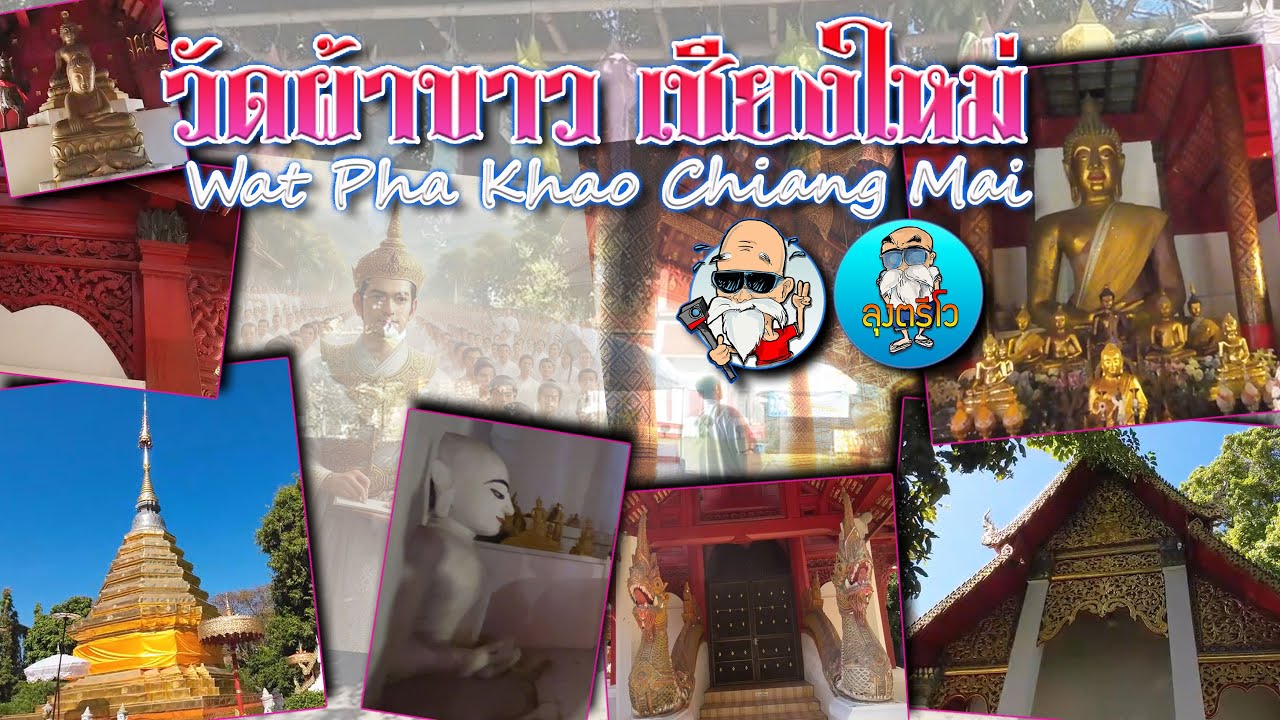
 Click to Access the Navigation Map GPS
Wat Pha Khao Map
Recommend

 Muang Chiang Mai(121)Chom Thong(47)Mae Chaem(25)Chiang Dao(33)Doi Saket(68)Mae Taeng(85)Mae Rim(69)Samoeng(29)Fang(71)Mae Ai(59)Phrao(70)San Pa Tong(103)San Kamphaeng(66)San Sai(73)Hang Dong(73)Hot(32)Doi Tao(22)Omkoi(11)Saraphi(74)Wiang Haeng(15)Chai Prakan(28)Mae Wang(32)Mae On(22)Doi Lo(34)Galyani Vadhana(1)


