
lovethailand home >North Travel Attractions >Chiang Mai Travel Attractions >Muang Chiang Mai >Phra Sing > Wat Sai Moon Myanmar
TL;DR: Wat Sai Moon Myanmar is located at Phra Sing Subdistrict, Mueang Chiang Mai District, Chiang Mai Province, open Daily.

Wat Sai Moon Myanmar
Open Days: Daily
General Visiting Hours: 08.00 – 17.00
Wat Sai Moon Myanmar, also known as Wat Sai Moon Maan, is an old Buddhist temple in Chiang Mai’s old city area. It is located at 103 Bumrung Buri Road, Phra Sing Subdistrict, Mueang Chiang Mai District, Chiang Mai Province, close to Chaeng Ka Tam, Wat Sai Moon Muang, Chiang Mai Gate, and the southeastern corner of the old city moat. The temple is a local Buddhist monastery under the Mahanikaya order and is especially important because it preserves a strong Myanmar identity through its architecture, Buddhist art, golden stupas, Myanmar-style religious buildings, Buddha images, murals, and its continuing role as a spiritual center for the Myanmar community in Chiang Mai.
Wat Sai Moon Myanmar gives visitors a different view of Chiang Mai from the better-known Lanna temples. The temple does not represent only northern Thai Buddhist art. It also shows the historical relationship between Chiang Mai, Myanmar, Mon communities, migrant communities, monks, craftsmen, and families who have lived in the city across different periods. Visitors can observe a distinct architectural language in the temple’s gate, gilded stupas, glass decoration, Buddha images, murals, and community atmosphere.
The name “Sai Moon” is connected with the geography of Chiang Mai’s old city. The southeastern corner of the moat is an area where water flowed out of the old city system, carrying and depositing sand. This explains the name connected with accumulated sand. In this area, two temples share related names: Wat Sai Moon Muang and Wat Sai Moon Myanmar. Their close location and different identities make the Chaeng Ka Tam and Bumrung Buri area an important place for understanding Chiang Mai through temple names, water systems, settlement, and community history.
The word “Maan” in Wat Sai Moon Maan is a northern Thai term historically used to refer to Myanmar or Burmese people. The temple name therefore identifies its cultural identity directly. Wat Sai Moon Myanmar is a Myanmar Buddhist temple within Chiang Mai’s historic urban area, and it has preserved this identity for generations. A visit to the temple is not only a religious stop. It is also a way to observe how Myanmar Buddhist culture has existed within Chiang Mai through monks, worshippers, craftsmen, migrant families, language activities, and community rituals.
The historical foundation of Wat Sai Moon Myanmar is connected with the period when Chiang Mai had deep political and cultural ties with Myanmar. The temple is recorded as having been established in 2101 B.E., a date associated with the period when Chiang Mai entered the wider Myanmar historical sphere. Later accounts connect the temple’s development with a Myanmar military figure known as Cham Sang or Thap Chai Sangram Cha Ban, who was associated with the Myanmar military presence in Lanna. Over time, Myanmar and Mon Buddhist devotees, together with their descendants in Chiang Mai, continued to support and maintain the temple.
The special value of Wat Sai Moon Myanmar lies in the way it preserves Myanmar Buddhist traditions in Chiang Mai. Many Myanmar-related religious sites in the city changed or lost their original role over time, but Wat Sai Moon Myanmar remains one of the clearest places where Myanmar identity can still be seen. This appears in the bilingual visual culture around the temple, the red and gold entrance gate, the viharn, the monks’ residence, the stupas, and the forms of the Buddha images. The temple is therefore an important destination for anyone interested in Myanmar culture within northern Thailand.
Historically, Wat Sai Moon Myanmar is not defined only by its early foundation. It also contains several layers of later restoration and reconstruction. The viharn was significantly restored in the early 20th century as a brick-and-plaster structure in Myanmar style. Other parts of the temple, including the stupas and monastic buildings, were also developed through the devotion of monks and Myanmar worshippers. This continuity shows that the temple is not a static historic site. It is a living monastery that has adapted to Chiang Mai’s changing urban and social environment.
The first striking feature is the temple’s entrance gate. Its Myanmar-style form, red and gold color scheme, and ornate decorative details immediately distinguish Wat Sai Moon Myanmar from many Lanna temples in Chiang Mai. Passing through the gate feels like crossing into a distinct cultural space within the old city. The courtyard and buildings inside are compact, but they present a clear and memorable Myanmar Buddhist atmosphere.
The viharn is a simple brick-and-plaster building with a two-tiered roof. Its design is not monumental, but it has a strong identity through its proportions, colors, and interior arrangement. Inside the viharn, the principal Buddha image is a Myanmar-style Buddha image in the Mara-vijaya posture. Its facial features, decoration, and devotional atmosphere differ from many Lanna-style principal Buddha images found around Chiang Mai, giving the viharn a distinctive artistic character.
The walls inside the viharn contain murals narrating episodes from the life of the Buddha. These paintings are valuable as examples of Myanmar Buddhist visual storytelling in Chiang Mai. They function as religious art, moral instruction, and cultural memory. Visitors should look at the murals slowly, observing the lines, colors, figures, and sequence of Buddhist stories. The paintings help explain why Wat Sai Moon Myanmar feels different from nearby temples in the old city.
The temple also contains old wooden carvings and an old dhammasana, or preaching seat. These objects show that the temple’s artistic value is not limited to large architecture or Buddha images. The dhammasana is important because it is associated with sermons and the teaching of Buddhist doctrine. Wooden carvings reflect devotional craftsmanship and the care invested in smaller ritual objects. Together, they add depth to the temple’s religious and artistic atmosphere.
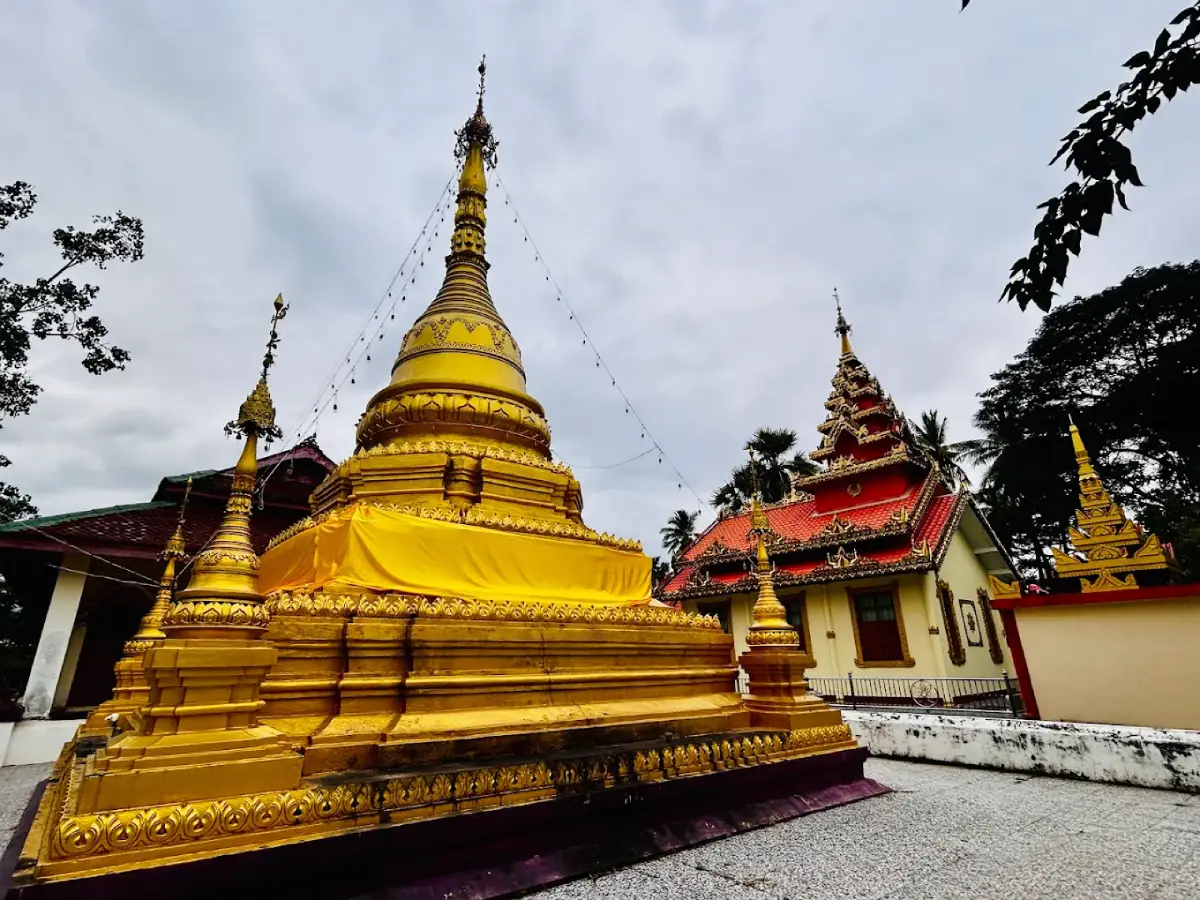
Behind the viharn stand two golden stupas, among the most memorable features of Wat Sai Moon Myanmar. The larger stupa is about 20 meters high and was built in 2387 B.E. Its form is associated with the Shwedagon Pagoda, with layered bases, an inverted-bell body, decorative patterns, and a five-tiered golden umbrella at the top. The smaller stupa is about 9 meters high and was built in 2432 B.E. It shows a Mon-Myanmar artistic form, with an indented octagonal base, an inverted-bell body, and a seven-tiered umbrella.
The two stupas clearly communicate the temple’s Myanmar identity. Their golden surfaces, forms, and decorative details differ from many Lanna stupas in Chiang Mai. The larger Shwedagon-inspired stupa connects the temple visually and spiritually with Myanmar Buddhist culture, while the smaller Mon-Myanmar stupa shows another layer of artistic influence. Visitors should observe the two stupas together, because they reveal how Myanmar and Mon Buddhist forms were preserved within Chiang Mai’s old city.
Another important sacred object is the white Myanmar jade Buddha image in the First Sermon posture. The image is about 5 feet high and was carved from Myanmar jade by craftsmen from Mandalay. This Buddha image has both religious and artistic importance. The white jade, Mandalay craftsmanship, and First Sermon posture carry strong Buddhist meaning. The First Sermon posture refers to the beginning of the Buddha’s teaching mission, when the Dharma was first proclaimed.
The monks’ residence, or jong-style building, is another key part of the temple’s Myanmar identity. It serves both practical and religious functions. Important monastic buildings at Wat Sai Moon Myanmar contain Myanmar-style Buddha images and glass decoration that gives the interior a bright, shimmering appearance. This use of colored glass creates a devotional atmosphere often associated with Myanmar Buddhist aesthetics. Another building functions as a two-story residence for monks and temple use.
Wat Sai Moon Myanmar is also socially important for the Myanmar community in Chiang Mai. Part of the temple grounds has been used for Myanmar-language learning for children of Myanmar families who were born or raised in Thailand. Since many children use Thai in daily life, learning Myanmar language during school breaks and weekend activities helps them maintain their language, prayers, and cultural identity. This makes the temple not only a place of worship, but also a community learning space.
The Myanmar-language activities at the temple have deep cultural meaning. Children growing up in Thailand may become distant from the language of their parents and grandparents. Through lessons, prayers, and temple-based activities, they reconnect with Myanmar Buddhist culture. Wat Sai Moon Myanmar therefore functions at the same time as a monastery, a community school, a cultural center, and a place of collective memory.
On important Buddhist days, Myanmar residents in Chiang Mai gather at Wat Sai Moon Myanmar to make merit, listen to sermons, chant, offer food, and participate in rituals. The temple is a center for community networks spread across Chiang Mai and nearby areas. On major Buddhist days such as Makha Bucha, Visakha Bucha, Asalha Bucha, Buddhist Lent, and the end of Buddhist Lent, the temple becomes especially active. Community chanting activities also help preserve religious practice and language among Myanmar worshippers.
The rituals and community activities at Wat Sai Moon Myanmar show how Thai and Myanmar cultural life coexist in Chiang Mai. Myanmar worshippers do not use the temple only for Myanmar religious occasions. They also participate in important days in Thai society, including family and community events. This demonstrates how Myanmar Buddhist culture adapts within Thailand while continuing to preserve its own language, rituals, and identity.
The temple is associated with Phra Ajahn Kondañña, who has served as an important Myanmar monastic leader at Wat Sai Moon Myanmar. His role reflects the temple’s continuity as a major Myanmar Buddhist monastery in Chiang Mai. The presence of a Myanmar abbot strengthens the connection between the temple and Myanmar worshippers, helping preserve religious practice, ritual language, and community relationships within the city.
Wat Sai Moon Myanmar remains open to worshippers and visitors. It is a living religious and community site, not an abandoned temple or a place that exists only as a historical reference. Ongoing merit-making, language activities, community gatherings, and care for religious buildings show that the temple continues to function as an important spiritual center for Myanmar residents in Chiang Mai and for travelers interested in Myanmar Buddhist culture.
Getting There is convenient because the temple is located on Bumrung Buri Road near Chaeng Ka Tam and Chiang Mai Gate. From Chiang Mai Gate, visitors can walk along Bumrung Buri Road or the inner Moon Muang Road area to reach the temple. From Wat Chedi Luang or Prapokklao Road, visitors can walk south through the old city toward Chaeng Ka Tam. Travelers staying in the southern old city, Tha Phae area, or Night Bazaar area can reach the temple by walking, red songthaew, tuk-tuk, motorcycle taxi, or private car.
Visitors driving to Wat Sai Moon Myanmar should plan carefully, because the temple is in the old city where roads and parking spaces are limited. Weekends, evenings, and busy periods around Chiang Mai Gate or Wua Lai Walking Street can be especially crowded. Walking or using local transport is often easier. Morning and late afternoon are good times to visit because the weather is more comfortable and the temple atmosphere is suitable for quiet observation.
Wat Sai Moon Myanmar can be included in a cultural route around Chaeng Ka Tam. Visitors can combine it with Wat Sai Moon Muang, Wat Mueang Mang, Wat Puak Chang, Chaeng Ka Tam, Chiang Mai Gate, Chiang Mai Gate Market, Wua Lai Walking Street, and Wat Chedi Luang. This route gives travelers a compact but layered experience of Myanmar Buddhist culture, Lanna temples, old neighborhoods, local markets, and the southern moat area of Chiang Mai.
For travelers interested in art history, Wat Sai Moon Myanmar can also be compared with other Myanmar-related temples in Chiang Mai, such as Wat Pa Pao, Wat Mahawan, and Wat Saen Fang. Seeing these temples together helps visitors understand that Chiang Mai is not only a Lanna city. It also contains visible Myanmar, Mon, Shan, and other cultural layers within its religious landscape.
Visitors should observe proper temple etiquette. Dress modestly, speak quietly, remove shoes before entering designated sacred areas, do not disturb monks or worshippers, and take photos respectfully. If language classes, community activities, or religious ceremonies are taking place, visitors should give priority to participants and respect the temple’s Myanmar Buddhist customs.
In summary, Wat Sai Moon Myanmar is a culturally important temple in Chiang Mai. It brings together the history of Chiang Mai’s relationship with Myanmar, a temple name connected with the old city’s water and sand landscape, Myanmar Buddhist architecture, two golden stupas, a white jade Buddha image carved by Mandalay craftsmen, murals, community language education, and the temple’s role as a spiritual center for Myanmar residents in Chiang Mai. For travelers who want to understand Chiang Mai as a multicultural northern city, Wat Sai Moon Myanmar is a meaningful stop.
| Name | Wat Sai Moon Myanmar |
| Other / Former Names | Wat Sai Moon Maan, Wat Mun Maan |
| Temple Type | Local Buddhist temple under the Mahanikaya order |
| Location | Phra Sing Subdistrict, Mueang Chiang Mai District, Chiang Mai Province |
| Address | 103 Bumrung Buri Road, Phra Sing Subdistrict, Mueang Chiang Mai District, Chiang Mai Province 50200 |
| Coordinates | Latitude 18.78216, Longitude 98.99123 |
| Highlights | Myanmar temple in Chiang Mai’s old city, red-and-gold entrance gate, Myanmar-style viharn, two golden stupas, white Myanmar jade Buddha image, and its role as a spiritual center for Myanmar residents in Chiang Mai |
| History | Established in 2101 B.E., with several later restorations and developments of the viharn, monastic buildings, and stupas that preserve Myanmar Buddhist art in Chiang Mai |
| Name Origin | “Sai Moon” refers to sand accumulation around the old moat area, while “Maan” is a northern Thai term associated with Myanmar people, reflecting the temple’s Myanmar identity |
| Key Founder / Patron Figure | Cham Sang, also referred to as Thap Chai Sangram Cha Ban, together with Myanmar Buddhist devotees who continued to support the temple |
| Distinctive Features | Strong Myanmar Buddhist architectural and artistic identity, including the entrance gate, viharn, golden stupas, glass decoration, and Myanmar-style Buddha images |
| Important Sacred Objects | Viharn, Myanmar-style principal Buddha image, Buddhist murals, old dhammasana, wooden carvings, two golden stupas, jong-style monastic building, and white Myanmar jade Buddha image |
| Stupas | Two golden stupas: the larger stupa is about 20 meters high and was built in 2387 B.E. with Shwedagon-inspired features; the smaller stupa is about 9 meters high and was built in 2432 B.E. in a Mon-Myanmar style |
| Important Buddha Images | Myanmar-style principal Buddha image in the viharn, Myanmar-style Buddha images in the monastic building, and a white Myanmar jade Buddha image in the First Sermon posture, about 5 feet high, carved by Mandalay craftsmen |
| Community Role | A spiritual, cultural, and language-learning center for Myanmar residents and families in Chiang Mai |
| Related Traditions / Activities | Buddhist merit-making days, chanting, Myanmar community activities, Myanmar-language learning for children, and family/community religious gatherings |
| Travel Information | Accessible from Chiang Mai Gate, Chaeng Ka Tam, Wat Sai Moon Muang, Moon Muang Road, and Bumrung Buri Road by walking, red songthaew, tuk-tuk, motorcycle taxi, or private car |
| Current Status | Open to worshippers and visitors; it remains an active religious and community temple |
| Open Days | Daily |
| General Visiting Hours | 08.00 – 17.00 |
| Abbot / Caretaker | Phra Ajahn Kondañña |
| Facilities | Viharn, worship areas, temple courtyard, monks’ quarters, sala or dining area, community activity space, and limited parking depending on old-city conditions |
| Main Areas / Zones | Entrance gate, viharn, two golden stupas, jong-style monastic building, sala area, temple courtyard, language-learning area, and Myanmar community activity areas |
| Nearby Tourist Attractions | 1. Wat Sai Moon Muang, about 0.1 km 2. Chaeng Ka Tam, about 0.2 km 3. Wat Mueang Mang, about 0.2 km 4. Wat Puak Chang, about 0.3 km 5. Chiang Mai Gate, about 0.3 km 6. Chiang Mai Gate Market, about 0.4 km 7. Wua Lai Walking Street, about 0.5 km 8. Wat Chedi Luang, about 0.7 km |
| Nearby Restaurants | 1. Pee Yai Restaurant, about 0.1 km, Tel. 088-232-4074 2. Owen Bistro, about 0.1 km, Tel. 083-322-2052 3. Dash Teak House, about 0.4 km, Tel. 053-279-230, 085-347-7554 4. See You Soon Cafe, about 0.6 km, Tel. 081-880-8380 5. Tien Sieng Vegetarian Restaurant, about 0.7 km, Tel. 053-206-056, 053-281-487 6. Aroon Rai Restaurant, about 0.8 km, Tel. 053-276-947 7. Huen Phen, about 1 km, Tel. 053-814-548 |
| Nearby Accommodations | 1. All In 1 Guesthouse, about 0.2 km, Tel. 053-271-133 2. Villa Lantara Chiang Mai, about 0.3 km, Tel. 053-282-122 3. Kodchasri Thani Heritage Collections, about 0.4 km, Tel. 053-281-950 4. Hotel De Nara, about 0.5 km, Tel. 053-271-224 5. Wealth Boutique Hotel Chiang Mai, about 0.6 km, Tel. 053-903-703 6. The Old City Wall Inn, about 0.8 km, Tel. 096-679-7990 |
Frequently Asked Questions (FAQ)
Q: Where is Wat Sai Moon Myanmar located?
A: Wat Sai Moon Myanmar is located at 103 Bumrung Buri Road, Phra Sing Subdistrict, Mueang Chiang Mai District, Chiang Mai Province, near Chaeng Ka Tam, Wat Sai Moon Muang, Chiang Mai Gate, and the southeastern corner of the old city moat.
Q: Is Wat Sai Moon Myanmar open daily?
A: Wat Sai Moon Myanmar is open daily. The general visiting period from 08.00 to 17.00 is suitable for travelers and worshippers.
Q: What are the former names of Wat Sai Moon Myanmar?
A: The temple is also known as Wat Sai Moon Maan or Wat Mun Maan. “Maan” is a northern Thai term historically associated with Myanmar people.
Q: What are the main highlights of Wat Sai Moon Myanmar?
A: The highlights include Myanmar-style architecture, the red-and-gold entrance gate, Myanmar-style viharn, Buddhist murals, two golden stupas, a white Myanmar jade Buddha image, and the temple’s role as a spiritual center for Myanmar residents in Chiang Mai.
Q: What are the two golden stupas like?
A: The temple has two golden stupas. The larger one is about 20 meters high and was built in 2387 B.E. with Shwedagon-inspired features. The smaller one is about 9 meters high and was built in 2432 B.E. in a Mon-Myanmar style.
Q: How is Wat Sai Moon Myanmar connected with the Myanmar community in Chiang Mai?
A: The temple is a spiritual and cultural center for Myanmar residents in Chiang Mai. It supports merit-making, chanting, community activities, and Myanmar-language learning for children.
Q: How can visitors get to Wat Sai Moon Myanmar?
A: Visitors can reach the temple from Chiang Mai Gate, Chaeng Ka Tam, Moon Muang Road, or Bumrung Buri Road by walking, red songthaew, tuk-tuk, motorcycle taxi, or private car. Parking in the old city can be limited.
Q: What nearby places can be included in the same route?
A: Nearby places include Wat Sai Moon Muang, Chaeng Ka Tam, Wat Mueang Mang, Wat Puak Chang, Chiang Mai Gate, Chiang Mai Gate Market, Wua Lai Walking Street, and Wat Chedi Luang.
 Category: ●Places of Worship
 Group: ●Temple
Last Update : 5 DayAgo
 Last Update : 5 DayAgo
 Click to Access the Navigation Map GPS
Wat Sai Moon Myanmar Map
Recommend

 Muang Chiang Mai(121)Chom Thong(47)Mae Chaem(25)Chiang Dao(33)Doi Saket(68)Mae Taeng(85)Mae Rim(69)Samoeng(29)Fang(71)Mae Ai(62)Phrao(70)San Pa Tong(105)San Kamphaeng(66)San Sai(73)Hang Dong(74)Hot(32)Doi Tao(22)Omkoi(11)Saraphi(74)Wiang Haeng(15)Chai Prakan(28)Mae Wang(32)Mae On(22)Doi Lo(34)Galyani Vadhana(1)


