
lovethailand home >North Travel Attractions >Chiang Mai Travel Attractions >Muang Chiang Mai >Hai Ya > Wat Puak Chang
TL;DR: Wat Puak Chang is located at Sridonchai Road, Hai Ya Subdistrict, Mueang Chiang Mai District, Chiang Mai Province, open Daily, hours 08.00 – 17.00.

Wat Puak Chang
Open Days: Daily
Opening Hours: 08.00 – 17.00
Wat Puak Chang is an old Buddhist temple in Chiang Mai, located around Sridonchai Road in Hai Ya Subdistrict, Mueang Chiang Mai District, Chiang Mai Province. It stands near Chaeng Ka Tam and the southeastern edge of Chiang Mai’s old city moat. Although the temple is modest in size, it carries strong historical and cultural value through its Lanna-style viharn, detailed murals, distinctive sala bat, Phra Chao Than Chai Buddha image, Ganesha statue, and its name, which preserves the memory of elephant keepers or an elephant-related community in old Chiang Mai.
The main appeal of Wat Puak Chang is its quiet local atmosphere. It is not as crowded as Chiang Mai’s major landmark temples, yet it offers meaningful details for travelers who enjoy Lanna architecture, local history, and living Buddhist culture. Visitors can pay respect to the principal Buddha image inside the viharn, observe Buddhist murals, visit the sala bat, and explore the temple’s relationship with the old communities around Sridonchai Road, Hai Ya, Wua Lai, and Chiang Mai Gate.
According to the temple’s history, Wat Puak Chang was founded in 2040 B.E. during the reign of King Mueang Kaeo of the Mangrai Dynasty. This period was important for Lanna Buddhism and Chiang Mai’s urban development. The temple’s location outside the old city wall, close to the southeastern corner of the moat, reflects the growth of religious and residential communities around the historic city. Wat Puak Chang should therefore be understood not only as a place of worship, but also as part of the older urban landscape of Chiang Mai.
Chiang Mai passed through many political and cultural phases, including the Mangrai period, the era of Burmese influence in Lanna, and the Rattanakosin period. Wat Puak Chang continued to be maintained through these changes. This continuity gives the temple layered meaning. It reflects royal-era Lanna history, community memory, local craftsmanship, Buddhist devotion, and the living role of a neighborhood temple in modern Chiang Mai.
The name Wat Puak Chang is directly connected with local life. The temple was formerly known by several names, including Wat Bua Ngoen, Wat Chok Pok, and Wat Puak Chang. The current name means a group of elephant handlers or an elephant unit. This meaning points to the possibility that the surrounding community was historically connected with elephant keeping, elephant training, or elephant-related work in the Lanna urban system. The temple’s name is therefore an important cultural clue rather than just a place name.
In Chiang Mai, several temples have names beginning with words such as “Puak” or “Chang,” often reflecting occupational groups, craft communities, or people with specific social functions. Wat Puak Chang belongs to this broader pattern of Lanna urban naming. Understanding the name helps visitors appreciate the temple more deeply, because the site preserves not only buildings and sacred images, but also memories of the people who once shaped the neighborhood.
Wat Puak Chang stands near Chaeng Ka Tam, the southeastern corner of the old city moat. It is also close to Chiang Mai Gate, Kamphaeng Din Road, Sridonchai Road, Wua Lai Road, and the old Hai Ya community. This location makes the temple easy to include in a cultural walking route. Travelers staying near the southern old city, Chiang Mai Gate, or the Night Bazaar area can reach the temple by walking, red songthaew, tuk-tuk, motorcycle taxi, or private car.
The temple has been developed under Phra Khru Thammatham Rungroj Thanaviro, who has served as abbot since 1999. One of the most important modern developments associated with the temple is the construction and improvement of the sala bat, an elegant Lanna-inspired building that has become a major feature of Wat Puak Chang. The building shows how a small neighborhood temple can continue to renew its religious space while keeping a strong Lanna visual identity.
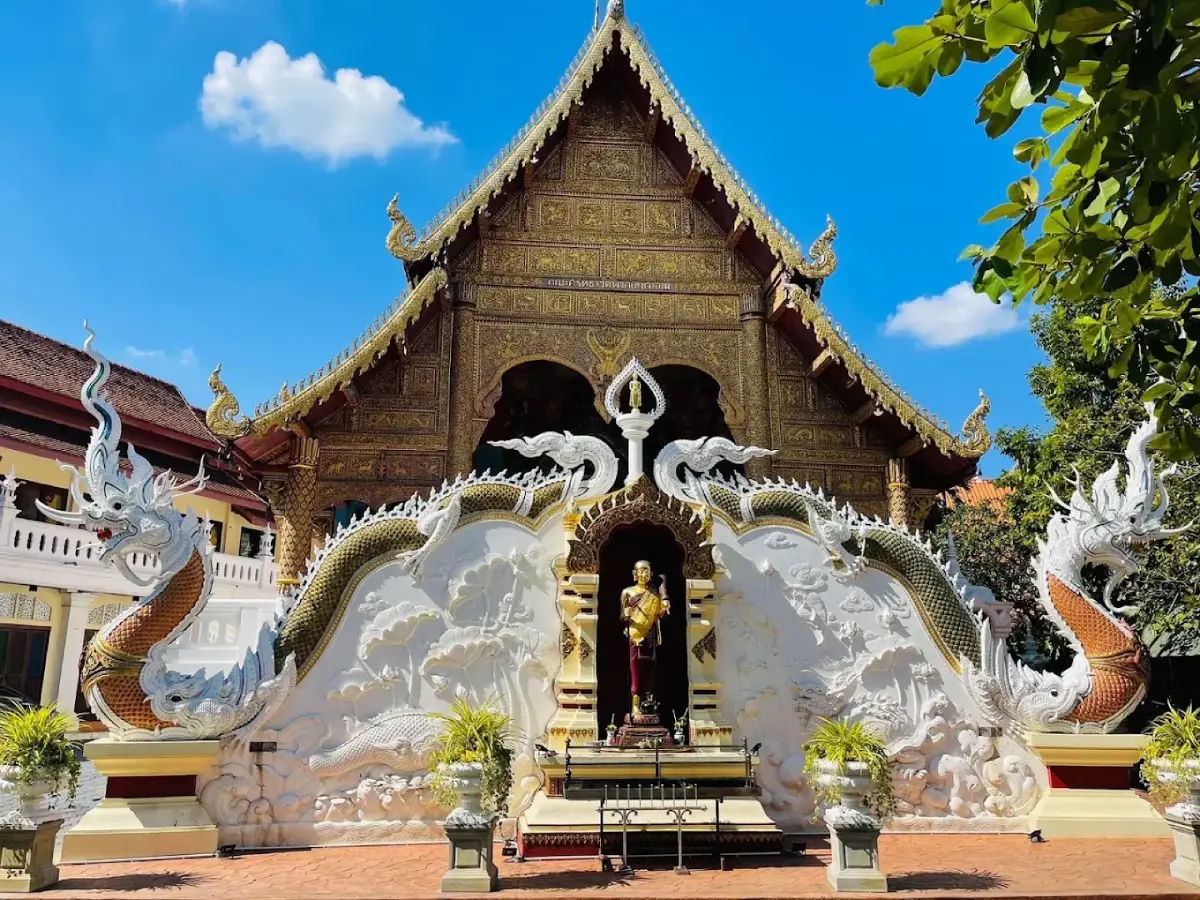
The viharn is one of the most important structures at Wat Puak Chang. It is relatively large compared with the temple compound and follows an applied Lanna architectural style. The front gable is richly decorated with delicate gilded patterns, while the overall roofline and decorative elements give the building a refined northern Thai character. From the front, the viharn feels dignified yet intimate, combining the visual language of Lanna temple architecture with the distinct personality of a local community temple.
The front wall of the viharn is painted in a bright blue tone, making it one of the temple’s most recognizable features. This vivid color contrasts with the golden ornamentation and carved wooden doors. The front area includes paintings of celestial beings, creating an atmosphere connected with Buddhist cosmology and Lanna religious imagination. The doors are carved with the thep phanom motif, a gesture of reverence that marks the transition into the sacred interior of the viharn.
Inside the viharn, the principal Buddha image is seated in the Mara-vijaya posture. The image has red lips, a feature associated with Burmese artistic influence. Its beauty lies in its local craftsmanship and devotional presence rather than in courtly grandeur. For local worshippers, the image functions as a spiritual center of the temple. Visitors should take time to sit quietly in front of the Buddha image to experience the calm atmosphere inside the viharn.
The interior decoration of the viharn is also worth close attention. Behind the principal Buddha image is a red-and-gold mural area decorated with glasswork and simple geometric forms. The combination of red, gold, and reflective surfaces draws the eye naturally toward the Buddha image. Along the side walls, painted murals narrate episodes from the life of the Buddha. These murals turn the viharn into both a devotional space and a visual learning space for Buddhist stories.
The murals are valuable for travelers interested in Lanna local art. They show how local artisans translated Buddhist narratives into visual form through color, composition, and character movement. The details are best appreciated slowly. Looking closely reveals the careful work of local painters and the religious atmosphere embedded in the walls of the viharn.
Another major feature of Wat Puak Chang is the sala bat, a masonry structure built with a Lanna-style roof. Its clean form, pale exterior, and small front garden make this part of the temple feel peaceful and visually balanced. The sala bat represents a more recent layer of the temple’s development while continuing to use Lanna-inspired architectural language. It is one of the best places within the temple to experience the quiet character of Wat Puak Chang.
Inside the sala bat is Phra Chao Than Chai, a Buddha image in the Mara-vijaya posture dressed in royal-style ornaments. The image wears a crown, necklaces, rings, armlets, and a red unalome mark on the forehead. It is seated on a lotus base with a graceful Lanna-style niche behind it. Phra Chao Than Chai is associated with prayers for auspiciousness. Visitors usually pay respect with calm intention and proper temple etiquette.
The sala bat also houses a statue of Ganesha, the Hindu deity widely respected as a symbol of knowledge, arts, learning, and auspicious beginnings. The presence of Ganesha within the temple reflects the broader Thai and Lanna cultural pattern in which Buddhist practice, local belief, and Hindu-derived symbolism can coexist in the same sacred environment. For travelers interested in religious culture, this small building contains meaningful layers of belief and visual symbolism.
Wat Puak Chang is memorable because it is not overly crowded. Even though it is located in a central area of Chiang Mai, the temple still feels like a living neighborhood temple. Visitors can see its relationship with the surrounding community, including nearby homes, school areas, small businesses, and local streets. This setting gives Wat Puak Chang an authenticity that differs from heavily touristed attractions.
For photography, the temple offers several attractive angles: the bright blue front of the viharn, the gilded gable, carved wooden doors, the white-toned sala bat, the small garden, and details of Phra Chao Than Chai. Photography should be done respectfully. Visitors should avoid blocking the viharn entrance, disturbing worshippers, or posing in ways that are unsuitable for a Buddhist temple.
The best time to visit Wat Puak Chang is in the morning or late afternoon. The weather is usually more comfortable, and natural light helps bring out the details of the viharn and sala bat. On Saturdays, travelers should plan carefully because nearby Wua Lai Road becomes busy in the evening due to the Saturday Walking Street. Visiting earlier in the day is usually more convenient for a quiet temple experience.
Getting There is convenient from Chiang Mai Gate, Wua Lai Road, the Night Bazaar area, and the southern part of the old city. Travelers can follow Sridonchai Road toward the area near Chaeng Ka Tam. The temple can be reached by private car, red songthaew, tuk-tuk, motorcycle taxi, or on foot from nearby accommodation. Parking in this neighborhood can be limited, especially during busy evenings and festival periods.
Wat Puak Chang works well as part of a half-day cultural route around the southeastern and southern side of Chiang Mai’s old city. Visitors can combine it with Chaeng Ka Tam, Wat Mueang Mang, Wat Sai Moon Muang, Chiang Mai Gate, Chiang Mai Gate Market, Wua Lai Walking Street, and Wat Sri Suphan. This route offers a balanced view of old temples, local markets, craft streets, community life, and Buddhist devotion in Chiang Mai.
For history-minded travelers, Wat Puak Chang should be read together with the area around Chaeng Ka Tam and the old earthen defensive line of Chiang Mai. The temple’s location reveals how sacred places, working communities, markets, and transportation routes were connected in Lanna urban life. Visiting a smaller temple like Wat Puak Chang helps complete the picture of Chiang Mai as a historic city rather than only a tourist destination.
Visitors should dress modestly, remove shoes before entering the viharn or designated sacred areas, speak quietly, and avoid interrupting monks or worshippers. If taking photos inside buildings, it is best to follow temple signs and avoid photographing during ceremonies or private acts of worship. Respectful behavior helps preserve the temple as a shared space for travelers, monks, local residents, and Buddhist devotees.
Overall, Wat Puak Chang is a small but meaningful temple for travelers seeking a deeper Chiang Mai experience. It combines history, local naming traditions, Lanna-inspired architecture, murals, a principal Buddha image, Phra Chao Than Chai, Ganesha, and a living community setting. A visit does not need to be long, but it should be unhurried. For anyone interested in Buddhist culture, Lanna art, and the quieter layers of Chiang Mai’s old city, Wat Puak Chang is a worthwhile stop.
| Name | Wat Puak Chang |
| Former Names | Wat Bua Ngoen, Wat Chok Pok, and Wat Puak Chang |
| Location | Sridonchai Road, Hai Ya Subdistrict, Mueang Chiang Mai District, Chiang Mai Province |
| Address | Around Sridonchai Road, near Chaeng Ka Tam, Mueang Chiang Mai District, Chiang Mai Province 50100 |
| Coordinates | Latitude 18.78066, Longitude 98.99340 |
| Highlights | Applied Lanna viharn, sala bat, Phra Chao Than Chai, Ganesha statue, and Buddhist murals inside the viharn |
| History | Founded in 2040 B.E. during the reign of King Mueang Kaeo of the Mangrai Dynasty and maintained through later historical periods |
| Name Origin | The name refers to a group of elephant keepers or an elephant unit, reflecting the local community’s historical connection with elephants |
| Distinctive Features | A small old temple outside the city wall with an applied Lanna viharn, gilded gable, bright blue front wall, carved wooden doors, and a Lanna-style sala bat |
| Important Sacred Objects | Principal Buddha image in Mara-vijaya posture, Phra Chao Than Chai, Ganesha statue, sala bat, and Buddhist mural paintings |
| Travel Information | Accessible from Chiang Mai Gate, Wua Lai Road, the Night Bazaar area, and Sridonchai Road by private car, red songthaew, tuk-tuk, motorcycle taxi, or on foot from nearby accommodation |
| Current Status | Open to worshippers and visitors; the temple remains an active local Buddhist temple connected with the surrounding community |
| Open Days | Daily |
| Opening Hours | 08.00 – 17.00 |
| Facilities | Prayer areas, viharn, sala bat, temple courtyard, and limited parking space depending on temple and neighborhood conditions |
| Main Areas / Zones | Viharn, sala bat, principal Buddha image, Phra Chao Than Chai, Ganesha statue, small garden area, and temple courtyard |
| Abbot / Caretaker | Phra Khru Thammatham Rungroj Thanaviro |
| Main Contact Number | 089-759-0324 |
| Nearby Tourist Attractions | 1. Chaeng Ka Tam, about 0.2 km 2. Wat Mueang Mang, about 0.4 km 3. Wat Sai Moon Muang, about 0.5 km 4. Chiang Mai Gate, about 0.7 km 5. Chiang Mai Gate Market, about 0.7 km 6. Wua Lai Walking Street, about 0.9 km 7. Wat Sri Suphan, about 1 km 8. Wat Chedi Luang, about 1.3 km |
| Nearby Restaurants | 1. FENGCHA Cafe, about 0.1 km, Tel. 091-067-7516 2. Aroon Rai Restaurant, about 0.6 km, Tel. 053-276-947 3. Dash Teak House, about 0.8 km, Tel. 053-279-230 4. Sailomjoy Restaurant, about 0.8 km 5. Huen Phen Restaurant, about 1.3 km, Tel. 086-911-2882 6. Khao Soi Islam, about 1.3 km, Tel. 053-271-484 7. The House by Ginger, about 1.4 km, Tel. 053-287-681 |
| Nearby Accommodations | 1. The Old City Wall Inn, about 0.3 km, Tel. 096-679-7990 2. The Mellow Pillow Hotel @ Chiang Mai Gate, about 0.8 km, Tel. 062-291-6886 3. BED Chiangmai Gate, about 0.9 km, Tel. 053-277-707 4. The Entaneer Poshtel, about 1 km, Tel. 053-111-623 5. iSilver Hotel, about 1.2 km, Tel. 053-277-211 |
Frequently Asked Questions (FAQ)
Q: Where is Wat Puak Chang located?
A: Wat Puak Chang is located around Sridonchai Road in Hai Ya Subdistrict, Mueang Chiang Mai District, Chiang Mai Province, near Chaeng Ka Tam, Chiang Mai Gate, and Wua Lai Road.
Q: What are the opening days and hours of Wat Puak Chang?
A: Wat Puak Chang is open daily from 08.00 to 17.00. Morning and late afternoon are usually the most comfortable times to visit.
Q: When was Wat Puak Chang founded?
A: The temple’s history places its founding in 2040 B.E., during the reign of King Mueang Kaeo of the Mangrai Dynasty.
Q: What does the name Wat Puak Chang mean?
A: The name refers to a group of elephant keepers or an elephant unit, preserving the memory of an elephant-related community in old Chiang Mai.
Q: What are the main highlights of Wat Puak Chang?
A: The highlights include the applied Lanna viharn, gilded gable, bright blue front wall, Buddhist murals, sala bat, Phra Chao Than Chai, and the Ganesha statue.
Q: What can visitors see inside the sala bat?
A: Inside the sala bat, visitors can pay respect to Phra Chao Than Chai, a Buddha image in royal-style ornaments, and a statue of Ganesha.
Q: How can visitors get to Wat Puak Chang?
A: Visitors can reach the temple from Chiang Mai Gate, Wua Lai Road, or the Night Bazaar area by following Sridonchai Road. It is accessible by private car, red songthaew, tuk-tuk, motorcycle taxi, or on foot from nearby accommodation.
Q: What nearby places can be included in the same route?
A: Nearby places include Chaeng Ka Tam, Wat Mueang Mang, Wat Sai Moon Muang, Chiang Mai Gate, Chiang Mai Gate Market, Wua Lai Walking Street, Wat Sri Suphan, and Wat Chedi Luang.
 Category: ●Places of Worship
 Group: ●Temple
Last Update : 2 MonthAgo
 Last Update : 2 MonthAgo
 Click to Access the Navigation Map GPS
Wat Puak Chang Map
Recommend

 Muang Chiang Mai(121)Chom Thong(47)Mae Chaem(25)Chiang Dao(33)Doi Saket(68)Mae Taeng(85)Mae Rim(69)Samoeng(29)Fang(71)Mae Ai(59)Phrao(70)San Pa Tong(103)San Kamphaeng(66)San Sai(73)Hang Dong(73)Hot(32)Doi Tao(22)Omkoi(11)Saraphi(74)Wiang Haeng(15)Chai Prakan(28)Mae Wang(32)Mae On(22)Doi Lo(33)Galyani Vadhana(1)


