
lovethailand home >North Travel Attractions >Chiang Mai Travel Attractions >Mae Taeng >Sop Poeng > Wat Tha Kham
TL;DR: Wat Tha Kham is located at Ban Tha Kham, Moo 6, Sop Poeng Subdistrict, Mae Taeng District, Chiang Mai Province, open Daily, hours 08.00 - 17.00.

Wat Tha Kham
Open Days: Daily
Opening Hours: 08.00 - 17.00
Wat Tha Kham, officially known in the religious registry as Wat Supattanaram, is located in Ban Tha Kham, Moo 6, Sop Poeng Subdistrict, Mae Taeng District, Chiang Mai Province. It is one of Mae Taeng’s most valuable cultural temples, especially for visitors interested in Lanna wooden architecture and rare Tai Yai mural paintings. The temple’s ancient wooden vihara was registered as a national historic site, with its boundary announced in the Royal Gazette, Volume 98, Section 177, on 27 October 1981. Wat Tha Kham is an important place to study because its vihara preserves both Lanna architectural identity and mural paintings by Tai Yai artisans.
The charm of Wat Tha Kham lies not only in the age of its vihara, but also in its connection with an old riverside community. The name “Tha Kham” is related to a former crossing point over the Mae Hao River. This local crossing gave the temple and the village their name. The temple therefore reflects a community shaped by waterways, travel, trade, and Buddhism. It is both a religious place and a cultural record of how people once lived and moved through Sop Poeng.
The temple was established around 1865, with Kruba Phrom Sorawicha as the leading monk in its construction. This period corresponds with the development of northern Thai communities during the early Rattanakosin era. Mae Taeng and nearby areas were connected with trade routes and multi-ethnic movement, including Tai Yai communities whose craftsmen left a clear artistic legacy. Wat Tha Kham is therefore a meaningful example of how Lanna Buddhist architecture and Tai Yai painting traditions came together in a rural Chiang Mai temple.
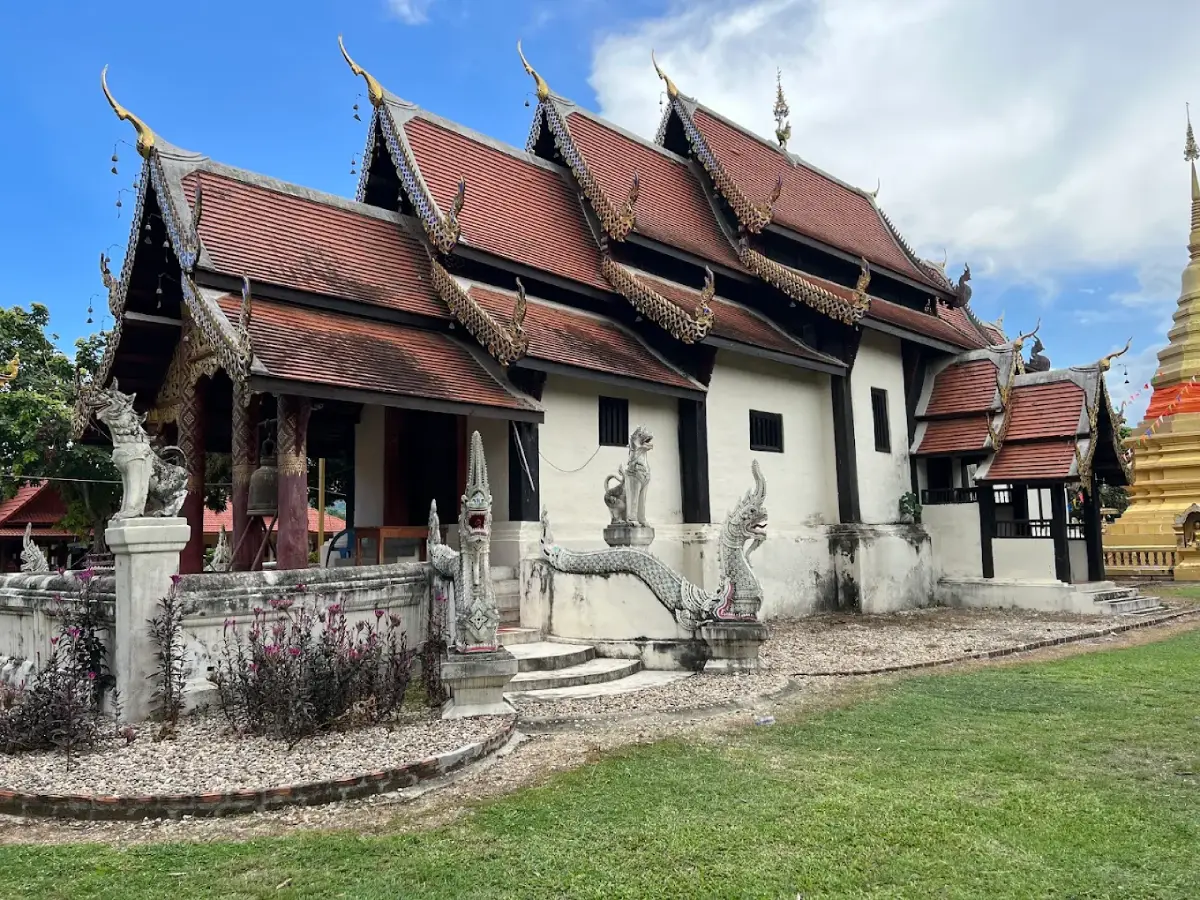
The vihara is the most important structure at Wat Tha Kham. It is a traditional Lanna wooden hall with distinctive layered roofing. The roof is tiered in 3 levels at both the front and back, giving the building a strong and elegant architectural rhythm. At the front, the tiered roof extends to cover the entrance stairways on both sides. From the outside, visitors can clearly see the proportion, craftsmanship, and wooden structure that make the vihara one of the temple’s main cultural treasures.
The entrance area includes naga figures beside the stairways, with upper naga heads and lower dragon-like forms. This naga-dragon feature reflects older beliefs and the artistic imagination of the local craftsmen. There are also side entrance roofs on the north and south sides, each reduced in 2 tiers to harmonize with the main vihara. These side entrances were used in connection with monastic rituals inside the vihara, showing that the architecture was designed for both beauty and religious function.
The pediment and lintel of the vihara include fine woodcarving, such as scrolling foliage, floral motifs, garuda elements, and colored glass decoration in blue, green, and deep blue tones. The roof-edge details resemble folds of cloth, creating a special visual character. These elements make Wat Tha Kham’s vihara significant not only as a large architectural form, but also as a refined work of local craftsmanship.
Inside the vihara are mural paintings in the Tai Yai tradition. The paintings include Buddhist biography, the Ten Jataka stories, the non-canonical Jataka story of Saeng Mueang Long Tham, and the episode of the Buddha subduing King Maha Chomphu. These murals express Buddhist teaching, local narrative traditions, and the artistic taste of the community in the past. They are not simply decorative paintings. They are visual stories that once helped communicate Buddhist ideas to local people.
The Tai Yai mural style at Wat Tha Kham is distinctive. The artists divided the wall into clear picture frames, painted mainly on the upper wall, and left the lower wall plain. Each scene generally finishes within its own frame rather than continuing across multiple frames. This makes the paintings easy to read as independent visual episodes. Visitors should observe this framing system carefully because it is one of the key features of Tai Yai painting at the temple.
The murals are highly significant because Tai Yai mural paintings in Chiang Mai that remain available for study are rare. Wat Tha Kham is one of the key surviving examples, alongside other important sites such as Wat Buak Krok Luang in Mueang Chiang Mai District and Wat Pa Daet in Mae Chaem District. The murals at Wat Tha Kham therefore have importance not only for the temple, but also for the wider study of Chiang Mai’s cultural and artistic heritage.
The presence of Tai Yai murals fits the historical context of Mae Taeng and the old trade routes. Sop Poeng is connected with routes leading toward northern Chiang Mai, Pai, and Mae Hong Son. Since the temple name is linked with a river crossing and local tradition suggests that goods may have once moved through this area by water, the community likely had economic and cultural connections with travelers and merchants. Tai Yai patrons or craftsmen may have contributed to the mural tradition preserved inside the vihara.
In addition to the vihara, Wat Tha Kham includes an ubosot located to the west of the vihara, along with a sermon hall, monks’ residences, and other spaces for religious activities. The ubosot is used for formal monastic acts, while the sermon hall supports Dhamma listening, merit-making, and community gatherings. These structures show that Wat Tha Kham is not only a historic site, but also a living village temple.
Historical temple records state that Wat Tha Kham received its royal boundary for the ubosot on 3 February 1950. The boundary measures 7 meters wide and 16 meters long. This confirms the temple’s formal role within the Sangha system and its ability to support important monastic activities. Wat Tha Kham is therefore both a community temple and an officially recognized Buddhist institution.
Wat Tha Kham continues to be important for Ban Tha Kham. It is a place for merit-making, Dhamma listening, Buddhist ceremonies, and community religious life. Within Sop Poeng Subdistrict, several village temples serve local communities, and Wat Tha Kham stands out because it combines community function with nationally significant heritage. It is both a spiritual center and a cultural learning site.
Visitors should begin with the ancient wooden vihara. Important points to observe include the 3-tiered front and rear roof structure, the entrance stairways, naga-dragon details, carved wooden pediment, lintel decoration, and the rhythm of the building as a whole. After that, visitors should spend time inside the vihara to study the mural paintings quietly and carefully, especially the framed scenes and the way Tai Yai artists arranged the narrative space.
Visitors should be careful when viewing the murals because old wall paintings are fragile. Do not touch the walls, do not lean against painted surfaces, avoid using flash near the murals, and keep noise low inside the vihara. The vihara and murals are cultural resources that cannot easily be replaced, so respectful behavior is essential.
Wat Tha Kham is suitable for travelers interested in old temples, Lanna architecture, wooden religious buildings, mural paintings, Tai Yai art, and cultural routes in Mae Taeng. It may not be as crowded as major tourist temples, but its quiet atmosphere and artistic depth make it especially rewarding for visitors who enjoy studying historic temples in detail.
Religious activities at Wat Tha Kham follow the rhythm of village Buddhism, including Buddhist holy day merit-making, the rains retreat, the end of the rains retreat, Kathin, robe-offering ceremonies, Dhamma listening, and community religious events. Although the temple is especially known for its historic vihara and murals, its basic role remains that of a living temple for Ban Tha Kham.
Traveling to Wat Tha Kham is most convenient by private car or rental car. From Chiang Mai city, take the Chiang Mai-Fang route toward Mae Taeng, pass Mae Malai, then continue onto the Mae Malai-Pai route toward Sop Poeng Subdistrict. The temple is on the route toward Huai Nam Dang and Pai, about 10 km from the main Chiang Mai-Fang road. Before the small lane leading to the temple, there is a sign, and the temple can be seen clearly from a distance once entering the area.
Travelers using public transportation should first reach Mae Taeng or Mae Malai, then continue by local transport, hired vehicle, or rental car to Ban Tha Kham in Sop Poeng Subdistrict. A private vehicle is more practical because the temple can be combined easily with nearby temples, restaurants, accommodations, cafés, and natural attractions along the Mae Malai-Pai route.
A suitable cultural route can begin at Wat Tha Kham to study the ancient vihara and Tai Yai murals, then continue to nearby temples in Sop Poeng and the surrounding area such as Wat Sop Poeng, Wat Pang Hang, or Wat Mae Khachan. Visitors who want to combine culture and nature can continue toward Mae Taeng elephant camps, Mok Fa Waterfall, Huai Nam Dang National Park, or the road to Pai, depending on time and travel plans.
Overall, Wat Tha Kham deserves more attention as one of Mae Taeng’s important cultural temples. Its value comes from the ancient wooden Lanna vihara, rare Tai Yai mural paintings, a founding history from the mid-19th century, a name connected with the Mae Hao river crossing, and its official registration as a historic site. Wat Tha Kham is more than a place for worship. It is a living source for understanding Lanna architecture, Tai Yai painting, and the history of Sop Poeng’s community life.
| Name | Wat Tha Kham, also known as Wat Supattanaram |
| Location | Ban Tha Kham, Moo 6, Sop Poeng Subdistrict, Mae Taeng District, Chiang Mai Province |
| Address | No. 16, Ban Tha Kham, Moo 6, Sop Poeng Subdistrict, Mae Taeng District, Chiang Mai 50330, Thailand |
| Temple Type | Public Buddhist Temple Under The Mahanikaya Order |
| Temple Code | 350060603 |
| History / Period | Founded around 1865 under Kruba Phrom Sorawicha. The temple received its royal ubosot boundary on 3 February 1950 |
| Historic Site Status | The vihara was registered as a national historic site, announced in the Royal Gazette, Volume 98, Section 177, on 27 October 1981 |
| Name Origin | The name is connected with a former crossing point over the Mae Hao River near Ban Tha Kham |
| Highlights | Ancient wooden Lanna vihara, Tai Yai mural paintings, 3-tiered roof reduction at the front and rear, carved wooden pediment, and naga-dragon stairway details |
| Mural Paintings | Tai Yai mural paintings depicting Buddhist biography, Ten Jataka stories, Saeng Mueang Long Tham, and the Buddha subduing King Maha Chomphu |
| Main Structures | Ancient vihara, ubosot, sermon hall, monks’ residences, and religious activity areas |
| Community Role | A spiritual center for Ban Tha Kham, used for merit-making, Dhamma listening, Buddhist ceremonies, and as a learning site for Lanna art in Sop Poeng |
| Open Days | Daily |
| Opening Hours | 08.00 - 17.00 |
| Travel Information | From Chiang Mai city, take the Chiang Mai-Fang route, pass Mae Malai, then continue onto the Mae Malai-Pai route toward Sop Poeng. The temple is about 10 km from the main Chiang Mai-Fang road. Private car or rental car is recommended |
| Current Status | Open as a community temple and cultural attraction in Sop Poeng Subdistrict, Mae Taeng District, Chiang Mai Province |
| Important Traditions | Buddhist holy day merit-making, rains retreat, end-of-rains retreat, Kathin, robe-offering ceremonies, Dhamma listening, and community Buddhist activities |
| Visitor Etiquette | Dress respectfully, keep quiet, do not touch the murals, avoid flash photography near the paintings, and treat the vihara and ubosot with respect |
| Nearby Tourist Attractions | 1. Wat Sop Poeng, about 4 km 2. Wat Pang Hang, about 5 km 3. Mae Taeng Elephant Camp, about 18 km 4. Mok Fa Waterfall, about 23 km 5. Huai Nam Dang National Park, about 58 km |
| Nearby Restaurants | 1. Green Food Coffee, Ban Pang Hang, about 6 km, Tel. 089-998-9906 2. Moonatic Shack, about 7 km 3. Restaurant At Veni Vana Valley Maetang, about 9 km, Tel. 080-031-2242 4. Restaurant At Siam Pavilion Resort, about 10 km, Tel. 053-995-491 5. Sibsan Cuisine, about 23 km |
| Nearby Accommodations | 1. Veni Vana Valley Maetang, about 9 km, Tel. 080-031-2242 2. Na Sompor Baan Din, about 9 km, Tel. 02-430-4464 3. Siam Pavilion Resort, about 10 km, Tel. 053-995-491 4. Absolute Thai Hillside Villa Resort, about 11 km, Tel. 089-103-8322 5. Baan Rai Lanna Resort, about 12 km |
Frequently Asked Questions (FAQ)
Q: Where is Wat Tha Kham located?
A: Wat Tha Kham is located in Ban Tha Kham, Moo 6, Sop Poeng Subdistrict, Mae Taeng District, Chiang Mai Province. Its official religious name is Wat Supattanaram.
Q: What are the opening days and hours of Wat Tha Kham?
A: Wat Tha Kham is open daily from 08.00 to 17.00.
Q: What is the main highlight of Wat Tha Kham?
A: The main highlight is the ancient wooden Lanna vihara, together with rare Tai Yai mural paintings, 3-tiered roof reduction, carved wooden decoration, and naga-dragon stairway details.
Q: When was Wat Tha Kham registered as a historic site?
A: The vihara of Wat Tha Kham was registered as a national historic site and announced in the Royal Gazette, Volume 98, Section 177, on 27 October 1981.
Q: Why are the mural paintings at Wat Tha Kham important?
A: The murals are rare Tai Yai-style paintings in Chiang Mai, depicting Buddhist biography, Jataka stories, and the non-canonical story of Saeng Mueang Long Tham.
Q: How can travelers get to Wat Tha Kham?
A: From Chiang Mai city, take the Chiang Mai-Fang route, pass Mae Malai, then continue onto the Mae Malai-Pai route toward Sop Poeng. The temple is about 10 km from the main Chiang Mai-Fang road. A private car or rental car is the most convenient option.
Q: What nearby places can be visited with Wat Tha Kham?
A: Nearby places include Wat Sop Poeng, Wat Pang Hang, Mae Taeng Elephant Camp, Mok Fa Waterfall, Huai Nam Dang National Park, and attractions along the Mae Malai-Pai route.
 Category: ●Places of Worship
 Group: ●Temple
Last Update : 2 WeekAgo
 Last Update : 2 WeekAgo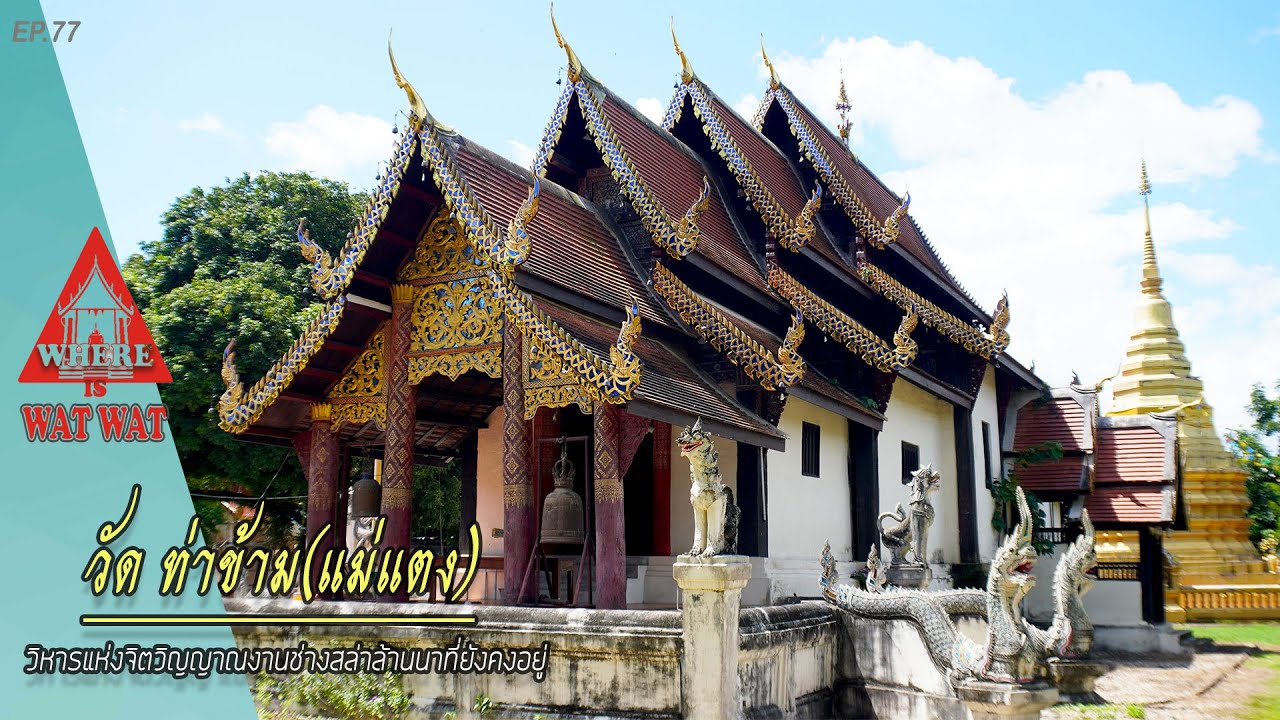
 Click to Access the Navigation Map GPS
Wat Tha Kham Map
Recommend

 Muang Chiang Mai(121)Chom Thong(47)Mae Chaem(25)Chiang Dao(33)Doi Saket(68)Mae Taeng(85)Mae Rim(69)Samoeng(29)Fang(71)Mae Ai(59)Phrao(70)San Pa Tong(103)San Kamphaeng(66)San Sai(73)Hang Dong(73)Hot(32)Doi Tao(22)Omkoi(11)Saraphi(74)Wiang Haeng(15)Chai Prakan(28)Mae Wang(32)Mae On(22)Doi Lo(34)Galyani Vadhana(1)


