
lovethailand home >South Travel Attractions >Trang Travel Attractions >Muang Trang >Bang Rak > Trang Vegetarian Festival
TL;DR: Trang Vegetarian Festival, Trang attractions : Art, Culture and Heritage, Art, Craft Centres, Tradition.
Trang Vegetarian Festival
Open Days: Held Annually From The 1st To The 9th Day Of The 9th Lunar Month In The Chinese Calendar; In 2026, The Main Festival Dates Are 10 – 18 October 2026
Opening Hours: Rituals And Vegetarian Kitchens Follow The Schedule Of Each Shrine
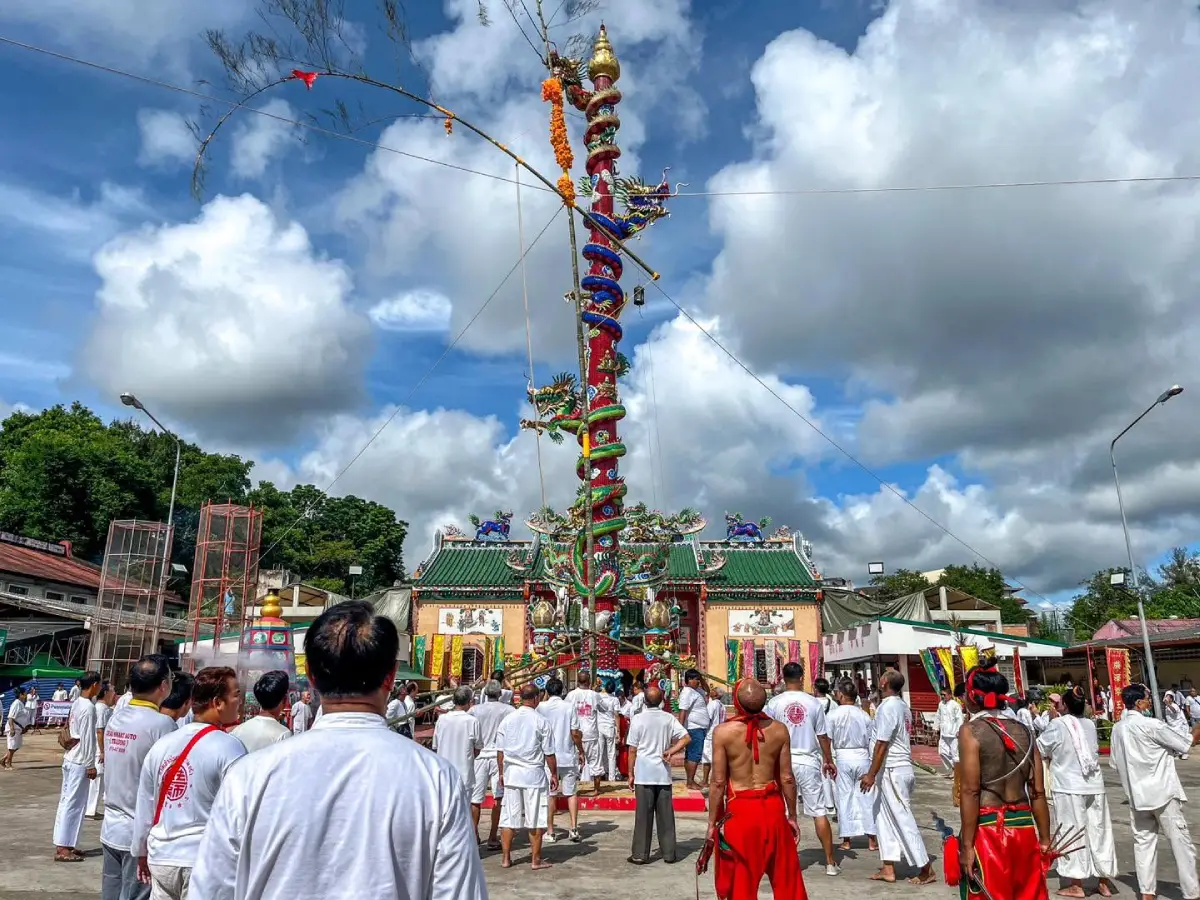
Trang Vegetarian Festival, locally known as the Trang Kin Phak or Vegetarian Observance Festival, is one of the province’s most important Thai-Chinese traditions. Held from the 1st to the 9th day of the 9th lunar month in the Chinese calendar, the festival centers on Chinese shrines across Trang, especially in Trang city. Devotees dress in white, abstain from meat, keep moral discipline, join shrine rituals, receive vegetarian meals from communal kitchens, and take part in processions, fire-walking, bridge-crossing, and the final sending-off ceremony.
Trang Vegetarian Festival is not simply a food event. It is a 9-day spiritual observance rooted in faith, compassion, discipline, and community solidarity. In Trang, many local people call it “Kin Phak,” meaning eating vegetables, but the practice goes far beyond diet. Devotees purify body, speech, and mind by avoiding meat, refraining from killing or harming living beings, avoiding alcohol and nightlife, dressing in white, chanting, meditating, and taking part in sacred ceremonies at Chinese shrines.
The festival follows the Chinese lunar calendar and is held from the 1st to the 9th day of the 9th lunar month, usually falling in September or October. In 2026, the main Vegetarian Festival dates in Thailand fall from 10 to 18 October 2026. Some shrines may begin preparation earlier or continue specific ceremonies after the main 9-day period, so visitors who want to join a particular ritual should check the latest schedule from the shrine they plan to visit.
Trang is one of southern Thailand’s strong centers of Thai-Chinese culture. During the festival, the city changes visibly. Yellow vegetarian flags appear in front of restaurants, shrines, and homes. Devotees wear white. Incense smoke, drums, firecrackers, shrine processions, and vegetarian kitchens fill the city with a distinctive atmosphere. For local families, the festival is a time to make merit, renew discipline, honor sacred beings, and reconnect with the community.
The first key meaning of the festival is moral purification. Devotees abstain from meat and animal products to avoid taking life and to cultivate compassion. The discipline also extends to behavior: participants try to speak carefully, control their emotions, avoid conflict, and remain mindful throughout the festival. Chanting, meditation, and prayer help devotees focus on kindness toward themselves, their families, and all living beings.
The second key meaning is spiritual protection and the removal of misfortune. Many devotees believe that strict vegetarian observance, shrine worship, the receiving of protective talismans, bridge-crossing ceremonies, and other rituals can help remove bad luck, illness, danger, and negative forces from life. This belief makes the Trang Vegetarian Festival a period of renewal, not just a temporary change in diet.
The third key meaning is community unity. The festival depends on shared effort. Some people donate money, rice, vegetables, cooking oil, and other ingredients. Others volunteer in shrine kitchens, prepare meals, serve food, clean utensils, guide processions, manage crowds, and support ritual spaces. The vegetarian kitchens are among the strongest expressions of generosity during the festival, because they allow devotees and visitors to eat together in a spirit of merit-making.
The beliefs behind the Trang Vegetarian Festival combine several Chinese religious and philosophical traditions, including Taoism, Confucian thought, deity worship, and Mahayana Buddhism. These traditions came with Chinese migrants who settled in Trang and brought their rituals, shrines, foodways, and spiritual practices with them. Over time, the festival became part of Trang’s local identity and one of the province’s most important annual traditions.
Important shrines in Trang city include Kiu Ong Ie Shrine, Chao Pho Muen Ram Shrine, Chao Pho Suea Shrine, Tai Sia Hud Jow Shrine, and Tham Kong Yia Shrine. Kiu Ong Ie Shrine is closely associated with the Nine Emperor Gods and is one of the key shrines in the local vegetarian tradition. Other shrines have their own sacred deities, ritual schedules, processions, kitchens, and groups of devotees, making the Trang festival a multi-shrine observance rather than a single-location event.
The day before the main festival, shrines are cleaned and purified with incense and fragrant smoke. Ritual objects are prepared, and the Teng Ko flagpole is raised in front of the shrine. At midnight, the Jade Emperor and the Nine Emperor Gods are invited to preside over the festival. Nine oil lamps are hung to represent the sacred presence of the Nine Emperor Gods. Once this ceremony is completed, the Vegetarian Festival begins in full spiritual form.
After the deities are invited into the shrine, ritual guards are symbolically stationed in different directions to protect the ceremonial space. Flags, offerings, directions, colors, and ritual objects all have meaning. The festival is therefore highly structured. It has a sequence, sacred geography, and symbolic order that visitors should respect when entering shrine areas or watching ceremonies.
Preparation for vegetarian observance also takes place at home. Devotees clean cooking utensils and remove traces of non-vegetarian food. Many families separate plates, pots, pans, and cooking tools for vegetarian meals only. Some households use a new set of utensils during the festival, while others receive meals from shrine kitchens. This careful separation of food and utensils reflects the seriousness of the observance.
The first-day worship ceremony is one of the major rituals. Offerings are made both at shrines and at home. Devotees believe that after 3 days of strict vegetarian practice, the body, mind, and emotions become cleaner and more balanced. The first 3 days are therefore a transition into deeper discipline, both physically and spiritually.
The Kho Kun ceremony is a ritual offering to the guardian soldiers who protect the ceremonial directions. It is generally performed on the 3rd, 6th, and 9th lunar days of the festival. Food and ritual offerings are presented according to shrine tradition. This ceremony shows how the festival creates a sacred protective order around the shrine and its devotees.
The Song Keng chanting ritual takes place daily after the Nine Emperor Gods are invited into the shrine. It is usually performed twice a day, in the morning and evening. The sound of chanting, drums, bells, and ritual movement gives the shrine its spiritual rhythm throughout the 9-day festival. For devotees, chanting is a way to focus the mind and cultivate purity.
The star-worship ceremony is held on the 7th lunar night to seek protection for those observing the festival. During this ceremony, protective talisman papers are distributed to devotees. The ritual reflects the connection between cosmic order, sacred protection, and human life. Visitors who attend should dress respectfully and follow the instructions of shrine staff.
The deity procession, sometimes described as the gods going out to visit their descendants, is one of the most visible parts of the Trang Vegetarian Festival. Shrines carry sacred palanquins through city streets. Local households and shops set up offering tables to welcome the procession, light incense, and set off firecrackers. The procession includes white-clad devotees, flags, musicians, shrine volunteers, palanquins, and spirit mediums.
During some processions, spirit mediums demonstrate ritual power through acts involving sharp objects or body piercing according to shrine belief. Visitors should watch from a safe distance, avoid blocking the procession, and remember that these acts are part of a sacred tradition for the local community. The procession should not be treated as entertainment alone.
Fire-walking is another important ritual. A bed of burning coals is prepared, and spirit mediums run across it to demonstrate sacred power and purity. Some devotees also take part according to local belief, seeing the fire as a purifying force. This ceremony requires careful crowd control and respect for safety boundaries. Visitors should stand only in designated viewing areas.
The final sending-off ceremony closes the festival. It includes a daytime ritual to send off the Jade Emperor at the flagpole and a late-night ceremony to send off the Nine Emperor Gods, traditionally around midnight. Devotees walk together to send the deities toward the water, reflecting the belief that they return to heaven by sea. After the procession leaves the shrine, lights are extinguished and the main doors are closed before the final lowering of the flagpole and related closing rituals.
Beyond shrine rituals, Trang City Municipality supports public activities that help preserve and present the tradition. In recent years, activities have taken place around Trang City Square, the area in front of Trang City Municipality Office, and Trang Clock Tower. These may include chanting ceremonies, candle-and-incense processions, lion and dragon dances, photo exhibitions, nutrition exhibitions, yellow-flag city decorations, check-in points, and campaigns encouraging residents and visitors to wear white.
Food is another strong reason to experience the festival in Trang. The province is famous for morning food culture, dim sum, roasted pork, coffee shops, and local Chinese-Thai dishes. During the vegetarian period, the city’s food atmosphere shifts toward plant-based meals, vegetarian kitchens, shrine food, Hokkien-influenced dishes, auspicious sweets, and local dishes adapted into vegetarian versions. This gives visitors a rare chance to see how Trang’s food culture changes during a sacred annual observance.
Visitors who want to observe vegetarian practice strictly should avoid meat, animal products, alcohol, intoxicants, strong flavors, and ingredients that are not accepted in vegetarian observance. Food preparation should be separated from non-vegetarian cooking when possible. First-time participants may reduce meat intake before the festival begins so that the body can adjust more comfortably.
Because the Trang Vegetarian Festival is a living sacred tradition, visitors should behave respectfully. Wear modest clothing, choose white clothing if joining the observance, avoid loud behavior in shrine areas, do not cross procession lines, do not touch ritual objects without permission, keep a safe distance from firecrackers and spirit mediums, and follow the directions of shrine volunteers and local authorities.
Getting There is convenient because many main events take place in Trang city. Travelers arriving by train can get off at Trang Railway Station and continue by local tuk-tuk, taxi, or on foot to the old town, clock tower area, and selected shrines. Travelers arriving by car should check procession routes in advance because traffic may be adjusted during major processions. Those arriving by air can fly to Trang Airport and continue into the city by local transport.
Visitors planning to attend the festival should choose accommodation in Thap Thiang or central Trang for easier access to shrines, food areas, and public activity zones. The festival period can be busy, especially on procession days and during evening rituals, so planning accommodation and transport in advance makes the trip smoother.
A meaningful Trang Vegetarian Festival itinerary should begin with a key shrine, followed by a visit to Trang Clock Tower, Trang City Square, the old-town streets, Trang Railway Station, and local vegetarian food areas. Travelers with more time can extend the route to Kantang District to visit Phraya Ratsadanupradit Mahison Phakdi Museum, Kantang Railway Station, and the First Para Rubber Tree of Thailand. This creates a deeper cultural route connecting faith, food, transport, and local history.
The Trang Vegetarian Festival remains one of the province’s most powerful expressions of faith. It brings together Chinese shrines, ritual discipline, vegetarian food, public generosity, community labor, and annual remembrance. For travelers, it offers a chance to understand Trang beyond beaches and cuisine. For local devotees, it is a sacred period of merit-making, purification, and shared identity that continues to shape the city every year.
| Name | Trang Vegetarian Festival / Trang Kin Phak Festival |
| Thai Name | ถือศีลกินเจ / ประเพณีถือศีลกินผักจังหวัดตรัง |
| Location | Chinese Shrines Across Trang Province, Especially In Trang City, Thap Thiang Subdistrict, Mueang Trang District, Trang Province |
| Main Event Areas | Kiu Ong Ie Shrine, Chao Pho Muen Ram Shrine, Chao Pho Suea Shrine, Tai Sia Hud Jow Shrine, Tham Kong Yia Shrine, Pao Kong Shrine, Trang City Square, And Trang Clock Tower Area |
| Festival Period | From The 1st To The 9th Day Of The 9th Lunar Month In The Chinese Calendar; In 2026, The Main Festival Dates Are 10 – 18 October 2026 |
| Opening Hours | Rituals And Vegetarian Kitchens Follow The Schedule Of Each Shrine |
| Fees | No Admission Fee For Main Public Festival Areas And Participating Shrines |
| Highlights | White Clothing, 9-Day Vegetarian Observance, Shrine Kitchens, Deity Processions, Fire-Walking, Bridge-Crossing, Knife-Ladder Rituals, Star Worship, And The Sending-Off Ceremony |
| History | A Long-Standing Thai-Chinese Tradition In Trang, Practiced For More Than 150 Years And Linked To Chinese Settlement In The Province |
| Importance | Focuses On Moral Discipline, Abstaining From Taking Life, Purifying The Mind, Removing Misfortune, And Strengthening Community Solidarity |
| Related Beliefs | Combines Chinese Beliefs Including Taoism, Confucian Thought, Deity Worship, And Mahayana Buddhism |
| Main Rituals | Raising The Teng Ko Flagpole, Inviting The Jade Emperor And The Nine Emperor Gods, Hanging 9 Sacred Lamps, First-Day Worship, Kho Kun, Song Keng Chanting, Star Worship, Deity Processions, Fire-Walking, And The Sending-Off Ceremony |
| Visitor Etiquette | Dress Modestly Or Wear White, Avoid Meat And Alcohol If Observing, Respect Shrine Spaces, Do Not Block Processions, Keep Distance From Firecrackers, And Follow Shrine Instructions |
| Travel Information | Reach Trang City By Train, Bus, Van, Private Car, Or Flight To Trang Airport, Then Continue To Shrines, Trang City Square, And Trang Clock Tower By Local Transport |
| Current Status | Still Held Annually As A Major Trang Tradition, Supported By Local Shrines, Trang City Municipality, Trang Province, And Tourism-Related Agencies |
| Facilities | Vegetarian Kitchens, Food Distribution Areas, Shrine Worship Areas, Ritual Grounds, City Check-In Points, And Vegetarian Food Stalls During The Festival |
| Main Areas / Zones | Shrine Areas, Vegetarian Kitchens, Communal Dining Areas, Ritual Courtyards, Teng Ko Flagpole Area, Offering Table Areas, Procession Routes, Trang City Square, And Trang Clock Tower Area |
| Organizers / Local Caretakers | Participating Chinese Shrines In Trang, Trang City Municipality, Trang Province, And Local Tourism Support Agencies |
| Main Contact Number | Trang City Municipality Tel. 075-218017 Or Hotline 1132 |
| Nearby Tourist Attractions | 1. Trang Clock Tower, About 0 km 2. Trang City Square, About 0 km 3. Trang Old Town And Street Art, About 1 km 4. Trang Railway Station, About 1 km 5. Kaphang Surin Park, About 2 km 6. Wat Tantayapirom Royal Monastery, About 2 km 7. Phraya Ratsadanupradit Mahison Phakdi Monument, About 2 km |
| Nearby Restaurants | 1. Phong Ocha 1, About 1 km, Tel. 086-268-1986 2. Ruean Thai Dim Sum, About 1 km, Tel. 075-219-342 3. Mee Dee Dim Sum, About 2 km, Tel. 086-595-7703 4. Ko Dum Muen Ram Trang, About 1 km 5. Phong Ocha 2, About 2 km, Tel. 075-217-789 6. B O Cha & Coffee Trang, About 1 km, Tel. 088-264-3288 |
| Nearby Accommodations | 1. Thumrin Thana Hotel, About 1 km, Tel. 075-211-211 2. Thumrin Hotel, About 1 km, Tel. 075-211-011 3. The Tree Sleep And Space, About 1 km, Tel. 081-100-4442 4. S2S Queen Trang Hotel, About 1 km, Tel. 075-218-229 5. Ban Ao Thong, About 1 km, Tel. 086-479-5466 6. Rua Rasada Hotel, About 2 km, Tel. 075-226-999 7. HOP INN Trang, About 3 km, Tel. 02-080-2222 |
Frequently Asked Questions (FAQ)
Q: When is the Trang Vegetarian Festival held?
A: It is held annually from the 1st to the 9th day of the 9th lunar month in the Chinese calendar. In 2026, the main festival dates are 10 – 18 October 2026.
Q: Where does the Trang Vegetarian Festival take place?
A: It takes place at Chinese shrines across Trang Province, especially in Trang city, including Kiu Ong Ie Shrine, Chao Pho Muen Ram Shrine, Chao Pho Suea Shrine, Tai Sia Hud Jow Shrine, and Tham Kong Yia Shrine.
Q: Why is the Trang Vegetarian Festival important?
A: The festival focuses on moral discipline, abstaining from harming living beings, spiritual purification, removal of misfortune, and community unity through shrine rituals and vegetarian kitchens.
Q: What are the main rituals of the festival?
A: Major rituals include raising the Teng Ko flagpole, inviting the Nine Emperor Gods, first-day worship, Kho Kun, Song Keng chanting, star worship, deity processions, fire-walking, bridge-crossing, and the final sending-off ceremony.
Q: What should visitors wear?
A: Visitors should dress modestly. Those joining the observance should wear white, avoid meat and alcohol, and keep body, speech, and mind disciplined throughout the festival.
Q: Where should first-time visitors start?
A: First-time visitors can start at a main shrine in Trang city or around Trang City Square and Trang Clock Tower, then follow the procession or ritual schedule of the shrine they want to visit.
Q: Is the festival suitable for general travelers?
A: Yes. It is suitable for travelers interested in Thai-Chinese traditions, vegetarian food, shrine culture, and faith-based travel, as long as they respect the sacred nature of the rituals.
Q: How can travelers get to the festival areas in Trang?
A: Travelers can reach Trang city by train, bus, van, private car, or flight to Trang Airport, then continue by local transport to shrines, Trang City Square, and Trang Clock Tower.
 Category: ●Art, Culture and Heritage
 Group: ●Art, Craft Centres, Tradition
Last Update : 4 WeekAgo
 Last Update : 4 WeekAgo
Recommend

 Historical Sites and Monuments(1)
 Landmarks and Memorials(2)
Art, Craft Centres, Tradition(3)
Landmarks and Memorials(2)
Art, Craft Centres, Tradition(3)
 Museums(2)
 Places of Worship
 Temple(15)
 Mosque(1)
 Other Sacred Sites(6)
 Research and Development
 Royal Project(1)
 Suburban Living
 Village, Community(5)
 Nature and Wildlife
 National Parks and Marine Reserves(6)
 Mountain (Doi)(8)
 Dam, Reservoir, Lake(1)
 Waterfalls(20)
 Hot Springs(1)
 Caves(11)
 Bays and Beaches(11)
 Islands(12)
 Other natural attractions(3)
 Entertainment and Agricultural
 Farms, Parks and Ecotourism(8)
 Outdoor and Adventure Activities(1)
 Travel Articles, Recipes
 Southern Food Menu, Southern Food Recipes(1)


