
lovethailand home >South Travel Attractions >Surat Thani Travel Attractions >Muang Surat Thani >Talat > Phum Pha Pa Tradition
TL;DR: Phum Pha Pa Tradition, Surat Thani attractions : Art, Culture and Heritage, Art, Craft Centres, Tradition.
Phum Pha Pa Tradition
Open Days: The night of the full moon of the 11th lunar month and during the Surat Thani Chak Phra, Kathin Robe Offering, and Long-Boat Racing Festival 2026, scheduled for 23 – 31 October 2026
Opening Hours: From early evening until dawn, followed by the robe-pulling ceremony on the morning of the first waning moon of the 11th lunar month
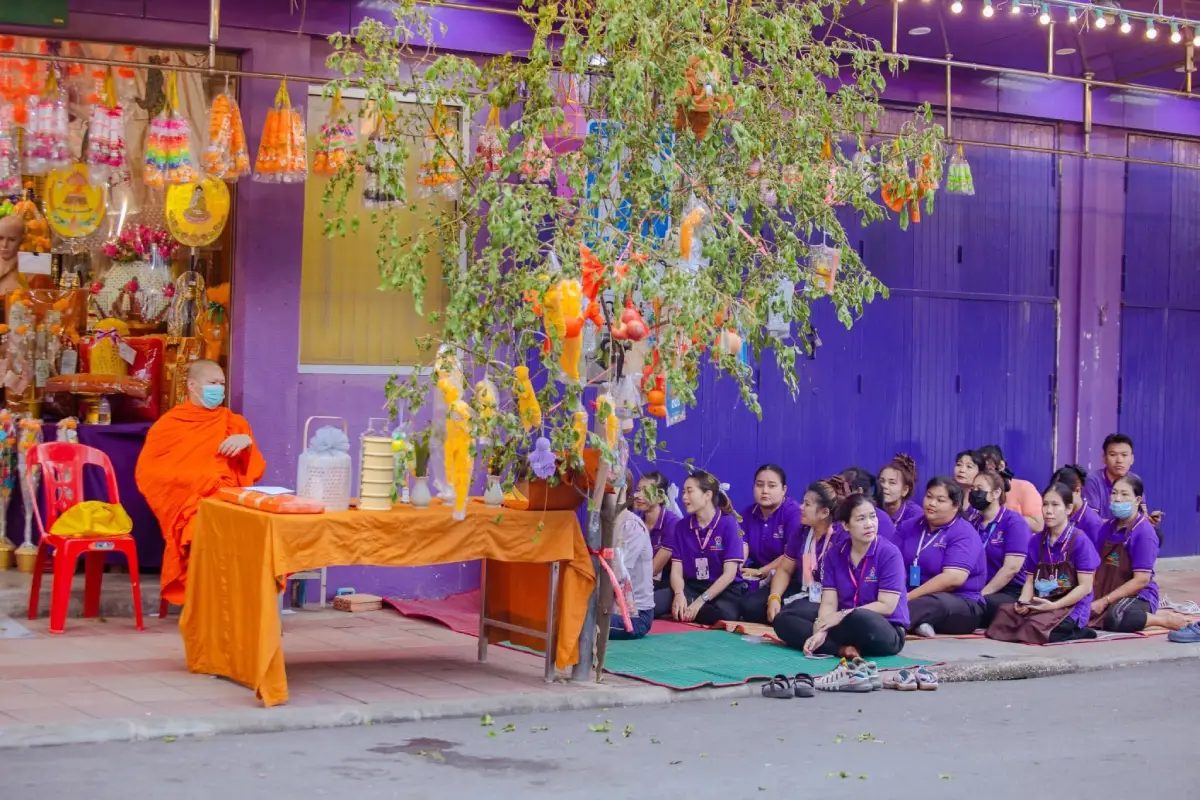
The Phum Pha Pa Tradition in Surat Thani, also known as the home-front robe-offering tradition, is one of the most distinctive Buddhist customs in southern Thailand. It is closely connected with the Chak Phra, Kathin Robe Offering, and Long-Boat Racing Festival of Surat Thani, which takes place during the period after the End of Buddhist Lent. What makes this tradition special is that residents, shops, households, temples, communities, and local organizations across Surat Thani city prepare robe-offering displays in front of their homes on the night of the full moon of the 11th lunar month, one night before the main Chak Phra procession.
This tradition transforms the city into a large open-air merit-making space. Instead of limiting Buddhist offerings to temple compounds, the people of Surat Thani extend the act of merit-making into streets, neighborhoods, shopfronts, and family homes. Visitors walking through the city on this night can see robe-offering trees, yellow monk robes, offerings, lights, decorated displays, and local families welcoming people to join in merit-making. It is one of the most intimate ways to experience the living Buddhist culture of Surat Thani.
The tradition takes place on the night of the full moon of the 11th lunar month. This is the night before the first waning moon of the 11th lunar month, which is the day associated with Chak Phra or Lak Phra in southern Thailand. On this evening, homeowners place a small tree, branch, or decorated structure in front of their homes and arrange it as a Phum Pha Pa, or robe-offering display. Some displays are simple and made according to the household’s means. Others are large, elaborate, and decorated with lights, Buddhist scenes, moral teachings, stories from the Buddha’s life, Jataka tales, heaven, hell, and symbolic scenes related to Buddhist belief.
The meaning of Phum Pha Pa comes from the older Buddhist practice of offering discarded cloth to monks. In the early Buddhist tradition, monks were allowed to search for ownerless cloth, known as pamsukula cloth, from forests, roadsides, cemeteries, or discarded places. They would wash, cut, sew, and dye these pieces of cloth into robes. When lay Buddhists saw the difficulty faced by monks, they began placing better cloth along paths or near places where monks passed, so that the cloth could be collected and used. This practice later developed into the robe-offering tradition known as Pha Pa.
In Surat Thani, this religious idea developed into the unique form of Phum Pha Pa Na Ban, or robe-offering displays in front of homes. The forest setting of the old practice is symbolically brought into the city through a tree or branch used as the center of the display. A yellow robe is hung on the display, together with necessary items for monks, such as candles, incense, toothpaste, matches, oil, food containers, and other monastic requisites. The display therefore carries both symbolic and practical meaning. It preserves the memory of the older Pha Pa practice while turning each household into an active participant in the citywide merit-making festival.
The Phum Pha Pa tradition is inseparable from the Chak Phra Festival. On the following morning, the first waning moon of the 11th lunar month, monks from local temples visit robe-offering displays according to assigned lots. The householders and participants sit respectfully with folded hands facing their display. When the monk pulls or receives the robe, the ritual for that display is completed. After that, the monks return to their temples, and the city moves into the wider atmosphere of Chak Phra processions, decorated Buddha boats, robe offerings, and long-boat racing.
This sequence shows how the festival begins at home before moving into the public procession. The night of Phum Pha Pa is about household preparation, devotion, and giving. The morning of Chak Phra is about receiving blessings, welcoming the Buddha image processions, and joining the larger religious activities of the city. Together, these stages form a continuous ritual cycle that links the home, the temple, the street, and the river.
The beauty of Phum Pha Pa lies in its diversity. Some displays use only a branch, a yellow robe, and a few monastic items. Others are decorated with flowers, lights, flags, fabric, donation boxes, and full narrative scenes. Larger households, businesses, or community groups may build decorated pavilions or themed displays. These can become important viewing points for local people and visitors. As the night goes on, people walk through the city in groups, admire the displays, take photographs respectfully, and make offerings according to their faith.
From a social perspective, the tradition strengthens family and community bonds. Before the event, family members prepare branches, offerings, decorations, robes, and donation items together. Neighbors may help each other set up displays. Shops and communities often work together to decorate whole streets. This cooperative process creates pride, unity, and a strong sense of belonging. Phum Pha Pa is therefore not only a Buddhist ritual but also a social tradition that brings the people of Surat Thani together in one shared night of merit-making.
For travelers, this tradition offers a different experience from watching a parade or attending a staged cultural show. Walking among home-front robe-offering displays allows visitors to see the faith of ordinary households up close. The atmosphere is warm, local, and deeply human. Children, parents, elders, shopkeepers, monks, residents, and tourists all become part of the same cultural moment. This makes the tradition especially meaningful for those who want to understand southern Thai Buddhist life at the community level.
The most important areas for experiencing the tradition are within Surat Thani City Municipality, especially around the city center, residential streets, shopfronts, the City Pillar Shrine area, Na Mueang Road, Ban Don Road, Si Tapi Road, the Tapi Riverfront, and the areas connected with the main Chak Phra Festival near Saphan Narit. In some years, the city robe-pulling ceremony is held at the Surat Thani City Pillar Shrine, marking the beginning of the home-front robe-offering tradition and the transition into the main Chak Phra day.
This tradition is widely recognized as a key cultural identity of Surat Thani. The sight of thousands of home-front robe-offering displays across the city makes the festival visually and spiritually distinctive. Visitors should not see the displays merely as decorations. Each one represents the faith of a family, a shop, an office, a community, or a group of people who wish to take part in the province’s major Buddhist festival.
Compared with ordinary robe-offering ceremonies, Surat Thani’s home-front Phum Pha Pa tradition is wider in scale and more open in form. It is not limited to a temple or a single ceremonial space. Anyone can participate according to their ability and faith. A small display in front of a modest home has the same spiritual value as a larger and more elaborate pavilion. The beauty of the tradition lies not only in decoration but also in the shared intention of an entire city to preserve Buddhist merit-making after the rainy-season retreat.
The best time to begin walking is early evening on the full-moon night of the 11th lunar month, when households are still arranging their displays and lights are being turned on. By around midnight, most displays are complete and the atmosphere becomes livelier. From after midnight until dawn, people walk through the city to admire the robe-offering displays and join in merit-making. The morning of the first waning moon is suitable for visitors who want to observe the robe-pulling ritual performed by monks.
When observing a Phum Pha Pa display, visitors should notice its main elements: the branch or tree used as the structure, the yellow robe, donation items, monastic requisites, candles, incense, and decorative storytelling. Larger displays may include scenes from Buddhist stories or moral teachings. These details make the tradition both a religious ritual and a form of local folk art. Each display becomes a small cultural text created by the household or community that prepares it.
Getting to Surat Thani city is convenient by plane, train, long-distance bus, or private car. Travelers arriving by air can fly to Surat Thani Airport and continue by road into the city. Those arriving by train can get off at Surat Thani Railway Station in Phunphin District and take local transport into Surat Thani City Municipality. Visitors driving into the city should check official traffic announcements, as roads near the Chak Phra Festival, Saphan Narit, and the Tapi Riverfront may be adjusted or temporarily closed during the event.
Getting There within the city is best done on foot after reaching the main festival area. Walking slowly is the ideal way to appreciate the details of each robe-offering display. Visitors staying near Talat, Na Mueang Road, Talat Mai Road, Karunrat Road, or Saphan Narit will have convenient access to the main areas where home-front displays and Chak Phra activities are concentrated.
Visitors should observe the tradition respectfully. The robe-offering display is a religious offering, not only a decorative installation. Do not touch items on the display without permission, block the entrance of a home, disturb householders, or photograph people in a disrespectful way. If visitors wish to make merit, they should place donations at the spot prepared by the host. Respectful behavior helps preserve the calm and sincere atmosphere of the tradition.
The Phum Pha Pa tradition is also an excellent cultural learning opportunity for children and young people. It shows how a Buddhist custom is passed from one generation to the next through household participation. Children help prepare displays, learn the meaning of robe offerings, see monks receive the robes in the morning, and absorb the value of community merit-making. The tradition functions like an open-air classroom in the middle of the city.
Within the larger Chak Phra, Kathin Robe Offering, and Long-Boat Racing Festival, Phum Pha Pa provides the spiritual foundation. Without the home-front robe-offering tradition, visitors might see only decorated Buddha boat processions and long-boat races. With Phum Pha Pa, they can understand that the festival begins at the household level. Every home-front display shows that the entire city participates, not only the temples and official organizers.
The Phum Pha Pa Tradition of Surat Thani is therefore worth preserving and experiencing. It carries religious meaning, local history, family participation, folk art, and community identity. During the night before Chak Phra, Surat Thani becomes a city of merit-making, where each home becomes a small sacred space and each street becomes a route of faith. For travelers, this is one of the most memorable ways to understand the heart of Surat Thani’s Buddhist culture.
| Name | Phum Pha Pa Tradition, or Home-Front Robe Offering Tradition, Surat Thani |
| Location | Surat Thani City Municipality, Mueang Surat Thani District, Surat Thani Province, Thailand |
| Main Event Areas | Homes, shops, and communities in Surat Thani City Municipality, especially around the City Pillar Shrine, Na Mueang Road, Ban Don Road, Si Tapi Road, the Tapi Riverfront, and areas connected with the Chak Phra Festival |
| Highlights | Home-front robe-offering displays across the city, yellow robes, monastic requisites, Buddhist-themed decorations, all-night walking atmosphere, and the robe-pulling ceremony on the morning of the first waning moon of the 11th lunar month |
| History | Rooted in the Buddhist practice of offering ownerless or donated cloth to monks, later developed in Surat Thani into home-front robe-offering displays held together with the Chak Phra Festival |
| Name Origin | Phum Pha Pa refers to a robe-offering display made from a tree or branch used to hang yellow robes, donations, and items for monks before the monk receives the robe the next morning |
| Distinctive Features | Residents prepare robe-offering displays in front of their own homes or shops across the city on the same night, with both simple displays and elaborate Buddhist-themed pavilions |
| Travel Information | Reach Surat Thani city by plane, train, bus, or private car, then walk through central city areas and streets connected with the Chak Phra Festival and Tapi Riverfront |
| Current Status | Still held annually together with the Chak Phra, Kathin Robe Offering, and Long-Boat Racing Festival. The 2026 main festival is scheduled for 23 – 31 October 2026. |
| Open Days | The night of the full moon of the 11th lunar month and during the Surat Thani Chak Phra, Kathin Robe Offering, and Long-Boat Racing Festival 2026, scheduled for 23 – 31 October 2026 |
| Opening Hours | From early evening until dawn, followed by the robe-pulling ceremony on the morning of the first waning moon of the 11th lunar month |
| Facilities | Walkable city areas, home-front display routes, restaurants, markets, city hotels, local transport, and public services arranged during the Chak Phra Festival |
| Main Areas / Zones | Home-front robe-offering display zones, city robe-pulling ceremony zone at the City Pillar Shrine, Tapi Riverfront zone, Saphan Narit zone, Chak Phra procession zone, and festival activity zones in Surat Thani City Municipality |
| Caretaker / Related Organizations | Surat Thani Province, Surat Thani City Municipality, Surat Thani Provincial Administrative Organization, Surat Thani Provincial Cultural Office, temples, communities, and local residents |
| Main Contact Number | Surat Thani City Municipality, Tel. 077-272-513 |
| Official Website / Official Page | Surat Thani City Municipality website, Surat Thani Province website, and official provincial Chak Phra Festival publicity channels |
| Nearby Tourist Attractions | 1. Surat Thani City Pillar Shrine, about 1 km 2. Saphan Narit and Tapi Riverfront, about 1 km 3. Ko Lamphu, about 2 km 4. Wat Phatthanaram Royal Temple, about 2 km 5. Pracha Rat Floating Market at Bang Bai Mai, about 6 km |
| Nearby Restaurants | 1. Khao Phra Ram Long Song Lao O, about 1 km, Tel. 084-266-3008, 081-538-2875 2. Sun Hiang Restaurant, about 1 km, Tel. 077-281-367, 077-272-180 3. Good Cafe Suratthani, about 2 km, Tel. 063-789-5982 4. The Riverside, about 3 km, Tel. 077-210-162, 083-740-9981 5. Artia Seafood, about 9 km, Tel. 077-200-390, 089-926-3809 |
| Nearby Accommodations | 1. CBD Hotel Surat Thani, about 1 km, Tel. 077-281999 2. Rajthani Hotel, about 1 km, Tel. 077-203141, 077-203142 3. The Port Hostel, about 1 km, Tel. 086-5954444 4. Blu Monkey Hub & Hotel Suratthani, about 2 km, Tel. 092-5395939 5. S.22 Hotel Suratthani, about 3 km, Tel. 081-8205496 |
Frequently Asked Questions (FAQ)
Q: When is the Phum Pha Pa Tradition in Surat Thani held?
A: It is held on the night of the full moon of the 11th lunar month, one night before the Chak Phra procession on the morning of the first waning moon of the 11th lunar month.
Q: Where can visitors see the tradition?
A: Visitors can see it in Surat Thani City Municipality, where residents, shops, and communities prepare robe-offering displays in front of their homes and businesses.
Q: Why is Surat Thani’s home-front robe-offering tradition famous?
A: It is famous because people across the city prepare robe-offering displays in front of their homes on the same night, creating a unique citywide Buddhist merit-making atmosphere.
Q: What are the main elements of a Phum Pha Pa display?
A: The main elements are a branch or tree, a yellow monk robe, donations, and necessary items for monks such as candles, incense, toothpaste, matches, oil, and monastic requisites.
Q: When does the robe-pulling ceremony take place?
A: The ceremony takes place in the morning of the first waning moon of the 11th lunar month, when monks receive the robe offerings from assigned displays.
Q: Can travelers walk around to see the displays?
A: Yes. Travelers can walk around the city to see the displays, but they should behave respectfully, avoid touching offerings without permission, and make donations only at the prepared spots.
Q: What is the best time to visit?
A: Early evening is good for watching households prepare the displays, after midnight is best for seeing completed decorations, and the next morning is best for observing the robe-pulling ritual.
Q: What nearby attractions can be combined with the visit?
A: Visitors can combine the tradition with the Chak Phra Festival, Saphan Narit, the Tapi Riverfront, Surat Thani City Pillar Shrine, Ko Lamphu, and Pracha Rat Floating Market at Bang Bai Mai.
 Category: ●Art, Culture and Heritage
 Group: ●Art, Craft Centres, Tradition
Last Update : 3 MonthAgo
 Last Update : 3 MonthAgo
Recommend

 Landmarks and Memorials(1)
Art, Craft Centres, Tradition(8)
 Museums(5)
 Educational Places
 Educational Gardens, Farm(1)
 University
 Public university(1)
 Rajabhat University(1)
 Private University(1)
 Places of Worship
 Temple(32)
 Other Sacred Sites(8)
 Research and Development
 Royal Project(1)
 Suburban Living
 Village, Community(6)
 Local Market(1)
 Nature and Wildlife
 National Parks and Marine Reserves(8)
 Mountain (Doi)(2)
 Dam, Reservoir, Lake(8)
 Waterfalls(34)
 Hot Springs(7)
 Caves(18)
 River, Canal(11)
 Bays and Beaches(30)
 Islands(16)
 Other natural attractions(10)
 Entertainment and Agricultural
 Animal camps and shows(6)
 Farms, Parks and Ecotourism(7)
 Outdoor and Adventure Activities(2)
 Shopping
 Shopping and Night Market(1)
 Department Store(2)
 Travel Articles, Recipes
 Travel Review, Food Review(1)
 Southern Food Menu, Southern Food Recipes(1)


