
lovethailand home >South Travel Attractions >Surat Thani Travel Attractions >Tha Chang >Tha Chang > Lak Phra
TL;DR: Lak Phra is located at Naris Bridge and Tapi riverfront, Talat Subdistrict, Mueang Surat Thani District, Surat Thani 84000, Thailand.
Lak Phra
Event Dates: 23–31 October 2026, spanning 9 days and 9 nights
Main Chak Phra Day: 27 October 2026, the first waning-moon day of the 11th lunar month
Surat Thani’s Lak Phra more commonly called Chak Phra locally, is one of southern Thailand’s largest end-of-Buddhist-Lent festivals. The celebration centres on the Tapi River embankment, Naris Bridge and the procession route through Surat Thani Municipality. Its defining features are more than 100 land and water-borne phanom phra floats, neighbourhood pha pa offering trees, the chance to make merit with many temples in one place, long-boat races and southern cultural performances. The 2026 festival runs from 23 to 31 October, while the principal Chak Phra procession takes place on 27 October, one day after the end of Buddhist Lent.
Surat Thani Lak Phra Festival is also known as the Surat Thani Chak Phra Festival. The names Lak Phra and Chak Phra refer to the same ritual: a revered Buddha image is placed in an ornate pavilion on a ceremonial float, and devotees pull the float from its temple to a communal gathering place. The act brings the Buddha image into the community so people can pay respect, offer alms and celebrate together. In Surat Thani, the observance has grown into a province-wide festival that combines land processions, river processions, pha pa offerings displayed in front of homes and long-boat racing on the Tapi River.
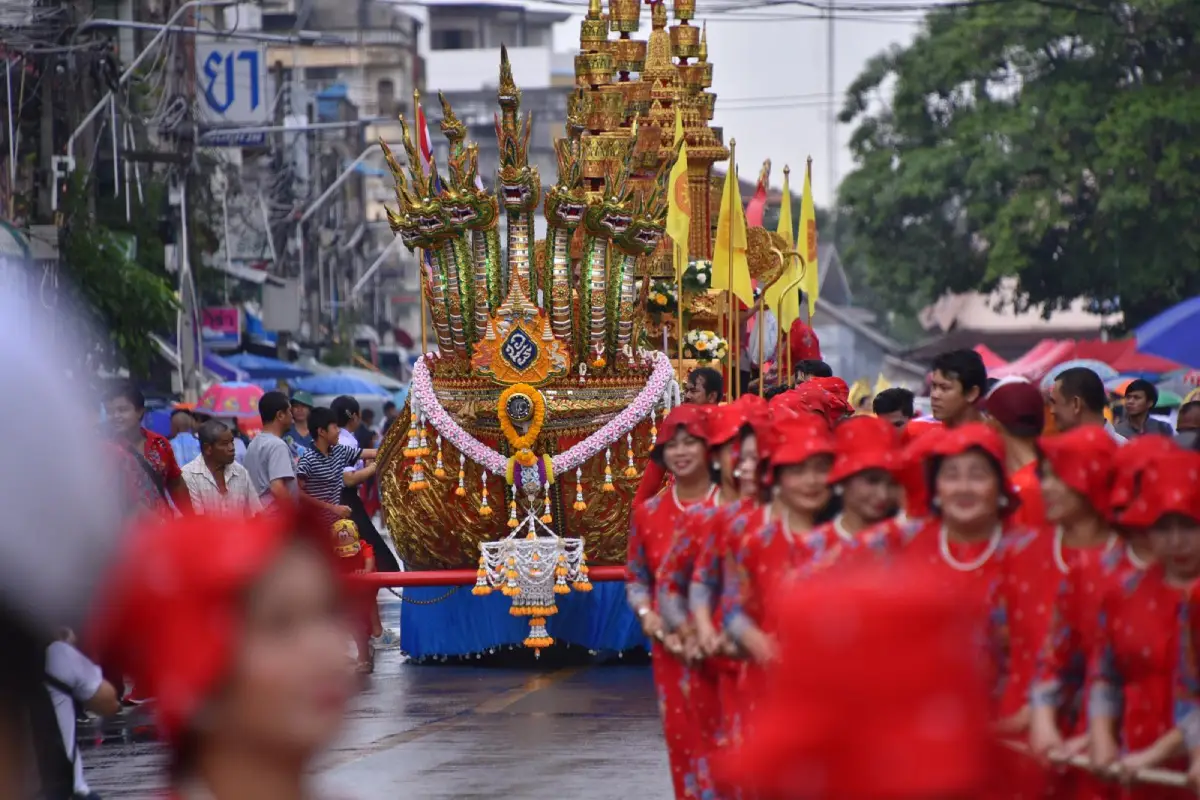
Chak Phra is practised in several southern provinces, but Surat Thani has developed a distinctive city-wide form. Temples and communities from across the province bring their phanom phra floats to Ban Don, the historic urban centre of Surat Thani. The floats line the Tapi riverfront and allow visitors to make merit with many temples without travelling across the province. Thick pulling ropes, nang lak participants, dance groups, drums and the tall roofs of the ceremonial pavilions give the event a strong visual identity while preserving its religious purpose.
The official 2026 Chak Phra, Pha Pa and Long-Boat Racing Festival is scheduled for 23–31 October 2026, lasting 9 days and 9 nights. The main procession and opening ceremony take place on 27 October. The principal venue is the Tapi River embankment around Naris Bridge in Mueang Surat Thani District. Pha pa displays and processional activities extend into streets, neighbourhoods, homes, shops and public offices throughout Surat Thani Municipality. Because Chak Phra follows the lunar calendar, its Gregorian date changes from year to year.
The end of Buddhist Lent and Chak Phra fall on consecutive days, not on the same day. Wan Ok Phansa, the end of the monastic rains retreat, is observed on the full-moon day of the 11th lunar month. Monks conclude the retreat and perform the Pavarana ceremony on that day. Chak Phra takes place the next morning, the first waning-moon day of the 11th lunar month. In 2026, Wan Ok Phansa falls on 26 October and Surat Thani’s main Chak Phra procession falls on 27 October. This distinction matters when planning a visit because the evening of 26 October is associated with viewing pha pa displays, while the morning of 27 October brings the offering ceremonies and principal processions.
The religious meaning of Chak Phra is connected with the Buddhist narrative of the Buddha spending the rains retreat in Tavatimsa Heaven to teach his mother. At the end of the retreat, the Buddha returned to the human world and was welcomed by a large gathering of devotees bearing food and offerings. The story also informs Tak Bat Devo, the alms-giving observance that commemorates the Buddha’s descent. During Chak Phra, the Buddha image represents the returning Buddha, while the phanom phra float functions as the ceremonial vehicle that carries the sacred image into the community.
The significance of Lak Phra lies as much in its preparation as in the public procession. Work usually intensifies 10–15 days before the event, and some temples begin earlier. Monks, craftspeople, families and young volunteers repair the float, build the pavilion, cut decorative panels, paint motifs, arrange textiles and prepare electrical systems. A single float can require carpenters, painters, floral decorators, electricians, musicians, rope handlers and dance trainers. The annual construction process passes practical cultural knowledge from one generation to the next.
The phanom phra float is the artistic centre of the festival. Local usage includes ruea phra, rot phra and ruea phanom phra, depending on whether the structure travels on land or water. A richly decorated busabok pavilion rises above the base and shelters the Buddha image. Craftspeople coordinate the platform, Thai patterns, arches and roof tiers so that the composition remains visible from a distance. Prow and stern sections may take the form of naga serpents, hong birds, garuda figures or creatures from Thai religious literature. The structure must also provide safe space for the Buddha image, ritual objects, monks and required equipment.
Traditional land floats once rested on two large wooden runners and were physically dragged along the ground. This construction explains the word lak, meaning to pull or drag. Modern temples often mount their pavilions on trucks or wheeled platforms so the floats can travel safely from distant temples into Surat Thani city. The method of transport has changed, but the pulling rope and walking procession remain symbols of collective participation. Land floats pass through neighbourhoods or join the main route from the Provincial Hall area towards Naris Bridge and the Tapi riverfront.
Water-borne phanom phra floats reflect southern Thailand’s river and canal geography. The traditional base may consist of one to three boats lashed together to form a stable raft, with the ceremonial pavilion positioned at the centre. Other boats tow or accompany the structure along rivers, canals or coastal waterways. In Surat Thani, the Tapi River provides the principal setting. The sight of decorated floats on the water, with drums heard from both river and shore, reveals how closely the Ban Don community developed around water transport.
Land and water processions use different vehicles but share the same purpose: bringing the Buddha image out of the temple so the public can pay respect and make merit. Land floats suit temples away from navigable waterways and now travel on roads. Water floats preserve the practice of riverine temples and communities connected to the Tapi. Surat Thani presents both forms within the same festival, allowing visitors to understand the transition from a water-based way of life to a modern provincial city.
In the days before Chak Phra, communities rehearse with gongs, barrel drums, taphon drums and the deep southern phon drum. Local accounts call this period khum phon or khum phra. The music serves several practical purposes: it trains the ensemble, prepares the pace of the procession and announces that the festival is approaching. On procession day, the rhythm helps walkers and rope teams coordinate their movement. The drums therefore support the physical act of pulling the float as well as the festive atmosphere.
The night of the full moon in the 11th lunar month transforms Surat Thani into a city of pha pa offering trees. Families, shops, schools, government offices and neighbourhood groups construct displays in front of their premises. A tree or branch forms the core, carrying a robe, monastic requisites, useful objects and donations. Larger displays may depict episodes from the Buddha’s life, Jataka stories, heaven, hell or moral teachings, illuminated so visitors can walk through the city and view them at night. This practice is known as phum pha pa na ban, or pha pa offering trees in front of the home, and is one of Surat Thani’s clearest cultural signatures.
The front-of-home pha pa tradition brings the merit-making ceremony directly into residential streets. A household prepares cloth, useful gifts and cooked food for monks, then watches over the display during the night of Wan Ok Phansa. Before dawn on the first waning-moon day, monks follow assigned lots to the individual displays. Residents kneel with hands together while the monk takes the cloth and receives the offering. The ceremony gives literal meaning to the local idea that merit comes to the doorstep.
The modern history of Surat Thani’s front-of-home pha pa custom includes two useful milestones. Local historical accounts credit Phayom Sarasin with encouraging a revival of the practice in 1924. Surat Thani Municipality later assumed a coordinating role. In 1987, the province recognised the combined Chak Phra and Pha Pa celebration as a major annual provincial event. These milestones help explain why municipal streets, civic organisations and households remain as important to the festival as the temples themselves.
Chak Phra day begins early. Residents offer alms and food near the floats, and the procession starts after the monks have eaten. Phanom phra floats from participating temples travel towards the central gathering area beside the Tapi River and Naris Bridge. Once the floats are parked in rows, visitors can pay respect to the Buddha images, donate to individual temples, receive blessed water and examine the craftsmanship more closely than they can while the procession is moving.
The phrase “worship at 100 temples and receive blessed water from 100 bowls in one remarkable day” captures a defining Surat Thani experience. Temples from across the province gather in the same urban area, making it possible to support many communities in a single visit. The precise number of participating floats varies with annual registration and temple readiness. Official 2026 publicity describes a gathering of more than 100 land and water phanom phra floats.
Khanom tom, a southern sticky-rice dumpling, is closely associated with Chak Phra. Families prepare the dumplings before the festival, using glutinous-rice dough and local wrapping methods that vary from place to place. Their compact form makes them suitable as food offerings and portable provisions. Within the festival, khanom tom serves as an offering, shared food and a domestic tradition that brings relatives together for preparation before the public event begins.
Sat tom is a playful activity derived from the surplus dumplings prepared for the merit-making occasion. Participants traditionally divide into sides and throw the dumplings according to local custom. The game once followed the meal offering or took place during a rest period in the procession, adding humour and relief after the physical work of pulling the floats. Visitors should join only in a clearly designated activity area. Food prepared for monks must be respected, and objects should never be thrown near Buddha images, monks or a moving procession.
Long-boat racing gives the festival another connection with the Tapi River. Paddlers must coordinate their stroke, power and response to signals so the entire boat moves as one unit. This teamwork mirrors the collective pull on a Chak Phra rope. Annual regulations define boat classes and crew sizes, and the programme may include races for royal trophies. Spectators should remain behind barriers along the embankment and stay clear of launching points, crew areas and safety operations.
Nang lak and dance groups represent the identity of participating temples and communities. Procession members wear Thai textiles or costumes designed to complement their float, performing in front of the ceremonial vehicle to drum rhythms. Their role is not separate from the observance: the group welcomes the public and demonstrates the community’s readiness to take part. Spectators should leave the route open, avoid walking between the dancers and the float, and never stand inside the working line of the pulling rope.
Artwork on the floats combines inherited Thai motifs with contemporary materials and lighting. Each community interprets the bow, pavilion base, mythical figures and illumination differently. Some floats emphasise traditional carved or cut patterns; others use lightweight materials and modern electrical systems. Float competitions encourage high standards, but the cultural value does not depend on expense alone. The safe installation of the Buddha image, respect for ritual use and participation of the community remain more important than lavish decoration.
Chak Phra also reflects the beliefs of agricultural and river communities. Traditional interpretations connect the merit of pulling the Buddha float with seasonal rain and fertility. Socially, the festival follows the monastic rains retreat, when people resume larger public activities and communal travel. Sharing labour, food, craftwork and processional duties strengthens relationships between temples and villages and gives younger participants practical responsibility.
The pulling rope creates one of the festival’s clearest images of social unity. As a float passes a home or neighbourhood, people step forward to pull for part of the route before handing the rope to the next group. This relay shows that the observance belongs to the wider community rather than to one temple alone. Unity is not merely a theme expressed in speeches; it becomes visible in the coordinated force needed to move, steer and protect the ceremonial float.
Travellers who want to see the religious sequence should arrive by the evening of Wan Ok Phansa. The night is best for walking among the illuminated pha pa displays. Before dawn the next morning, monks visit assigned offering trees and the main Chak Phra activities begin. Morning reveals the alms offerings and community preparations, midday is suitable for making merit along the rows of floats, and evening brings lighting and cultural programmes. Daily activities differ, so visitors should check the organiser’s current programme before setting out.
The event area can be understood in four functional zones. The Tapi River embankment and Naris Bridge form the main gathering area for floats, river viewing and festival stages. The land procession moves from the Provincial Hall side through the city towards the bridge. The Tapi River carries the water procession and long-boat races. Streets, homes, shops and public buildings across Surat Thani Municipality form the network of front-of-home pha pa displays. Traffic closures, parking arrangements and stage positions may change with the annual safety plan.
Naris Bridge is the most useful navigation point for visitors. The approximate central coordinates are 9.145623, 99.323642, on the Tapi riverfront in Talat Subdistrict, Mueang Surat Thani District, Surat Thani 84000. The festival covers a much wider area than a single map pin. Drivers should park outside the densest event zone and continue on foot. On the main procession day, walking between the riverfront, offering displays and food markets is generally more practical than moving a vehicle through short inner-city distances.
Getting There: Surat Thani International Airport is approximately 30 kilometres from Naris Bridge. Taxis, rental cars and city transfer services connect the airport with central Surat Thani. Surat Thani Railway Station is in Phunphin District, approximately 16 kilometres from the event area, with taxis, songthaews and local transport available for the onward journey. The city bus terminal is usually a 15–20 minute drive in normal traffic. Visitors staying around Na Mueang Road, the Shrine Market or the Tapi riverfront can reach much of the festival on foot. Public transport and walking are the best options on 27 October because roads near the Provincial Hall, Naris Bridge and the embankment may be closed or restricted.
Drivers should allow more time than on an ordinary day and must not block temple entrances, U-turn points, bridge approaches or emergency lanes. Parking beside the floats is impractical because the large vehicles need space to turn and align. Families travelling with children or older relatives should choose an obvious meeting point away from the procession route, exchange telephone numbers and avoid narrow crowd bottlenecks while floats are moving.
Late October in Surat Thani can bring rain. A compact umbrella or rain jacket, shoes with reliable grip and a waterproof cover for a telephone or camera are useful. Large umbrellas can block the view in a crowd, so move to the side when opening one. Timber surfaces, ramps and the river embankment may become slippery. Adults should keep children close whenever the route approaches the Tapi River.
Clothing should be respectful and suitable for extended walking. Covered shoulders, appropriately long trousers or skirts and comfortable footwear allow visitors to move between outdoor festival areas and spaces used for worship. Follow signs and instructions before entering any float platform or designated prayer area. Remove shoes where required, and do not touch Buddha images, pavilions, offerings or load-bearing ropes without permission.
Photography is welcome in public areas, but the ceremony should take priority over the picture. Avoid flash near monks and ritual participants, keep selfie sticks away from the pulling rope and never climb a float base for a higher angle. Ask before taking close portraits of children, dancers or householders at pha pa displays. The best time to study and photograph the craftsmanship is after the floats have parked, when visitors can move around them without interrupting the procession.
Donations should be placed in the boxes, trays or digital channels provided by each temple. Money should not be placed directly on a Buddha image or on decorative surfaces that are not intended to receive offerings. Queue calmly when receiving blessed water. Making merit with many temples does not require rushing to maximise a number; respectful attention and understanding are more valuable than the number of stops completed.
Food areas reflect the flavours of Surat Thani through southern curries, snacks, seafood, sweets and dishes from the city’s evening markets. Choose vendors with clean preparation areas and appropriate hot or cold storage. A refillable bottle and reusable bag reduce waste, but food containers should never be placed on a phanom phra float or in a ritual area. The Surat Thani Shrine Market and Na Mueang Road are close enough to offer alternatives when the main riverside stalls are crowded.
Older visitors, wheelchair users and families with young children may find it easier to view the floats after the moving procession has finished. Barriers, temporary cables and uneven surfaces can limit access in some sections. Ask on-site staff for the most practical entrance and nearest toilet. Arriving early, before crowds reach their peak, or visiting on a day after the opening procession can make merit-making and close viewing considerably easier.
Water safety requires particular attention because several activities take place beside the Tapi River. Stay within authorised spectator areas, do not stand on embankment edges or closed pontoons and do not take a private boat near the race course. Never leave a child unattended near the water. If heavy rain, wind or official instructions require a change of location, move immediately. A pleasant riverside walkway in ordinary conditions can become extremely crowded during a procession or boat race.
Surat Thani Municipality is the principal coordinating body, working with Surat Thani Province, the Surat Thani Provincial Administrative Organisation, temples, communities, cultural and tourism agencies, safety services and other partners. The municipality’s published telephone number is +66 77 272 513. Use the organiser’s current announcements for exact daily times, race categories, traffic closures and any changes to the programme.
The festival supports the local economy at several levels. Temples and communities commission materials, craftwork and food in advance. City-centre restaurants serve large crowds, accommodation near the riverfront fills quickly and local producers gain a public marketplace. Economic activity must remain balanced with the sacred character of the event. Stalls, amplified sound and commercial promotion should not obstruct floats, chanting or merit-making areas.
Cultural preservation involves both objects and knowledge. The objects include float frames, pavilions, decorative patterns, drums, textiles and costumes. The knowledge includes load-bearing design, safe river assembly, phon-drum rhythm, processional control and ritual order. Much of this knowledge is transmitted by doing rather than by reading. Giving young people meaningful construction and organisational roles is therefore more valuable than limiting their participation to a performance on the final day.
A modern Chak Phra festival must accommodate a large audience without damaging the values or physical spaces on which it depends. The Tapi River hosts floats, races and stages. Inner-city roads carry land processions, pedestrians and everyday traffic. Floats have also become larger and may use complex lighting. Crowd planning, electrical safety and processional spacing are therefore part of responsible cultural preservation, not administrative matters separate from tradition.
A one-day cultural visit works best when it begins on the evening of 26 October 2026 and continues through the morning of 27 October. Visitors can view pha pa displays, eat at the Shrine Market and learn the route to Naris Bridge on the first evening. Early the next morning, they can see the offering ceremonies and principal land and water processions, then make merit along the parked floats. The afternoon can be used for craft details or boat racing, followed by cultural activities announced for the evening.
With 2–3 days, visitors can separate the experience into the pha pa night and old-town walk, the main procession and merit-making day, and a quieter day for parked floats and nearby landmarks. Surat Thani City Pillar Shrine, Wat Sai, the Shrine Market and Ko Lamphu Public Park are all within a short distance of the central venue. This slower plan suits older travellers, families and photographers who want time with the artistry rather than spending the whole visit in the heaviest procession-day crowds.
Accommodation should be chosen by walking distance as well as by room facilities. Hotels around Na Mueang Road and the market are close enough for guests to return during the day, although street closures and amplified programmes can affect vehicle access. Travellers continuing to the airport, railway station or Don Sak piers should allow extra time and discuss transport with their hotel in advance. Booking early is advisable because the nearest city-centre rooms are in high demand during the festival.
Surat Thani Lak Phra is therefore much more than a Buddha-image parade after Buddhist Lent. Within one celebration, visitors encounter Buddhist history, faith, community craft, percussion, southern food, traditional games, river racing and province-wide cooperation. Anyone who follows the sequence from the pha pa night to the dawn offerings, the phanom phra processions, merit-making and later celebrations will see that the festival’s scale is not defined by the number of floats alone. Its real strength comes from temples, households and the city working together to bring a shared act of faith into public life.
| Event Name | Surat Thani Chak Phra, Pha Pa and Long-Boat Racing Festival 2026 |
| Alternative Names | Lak Phra Festival, Chak Phra Festival, Surat Thani Chak Phra Festival |
| 2026 Event Dates | 23–31 October 2026, spanning 9 days and 9 nights |
| Main Chak Phra Day | 27 October 2026, the first waning-moon day of the 11th lunar month |
| Wan Ok Phansa | 26 October 2026, the full-moon day of the 11th lunar month |
| Festival Type | End-of-Buddhist-Lent merit-making festival with land and river processions, neighbourhood pha pa offerings, long-boat races and cultural activities |
| Main Highlights | More than 100 land and water phanom phra floats, merit-making with many temples in one place, front-of-home pha pa trees, nang lak and dance processions, phon drumming and long-boat racing on the Tapi River |
| Religious Origin | The festival commemorates the Buddha’s return from Tavatimsa Heaven after the rains retreat. A Buddha image is carried into the community on a ceremonial float for worship and merit-making. |
| Historical Milestones | The front-of-home pha pa practice was revived in 1924, and Surat Thani Province recognised the combined Chak Phra and Pha Pa celebration as an annual provincial event in 1987. |
| Main Venue | Tapi River embankment, Naris Bridge, the Provincial Hall–Naris Bridge procession route and neighbourhoods within Surat Thani Municipality |
| Address | Naris Bridge and Tapi riverfront, Talat Subdistrict, Mueang Surat Thani District, Surat Thani 84000, Thailand |
| Approximate Central Coordinates | 9.145623, 99.323642 |
| Activity Areas | 1. Tapi River embankment and Naris Bridge 2. Land-float procession route 3. Tapi River water procession and race course 4. Front-of-home pha pa displays throughout the municipality |
| Organisers | Surat Thani Municipality with Surat Thani Province, the Provincial Administrative Organisation, temples, communities and partner agencies |
| Getting There | Search for “Naris Bridge Surat Thani.” The venue is about 30 kilometres from Surat Thani Airport and 16 kilometres from Surat Thani Railway Station. Visitors staying near Na Mueang Road and the market can walk to the main event area. |
| Visitor Etiquette | Dress respectfully, do not cross a moving procession, keep clear of pulling ropes, do not touch Buddha images or pavilions, remain behind river barriers and follow staff instructions. |
| Nearby Attractions | 1. Surat Thani City Pillar Shrine, approximately 0.8 kilometres 2. Surat Thani Shrine Market and Wat Sai, approximately 0.7 kilometres 3. 100-Year Curved Bridge Market, approximately 0.9 kilometres 4. Ko Lamphu Public Park, approximately 1.5 kilometres 5. Wat Phatthanaram, approximately 1.8 kilometres |
| Nearby Restaurants | 1. Thip Rot, approximately 0.1 kilometres, Tel. +66 84 246 2262 2. Baan No. 5, Naris Bridge Branch, approximately 0.2 kilometres, Tel. +66 87 547 7345 3. Seree Tae Tiam, Shrine Market Branch, approximately 0.8 kilometres, Tel. +66 81 895 2065 4. Day & Night of Surat Thani, approximately 4.5 kilometres, Tel. +66 77 405 795 5. Lamphu 1 Pak Nam Tapi, approximately 7 kilometres, Tel. +66 77 285 120, +66 65 994 4954 |
| Nearby Accommodation | 1. Rajthani Hotel, approximately 0.3 kilometres, Tel. +66 77 203 141, +66 77 203 142 2. CBD Hotel Suratthani, approximately 0.3 kilometres, Tel. +66 77 281 999 3. My Place @ Surat Hotel, approximately 0.5 kilometres, Tel. +66 77 272 288 4. Blu Monkey Hub & Hotel Suratthani, approximately 1.2 kilometres, Tel. +66 92 539 5939 5. Orchid Riverview Hotel, approximately 1.8 kilometres, Tel. +66 77 380 666 |
| Contact | Surat Thani Municipality, Tel. +66 77 272 513 |
Frequently Asked Questions (FAQ)
Q: When is the Surat Thani Lak Phra Festival in 2026?
A: The festival runs from 23 to 31 October 2026, spanning 9 days and 9 nights. The main Chak Phra procession and opening ceremony take place on 27 October 2026.
Q: Are Wan Ok Phansa and Chak Phra on the same day?
A: No. Wan Ok Phansa falls on the full moon of the 11th lunar month, while Chak Phra takes place the next day. In 2026, the dates are 26 and 27 October respectively.
Q: Where is the Surat Thani Chak Phra Festival held?
A: The main venue is the Tapi River embankment around Naris Bridge in Mueang Surat Thani. Activities also extend along the Provincial Hall procession route and throughout municipal neighbourhoods displaying front-of-home pha pa trees.
Q: Which day offers the most complete cultural experience?
A: Stay in the city on the evening of 26 October to see the pha pa displays, then attend the early offerings, land and water processions and riverside merit-making on 27 October 2026.
Q: What is the difference between a land float and a water float?
A: A land phanom phra pavilion is mounted on a wheeled platform or vehicle for a road procession. A water phanom phra pavilion stands on a boat or raft and travels along the river. Both carry a Buddha image for public worship and merit-making.
Q: What is a front-of-home pha pa tree?
A: It is an offering display prepared outside a home, shop or office on the night of Wan Ok Phansa. Cloth, food and useful items are arranged on the display, and a monk receives the offering early the next morning.
Q: How do I travel to the Surat Thani Chak Phra Festival?
A: Use Naris Bridge as the navigation point. The venue is about 30 kilometres from Surat Thani Airport and 16 kilometres from Surat Thani Railway Station. On the main procession day, use public transport or park outside the event zone and continue on foot.
Q: What should I bring to the festival?
A: Wear respectful clothing and non-slip walking shoes. Bring a compact umbrella or rain jacket, drinking water, waterproof protection for your telephone and suitable cash for donations, and follow all barriers and staff instructions.
 Category: ●Art, Culture and Heritage
 Group: ●Art, Craft Centres, Tradition
Last Update : 3 MonthAgo
 Last Update : 3 MonthAgo
Recommend

 Landmarks and Memorials(1)
Art, Craft Centres, Tradition(8)
 Museums(5)
 Educational Places
 Educational Gardens, Farm(1)
 University
 Public university(1)
 Rajabhat University(1)
 Private University(1)
 Places of Worship
 Temple(32)
 Other Sacred Sites(8)
 Research and Development
 Royal Project(1)
 Suburban Living
 Village, Community(6)
 Local Market(1)
 Nature and Wildlife
 National Parks and Marine Reserves(8)
 Mountain (Doi)(2)
 Dam, Reservoir, Lake(8)
 Waterfalls(34)
 Hot Springs(7)
 Caves(18)
 River, Canal(11)
 Bays and Beaches(30)
 Islands(16)
 Other natural attractions(10)
 Entertainment and Agricultural
 Animal camps and shows(6)
 Farms, Parks and Ecotourism(7)
 Outdoor and Adventure Activities(2)
 Shopping
 Shopping and Night Market(1)
 Travel Articles, Recipes
 Travel Review, Food Review(1)
 Southern Food Menu, Southern Food Recipes(1)


