
lovethailand home >South Travel Attractions >Surat Thani Travel Attractions >Kan Chana Dit >Ka Dae > Surat Thani Oyster Farming Area
TL;DR: Surat Thani Oyster Farming Area is located at Around the mouths of Khlong Tha Thong and Khlong Kradae, Kanchanadit District, Surat Thani Province, open This is an open-water oyster farming area; visitors should arrange a boat or.

Surat Thani Oyster Farming Area
Open Days: This is an open-water oyster farming area; visitors should arrange a boat or local service in advance.
Best Visiting Time: Morning or low tide
Surat Thani Oyster Farming Area, often referred to in Thai travel sources as the oyster farming center or oyster farm of Kanchanadit, is a coastal aquaculture and community-based learning destination in Surat Thani Province. The area is located around the mouths of Khlong Tha Thong and Khlong Kradae, where freshwater canals meet the coastal waters of Bandon Bay. This natural setting creates an ideal brackish-water environment for oyster cultivation. The area is especially known for large Surat Thani oysters, a local specialty valued for their size, freshness, and naturally sweet flavor.
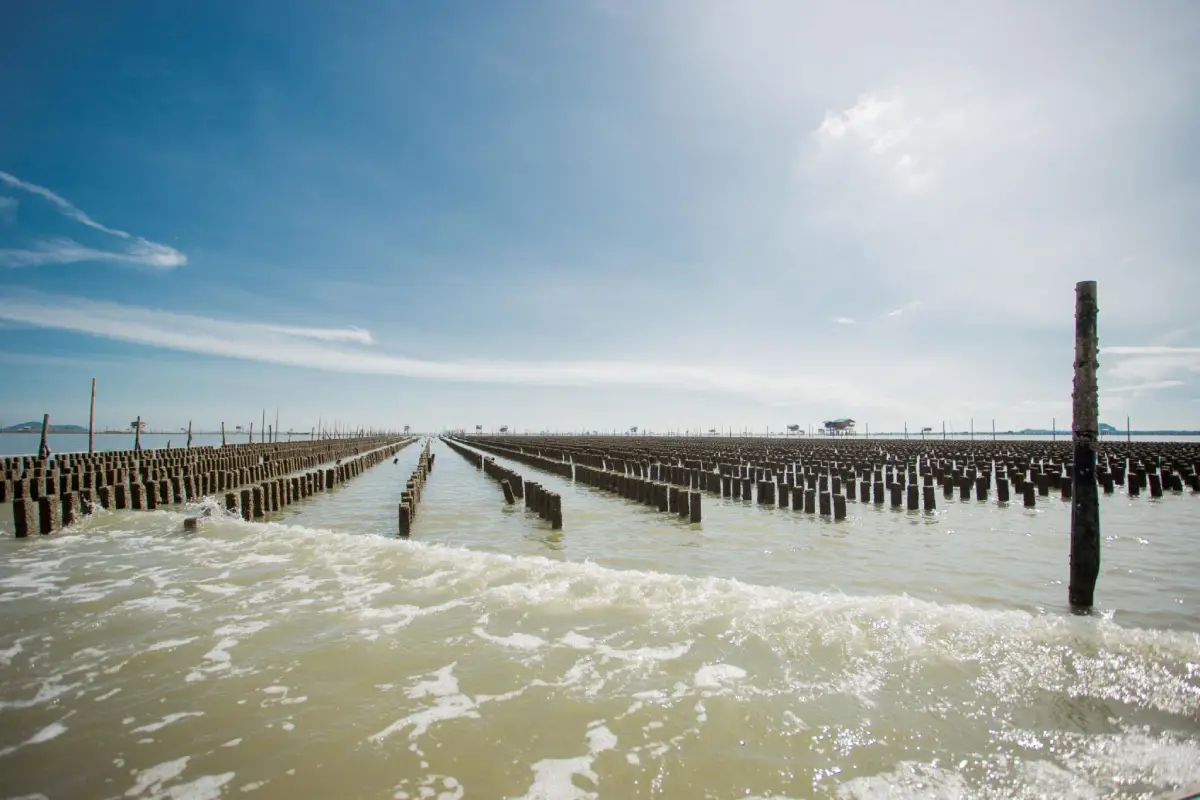
This is not a conventional tourist center with a fixed building, ticket counter, and walk-in exhibition hall. It is a working oyster farming area connected with local fishing communities. Visitors normally experience the area by arranging a long-tail boat from the Tha Thong community or nearby local operators. The trip allows visitors to see oyster farms in the water, concrete posts and farming structures where oysters attach and grow, floating huts used by fishermen, mangrove scenery, and the everyday coastal livelihood of Kanchanadit.
The original local description identifies the area as a natural oyster cultivation site at the mouths of Khlong Tha Thong and Khlong Kradae. It also notes that oysters from these estuary areas are larger than those from many other places. This core identity remains important today, as Kanchanadit and Bandon Bay continue to appear in tourism, community, and trade-related sources as a well-known oyster production area. For travelers, the visit is valuable because it shows the origin of one of Surat Thani’s most recognizable food products, rather than presenting oysters only as a dish served in restaurants.
The landscape of the oyster farming area is shaped by the meeting of river water, canal water, and the sea. Nutrient-rich brackish water supports the growth of oysters and other coastal shellfish. Local farmers use suitable materials such as concrete posts, ropes, and other structures to allow oyster larvae to attach and grow. Over time, the oysters develop naturally in the water, while farmers monitor the farm, maintain equipment, and harvest oysters when the size and quality are suitable.
A boat trip from the Tha Thong area to the oyster farms usually takes about 20 minutes. The route passes local waterways, coastal communities, mangroves, fishing boats, and open farming areas. The journey is part of the experience. Visitors can observe how the settlement, waterways, and sea are connected, and how aquaculture remains part of everyday life in Kanchanadit. The boat ride also gives a clearer sense of why the area is different from inland attractions: everything depends on tide, weather, water quality, and the rhythm of the sea.
The best time to visit is in the morning or during low tide. At low tide, oyster clusters attached to concrete posts and farming structures are easier to see. When the tide is high, visitors may mostly see the tops of posts and the water surface. Choosing the right time therefore affects the quality of the visit. A well-timed trip allows travelers to see the actual oyster-growing system more clearly and understand how local farmers work with the natural rise and fall of the tide.
One of the most memorable sights is the presence of small huts, known locally as khanam, built over the water. These simple structures are used by oyster farmers as resting places, work areas, and observation points for their farms. Some have also been developed into community-based tourism spaces where visitors can learn about oyster cultivation, taste seafood, and understand the fishing lifestyle of Bandon Bay. The khanam is one of the strongest visual symbols of Surat Thani’s oyster-farming culture.
Surat Thani oysters are widely associated with the qualities of being pale, plump, clean, and fresh. The reputation comes from the suitable water conditions of Bandon Bay and the experience of local farmers. When visitors see the farms directly, they understand that oyster quality depends on more than branding. It is shaped by water movement, salinity, nutrients, local knowledge, careful maintenance, and time. A single oyster reflects the wider relationship between people, the coast, and the marine environment.
The visit can also include learning about other forms of coastal aquaculture and fishing, such as mussel farming, cockle farming, crab and fish catching, and mangrove-related activities in some community routes. These activities help visitors understand that Bandon Bay is not only an oyster area. It is a living coastal ecosystem that supports many types of seafood and many local families. Protecting water quality and coastal habitats is therefore essential for both the environment and the local economy.
The Pak Nam Kradae area is another important point connected with seafood, oyster farms, mangroves, and local restaurants. Many visitors combine an oyster farm trip with a seafood meal in the area. This creates a complete route: seeing the farming source, understanding the production process, and then tasting local seafood near the coast. For travelers who enjoy food culture, this is one of the most direct ways to experience Surat Thani’s identity.
Families, students, educational groups, seafood lovers, photographers, and cultural travelers can all benefit from visiting the oyster farming area. Children can learn about estuary ecosystems and the origin of seafood, while adults can better understand local livelihoods and the economic importance of aquaculture. The trip is also useful for anyone interested in sustainable community tourism, because it shows how local people use natural resources while depending on the health of the environment.
Visitors should behave respectfully throughout the trip. Oyster farms are working areas, not artificial display zones. Do not touch farming structures without permission, do not climb onto huts or platforms without the owner’s consent, do not throw trash into the water, and follow the boat operator’s instructions. Wearing a life jacket is recommended for all boat trips, especially for children, elderly visitors, and anyone unfamiliar with small boats.
Getting There is easiest by private car, rental car, or local hired vehicle. From Surat Thani city, travel toward Kanchanadit District on Highway 401, then continue to the Tha Thong or Kradae area depending on the planned boat departure point. Visitors who choose the Tha Thong route should arrange a long-tail boat from the local community. Visitors who choose the Pak Nam Kradae route can combine the trip with seafood restaurants and coastal viewpoints in the same area.
Because the experience depends on tide, boat availability, weather, and local operators, travelers should arrange the visit in advance. Group travelers should confirm the number of passengers, boat capacity, life jackets, meeting point, boat cost, and expected duration before departure. During the rainy season or when the sea is rough, the plan may need adjustment. Good preparation makes the trip safer and more meaningful.
A visit to the oyster farming area can be combined with nearby places in Kanchanadit, such as Pak Nam Kradae, Kadaejae Agricultural Monkey Training Center, Wat Phra Phutthabat, Wat Tham Khuha, Sinmana Farmstay, and local seafood restaurants. This route helps visitors experience Surat Thani through food, fishing culture, coastal ecology, and community life rather than seeing the province only as a gateway to islands.
Overall, the Surat Thani Oyster Farming Area is one of the most meaningful coastal experiences in Kanchanadit. It brings together Bandon Bay, Khlong Tha Thong, Khlong Kradae, local fishing communities, oyster farms, floating huts, mangroves, and fresh seafood. With the right timing, advance boat arrangements, and respectful behavior, the visit offers a clear and memorable understanding of why Surat Thani oysters are so strongly connected with the identity of the province.
| Name | Surat Thani Oyster Farming Area / Oyster Farm, Kanchanadit |
| Thai Name | ศูนย์เพาะเลี้ยงหอยนางรม / ฟาร์มหอยนางรมสุราษฎร์ธานี |
| Location | Around the mouths of Khlong Tha Thong and Khlong Kradae, Kanchanadit District, Surat Thani Province |
| Address Summary | Tha Thong community, Ban Pak Nam Tha Thong, and Ban Pak Kadae areas, Kanchanadit District, Surat Thani 84160, Thailand |
| Reference Coordinates For Ban Pak Kadae | 9.20969462416023, 99.47748759745497 |
| Place Type | A natural oyster farming area in estuary and coastal waters, usually visited by local long-tail boat |
| Highlights | Boat trip to oyster farms, oyster clusters on concrete posts, oyster farming methods, floating huts, mangrove scenery, and Kanchanadit fishing-community life |
| Significance | A well-known production area for Surat Thani oysters and an important part of the province’s seafood identity |
| Travel Information | From Surat Thani city, take Highway 401 toward Kanchanadit District, then continue to Tha Thong or Kradae for a local boat trip. The boat ride from Tha Thong village pier to the oyster farm area takes about 20 minutes. |
| Current Status | An active oyster farming and community-based coastal tourism area in Kanchanadit District |
| Best Visiting Time | Morning or low tide, when oysters attached to concrete posts and farming structures are easier to see |
| Fees | No confirmed fixed admission fee for a permanent visitor center; boat and local service costs depend on the operator. |
| Main Areas / Zones | Tha Thong village pier Khlong Tha Thong estuary Khlong Kradae / Ban Pak Kadae area Open-water oyster farming plots Concrete posts and oyster farming structures Floating huts Mangrove and boat-route areas |
| Main Activities | Boat tour, oyster farming observation, coastal aquaculture learning, fishing-community photography, local seafood tasting, and Bandon Bay ecosystem study |
| Coastal Aquaculture Information Office | Surat Thani Coastal Aquaculture Research and Development Center, Tel. 077-255-288 |
| Visitor Guidelines | Arrange the boat in advance, wear a life jacket, do not litter, do not touch oyster-farm equipment without permission, do not climb onto huts or farm structures by yourself, and follow the boat operator or farm owner’s instructions. |
| Nearby Tourist Attractions | 1. Ban Pak Nam Tha Thong, about 1 km 2. Pak Nam Kadae, about 14 km 3. Kadaejae Agricultural Monkey Training Center, about 18 km 4. Wat Phra Phutthabat Kanchanadit, about 19 km 5. Wat Tham Khuha Surat Thani, about 20 km 6. Sinmana Farmstay, about 22 km 7. Sri Surat Bridge, about 28 km |
| Nearby Restaurants | 1. Khiang Le Seafood Surat Thani, about 14 km, Tel. 077-255-243, 085-571-1819 2. Nai Aow Seafood, about 14 km, Tel. 077-379-311, 092-242-3366 3. THE BEST Tom Yum Noodles With Lava Egg, about 18 km, Tel. 096-939-6194 4. D’Duck, about 20 km, Tel. 064-549-9945 5. Grilled Bananas Mae Fad Coconut Milk Drink, Kanchanadit Branch, about 20 km, Tel. 089-594-1709 |
| Nearby Accommodations | 1. Sinmana Farmstay, about 22 km, Tel. 081-597-7575 2. Rose Garden Resort, about 20 km, Tel. 085-112-2339 3. Klang Na Resort, about 24 km, Tel. 080-531-5119 4. Tongmai Resort, about 25 km, Tel. 077-452-556 5. K Park Grand Hotel Surat Thani, about 29 km, Tel. 077-213-700-5, 082-423-0491 6. The O Valley Boutique Hotel, about 35 km, Tel. 077-357-311 |
Frequently Asked Questions (FAQ)
Q: Where is the Surat Thani Oyster Farming Area located?
A: It is located around the mouths of Khlong Tha Thong and Khlong Kradae in Kanchanadit District, Surat Thani Province, within the coastal environment of Bandon Bay.
Q: How do visitors reach the oyster farms?
A: Visitors travel from Surat Thani city toward Kanchanadit District, then arrange a local long-tail boat from the Tha Thong or Kradae area to visit the open-water oyster farms.
Q: What is the best time to visit?
A: Morning or low tide is best because oyster clusters and farming structures attached to concrete posts are easier to see.
Q: How long is the boat ride from Tha Thong?
A: The boat ride from Tha Thong village pier to the oyster farming area takes about 20 minutes.
Q: Is there an admission fee?
A: There is no confirmed fixed admission fee for a permanent visitor center. Main expenses depend on the boat or local service arranged before the trip.
Q: What makes Surat Thani oysters special?
A: They are known for their large size, plump texture, freshness, and growth in nutrient-rich brackish water around Bandon Bay.
Q: Is the trip suitable for families?
A: Yes, but families should choose calm weather, use life jackets, and supervise children closely throughout the boat trip.
Q: What nearby places can be visited on the same route?
A: Nearby places include Pak Nam Kadae, Kadaejae Agricultural Monkey Training Center, Wat Phra Phutthabat, Wat Tham Khuha, Sinmana Farmstay, and seafood restaurants in Kanchanadit.
 Category: ●Entertainment and Agricultural
 Group: ●Farms, Parks and Ecotourism
Last Update : 1 MonthAgo
 Last Update : 1 MonthAgo
 Click to Access the Navigation Map GPS
Surat Thani Oyster Farming Area Map
Recommend

 Art, Culture and Heritage
 Landmarks and Memorials(1)
 Art, Craft Centres, Tradition(8)
 Museums(5)
 Educational Places
 Educational Gardens, Farm(1)
 Places of Worship
 Temple(32)
 Other Sacred Sites(8)
 Research and Development
 Royal Project(1)
 Suburban Living
 Village, Community(6)
 Local Market(1)
 Nature and Wildlife
 National Parks and Marine Reserves(8)
 Mountain (Doi)(2)
 Dam, Reservoir, Lake(8)
 Waterfalls(34)
 Hot Springs(7)
 Caves(18)
 River, Canal(11)
 Bays and Beaches(30)
 Islands(16)
 Other natural attractions(10)
 Animal camps and shows(6)
Farms, Parks and Ecotourism(7)
Animal camps and shows(6)
Farms, Parks and Ecotourism(7)
 Outdoor and Adventure Activities(2)
 Shopping
 Shopping and Night Market(1)
 Travel Articles, Recipes
 Southern Food Menu, Southern Food Recipes(1)


