
lovethailand home >South Travel Attractions >Songkhla Travel Attractions >Muang Songkhla >Khao Rup Chang > Songkhla Rajabhat University
TL;DR: Songkhla Rajabhat University is located at 160 Moo 4, Kanchanawanit Road, Khao Rup Chang Subdistrict, Mueang Songkhla District, Songkhla 90000, Thailand.
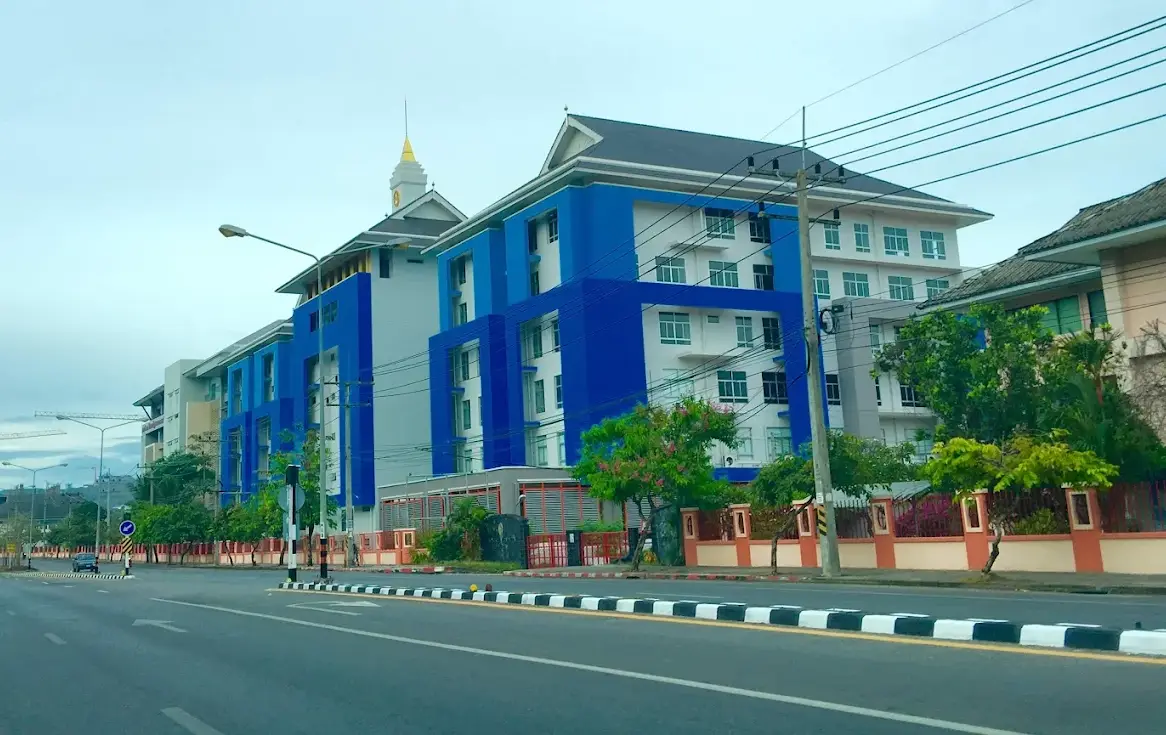
Songkhla Rajabhat University
Open Days (Administrative Offices): Monday – Friday, excluding public holidays
Opening Hours (Administrative Offices): 08:30 – 16:30
Songkhla Rajabhat University (SKRU) is a public university with a long history and an important role in the development of education in southern Thailand. Located at 160 Moo 4, Kanchanawanit Road, Khao Rup Chang Subdistrict, Mueang Songkhla District, Songkhla Province, the university occupies an area of 444 rai, 1 ngan, and 14.3 square wah. Its history began in 1919 as a regional teacher-training school before the institution developed through several stages, including Songkhla Teacher Training School, Songkhla Teachers College, and Songkhla Rajabhat Institute. It officially became Songkhla Rajabhat University on June 15, 2004. Today, the university is recognized for teacher education, the humanities, social sciences, science and technology, business administration, agricultural technology, fine arts, and community development, while maintaining a strong commitment to the sustainable development of southern Thailand.
In 2026, Songkhla Rajabhat University marked 107 years since the establishment of its original teacher-training institution and 22 years since receiving university status. This long history makes the institution more than a place of higher education. For generations, it has contributed to the development of schools, the preparation of teachers, the expansion of educational opportunities, and the creation of knowledge for communities throughout southern Thailand. The university currently comprises eight faculties and one college, with educational operations extending to Satun Province and a regional development mission covering Songkhla, Satun, and Phatthalung provinces.
The main campus is situated in Khao Rup Chang, an important educational and residential area within Mueang Songkhla District. Kanchanawanit Road connects Songkhla city with Hat Yai and nearby communities, making the university accessible from several directions. The campus includes academic buildings, the central administration building, faculty offices, laboratories, learning centers, a library, student residences, sports facilities, dining areas, and spaces for student activities. These facilities are spread across a large university compound designed to support both formal education and everyday student life.
The campus environment combines landscaped grounds, mature trees, contemporary academic buildings, and outdoor spaces for recreation and social activities. Many buildings emphasize functional design and the needs of modern teaching, while some architectural features reflect local cultural influences. Internal roads connect the major faculty buildings and administrative facilities. The university also provides an internal shuttle service during designated periods to help students, staff, and visitors move around the campus more conveniently.
The history of Songkhla Rajabhat University began in 1919, when educational authorities responsible for Monthon Nakhon Si Thammarat, whose administrative center was then in Songkhla, worked with the Songkhla provincial education authorities to establish a regional teacher-training program. The objective was to prepare teachers for primary schools at a time when educational opportunities were expanding across southern Thailand. The training program was initially conducted alongside the regional school that later became Mahavajiravudh School, then located in the area now associated with Wichianchom School.
During the earliest period, students who had completed the third year of primary education could continue studying through the fourth, fifth, and sixth primary grades while receiving additional teacher-training instruction. Graduates obtained a regional teaching certificate. This system reflected the educational conditions of early twentieth-century Thailand, when the expansion of primary schooling created a pressing demand for qualified teachers, particularly in rural communities and districts far from major urban centers.
Following the introduction of the Primary Education Act in 1921, teacher preparation became more formally organized. In 1925, educational authorities established a dedicated regional elementary teacher-training school at Tha Chamuang in the former Kamphaeng Phet District, now Rattaphum District, Songkhla Province. Known as the Elementary Teacher Training School, the institution admitted qualified secondary-school graduates and teachers nominated by provincial authorities. Students normally studied for two years before receiving a professional elementary teaching certificate.
The reorganization of Thailand's administrative system in 1933, which ended the former monthon system, brought further changes. In 1934, the institution at Tha Chamuang was renamed the Provincial Certificate Teacher Training School and its admission requirements and curriculum were adjusted. In 1939, it adopted a two-year program for students who had completed the third year of secondary school, with graduates receiving a provincial teaching certificate. These developments reflected the gradual standardization of teacher training in Thailand.
The institution also participated in a program designed to prepare teachers for rural community schools. Students selected from remote subdistricts could enter a three-year teacher-training pathway and then return to serve in their home communities after graduation. This approach was particularly significant because it linked teacher education directly to local needs and helped distribute educational services to areas with limited access to trained personnel. The commitment to serving communities established during this early period remains an important part of the university's identity today.
In 1939, the Provincial Certificate Teacher Training School moved from Tha Chamuang to Kho Hong in Hat Yai District. In 1947, it was reorganized as an Elementary Teacher Training School, accompanied by further curriculum adjustments. These changes reflected the growing need to strengthen teacher qualifications and improve the quality of primary education as the national school system continued to expand.
Another important development occurred in 1955, when the institution began offering a two-year Certificate in Education program for eligible secondary-school graduates and adopted the name Songkhla Teacher Training School. On June 1, 1956, the school moved to the Ban Khao Rup Chang area of Mueang Songkhla District. This location eventually became the present main campus of Songkhla Rajabhat University, establishing the geographical continuity that has characterized the institution for the following decades.
On May 1, 1961, Songkhla Teacher Training School was elevated to Songkhla Teachers College. During the same year, the college expanded its academic offerings to include the Higher Certificate in Education. The transition represented an important improvement in professional qualifications and academic standards. It also strengthened the college's position as a major institution for teacher preparation in southern Thailand.
The Teachers College Act of 1975 brought another significant change by allowing Songkhla Teachers College to offer bachelor's degree education in the teaching profession. Qualified holders of the Higher Certificate in Education and eligible in-service teachers could undertake two additional years of study to obtain a Bachelor of Education degree. This opened a pathway for experienced teachers to improve their academic credentials and professional knowledge.
In 1979, the college introduced programs for in-service teachers and educational personnel, providing opportunities for working professionals to continue studying toward higher teaching qualifications. In 1981, Songkhla Teachers College collaborated with Prince of Songkla University to offer studies in hotel management, tourism, and aquaculture through a project known as Songkhla Community College. This collaboration marked an important expansion beyond teacher preparation into academic and professional fields closely connected to the southern Thai economy.
The Teachers College Act of 1984 further expanded the responsibilities of teachers colleges by allowing them to provide professional education in fields needed by local communities. Songkhla Teachers College subsequently broadened its academic offerings. In 1986, it introduced continuing education for working personnel, known in Thai as Kor Sor Bor Por, initially in education and later extending into liberal arts and science. These developments strengthened the institution's role in lifelong learning and regional professional development.
February 14, 1992, marked a particularly important moment in the institution's history. King Bhumibol Adulyadej, King Rama IX, graciously bestowed the name “Rajabhat” upon the teachers colleges throughout Thailand. Songkhla Teachers College consequently became Songkhla Rajabhat Institute. The term Rajabhat is associated with service under the monarchy and expresses the ideal of using knowledge and education for the benefit of the people. The new name established a stronger shared identity for institutions dedicated to regional education and public service.
Songkhla Rajabhat Institute continued expanding its academic programs and began offering postgraduate education in 2001. On June 15, 2004, it was elevated to Songkhla Rajabhat University under the Rajabhat University Act of 2004. The transition provided a wider framework for academic administration, research, postgraduate education, and community engagement. Although the institution's organizational status changed, its original commitment to teacher education and local development remained central to its mission.
The university's history can therefore be understood through several major stages: its original establishment as a regional teacher-training institution in 1919; the development of specialized teacher-training schools; relocation to the present Khao Rup Chang campus in 1956; elevation to Songkhla Teachers College in 1961; the introduction of bachelor's degree programs in 1975; adoption of the Rajabhat name in 1992; and full university status in 2004. Each stage represents an institutional response to changing educational needs while maintaining continuity with its original purpose.
Songkhla Rajabhat University later expanded its educational opportunities into Satun Province. On January 24, 2009, the University Council approved the establishment project for Songkhla Rajabhat University, Satun Campus. The campus was developed to support human resource development and improve access to higher education in Satun and the southern border region. It is located in the Thung Yai Saraphi public land area, La-ngu Subdistrict, La-ngu District, Satun Province, and occupies approximately 339 rai, 3 ngan, and 35 square wah.
The distinction between the Songkhla and Satun campuses is important for prospective students and visitors. The main campus in Mueang Songkhla serves as the university's administrative center and offers a broad range of academic programs. The Satun Campus supports local educational development in a separate location, where the College of Innovation and Management is based. Students should always confirm the designated place of study for their particular program before making admission or travel arrangements.
The university's philosophy is to serve as a higher education institution for local development, while its vision is to be a leading university for sustainable local development. These principles shape its mission of producing qualified teachers and professionals, conducting research, providing academic services, promoting cultural heritage, and strengthening the sustainable development of communities. For Songkhla Rajabhat University, local development includes improvements in education, occupations, economic opportunities, community wellbeing, culture, and environmental quality.
The university's institutional aspiration is expressed through the Thai verse “Panyayan Khong Thongthin, Phalang Phaendin Haeng Sayam, Sanong Phra Ratcha Pitukham, Ngodngam Yang Yangyuen,” reflecting the relationship between local wisdom, national service, and sustainable development. The university also promotes an organizational culture described as “Beauty Amid Diversity,” which recognizes the different generations, educational backgrounds, cultural practices, and religious beliefs found within its community. Such diversity is especially meaningful in southern Thailand, where people from different cultural traditions have long lived and worked together.
The official university colors are white and red. White symbolizes correctness and purity, while red represents love and strength. Together, these colors express the university's ideal that students should have the courage to think independently and act with integrity and good intentions. The colors are part of the institutional identity used during university activities and help strengthen the sense of belonging shared by students and graduates.
The university emblem follows the Rajabhat tradition and incorporates five symbolic colors: blue, green, gold, orange, and white. Blue represents the monarchy, green symbolizes the natural environment associated with Rajabhat universities, gold expresses the flourishing of wisdom, orange represents the advancement of local arts and culture, and white symbolizes intellectual purity. These elements reflect an educational identity built around knowledge, ethical conduct, local heritage, and public responsibility.
The official university flower is the Parichat flower, also known in Thai as Parichat or Parichattra. Its name is closely associated with the Songkhla Rajabhat student community, particularly through welcoming activities for new students known as “New Parichat Blossoms.” The university tree is the Sea Alexandrian Laurel, locally called Saraphi Thale or Krathing, scientifically known as Calophyllum inophyllum L. This coastal tree produces fragrant white flowers and grows naturally in tropical maritime environments, making it a meaningful symbol for an institution located in Songkhla Province.
As of the 2026 academic year, Songkhla Rajabhat University identifies eight faculties and one college within its institutional structure, with a total of 70 academic programs reported in its university overview. The faculties are Education; Humanities and Social Sciences; Science and Technology; Management Sciences; Agricultural Technology; Fine Arts; Industrial Technology; and Nursing. The College of Innovation and Management operates at Satun Campus. The Faculty of Nursing was formally established in 2026, representing a further expansion of the university's academic structure into health-related disciplines.
The Faculty of Education is particularly significant because it continues the university's original mission of preparing teachers. Its academic fields include Thai Education, English Education, Social Studies Education, Mathematics Education, General Science Education, Early Childhood Education, Physical Education, Special Education, and Counseling Psychology and Guidance. Teacher education combines subject knowledge with pedagogical methods, assessment, classroom management, professional ethics, and practical teaching experience.
The Faculty of Humanities and Social Sciences supports the study of language, history, society, public administration, and community development. Its academic programs include Thai, English, English for Service Business, Social Welfare, Geoinformatics, Public Administration, Community Development, History for Social Communication, and Indonesia-Malaysia Studies for International Affairs. These fields are especially relevant to southern Thailand's cultural and linguistic diversity and the region's connections with neighboring countries.
Indonesia-Malaysia Studies for International Affairs is a distinctive example of a program connected to the geography of southern Thailand. Songkhla serves as an important point of connection between Thailand and the broader Malay Peninsula. Studying the societies, cultures, languages, and international relationships of Indonesia and Malaysia provides useful knowledge for careers in communication, cultural cooperation, international organizations, tourism, and regional development.
The Faculty of Science and Technology offers education in both fundamental and applied sciences. Its fields include Computer Science, Information Technology and Digital Innovation, Biology, Biotechnology, Mathematics, Applied Physics, Chemistry, Environmental Science, Microbiology, Community Public Health, and Home Economics. These disciplines contribute to scientific research, digital transformation, natural resource management, public health, and the practical application of scientific knowledge.
The Faculty of Management Sciences specializes in business and organizational education. Its academic areas include Accountancy, Marketing, Management, Business Computing, Human Resource Management, Communication Arts, Business Economics, Tourism and Hospitality Business Management, Retail Innovation Management, and Local Entrepreneurship. These programs support the development of professionals and entrepreneurs who can contribute to trade, tourism, service industries, local enterprise, and the modern economy.
The Faculty of Agricultural Technology focuses on fields related to crop production, livestock, food technology, aquaculture, agricultural science, and agribusiness. Academic programs include Crop Production Technology, Animal Production Technology, Agriculture, Food Innovation and Business Management, Food Industry Technology, and Aquatic Animal Production Technology. These areas are important to southern Thailand, where agricultural production, fisheries, and food-related businesses form a significant part of the regional economy.
The Faculty of Fine Arts plays a major role in creative education and the preservation of cultural heritage. Its programs include Thai and Folk Music, Dance and Performing Arts, Visual Arts, Design, Western Music, and Dance Education. Academic training in these subjects helps develop artists, performers, designers, and cultural educators who can sustain traditional knowledge while creating work for contemporary audiences and creative industries.
In September 2026, the Faculty of Fine Arts presented cultural and artistic activities including the Southern Theatre Festival 2026 and the concert “SAWASDEE SOUTHERN SOUL: The Charm of Southern Life Toward Creative Soft Power.” Such events provide opportunities for students, lecturers, and artists to present their work and explore southern Thai cultural identity through music, theatre, and contemporary creative expression.
The Faculty of Industrial Technology provides education in Logistics Engineering, Production Technology, Industrial Technology, Industrial Electrical Technology, Industrial Management Technology, and Information Technology and the Internet of Things. These programs address the need for skilled personnel in industrial production, transportation, technical management, automation, and digital systems. Their practical orientation reflects the university's continuing commitment to preparing graduates for professional and technological change.
The establishment of the Faculty of Nursing in 2026 represents another important stage in the university's academic development. The new faculty expands the institutional structure into nursing and healthcare education. This development is relevant to the need for qualified healthcare personnel, particularly in communities where accessible health services, preventive care, and improved quality of life are essential components of sustainable development.
The College of Innovation and Management is located at Songkhla Rajabhat University's Satun Campus. Its undergraduate fields include Innovation Management and Tourism. The college's location connects its educational mission to Satun's communities, tourism resources, natural environment, and regional economy. It also provides a pathway for students in the southern border region to access university education without necessarily relocating to Songkhla city.
Postgraduate education further strengthens the university's role in professional and academic development. The 2026 admission planning document identifies a Master of Education in Curriculum and Instruction, a Master of Public Administration in Public Policy and Local Management, a Master of Arts in Music Education, and a Graduate Diploma in the Teaching Profession. These programs provide opportunities for teachers, public-sector professionals, and arts educators to strengthen their qualifications and specialist knowledge.
Research and academic services are major elements of Songkhla Rajabhat University's mission. The Research and Development Institute supports academic research, knowledge transfer, and collaboration with government agencies, businesses, and communities. Research activities can address education, agriculture, community enterprises, local products, science, technology, and cultural development. The emphasis is on creating knowledge that contributes to practical improvements in people's lives.
In October 2026, the university participated in an academic activity focused on developing local products for wider markets in cooperation with community development organizations in Songkhla Province. Activities of this kind demonstrate how university knowledge can contribute to product improvement, entrepreneurship, innovation, and the creation of economic opportunities. They also help connect traditional local skills with modern production, design, and management methods.
The university's cultural mission is supported by its Office of Arts and Culture, which promotes the study, preservation, and communication of southern Thai cultural heritage. Its work includes initiatives connected with Songkhla Studies and the university's Centenary Museum, as well as the collection and dissemination of knowledge about local history, ways of life, art, traditions, and community wisdom. These activities strengthen the university's role as a center of cultural knowledge.
The Songkhla Studies initiative focuses on collecting and sharing information about Songkhla Province, including historical records, community traditions, photographs, local knowledge, and cultural practices. The Centenary Museum project is associated with the preservation and presentation of the university's institutional history. Together, these initiatives support the documentation of knowledge valuable to students, researchers, and people interested in the history of southern Thailand.
One of the most important buildings on campus is Building 48, the main administration building, which accommodates the Office of the President and central administrative units. It functions as a major point for institutional management, coordination, and official services. Other significant academic buildings include those of the Faculty of Management Sciences, Faculty of Humanities and Social Sciences, Faculty of Science and Technology, and the university's other faculties.
Building 59, the Language and Computer Center, is another important campus facility. It supports digital services, computer laboratories, language-related activities, and information technology training. The Office of Academic Resources and Information Technology provides additional learning resources and digital infrastructure to students, lecturers, and staff. These facilities help users access academic information and develop the digital competencies needed for modern education and employment.
The university also maintains a Sport and Health Center, gymnasium, and swimming pool that support physical education, recreation, and wellbeing. Some facilities provide services to external users under the applicable regulations and operating schedules. Additional campus services include a medical room, prayer room, dining facilities, student accommodation, a cooperative store, and accessibility-related services. These amenities contribute to a university environment that accommodates students from varied backgrounds.
Songkhla Palace Hotel is another facility associated with the university. It is connected with accommodation services and practical hospitality training, providing an example of how professional education can be linked to real service operations. Those interested in using its accommodation facilities should contact the hotel directly to confirm current services and booking arrangements.
University traditions help establish a sense of identity and connection among students, faculty members, staff, and alumni. Welcoming activities for new students frequently incorporate the name Parichat, reflecting the university flower. On June 20–21, 2026, the university organized the welcoming event for the 107th group of new Parichat students. The program was designed to introduce new students to university life, encourage friendships, and strengthen their sense of belonging to the Songkhla Rajabhat community.
The Wai Khru ceremony, through which students express gratitude and respect to their teachers, is particularly meaningful at a university founded as a teacher-training institution. On July 23, 2026, Songkhla Rajabhat University held its annual Wai Khru and Teacher Appreciation Ceremony at the university's Chalermprakiat Auditorium. Students, faculty members, and administrators participated in the event, which emphasized respect for educators, gratitude, professional ethics, and the preservation of Thai cultural traditions.
Music, dance, visual arts, and cultural performances also form an important part of university life. Through traditional Thai music, southern folk performances, contemporary theatre, and artistic exhibitions, students have opportunities to develop professional and creative skills while engaging with the cultural heritage of the region. These activities also provide opportunities for the university to work with local artists, cultural organizations, and communities.
The university's commitment to local development is closely connected with the multicultural character of southern Thailand. Songkhla and neighboring provinces are home to communities with different languages, religious beliefs, and cultural traditions. Education in this environment benefits from respect for diversity and an understanding of different community needs. Facilities such as prayer rooms and other student services support this inclusive approach to campus life.
For visitors interested in educational tourism, Songkhla Rajabhat University offers an opportunity to learn about the history of teacher education and regional higher education in southern Thailand. Public lectures, student exhibitions, scientific activities, cultural performances, and community engagement events may be open to visitors when announced by the university. Educational tours of classrooms, laboratories, and specialist facilities should be arranged with the responsible department in advance to comply with university regulations and avoid disrupting academic activities.
A visit to Songkhla Rajabhat University can also be combined with cultural and nature-based tourism around Mueang Songkhla. The Khao Rup Chang area has natural attractions and wildlife learning facilities, while Songkhla Old Town offers historical architecture, traditional commercial streets, and evidence of the city's maritime trading heritage. These destinations provide a broader context for understanding the relationship between higher education, regional economic development, cultural preservation, and the evolution of Songkhla city.
Getting There: Songkhla Rajabhat University is located at 160 Moo 4, Kanchanawanit Road, Khao Rup Chang Subdistrict, Mueang Songkhla District. Visitors traveling from Hat Yai can follow Kanchanawanit Road toward Songkhla city and enter the university through an appropriate campus gate. Travelers coming from central Songkhla can follow Kanchanawanit Road toward Hat Yai. The campus can be reached by private vehicle, taxi, or public transport connecting Hat Yai and Songkhla. Public transport users should confirm the nearest suitable stop and any local transfer required before traveling.
The university also operates an internal shuttle service for students, lecturers, staff, and members of the public. The published service periods are 08:00–09:30 and 11:00–13:30, excluding public holidays. Because the campus is extensive, visitors are advised to consult the university map before traveling to their destination building. Administrative inquiries can be directed to the main administration building or the university's official contact channels.
Administrative offices with published government office schedules operate Monday to Friday from 08:30 to 16:30, excluding government and public holidays. The university's main telephone numbers are +66 74 260 200 to +66 74 260 204, and general information is available through its official website at www.skru.ac.th. Opening times for the library, sports facilities, laboratories, and individual academic buildings may differ from administrative office hours.
Songkhla Rajabhat University remains an institution of major historical, educational, and cultural importance in southern Thailand. From its origins as a regional teacher-training school in 1919 to its present role as a multidisciplinary university in 2026, it has contributed to the education of teachers, professionals, and local development specialists for more than a century. Its enduring commitment to education, research, community engagement, and cultural preservation reflects the belief that knowledge and learning should serve as foundations for the sustainable development of society.
| University Name | Songkhla Rajabhat University (SKRU) |
| Thai Name | มหาวิทยาลัยราชภัฏสงขลา |
| Institution Type | Public university dedicated to local and regional development |
| Address | 160 Moo 4, Kanchanawanit Road, Khao Rup Chang Subdistrict, Mueang Songkhla District, Songkhla 90000, Thailand |
| Songkhla Campus Area | 444 rai, 1 ngan, and 14.3 square wah |
| Original Establishment | 1919, as a regional teacher-training institution |
| Relocation to Present Campus | June 1, 1956 |
| Teachers College Status | May 1, 1961 |
| Royal Bestowal of Rajabhat Name | February 14, 1992 |
| University Status | June 15, 2004 |
| Institutional Age in 2026 | 107 years since its original establishment; 22 years as a university |
| Founding Authorities | Educational authorities of Monthon Nakhon Si Thammarat and Songkhla Province, who initiated the regional teacher-training institution in 1919 |
| University President | Assistant Professor Pichet Chanthawee (as of October 2026) |
| Philosophy | Higher Education Institution for Local Development |
| Vision | A Leading University for Sustainable Local Development |
| Institutional Aspiration | Local wisdom, service to the nation, and sustainable development, expressed in the university's traditional Thai institutional verse |
| University Colors | White and red |
| University Flower | Parichat Flower |
| University Tree | Saraphi Thale / Sea Alexandrian Laurel (Calophyllum inophyllum L.) |
| Faculties and Colleges | 8 faculties and 1 college |
| Faculty and College List | 1. Faculty of Education
2. Faculty of Humanities and Social Sciences 3. Faculty of Science and Technology 4. Faculty of Management Sciences 5. Faculty of Agricultural Technology 6. Faculty of Fine Arts 7. Faculty of Industrial Technology 8. Faculty of Nursing 9. College of Innovation and Management (Satun Campus) |
| Academic Programs in 2026 | 70 programs according to the university's official 2026 overview |
| Student Population in 2026 | 14,328 students according to the university's official 2026 overview |
| Campuses | Main campus in Songkhla and Satun Campus in La-ngu District, Satun Province |
| Regional Service Areas | Songkhla, Satun, and Phatthalung provinces |
| Academic Strengths | Teacher education, local development, science, technology, humanities, social sciences, agriculture, business, and cultural studies |
| Important Campus Facilities | Building 48 Administration Building, Building 59 Language and Computer Center, faculty buildings, library, Office of Arts and Culture, Chalermprakiat Auditorium, Sport and Health Center, swimming pool, gymnasium, dining facilities, and student residences |
| Cultural Learning Initiatives | Songkhla Studies and Songkhla Rajabhat University Centenary Museum initiatives for preserving and communicating local heritage |
| University Traditions | Wai Khru and Teacher Appreciation Ceremony, New Parichat Student Welcoming Activities, arts and music events, student development programs, and community engagement activities |
| Administrative Office Open Days | Monday – Friday, excluding government and public holidays |
| Administrative Office Hours | 08:30 – 16:30 |
| Internal Shuttle Service | 08:00 – 09:30 and 11:00 – 13:30, excluding public holidays, according to the published campus transport schedule |
| Visitor Access | Public events and study visits are subject to university announcements and regulations; access to laboratories and restricted facilities should be arranged in advance |
| Facilities | Library, dining areas, student accommodation, hospitality training hotel, sports facilities, swimming pool, medical room, prayer room, cooperative store, campus shuttle, and accessibility services |
| Getting There | Via Kanchanawanit Road between Hat Yai and Songkhla city; accessible by private vehicle, taxi, or connecting public transport |
| Tourist Attractions in Mueang Songkhla | 1. Songkhla Zoo
2. Wat Khao Kao Saen 3. Kao Seng Market 4. Songkhla Old Town 5. Chalathat Beach |
| Restaurants in Mueang Songkhla | 1. Coffee P'eak, Tel. +66 74 314 682
2. Mong Lay Ma Cafe, Tel. +66 87 395 6611 3. Tam Sading & Saep Sadung Restaurant, Tel. +66 61 808 4742 4. Krua Khanom Jeen Restaurant, Tel. +66 85 235 5505 5. Mountain View Cafe & Restaurant, Tel. +66 74 260 198 |
| Accommodation in Mueang Songkhla | 1. Songkhla Palace Hotel, Tel. +66 92 838 9119
2. HOP INN Songkhla, Tel. +66 2 080 2222 3. Sun Inn, Tel. +66 90 232 8428 4. A List Hotel Songkhla, Tel. +66 92 740 6600 5. Songkhla Tae Raek Antique Hotel, Tel. +66 94 317 3338 |
| Main Telephone | +66 74 260 200 to +66 74 260 204 |
| saraban@skru.ac.th | |
| Official Website | https://www.skru.ac.th/ |
| Current Status | Operating as an active public university in 2026 |
Academic Programs at Songkhla Rajabhat University, Academic Year 2026
| Faculty / Level | Programs and Fields of Study |
| Faculty of Education | Bachelor's Degree, Regular Program 1. Bachelor of Education in Thai 2. Bachelor of Education in English 3. Bachelor of Education in Social Studies 4. Bachelor of Education in Mathematics 5. Bachelor of Education in General Science 6. Bachelor of Education in Early Childhood Education 7. Bachelor of Education in Physical Education 8. Bachelor of Education in Special Education and Thai 9. Bachelor of Education in Counseling Psychology and Guidance Postgraduate Programs 1. Master of Education in Curriculum and Instruction 2. Graduate Diploma in the Teaching Profession |
| Faculty of Humanities and Social Sciences | Bachelor's Degree, Regular Program 1. Bachelor of Education in Chinese 2. Bachelor of Arts in Thai 3. Bachelor of Arts in English 4. Bachelor of Arts in English for Service Business 5. Bachelor of Arts in Social Welfare 6. Bachelor of Science in Geoinformatics 7. Bachelor of Public Administration: Public Policy 8. Bachelor of Public Administration: Local Government Management 9. Bachelor of Public Administration: Justice Administration and Law 10. Bachelor of Arts in Community Development 11. Bachelor of Arts in History for Social Communication 12. Bachelor of Arts in Indonesia-Malaysia Studies for International Affairs Master's Degree 1. Master of Public Administration in Public Policy and Local Management |
| Faculty of Science and Technology | Bachelor's Degree, Regular Program 1. Bachelor of Science in Computer Science 2. Bachelor of Science in Information Technology and Digital Innovation 3. Bachelor of Science in Biology 4. Bachelor of Science in Home Economics 5. Bachelor of Science in Biotechnology 6. Bachelor of Science in Mathematics 7. Bachelor of Science in Applied Physics 8. Bachelor of Science in Chemistry 9. Bachelor of Science in Environmental Science 10. Bachelor of Public Health in Community Public Health 11. Bachelor of Science in Health and Beauty 12. Bachelor of Technology in Agricultural Innovation for Sustainability 13. Bachelor of Science in Microbiology |
| Faculty of Management Sciences | Bachelor's Degree, Regular Program 1. Bachelor of Business Administration in Business Computing 2. Bachelor of Business Administration in Human Resource Management 3. Bachelor of Business Administration in Marketing 4. Bachelor of Business Administration in Management 5. Bachelor of Management in Tourism and Hospitality Business Management 6. Bachelor of Communication Arts 7. Bachelor of Economics in Business Economics 8. Bachelor of Accountancy 9. Bachelor of Business Administration in Retail Innovation Management 10. Bachelor of Management in Local Entrepreneurship Bachelor's Degree, Special Program 1. Management (Credit Transfer Pathway) 2. Accountancy 3. Accountancy (Credit Transfer Pathway) |
| Faculty of Agricultural Technology | Bachelor's Degree, Regular Program 1. Bachelor of Technology in Crop Production Technology 2. Bachelor of Technology in Animal Production Technology 3. Bachelor of Technology in Food Innovation and Business Management (Interdisciplinary Program) 4. Bachelor of Science in Agriculture 5. Bachelor of Science in Food Industry Technology 6. Bachelor of Science in Aquatic Animal Production Technology Additional Study Pathways 1. Food Innovation and Business Management (Credit Transfer) 2. Agriculture (Credit Transfer) 3. Food Industry Technology (Credit Transfer) 4. Aquatic Animal Production Technology (Credit Transfer) |
| Faculty of Fine Arts | Bachelor's Degree, Regular Program 1. Bachelor of Fine Arts in Thai and Folk Music 2. Bachelor of Fine Arts in Dance and Performing Arts 3. Bachelor of Fine Arts in Visual Arts 4. Bachelor of Fine Arts in Design 5. Bachelor of Music in Western Music 6. Bachelor of Education in Dance Education Master's Degree 1. Master of Arts in Music Education |
| Faculty of Industrial Technology | Bachelor's Degree, Regular Program 1. Bachelor of Engineering in Logistics Engineering 2. Bachelor of Industrial Technology in Production Technology 3. Bachelor of Technology in Industrial Technology 4. Bachelor of Industrial Technology in Industrial Electrical Technology (Continuing Program) 5. Bachelor of Technology in Industrial Management Technology (Continuing Program) 6. Bachelor of Industrial Technology in Information Technology and IoT (Continuing Program) Bachelor's Degree, Special Program 1. Industrial Management Technology (Continuing Program) |
| Faculty of Nursing | Faculty-level academic unit established in 2026 to support the development of nursing education |
| College of Innovation and Management, Satun Campus | Bachelor's Degree 1. Bachelor of Business Administration in Innovation Management 2. Bachelor of Arts in Tourism |
Frequently Asked Questions (FAQ)
Q: Where is Songkhla Rajabhat University located?
A: The main campus is located at 160 Moo 4, Kanchanawanit Road, Khao Rup Chang Subdistrict, Mueang Songkhla District, Songkhla Province 90000, Thailand.
Q: What are the opening days and hours of Songkhla Rajabhat University?
A: Administrative offices with published government office schedules operate Monday to Friday from 08:30 to 16:30, excluding public holidays. Access hours for individual campus facilities may differ.
Q: When was Songkhla Rajabhat University founded?
A: The institution originated in 1919 as a regional teacher-training school and officially became Songkhla Rajabhat University on June 15, 2004.
Q: What were the former names of Songkhla Rajabhat University?
A: The institution developed through several names, including the Regional Teacher Training School, Elementary Teacher Training School, Songkhla Teacher Training School, Songkhla Teachers College, and Songkhla Rajabhat Institute.
Q: How many faculties does Songkhla Rajabhat University have?
A: In the 2026 academic year, the university lists eight faculties and one college. The faculties cover education, humanities and social sciences, science and technology, management sciences, agricultural technology, fine arts, industrial technology, and nursing. The College of Innovation and Management is based at Satun Campus.
Q: Does Songkhla Rajabhat University have a campus in Satun Province?
A: Yes. Satun Campus is located in La-ngu Subdistrict, La-ngu District, Satun Province, separately from the main campus in Mueang Songkhla.
Q: What is Songkhla Rajabhat University best known for?
A: It is particularly known for teacher education, professional development, community-based research, and programs that support local development, including science, technology, business, agriculture, the humanities, and southern Thai arts and culture.
Q: Can members of the public visit Songkhla Rajabhat University?
A: Visitors may attend announced public events or arrange educational study visits. Access to classrooms, laboratories, and restricted facilities must follow the university's regulations and may require advance permission.
 Category: ●University
 Group: ●Rajabhat University
Last Update : 4 DayAgo
 Last Update : 4 DayAgo
 Click to Access the Navigation Map GPS
Songkhla Rajabhat University Map
Recommend

 Art, Culture and Heritage
 Historical Sites and Monuments(2)
 Landmarks and Memorials(7)
 Royal Palace(1)
 Art, Craft Centres, Tradition(4)
 Museums(4)
 Art Gallery(1)
 Educational Places
 Library(1)
 Educational Gardens, Farm(3)
 Public university(2)
 Autonomous Universities(1)
 Rajamangala University of Technology(1)
Rajabhat University(1)
 Private University(1)
 Places of Worship
 Temple(52)
 Mosque(2)
 Other Sacred Sites(11)
 Suburban Living
 Village, Community(3)
 Local Market(3)
 Floating Market(2)
 Nature and Wildlife
 National Parks and Marine Reserves(5)
 Mountain (Doi)(6)
 Dam, Reservoir, Lake(5)
 Waterfalls(12)
 Caves(4)
 River, Canal(2)
 Bays and Beaches(13)
 Islands(3)
 Other natural attractions(2)
 Entertainment and Agricultural
 Zoos and Aquariums(2)
 Animal camps and shows(1)
 Farms, Parks and Ecotourism(6)
 Waterpark(1)
 Travel Articles, Recipes
 Travel Review, Food Review(1)
 Southern Food Menu, Southern Food Recipes(2)


