
lovethailand home >South Travel Attractions >Phuket Travel Attractions >Ka Thu >Ka Thu > Phuket Vegetarian Festival
TL;DR: Phuket Vegetarian Festival, open 10 – 18 October 2026, hours Rituals and processions follow the schedule of each participating shrine.
Phuket Vegetarian Festival
Open Days: 10 – 18 October 2026
Opening Hours: Rituals and processions follow the schedule of each participating shrine
The Phuket Vegetarian Festival, locally known as the Phuket Jae or Jia Chai Festival, is one of Phuket’s most important cultural and spiritual traditions. The festival is held every year from the 1st to the 9th day of the 9th lunar month in the Chinese calendar. In 2026, the Phuket Vegetarian Festival is scheduled for 10 – 18 October. It is observed at Chinese shrines across Phuket, especially in Phuket Town, Kathu, Thalang, and the Saphan Hin area.
The festival is far more than a period of eating vegetarian food. It is a sacred time for spiritual purification, self-discipline, merit-making, and community faith. Participants wear white, abstain from meat, avoid alcohol and intoxicants, refrain from harming living beings, speak carefully, behave respectfully, and keep body, speech, and mind as pure as possible. Vegetarian food is one part of the observance, but the deeper meaning lies in moral discipline, shrine rituals, ancestral respect, and devotion to the Nine Emperor Gods.
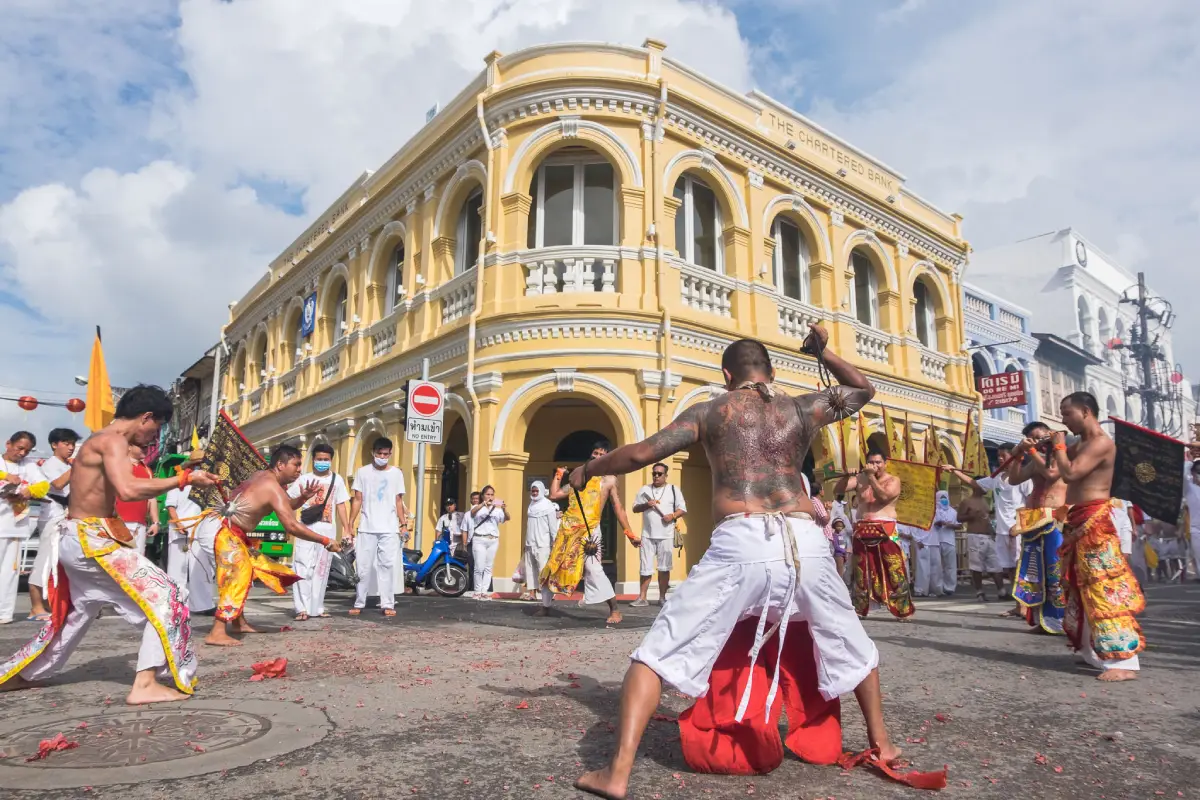
Phuket has a strong Chinese-Thai cultural identity, especially from Hokkien Chinese communities that settled on the island during the tin-mining era. Chinese shrines, deities, ritual language, food traditions, family worship, and community festivals became deeply rooted in Phuket life. During the Vegetarian Festival, the atmosphere of Phuket changes visibly. People dress in white, yellow vegetarian flags appear across the city, vegetarian food stalls fill the streets, incense smoke rises from shrines, and processions move through the town with drums, firecrackers, palanquins, spirit mediums, and large crowds of devotees.
The origin of the Phuket Vegetarian Festival is closely connected with Lai Thu or present-day Kathu, once an important tin-mining community. According to local tradition, a Chinese opera troupe came to perform in the mining settlement. After illness spread among the performers and local people, the troupe remembered that they had failed to observe their annual vegetarian ritual for the Nine Emperor Gods. They then performed the Jia Chai ritual to ask forgiveness and seek protection. When the illness subsided, local people developed deep faith in the ritual and continued the practice every year.
This origin story shows why the festival must be understood as a community tradition rather than only as a food festival. It links tin mining, Chinese migration, local shrines, illness, protection, gratitude, and spiritual discipline. The festival became a way for the community to ask for blessings, purify itself, honor sacred beings, and strengthen social unity. Its survival for more than two centuries shows how deeply the tradition belongs to Phuket.
One of the first major rituals is the raising of the Go Teng pole in front of a shrine. The pole signals that the Vegetarian Festival has begun. Nine oil lamps are hung on the pole to symbolize the Nine Emperor Gods. Once the pole is raised, the shrine enters a sacred period. Devotees begin wearing white, observe the vegetarian rules, prepare offerings, light incense, chant prayers, and help prepare the shrine kitchen and ritual space.
The discipline of vegetarian observance is the heart of the festival. Participants avoid meat and animal products according to shrine practice, keep their bodies clean, behave respectfully, avoid sexual misconduct, do not drink alcohol, avoid false speech, and refrain from harming others. White clothing represents purity and respect. Serious participants also use clean eating utensils, avoid food contaminated by meat, and maintain physical and mental discipline throughout the 9-day period.
Shrine worship takes place throughout the festival. Devotees light incense, burn fragrant wood, offer gold and silver papers, place fruit and vegetarian offerings, fill oil lamps, and pray to the deities. The shrine atmosphere is filled with incense smoke, chanting, drums, ritual music, and quiet devotion. These rituals create a sacred environment where the community gathers around shared faith.
Spirit-medium rituals are among the most distinctive elements of the Phuket Vegetarian Festival. The spirit mediums, known in Thai as Ma Song, are believed to be possessed by deities who perform rituals and receive misfortune on behalf of devotees. Assistants help the Ma Song dress, prepare symbolic weapons, control movement, and maintain ritual order. The ceremony includes drums, gongs, incense, fragrant wood, offerings, and invocation chants.
On important days such as the 3rd, 6th, and 9th days of the festival, rituals become more intense. One of these is the Khokun ritual, a ceremonial offering to the deity’s spiritual soldiers. Food, symbolic objects, and ritual elements are prepared to honor divine forces believed to protect the shrine, the devotees, and the wider community. This reflects the festival’s ritual worldview, in which humans, deities, and unseen guardians are connected.
Chanting ceremonies, known as Song Keng, are performed during the festival, often in the morning and evening. After evening chanting, the names of participants may be read as a way of presenting them before the deities. The ritual asks for health, protection, peace, and longevity. It also shows that the festival is not only public spectacle, but also a structured religious practice inside the shrine.
The star-worship ritual takes place on the 7th night of the festival. It is connected with the older Chinese belief in celestial protection and prayers for long life, health, and protection from illness. In some shrine practices, talisman papers are prepared and distributed to devotees. This ritual reveals the deeper Daoist and Chinese cosmological roots behind the Vegetarian Festival.
The most widely recognized public ritual is the street procession, known as Iw Keng. During this ritual, sacred images and palanquins are carried through the streets as deities visit the people. The procession includes banners, name plaques, palanquins, devotees in white, shrine attendants, Ma Song, and large groups of worshippers. Families and businesses along the route prepare offering tables, light incense, and set off firecrackers to welcome the procession.
The palanquin is one of the most important ritual objects. It is treated as the seat of the deity, especially the palanquin of the Nine Emperor Gods. When the main palanquin passes, people along the route show respect. Visitors should remember that this is a sacred procession, not a performance staged only for tourists. It is important to avoid blocking the route, touching sacred objects without permission, standing too close to spirit mediums, or treating ritual space as merely a photography backdrop.
Fire-walking is another important ritual. The fire is understood as a sacred purifying force. Participants believe that divine protection allows the pure and faithful to cross the fire safely. The ritual symbolizes purification, protection, and the burning away of misfortune. Visitors should watch from designated areas only, as the ritual involves heat, crowds, and fire safety risks.
The Koi Han ritual is a form of misfortune-clearing ceremony. Participants prepare symbolic items such as paper figures representing themselves, cut hair, nail clippings, coins, and Chinese chives. These objects are used to represent negative influences or misfortune that participants wish to remove. After passing through the ritual, devotees may receive a stamp on the back of their white shirt, symbolizing that the cleansing has been completed.
The sending-off ceremony takes place on the final night of the festival. During the day, the Jade Emperor is sent off at the Go Teng pole. At night, shrine processions move toward the sea, especially the Saphan Hin area, to send the Nine Emperor Gods back to heaven. Firecrackers sound continuously, crowds gather along the route, and the final ceremony marks the end of the sacred period. When the procession leaves the shrine, the lights inside the shrine are extinguished and the main doors are closed.
Important shrines in the Phuket Vegetarian Festival include Kathu Shrine in Kathu District, Tha Ruea Shrine in Thalang, Jui Tui Shrine on Ranong Road in Phuket Town, Lor Rong Shrine on Phatthana Road, Bang Niao Shrine on Phuket Road, and Sam Kong Shrine on Yaowarat Road. Other shrines across the island also participate according to their own schedules and traditions. Visitors can choose which area to visit depending on whether they want to experience the festival in Phuket Old Town, Kathu, Thalang, or near Saphan Hin.
Jui Tui Tao Bo Keng Shrine is one of the most important shrines in Phuket Town. It is located on Ranong Road near the local market and Phuket Old Town. Many devotees visit to pray, make offerings, fill oil lamps, and experience the central town atmosphere of the festival. Kathu Shrine is also historically important because Kathu is strongly linked with the origin story of the festival and Phuket’s tin-mining communities.
Vegetarian food is a major part of the festival atmosphere. Many restaurants and temporary stalls serve food prepared without meat and in accordance with vegetarian festival practice. Common dishes include vegetarian noodles, rice with vegetarian curries, vegetarian fried tofu, Chinese-style vegetarian snacks, steamed buns, stir-fried dishes, and Phuket-style vegetarian sweets. The food scene is both religious and social, helping participants observe the ritual while also supporting local vendors and community kitchens.
Visitors should follow basic etiquette. Wear polite clothing, preferably white or light-colored. Give way to processions, avoid standing in front of palanquins, keep a respectful distance from spirit mediums, do not touch ritual objects, avoid using flash photography too close to ceremonies, and follow instructions from shrine staff or authorities. Firecrackers, smoke, loud noise, crowds, and temporary road closures are part of the festival, so families with children, elderly visitors, and people with respiratory issues should plan carefully.
Travel planning is important during the festival. Streets in Phuket Town may be closed or redirected during Iw Keng processions. Visitors should check shrine and municipal announcements each year, choose safe viewing points, and allow extra travel time. Staying in Phuket Old Town, Talat Yai, or Talat Nuea makes it easier to walk to many festival areas rather than drive into crowded streets.
Getting There depends on the shrine or viewing area. From Phuket International Airport, take Thepkasattri Road toward Phuket Town; the journey usually takes about 45 to 60 minutes depending on traffic. From Patong, travel through Kathu or Wichit Songkhram Road toward Phuket Town, usually taking about 35 to 50 minutes. Travelers arriving by road from other provinces enter Phuket through the bridge system at the northern end of the island and continue south along Thepkasattri Road toward Phuket Town.
A good cultural route can begin at Jui Tui Tao Bo Keng Shrine on Ranong Road, continue through Phuket Old Town, visit Pud Jor Shrine, the Shrine of the Serene Light, the Downtown Market, Phuket Thai Hua Museum, and Chinpracha House, then continue to Saphan Hin for the sending-off atmosphere. Visitors interested in history should also include Kathu Shrine, Kathu Local Heritage Conservation Center, and Phuket Mining Museum to understand the connection between the festival, Chinese migration, tin mining, and Kathu community history.
The Phuket Vegetarian Festival is valuable because it brings together religion, cultural heritage, community discipline, food, shrine networks, public processions, and local identity. The whole city participates: shrines hold rituals, families set offering tables, vendors prepare vegetarian food, devotees wear white, authorities manage roads and safety, and visitors come to learn. The festival is therefore not one event at one location, but a living cultural system spread across Phuket.
In summary, the Phuket Vegetarian Festival should be experienced with respect. It is a sacred 9-day tradition of vegetarian observance, deity worship, misfortune-clearing, ancestral respect, community unity, and Hokkien-Chinese heritage. Visitors who understand its meaning will see Phuket far beyond beaches and old buildings. They will see a city shaped by faith, memory, ritual discipline, drums, incense, firecrackers, processions, vegetarian food, and the shared effort of communities that have carried this tradition forward for generations.
| Name | Phuket Vegetarian Festival / Phuket Jae Festival / Jia Chai |
| Main Area | Chinese shrines across Phuket Province, especially Phuket Town, Kathu, Thalang, and Saphan Hin |
| 2026 Festival Dates | 10 – 18 October 2026 |
| Traditional Period | From the 1st to the 9th day of the 9th lunar month in the Chinese calendar, lasting 9 days and 9 nights |
| Highlights | White clothing, vegetarian observance, Go Teng pole raising, chanting, deity invocation, spirit-medium rituals, Iw Keng street processions, fire-walking, Koi Han misfortune-clearing ritual, star worship, and final sending-off ceremony |
| Origin | Linked with Lai Thu or present-day Kathu during Phuket’s tin-mining era, when a Chinese opera troupe performed the vegetarian ritual to seek relief from illness and the local community later continued the practice annually |
| Cultural Importance | A major Phuket cultural heritage tradition reflecting Hokkien-Chinese faith, moral discipline, deity worship, ancestral respect, community unity, and Phuket identity |
| Important Shrines | 1. Kathu Shrine, Kathu District 2. Tha Ruea Shrine, Thalang District 3. Jui Tui Shrine, Ranong Road, Phuket Town 4. Lor Rong Shrine, Phatthana Road, Phuket Town 5. Bang Niao Shrine, Phuket Road, Phuket Town 6. Sam Kong Shrine, Yaowarat Road, Phuket Town |
| Main Town Landmark | Jui Tui Tao Bo Keng Shrine, 283 Ranong Road, Talat Nuea Subdistrict, Mueang Phuket District, Phuket 83000, Tel. 076-213-243 |
| Admission Fee | No admission fee for public processions and general festival atmosphere. Personal expenses depend on transport, food, offerings, and donations. |
| Main Practices | Wear polite white clothing, abstain from meat, avoid alcohol and intoxicants, maintain purity of body, speech, and mind, avoid harming others, and follow shrine rules |
| Main Areas / Zones | Shrine ritual areas, vegetarian kitchens, procession routes, offering-table areas, Phuket Town streets, and Saphan Hin sending-off area |
| Travel Information | From Phuket International Airport, travel south on Thepkasattri Road toward Phuket Town. From Patong, travel through Kathu or Wichit Songkhram Road toward Phuket Town. Allow extra time because roads may be closed or redirected during processions. |
| Caretaker / Related Organizations | Participating shrines, Phuket shrine networks, Phuket City Municipality, Phuket Province, cultural agencies, tourism agencies, and local safety authorities |
| Main Municipal Contact | Phuket City Municipality Tel. 0-7621-2196 |
| Nearby Tourist Attractions | 1. Pud Jor Shrine, about 0.1 km 2. Phuket Downtown Market, about 0.3 km 3. Phuket Old Town, about 0.8 km 4. Shrine of the Serene Light, about 1 km 5. Phuket Thai Hua Museum, about 1 km 6. Chinpracha House, about 1 km 7. Saphan Hin, about 3 km 8. Kathu Shrine, about 8 km |
| Nearby Restaurants | 1. Raya, about 1 km, Tel. 076-218-155, 092-252-4883 2. One Chun, about 1 km, Tel. 076-355-909 3. The Charm Dining Gallery, about 1 km, Tel. 076-530-199 4. Tu Kab Khao, about 1.2 km, Tel. 076-608-888 5. Mee Sapam Khun Yai Chian, about 6 km 6. Laem Hin Seafood, about 8 km |
| Nearby Accommodations | 1. Hotel Midtown Ratsada, about 0.8 km, Tel. 091-915-4945-7 2. Courtyard by Marriott Phuket Town, about 1.2 km, Tel. 076-351-166 3. Royal Phuket City Hotel, about 1.5 km, Tel. 076-233-355 4. Blu Monkey Hub & Hotel Phuket, about 1.5 km, Tel. 076-354-266 5. Phuket Merlin Hotel, about 1.5 km 6. The Pago Design Hotel Phuket, about 5 km |
Frequently Asked Questions (FAQ)
Q: When is the Phuket Vegetarian Festival in 2026?
A: The Phuket Vegetarian Festival 2026 is scheduled for 10 – 18 October 2026, corresponding to the 1st to the 9th day of the 9th lunar month in the Chinese calendar.
Q: Where did the Phuket Vegetarian Festival originate?
A: The origin is linked with Lai Thu or present-day Kathu during Phuket’s tin-mining era, when a Chinese opera troupe performed the vegetarian ritual to seek protection from illness.
Q: What should participants do during the festival?
A: Participants should wear polite white clothing, abstain from meat, avoid alcohol and intoxicants, behave respectfully, keep body, speech, and mind pure, and follow the rules of each shrine.
Q: What are the main rituals of the festival?
A: Main rituals include raising the Go Teng pole, deity worship, spirit-medium rituals, Khokun, Song Keng chanting, star worship, Iw Keng street processions, fire-walking, Koi Han misfortune-clearing, and the final sending-off ceremony.
Q: Where is the best place to watch the processions?
A: Popular viewing areas are in Phuket Town, especially around Ranong Road, Phuket Old Town, Phuket Road, and routes toward Saphan Hin. Visitors should check annual shrine and municipal announcements before traveling.
Q: Is there an admission fee?
A: No. Watching public processions and experiencing the general festival atmosphere is free. Personal costs depend on transportation, food, offerings, and donations.
Q: Which shrines are important during the festival?
A: Important shrines include Kathu Shrine, Tha Ruea Shrine, Jui Tui Shrine, Lor Rong Shrine, Bang Niao Shrine, and Sam Kong Shrine.
Q: What should visitors be careful about?
A: Visitors should be careful with firecrackers, smoke, loud noise, crowds, temporary road closures, and ritual areas. They should avoid blocking processions, disturbing spirit mediums, or touching sacred objects without permission.
 Category: ●Art, Culture and Heritage
 Group: ●Art, Craft Centres, Tradition
Last Update : 3 WeekAgo
 Last Update : 3 WeekAgo

 Landmarks and Memorials(7)
Art, Craft Centres, Tradition(5)
Landmarks and Memorials(7)
Art, Craft Centres, Tradition(5)
 Museums(4)
 Historic Homes and Cities(1)
 Art Gallery(1)
 Educational Places
 Educational Gardens, Farm(2)
 Places of Worship
 Temple(14)
 Mosque(47)
 Other Sacred Sites(11)
 Suburban Living
 Village, Community(2)
 Floating Market(1)
 Nature and Wildlife
 National Parks and Marine Reserves(2)
 Mountain (Doi)(2)
 Dam, Reservoir, Lake(1)
 Waterfalls(4)
 Bays and Beaches(30)
 Islands(12)
 Other natural attractions(10)
 Entertainment and Agricultural
 Zoos and Aquariums(1)
 Stadium(2)
 Farms, Parks and Ecotourism(4)
 Amusement Park(2)
 Waterpark(1)
 Theater(1)
 Outdoor and Adventure Activities(1)
 Shopping
 Shopping and Night Market(1)
 Travel Articles, Recipes
 Southern Food Menu, Southern Food Recipes(5)


