
lovethailand home >South Travel Attractions >Chumphon Travel Attractions >Lang Suan >Wang Tako > The Traditional Boat Race Parade
TL;DR: The Traditional Boat Race Parade.
The Traditional Boat Race Parade
Main Festival Day: The 1st Waning Day Of The 11th Lunar Month Every Year, After The End Of Buddhist Lent
Festival Period: Usually Held Over Several Days According To The Annual Official Schedule
Main Venue: Southern Regional Boat-Racing Field, Lang Suan River, Around Wat Dan Prachakorn Pier, Lang Suan District, Chumphon Province
The Hae Phra Boat Procession And Khuean Khon Ching Thong Boat Race In Lang Suan, Chumphon is one of the most important cultural festivals of the Lang Suan River basin and one of the most distinctive southern Thai traditions in Chumphon Province. The festival combines Buddhist devotion, river culture, long-boat racing, temple participation, community pride, and local hospitality into one large annual event. Held after the end of Buddhist Lent, the festival includes Tak Bat Devo merit-making, land and water Buddha processions, decorated Buddha boats, traditional performances, local markets, and the famous “Khuean Khon Ching Thong” race, a boat-racing style unique to Lang Suan.
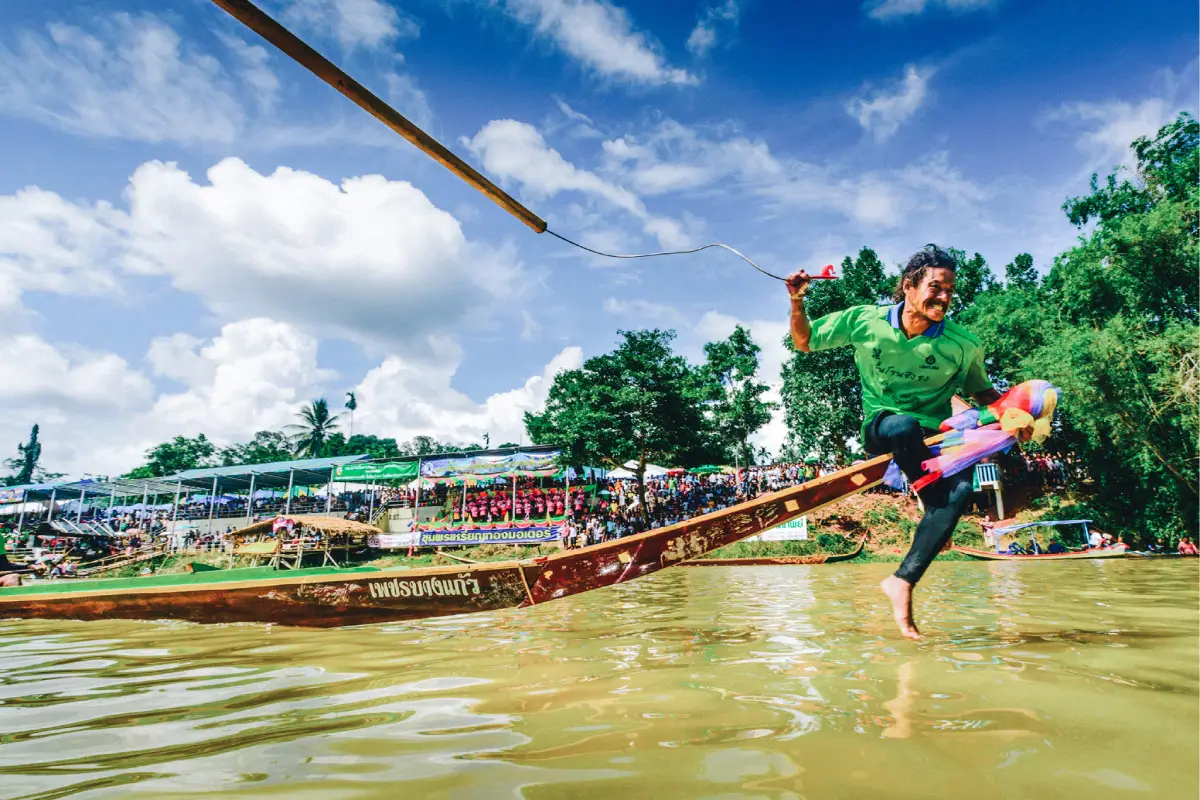
The core identity of the festival is “Khuean Khon Ching Thong,” which means climbing onto the bow projection of a racing boat to seize the victory flag. Unlike ordinary long-boat races where the winner is decided simply by speed, the Lang Suan race is decided by the skillful grabbing of the flag at the finish line. The sternman must steer the boat straight, the paddlers must maintain perfect rhythm, and the bowman must climb forward at the right moment to seize the flag. Victory depends on speed, timing, balance, courage, coordination, and the precise relationship between every position in the boat.
The festival begins around the 1st waning day of the 11th lunar month, the day after the end of Buddhist Lent. In Thai Buddhist tradition, this period is associated with Tak Bat Devo, the merit-making ceremony that recalls the Buddha’s return from Tavatimsa Heaven after the rainy-season retreat. In Lang Suan, local communities bring important Buddha images from temples into processions so that people can pay respect and make merit. The religious procession then connects naturally with long-boat racing on the river, turning the festival into both a sacred event and a public celebration.
The history of the Lang Suan boat race is deeply tied to the river. Local tradition links the early form of the event to the time when Phraya Charun Ratchaphokakon governed Lang Suan during the reign of King Rama V. In its older form, communities pulled Buddha boats along the river, and boats from different temples or villages competed to tow the sacred boat. The winning community would bring the Buddha image to its temple, hold a night celebration, and make merit the following morning. This early practice reflects a time when the Lang Suan River was the main transportation route and the center of local religious life.
As the festival developed, the race became more organized. During the period of Luang Pranee Prachachon, the release system was adapted by tying the sterns of competing boats with a rope. When the boats strained forward and the rope became tight, it was cut to release the boats at the same time. This shows how the local race gradually developed clearer rules and a stronger sense of fair competition. Later, the race field, distance, categories, judging system, and ceremonial structure became more formal.
The main race field is on the Lang Suan River, from the area behind Lang Suan Town Municipality and under the curved railway bridge toward Wat Dan Prachakorn Pier. The racing distance is about 500 meters. During the festival, both banks of the river become natural spectator stands filled with local people, tourists, cheering groups, and families. The sound of drums, whistles, paddling rhythms, announcers, and crowd cheers creates an intense festival atmosphere that makes the Lang Suan River the center of the district for several days.
Wat Dan Prachakorn is central to the festival because the race field ends near its pier. The temple is located in Lang Suan District, Chumphon Province, and has long been connected with the river and local Buddhist life. It contains a main ordination hall, sermon hall, monks’ residences, bell tower, drum tower, and important Buddha images. The connection between the temple pier and the racing field makes Wat Dan Prachakorn both a religious landmark and a practical focal point of the annual boat-racing tradition.
In the past, many racing boats belonged to temples or communities. A racing boat was not only sports equipment; it represented the dignity of a temple, a village, and its paddlers. Each boat required maintenance, preparation, decoration, and ritual respect. Before the competition, boat-blessing or spirit-honoring ceremonies were often performed to encourage the paddlers and pay respect to the boat’s protective spirit. This ritual dimension shows that long-boat racing in Lang Suan is connected with belief, craftsmanship, and community identity.
Traditional Lang Suan racing boats were dug from whole logs, often from takian wood. They were long, narrow, and built for speed and balance on the river. Local information describes boats about 18 to 19 meters long, with a boat flag and paired paddlers along the hull, except for the bowman and sternman. A gong, whistle, or other rhythm signal helps paddlers move together. The power of the boat therefore comes not only from strength but also from synchronized timing and collective discipline.
Modern racing categories are organized to support different teams and age groups. The latest confirmed festival included several categories such as long boats with 30 to 32 paddlers, local paddler categories, student and youth boats, community boats, and conservation-style dugout boats. The youth category is especially important because it allows younger generations to learn paddling discipline, boat culture, and the rules of Khuean Khon Ching Thong. This ensures that the tradition remains active rather than becoming only a memory of older generations.
The flag-grabbing rule is the most thrilling feature of the Lang Suan race. The victory flag is attached to a strip of red cloth tied to small rattan placed near the finish line. The flag system is set on a judging raft or finish-line structure. Two boats charge toward the line from opposite sides, and each bowman must climb forward onto the bow projection to seize the flag. The winner must seize the flag correctly according to the rules. The moment is fast, risky, and dramatic, which is why spectators watch the finish line with intense attention.
The term “khon” refers to the bow projection of the racing boat. Climbing onto it is difficult because the boat is moving quickly and the river surface is disturbed by paddling force and the wake of the competing boat. The bowman must balance on a narrow surface, judge the distance to the flag, and seize it at the exact moment. A slight mistake can lead to a missed flag, a fall into the water, or a lost race. This is why the bowman is one of the most admired positions in the Lang Suan boat race.
Race prizes have also changed over time. In earlier periods, the winning boat could receive a decorative cloth for the bow, while paddlers might receive traditional cloth. Later, prizes included kerosene to be offered to temples because many boats belonged to temples. Since 1964, the Lang Suan race has been associated with royally bestowed trophies and shields, raising the status of the race and reinforcing its importance as a major southern long-boat-racing field.
The festival includes much more than racing. Important activities include “Open City, Free Food,” boat-blessing ceremonies, Buddha boat celebrations, Tak Bat Devo merit-making, land and water Buddha processions, decorated boat contests, local performances, market stalls, community products, and evening entertainment. These activities make the festival a major annual gathering for Lang Suan residents. People come to make merit, meet relatives, welcome visitors, cheer for local boats, and celebrate their river heritage.
Tak Bat Devo gives the festival its strong Buddhist foundation. On the morning after the end of Buddhist Lent, people make merit and give alms to monks. The Buddha processions follow, with temples and communities bringing important Buddha images in decorated land and water processions. This part of the festival preserves the religious meaning of the event, even though many visitors may first know the festival through the excitement of long-boat racing.
The decorated Buddha boats are another highlight. Each temple, school, or community prepares its own beautifully decorated boat or float. Some use flowers, some use local produce, and others create symbolic or imaginative designs. Walking through the decorated boat area allows visitors to see craftsmanship, community cooperation, and local creativity before the racing begins on the river.
The “Open City, Free Food” activity is one of the most memorable expressions of Lang Suan hospitality. Local residents, shops, schools, agencies, and community groups prepare food, desserts, drinks, and local dishes to share with visitors. Some groups cook fresh food at the event. This atmosphere of generosity makes the festival feel like a town-wide welcome, not only a sports competition.
The cultural status of the festival is nationally significant. The Khuean Khon Ching Thong tradition has been recognized as an element of intangible cultural heritage in the category of traditional games, folk sports, and martial arts. It has also been promoted as an Unseen Thailand attraction under the identity “Thong Nueng Nai Siam,” or “The One Flag Of Siam.” This recognition reflects the fact that the Lang Suan race is not simply a local sport; it is a cultural system with rules, rituals, craftsmanship, history, and a strong regional identity.
The festival strengthens community unity in a practical way. One racing boat requires paddlers, boat caretakers, ritual specialists, supporters, cooks, organizers, cheering teams, and temple or village backing. Even those who do not paddle can still contribute to the team and the festival. This shared labor gives the tradition its strength and helps maintain the connection between temples, homes, schools, public agencies, and local residents.
For visitors, the best way to experience the festival is to follow the full sequence rather than watching only the race. Morning is suitable for Tak Bat Devo and Buddha processions. Afternoon and evening are suitable for boat racing along the river. Key racing days and final rounds attract large crowds, so visitors should arrive early to find a good viewing point. The strongest atmosphere is usually found near the finish line, where the bowman attempts to seize the flag.
Getting There is convenient by car, train, or bus. Lang Suan District lies on the main southern route, and visitors can use Highway 41 before entering Lang Suan town. The race field is near Lang Suan Town Municipality and Wat Dan Prachakorn Pier. Travelers arriving by train can get off at Lang Suan Railway Station and continue by local transport to the festival area. During the festival, visitors should allow extra travel time because traffic and parking around the river and town center become busy.
Visitors should remember that the festival is both a Buddhist event and a public celebration. Dress respectfully for religious ceremonies, do not block processions, do not enter restricted racing areas, do not stand too close to the riverbank, and do not litter in or near the river. Following safety guidance from organizers is important, especially near piers, crowded riverbanks, and race-control zones.
Photography is rewarding but should be done carefully. Good scenes include the land Buddha procession, water procession, decorated boats, paddlers preparing before the race, the synchronized paddling rhythm, the bowman climbing onto the bow, and the crowd cheering from both riverbanks. When photographing religious ceremonies, visitors should remain calm, respectful, and avoid disturbing monks or participants.
The festival remains a living tradition because local people continue to practice it directly. They prepare boats, train paddlers, bless boats, join processions, provide food, organize activities, and pass on boat knowledge to younger generations. This makes the festival more than a performance for visitors. It is a real community institution that keeps Lang Suan’s river culture active.
After visiting the festival, travelers can continue to nearby attractions in Lang Suan and the surrounding coastal area, including Lang Suan market, Suan Nai Dum, Pak Nam Lang Suan, the Prince of Chumphon Shrine and HTMS Chakri Naruebet Replica, Ko Phithak, Bang Nam Chuet Beach, and Arunothai Beach. These places add riverside, town, coastal, and community-based experiences to the trip.
Overall, the Hae Phra Boat Procession And Khuean Khon Ching Thong Boat Race in Lang Suan is one of Chumphon’s most complete cultural festivals. It combines Buddhist devotion, river life, local sport, boat craftsmanship, community unity, and the dramatic skill of flag grabbing into a single annual event. Its unique race rules make it different from ordinary long-boat races, while its religious and community foundations make it deeply meaningful to the people of Lang Suan. For travelers seeking a living southern Thai tradition, this festival is one of the most important events to experience in Chumphon.
| Tradition Name | Hae Phra Boat Procession And Khuean Khon Ching Thong Boat Race, Lang Suan, Chumphon |
| Main Venue | Southern Regional Boat-Racing Field, Lang Suan River, from the area behind Lang Suan Town Municipality to Wat Dan Prachakorn Pier, Lang Suan District, Chumphon Province |
| Reference Address | Wat Dan Prachakorn, Lang Suan Subdistrict, Lang Suan District, Chumphon 86110, Thailand |
| Navigation | Search “Wat Dan Prachakorn Lang Suan” or “Southern Regional Boat-Racing Field Lang Suan River” |
| Festival Period | Begins on the 1st waning day of the 11th lunar month every year, after the end of Buddhist Lent, and is usually held over several days |
| 2026 Lunar Calendar Reference | The end of Buddhist Lent falls on October 26, 2026, and the 1st waning day of the 11th lunar month falls on October 27, 2026 |
| Importance | A major cultural heritage festival of the Lang Suan River basin that combines Buddhist merit-making, river life, folk sport, and community unity |
| Main Rituals And Activities | Tak Bat Devo, land Buddha procession, water Buddha procession, decorated Buddha boat celebration, boat-blessing ceremony, Khuean Khon Ching Thong long-boat race, boat contests, local performances, and community markets |
| History | Rooted in river-based Buddhist processions and traditional boat pulling along the Lang Suan River, later developed into a formal long-boat race with unique flag-grabbing rules |
| Boat Characteristics | Traditional boats were dug from whole logs, often takian wood, with paired paddlers, a bowman, a sternman, a boat flag, and rhythm signals such as gong or whistle |
| Khuean Khon Ching Thong Identity | The bowman climbs onto the bow projection to seize the victory flag at the finish line, requiring teamwork between paddlers, sternman, and bowman |
| Race Distance | About 500 meters on the Lang Suan River, from behind Lang Suan Town Municipality toward Wat Dan Prachakorn Pier |
| Current Status | An annual Lang Suan festival; the latest confirmed edition was the 182nd festival in 2025 at the Southern Regional Boat-Racing Field on the Lang Suan River |
| Related Agencies | Lang Suan District, Chumphon Provincial Administrative Organization, Lang Suan Town Municipality, Lang Suan River Foundation, temples, and local communities in Lang Suan District |
| Tourism Information Contact | TAT Chumphon Office, Tel. 077-501-831, 077-502-775 |
| Festival Facilities | Spectator areas along both riverbanks, coordination points, procession areas, festival stage, toilets, first-aid points, security system, vendors, and community product stalls during the festival |
| Main Areas / Zones | Wat Dan Prachakorn Pier, Lang Suan River race field, boat release point, flag-grabbing finish line, judging raft, spectator riverbanks, main festival stage, and decorated Buddha boat area |
| Nearby Tourist Attractions | 1. Lang Suan Market Area, About 1 km 2. Lang Suan Railway Bridge, About 1 km 3. Wat Khan Ngoen, About 2 km 4. Suan Nai Dum, About 10 km 5. Prince Of Chumphon Shrine And HTMS Chakri Naruebet Replica, Pak Nam Lang Suan, About 15 km 6. Ko Phithak, About 18 km 7. Arunothai Beach, About 22 km |
| Nearby Restaurants | 1. Khun Noi Restaurant, About 1 km, Tel. 077-544-027 2. Steak House Lang Suan, About 1 km, Tel. 077-544-618, 089-288-1398 3. Isan Lang Suan Restaurant, About 2 km, Tel. 081-894-6812 4. Roti Cha Chak wow@Lang Suan, About 2 km, Tel. 092-291-1626 5. Sukhi A La Carte Lang Suan, About 3 km, Tel. 095-042-1295, 080-003-1433 6. Tam Mariam Lang Suan, About 4 km, Tel. 065-461-4291 7. Fa Yam Yen Restaurant, About 5 km, Tel. 077-653-122 |
| Nearby Accommodations | 1. Pugdee Hotel Lang Suan, About 1 km, Tel. 077-561-198 2. Lang Suan Place Hotel, About 3 km 3. Auychai Grand Hotel, About 3 km 4. Lang Suan Resort, About 4 km, Tel. 077-545-080 5. Chan Sawang Resort, About 5 km, Tel. 090-698-4855 6. Happy Resort Lang Suan, About 7 km |
Frequently Asked Questions (FAQ)
Q: When is the Hae Phra Boat Procession And Khuean Khon Ching Thong Boat Race held?
A: It begins on the 1st waning day of the 11th lunar month every year, the day after the end of Buddhist Lent, and is usually held over several days according to the annual schedule.
Q: Where is the festival held?
A: The main venue is the Southern Regional Boat-Racing Field on the Lang Suan River, from the area behind Lang Suan Town Municipality to Wat Dan Prachakorn Pier in Lang Suan District, Chumphon Province.
Q: What does Khuean Khon Ching Thong mean?
A: It means climbing onto the bow projection of a racing boat to seize the victory flag at the finish line. The winner is determined by correct flag grabbing, not by speed alone.
Q: Why is the Lang Suan boat race important?
A: It is a major cultural heritage of the Lang Suan River basin, combining Buddhist devotion, river life, folk sport, boat craftsmanship, and community unity.
Q: What activities are included in the festival?
A: The festival includes Tak Bat Devo, land and water Buddha processions, decorated Buddha boat celebrations, boat-blessing ceremonies, long-boat racing, boat contests, local performances, vendors, and community activities.
Q: What is the best time to watch the festival?
A: Morning is best for Tak Bat Devo and Buddha processions, while afternoon and evening are suitable for watching long-boat races. Opening race days and final rounds usually attract the largest crowds.
Q: How can visitors get to the festival?
A: Visitors can drive via Highway 41 into Lang Suan town, or take a train to Lang Suan Railway Station and continue by local transport to the Lang Suan River race field and Wat Dan Prachakorn area.
Q: Which nearby places can be visited on the same trip?
A: Nearby places include Lang Suan market, Suan Nai Dum, the Prince of Chumphon Shrine and HTMS Chakri Naruebet Replica at Pak Nam Lang Suan, Ko Phithak, and Arunothai Beach.
 Category: ●Art, Culture and Heritage
 Group: ●Art, Craft Centres, Tradition
Last Update : 2 MonthAgo
 Last Update : 2 MonthAgo
Recommend

 Historical Sites and Monuments(1)
 Landmarks and Memorials(2)
Art, Craft Centres, Tradition(3)
 Museums(2)
 Educational Places
 Educational Gardens, Farm(1)
 Places of Worship
 Temple(31)
 Other Sacred Sites(10)
 Research and Development
 Royal Project(1)
 Suburban Living
 Village, Community(5)
 Local Market(1)
 Nature and Wildlife
 National Parks and Marine Reserves(7)
 Mountain (Doi)(5)
 Dam, Reservoir, Lake(1)
 Waterfalls(26)
 Hot Springs(1)
 Caves(21)
 River, Canal(7)
 Bays and Beaches(30)
 Islands(13)
 Other natural attractions(7)
 Entertainment and Agricultural
 Farms, Parks and Ecotourism(3)
 Outdoor and Adventure Activities(4)
 Shopping
 Shopping and Night Market(1)
 Travel Articles, Recipes
 Travel Review, Food Review(1)


