
lovethailand home >Eastern Travel Attractions >Trat Travel Attractions >Bo Rai >Dan Chum Phon > Wat Mai Photharam
TL;DR: Wat Mai Photharam is located at Ban Dan Chumphon, Moo 1, Dan Chumphon Subdistrict, Bo Rai District, Trat Province, open Daily, hours 08.00 - 17.00.
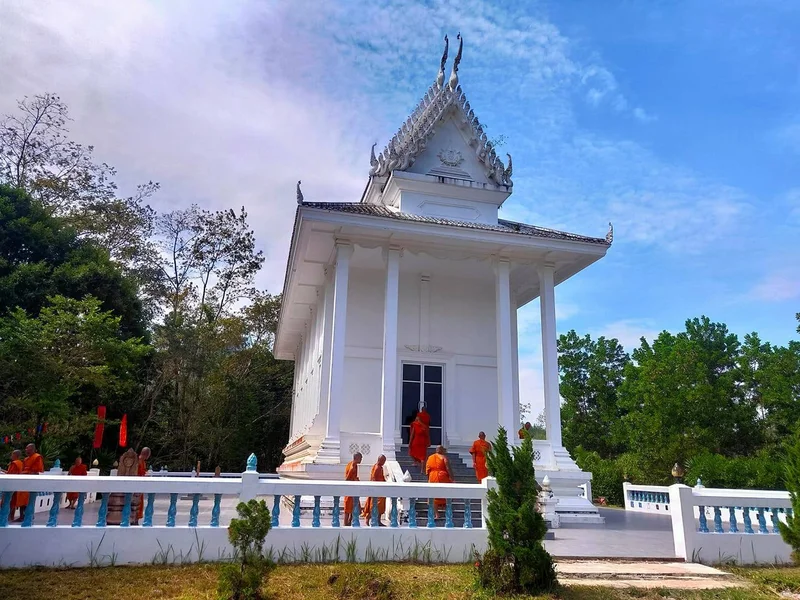
Wat Mai Photharam
Open Days: Daily
Opening Hours: 08.00 - 17.00
Wat Mai Photharam, also locally known as Wat Dan Chumphon, is a rural Buddhist temple in Ban Dan Chumphon, Moo 1, Dan Chumphon Subdistrict, Bo Rai District, Trat Province. It is a meaningful destination for travelers who want to explore the inland cultural side of Trat beyond islands, beaches, and ferry routes. The temple is known for its revival from an old abandoned temple, its white ordination hall, its mountain-view setting, and its role as a spiritual center for the local community.
Wat Mai Photharam belongs to the Mahanikaya order and is classified as a local Buddhist temple. The temple occupies a large area of 108 rai, 2 ngan, and 39 square wah. Its eastern boundary connects with the Bo Rai-Noen Sung road, while the western side reaches the mountain. This setting gives the temple a special rural character. It is not a commercial tourist temple, but a living community temple where Buddhist faith, village life, and natural scenery come together.
The history of Wat Mai Photharam is especially interesting because the site was originally an abandoned temple called Wat Photharam. In 1987, Mr. Suriyan Samaknarong submitted a request to establish the temple again. Permission was granted in 1988, and the temple was officially established on 20 December 1988 under the name Wat Mai Photharam. The word “Mai,” meaning new, reflects the revival of an old sacred place and the return of Buddhist life to a site that had once been left unused.
This revival is important because restoring an abandoned temple requires community faith, administrative effort, land management, construction of monastic buildings, and continuous care from monks and local devotees. Wat Mai Photharam therefore represents more than a simple temple foundation. It tells the story of a community bringing an old religious site back to life and turning it once again into a place for worship, merit-making, education, and local gathering.
The temple has several important monastic structures. Its sermon hall measures 34 meters wide and 38 meters long and was built in 1988 as a reinforced concrete building. The temple also has 4 monks’ residences, including a wooden building, a half-concrete half-wooden building, and 2 concrete buildings. There is also a wooden merit-making hall, a crematorium, and spaces used for religious and community activities. These structures show that the temple serves both monastic life and the needs of villagers.
The principal Buddha image in the ordination hall is in the subduing Mara posture. It has a lap width of 25 inches and a height of 114 centimeters and was made in 1983. This image is the main focus for worshippers. The temple also has a replica of Luang Pho Sothon with a lap width of 29 inches and a height of 160 centimeters, images of Phra Moggallana and Phra Sariputta, each 1 meter high, made in 1992, and additional Buddha images in meditation posture and alms-bowl-holding posture.
The presence of a Luang Pho Sothon replica connects the temple with one of the most respected Buddha images in eastern Thailand. Many people in the eastern region hold Luang Pho Sothon in high devotion. The images of Phra Moggallana and Phra Sariputta add another layer of Buddhist meaning, reminding visitors of the Buddha’s two chief disciples, known for spiritual power, wisdom, discipline, and devotion to the Dhamma.
One of the most visually memorable features of Wat Mai Photharam is its white ordination hall. From the area around the hall, visitors can enjoy a view over Dan Chumphon village and the Banthat mountain range. This makes the temple appealing not only as a place of worship, but also as a quiet viewpoint in rural Bo Rai. The white ordination hall stands out against the surrounding natural scenery and gives the temple a peaceful and clean visual identity.
The temple also has an educational role. A Dhamma section of a Buddhist scripture school was opened here in 1984. This shows that Wat Mai Photharam is not only a place for ceremonies. It is also a place of Buddhist learning, supporting monks, novices, and those who study the teachings of Buddhism. In rural communities, temples like this often function as spiritual and educational anchors.
The temple’s known abbots in earlier records include Phra Baidika Chun Suphacharo, who served from 1989 to 1991, and Phra Suthin Mahitthiko, recorded from 1992 onward in historical temple information. More recent kathin information from 2024 identifies the abbot as Phra Khru Sitthi Thammatthat. This confirms that the temple remains an active religious site with monks in residence and ongoing Buddhist activities.
Visitors to Wat Mai Photharam can begin by paying respect to the principal Buddha image, then worship the Luang Pho Sothon replica and the images of Phra Moggallana and Phra Sariputta. After that, they can walk around the temple grounds, see the sermon hall, observe the monks’ residences from a respectful distance, and visit the area around the white ordination hall for the view of the village and mountains. A typical visit may take around 30 minutes to 1 hour.
Dan Chumphon Subdistrict has a rural charm that differs from Trat town and the coastal tourism areas. A visit to Wat Mai Photharam helps travelers see another side of Trat Province: mountain villages, local Buddhist communities, and inland cultural routes. Trat is often known for Ko Chang, Ko Kut, and the sea, but places like Wat Mai Photharam show that the province also has important rural temples and community heritage.
Bo Rai District is historically associated with gemstones and frontier communities. Wat Mai Photharam sits within this inland landscape, close to mountains and local villages. This makes the temple a good cultural stop for travelers interested in the relationship between temple, village, mountain scenery, and local identity in eastern Thailand.
Getting There is most convenient by private car or rental car. From Trat town, travel toward Bo Rai District, then continue to Dan Chumphon Subdistrict and Ban Dan Chumphon, Moo 1. The temple is near the Bo Rai-Noen Sung route. Visitors can set the destination as Wat Mai Photharam Dan Chumphon or Wat Dan Chumphon. Travelers without a private vehicle can go to Bo Rai first and then arrange local transport to the temple, but advance planning is recommended.
Visitors should dress respectfully, keep their voices low, and avoid disturbing monks or local worshippers. Photography around the white ordination hall and viewpoint should be done politely. Since this is an active local temple, travelers should remember that the site is used by villagers for worship, merit-making, funerary rites, and Buddhist community events.
The best time to visit is in the morning or late afternoon, when the weather is more comfortable and the light is softer for photography. During the rainy season, travelers should check road conditions and prepare suitable footwear. The mountain-side setting makes the temple especially atmospheric after rain, but visitors should still be careful on wet surfaces.
Wat Mai Photharam is suitable for families, elderly visitors, cultural travelers, and foreign visitors who want to see a real rural Thai temple. It is also useful for students who want to learn about temple revival, Buddhist education, local monastic structures, and the role of temples in village life. The temple is simple, calm, and meaningful rather than grand or commercial.
The temple can be combined with other places in Bo Rai District, such as Wat Bo Ploy, Khlong Kaeo National Park, local Kasong ethnic community learning routes, and the town area of Bo Rai. Travelers may also stay in Bo Rai, Khao Saming, or Trat town depending on their itinerary. Restaurants and accommodations are more available in the district center and along main routes, so food and travel timing should be planned in advance.
For international travelers, Wat Mai Photharam can be described as a revived rural Buddhist temple in Bo Rai District. Its key points are the white ordination hall, mountain-view setting, village Buddhist life, and the transformation of an old abandoned temple into an active community monastery. The value of the temple lies in its continuity, simplicity, and connection with local people.
In summary, Wat Mai Photharam in Dan Chumphon, Bo Rai District, Trat Province, is a peaceful and meaningful temple for worship, merit-making, cultural travel, and learning about local Buddhist life. Its history as a revived abandoned temple, its large temple grounds, its important Buddha images, its white ordination hall, and its view of Dan Chumphon village and the Banthat mountain range make it a valuable stop on an inland Trat cultural route.
| Name | Wat Mai Photharam, Also Known As Wat Dan Chumphon |
| Location | Ban Dan Chumphon, Moo 1, Dan Chumphon Subdistrict, Bo Rai District, Trat Province |
| Address | Moo 1, Ban Dan Chumphon, Dan Chumphon Subdistrict, Bo Rai District, Trat 23140, Thailand |
| Highlights | Rural Buddhist temple revived from an old abandoned temple, white ordination hall, principal Buddha image, Luang Pho Sothon replica, and mountain-view setting over Dan Chumphon village and the Banthat range |
| History | Officially established on 20 December 1988. The site was formerly an abandoned temple called Wat Photharam. Permission to establish the temple was requested in 1987 and granted in 1988. The temple received its consecrated boundary on 31 July 2006 |
| Name Origin | The name Wat Mai Photharam reflects the revival of the old abandoned Wat Photharam site, while Wat Dan Chumphon is the local name connected with the village where the temple is located |
| Distinctive Features | Large temple grounds of 108 rai, 2 ngan, and 39 square wah; western boundary adjoining the mountain; sermon hall, monks’ residences, merit hall, crematorium, white ordination hall, and village viewpoint |
| Sacred Objects | Principal Buddha image in subduing Mara posture, Luang Pho Sothon replica, images of Phra Moggallana and Phra Sariputta, Buddha image in meditation posture, and Buddha image in alms-bowl-holding posture |
| Travel Information | From Trat town, travel toward Bo Rai District, then continue to Dan Chumphon Subdistrict and Ban Dan Chumphon, Moo 1. The temple is near the Bo Rai-Noen Sung route. A private car, rental car, or local hired vehicle is recommended |
| Current Status | Active local Buddhist temple under the Mahanikaya order in Dan Chumphon Subdistrict, Bo Rai District, Trat Province |
| Open Days | Daily |
| Opening Hours | 08.00 - 17.00 |
| Facilities | Worship Area, Sermon Hall, Monks’ Residences, Merit-Making Hall, Crematorium, Parking Area, Viewpoint Around The Ordination Hall |
| Main Areas / Zones | White Ordination Hall, Principal Buddha Image, Luang Pho Sothon Replica, Images Of Phra Moggallana And Phra Sariputta, Sermon Hall, Monks’ Residences, Viewpoint Over Dan Chumphon Village And Banthat Mountain Range |
| Abbot / Caretaker | Phra Khru Sitthi Thammatthat |
| Main Contact Number | Dan Chumphon Subdistrict Administrative Organization, Tel. 064-236-2251, Fax 039-510-843 |
| Official Website / Official Page | Dan Chumphon Subdistrict Administrative Organization |
| Nearby Tourist Attractions | 1. Wat Bo Ploy, About 18 km 2. Bo Rai District Center And Bo Rai Hospital Area, About 18 km 3. Khlong Kaeo National Park, About 25 km 4. Wat Padao, Dan Chumphon Subdistrict, About 10 km 5. Kasong Ethnic Community Learning Area, Dan Chumphon, About 5 km 6. Trat Town, About 75 km |
| Nearby Restaurants | 1. Baan Yai Restaurant, Dan Chumphon, About 5 km 2. Mawa Cafe Bo Rai, About 18 km, Tel. 082-364-0944 3. Restaurants In Bo Rai District Center, About 18 km 4. Restaurants Near Wat Bo Ploy, About 18 km 5. Cafes And Local Restaurants Along Bo Rai-Noen Sung Route, About 15 km 6. Lamphurai Riverside Resort & Spa, About 45 km, Tel. 063-190-1099 |
| Nearby Accommodations | 1. Bo Rai Resort Trat, About 17 km 2. Lamphurai Riverside Resort & Spa, About 45 km, Tel. 063-190-1099 3. Khao Saming Paradise Resort, About 45 km, Tel. 039-510-990, 064-963-3361 4. Accommodations In Bo Rai District Center, About 18 km 5. Accommodations In Khao Saming District, About 45 km 6. Accommodations In Trat Town, About 75 km |
Frequently Asked Questions (FAQ)
Q: Where is Wat Mai Photharam located?
A: Wat Mai Photharam is located in Ban Dan Chumphon, Moo 1, Dan Chumphon Subdistrict, Bo Rai District, Trat Province. Local people also call it Wat Dan Chumphon.
Q: What is the history of Wat Mai Photharam?
A: The site was formerly an abandoned temple called Wat Photharam. It was revived and officially established as Wat Mai Photharam on 20 December 1988.
Q: What are the main highlights of Wat Mai Photharam?
A: The highlights include the white ordination hall, principal Buddha image in subduing Mara posture, Luang Pho Sothon replica, images of Phra Moggallana and Phra Sariputta, large sermon hall, and the view of Dan Chumphon village and the Banthat mountain range.
Q: Who is the abbot of Wat Mai Photharam?
A: Recent kathin information identifies Phra Khru Sitthi Thammatthat as the abbot of Wat Mai Photharam.
Q: What are the opening hours of Wat Mai Photharam?
A: Wat Mai Photharam is open daily from 08.00 to 17.00, making it suitable for daytime worship, merit-making, and cultural visits.
Q: How can visitors get to Wat Mai Photharam?
A: From Trat town, travel toward Bo Rai District, then continue to Dan Chumphon Subdistrict and Ban Dan Chumphon, Moo 1. A private car, rental car, or local hired vehicle is recommended.
Q: What nearby places can be visited with Wat Mai Photharam?
A: Nearby places include Wat Bo Ploy, Khlong Kaeo National Park, Wat Padao, Kasong ethnic community learning areas, and Bo Rai District center.
Q: Is Wat Mai Photharam suitable for foreign travelers?
A: Yes. It is suitable for foreign travelers interested in rural Thai temples, revived abandoned temples, village Buddhist life, and mountain-view temple settings in Trat Province.
 Category: ●Places of Worship
 Group: ●Temple
Last Update : 5 MonthAgo
 Last Update : 5 MonthAgo
 Click to Access the Navigation Map GPS

 Art, Culture and Heritage
 Historical Sites and Monuments(1)
 Landmarks and Memorials(1)
 Art, Craft Centres, Tradition(3)
 Museums(2)
 Educational Places
 Museum for Study(1)
 Educational Gardens, Farm(2)
Temple(11)
 Mosque(2)
 Other Sacred Sites(2)
 Suburban Living
 Village, Community(6)
 Local Market(2)
 Nature and Wildlife
 National Parks and Marine Reserves(2)
 Mountain (Doi)(1)
 Dam, Reservoir, Lake(3)
 Waterfalls(15)
 River, Canal(1)
 Bays and Beaches(21)
 Islands(19)
 Other natural attractions(12)
 Entertainment and Agricultural
 Outdoor and Adventure Activities(1)
 Shopping
 Shopping and Night Market(1)
 Travel Articles, Recipes
 Travel Review, Food Review(1)


