
lovethailand home >Eastern Travel Attractions >Chon Buri Travel Attractions >Bang Lamung >Pong > Thammasat University Pattaya Campus
TL;DR: Thammasat University Pattaya Campus is located at Pong Subdistrict, Bang Lamung District, Chon Buri Province, Thailand, open Monday–Friday (Standard University Office Hours, Excluding Official Holidays), hours 08:30–16:30 (Lunch Break: 12:00–13:00).

Thammasat University Pattaya Campus
Open Days: Monday–Friday (Standard University Office Hours, Excluding Official Holidays)
Opening Hours: 08:30–16:30 (Lunch Break: 12:00–13:00)
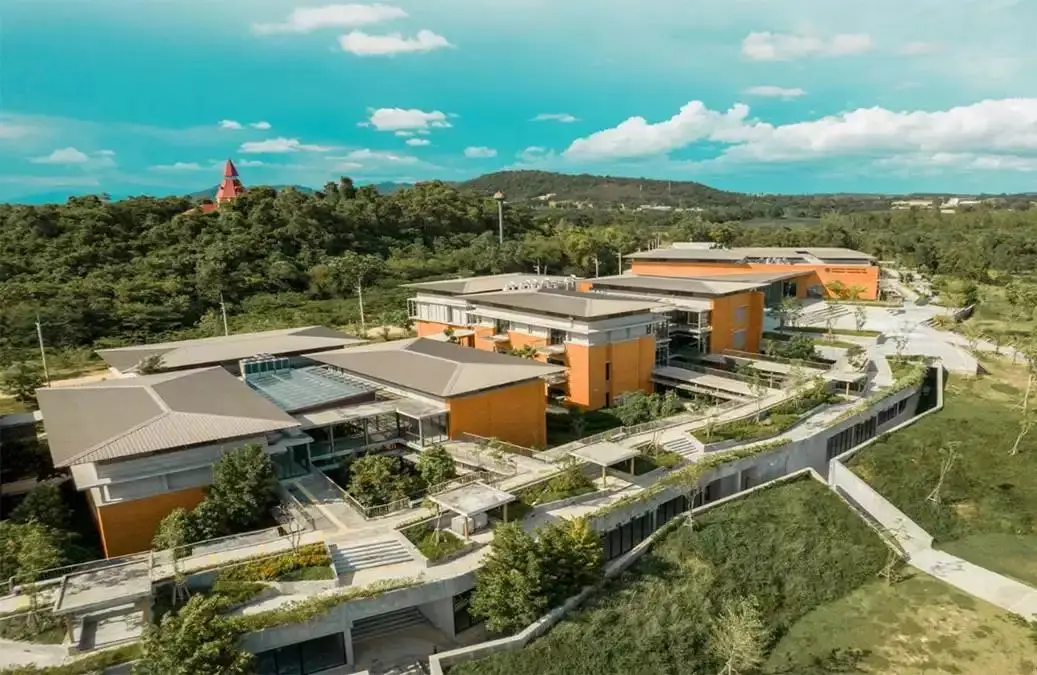
Thammasat University, Pattaya Campus is one of the regional educational centers of Thammasat University, located at 39/4 Moo 5, Pong Subdistrict, Bang Lamung District, Chon Buri 20150, Thailand. Covering approximately 584 rai, the campus serves as an important center for higher education, research, professional training, and technological innovation in eastern Thailand. Its history began with a major land donation in 1987, followed by the establishment of a higher education innovation center in 1995, the introduction of graduate education in 2006, and undergraduate teaching in 2015. Today, Pattaya Campus is particularly associated with automotive engineering, industrial automation, advanced technology, and the development of an integrated medical innovation ecosystem within Thailand's Eastern Economic Corridor (EEC). Its facilities include academic buildings, engineering laboratories, student accommodation, a university library, seminar facilities, landscaped spaces, and ECO HOTEL by Thammasat, which supports residential conferences and educational activities.
Thammasat University Pattaya Campus has a geographical setting quite different from the busy beachfront and entertainment districts commonly associated with Pattaya. The campus is located inland in Pong Subdistrict, within Bang Lamung District, where hills, trees, reservoirs, and sporting facilities form an important part of the landscape. Several Siam Country Club golf courses are situated around the wider campus area, creating a green environment that feels markedly different from the high-density urban districts closer to Pattaya Beach.
The campus's location in eastern Thailand also provides an important academic advantage. Chon Buri Province forms part of one of the country's principal industrial and economic regions, with extensive activities in automotive manufacturing, logistics, technology, international business, and specialized services. Being situated within this broader industrial environment allows the university to connect academic teaching with technical challenges, research requirements, and workforce needs arising in actual manufacturing and business operations. The campus's substantial land area also supports facilities that require more space than conventional lecture halls, particularly engineering workshops, research facilities, and future medical infrastructure.
The history of Pattaya Campus is closely connected to that of Thammasat University itself. The university was founded on June 27, 1934, under the original name University of Moral and Political Sciences, or Thammasat and Political Science University. Professor Dr. Pridi Banomyong, also known by his title Luang Praditmanutham, was the driving force behind its establishment and served as its first Rector-Administrator. The university emerged from the ambition to expand public access to advanced education, especially in law, politics, public administration, and the social sciences, following Thailand's political transformation in 1932.
In its early years, Thammasat University was centered at Tha Phra Chan in Bangkok. Over time, its teaching, research, and public service responsibilities expanded, leading to the development of additional educational sites such as Rangsit Campus in Pathum Thani Province and regional centers elsewhere in Thailand. The growth of academic disciplines and the demand for advanced research facilities prompted the university to consider locations that could accommodate specialized teaching, industry collaboration, and technological development.
The origins of Pattaya Campus date to 1987, when Thong Thavorn Industry Co., Ltd., through Dr. Thaworn Phornprapha, donated land in Pong Subdistrict, Bang Lamung District, Chon Buri Province, to Thammasat University. The original donation comprised 565 rai, 3 ngan, and 35 square wah according to the university's historical record. The donated land was intended for education, advanced professional training, academic research, scholarly services to society, the preservation of arts and culture, and activities serving the public interest.
The donation agreement reflected a long-term approach to land use. While the university had not yet constructed buildings or infrastructure on certain sections, the donor company could use those areas for agricultural activities connected with scientific and technological study under the stated conditions. The agreement also proposed the name Thammasat University, Thaworn–Usa Phornprapha Center, honoring individuals associated with the contribution. This historical name remains relevant to the origin of the campus, although the public-facing designation used today is Thammasat University, Pattaya Campus.
In 1994, Thammasat University began systematically planning how the Pattaya site could serve its expanding educational mission. Tha Phra Chan had become constrained by its location in Bangkok's historic conservation district, where further construction was limited. Meanwhile, the Rangsit area was experiencing growing urban and residential development. The university recognized that the Bang Lamung property offered a different environment, particularly suitable for research facilities and technological education closely connected with industrial production.
On January 30, 1995, the University Council resolved to establish the Higher Education Innovation Center. The new unit was designed to operate with a flexible management structure and four principal responsibilities: research and development, advanced continuing education, training and conferences, and academic resource services. These missions established the foundations of a campus intended to engage not only university students but also public agencies, businesses, industrial organizations, and communities throughout eastern Thailand.
During the 1995 fiscal year, the university secured government funding for the development of the training and seminar complex. On February 25, 1997, His Royal Highness Crown Prince Maha Vajiralongkorn, holding that royal title at the time, presided over the foundation-stone-laying ceremony for the Pattaya Campus training facilities. Construction was carried out during the 1996–1999 fiscal years. The initial complex included training and seminar buildings, catering facilities, hotel accommodation, a clubhouse and swimming pool, and a tennis court.
The original campus concept was frequently described as a Learning Resort. Rather than limiting the site's role to scheduled university lectures, the idea was to provide an integrated environment for professional education, residential training, conferences, and organizational development. Accommodation and catering services allowed government bodies, businesses, and educational organizations to arrange activities extending over several days, while the university could provide teaching spaces and academic expertise.
On February 10, 1997, the Higher Education Innovation Center was reorganized and renamed the College of Higher Education Innovation. Another administrative change followed on March 7, 2008, when the University Council approved the name College of Innovation. These changes concerned academic and administrative units within Thammasat University. They did not represent the establishment of a separate university in Chon Buri or a change to Thammasat University's own official name.
The development of regional educational administration was another important step. Following a University Council resolution dated December 20, 2004, administrative arrangements for Pattaya Campus took effect on February 1, 2005. The resulting administrative structure supported teaching, research, academic services, and facilities management while helping Thammasat University expand its regional educational activities.
A notable partnership was signed on December 21, 2004, between Thammasat University and the Chon Buri Provincial Administrative Organization. The agreement concerned the establishment of a local administration training center and botanical garden, supported by funding for buildings and physical development. This cooperation connected the university's academic resources with the development needs of local government organizations and communities in eastern Thailand.
Graduate teaching began at Pattaya Campus during the 2006 academic year. The initial fields included Technology Management, a special master's program in Community Development, Politics and Government for Executives, and Service Innovation. These programs reflected the campus's early role in developing professionals working in public administration, business, community development, and innovation-related activities.
On June 1, 2006, Thammasat University established the Pattaya Campus Library to support its growing academic activities. The library provided teaching and research resources for lecturers, students, and staff in eastern Thailand. Its services were integrated with the wider Thammasat library network, enabling users to access academic collections and information resources beyond those physically held at the Pattaya location.
Campus infrastructure continued to develop through the construction of local administration training facilities, educational activity buildings, sports grounds, and a distinctive dome-shaped pavilion on Khao Matoom Hill. The hilltop pavilion formed part of the campus's landscape development and provided a connection between the academic buildings and the surrounding natural environment.
In 2015, the campus entered another stage of development when undergraduate teaching was introduced. The early undergraduate fields included an English-language Automotive Engineering program, Software Engineering, and Automotive Technology. The transition from a primarily graduate and training-oriented center toward undergraduate engineering education reflected the university's increasing commitment to preparing technical personnel for eastern Thailand's industrial sector.
Automotive engineering education received substantial support from the private sector. Siam Motors Group contributed 60 million baht toward the construction of an automotive engineering laboratory building covering approximately 5,000 square meters. Bangkok Bank contributed another 30 million baht for two student dormitory buildings containing a total of 48 rooms. These investments demonstrated the importance of cooperation between industry and higher education in providing facilities for practical engineering education.
The Faculty of Engineering subsequently developed automotive technology education further, combining mechanical systems, control engineering, electronics, manufacturing technology, and practical industrial applications. These subjects are directly related to technological changes affecting the automotive industry, particularly automation, robotics, electric vehicles, and increasingly sophisticated production systems.
Construction of the university's integrated academic and laboratory building progressed between the 2016 and 2019 fiscal years. Following its completion, the building became known as Thammasat Innovation Hub. It is one of the campus's important facilities for academic development and innovation-related activities, supporting the university's ambition to connect students, researchers, and external organizations within a collaborative learning environment.
In 2018, Thammasat University approved the administrative elevation of the Pattaya Campus management unit to a dedicated campus administrative division. This organizational development strengthened responsibility for buildings, public utilities, security, landscape maintenance, and campus operations. It also helped prepare the center for larger educational, research, and regional development projects.
The establishment of Thailand's Eastern Economic Corridor created an additional strategic role for Pattaya Campus. The university developed plans associated with the Thammasat Integrated Medical Innovation Center, Pattaya, known as EECmd. The project seeks to integrate science, technology, medicine, healthcare, and digital information within an innovation-focused environment, contributing to the region's medical workforce, research capacity, and healthcare-related development.
During this expansion, the university also received an additional land donation of 18 rai, 2 ngan, and 74 square wah from Dr. Pornthep Phornprapha. The increase brought the campus area to approximately 584 rai. The additional land provided space for long-term infrastructure development, including facilities potentially associated with higher education, research, medical services, and collaboration with external organizations.
The university's vision for Pattaya Campus evolved toward the concept of an Innopolis Campus, or innovation-oriented university city. The principal goals include creating an academic hub, a center of research excellence, and a center for academic services and learning resources. The broader objective is to establish an environment in which students, researchers, industries, government organizations, and communities can cooperate on projects with practical economic and social value.
The development of the Pattaya Medical Center represents a major element of the campus's current transformation. In August 2026, the Chair of Thammasat University's Council visited Pattaya Campus to inspect the progress of building renovations intended for the establishment of the medical center and to review supporting infrastructure. This work forms part of a long-term approach to developing healthcare services, medical innovation, and research partnerships within the Eastern Economic Corridor.
As of 2026, Professor Dr. Supasawad Chardchawarn serves as President of Thammasat University. The campus's local administrative leadership includes Associate Professor Dr. Pruet Toh-Udom, Vice President for Pattaya Campus Administration and Health Sciences, and Associate Professor Dr. Nattadon Pannucharoenwong, Assistant to the Rector for Pattaya Campus Administration. Campus management encompasses academic support, student services, facilities, and the development of strategic university projects.
Pattaya Campus shares the institutional identity of Thammasat University. Its official colors are yellow and red, and its emblem features the Dharmachakra, or Wheel of Dhamma, with a constitution tray at the center. These symbols reflect the university's historical emphasis on educational freedom, justice, public service, and civic responsibility. The Royal Poinciana tree and the royal composition Yoong Thong are also important parts of Thammasat's cultural identity across its educational centers.
The Central Lecture Building is one of the campus's principal facilities and serves as a recognized location for campus administration and contact services. It accommodates teaching and academic activities, meetings, and functions that link administrative operations with services for students and staff. Its central role makes it an important reference point for visitors attending campus events and academic appointments.
Thammasat Innovation Hub is a prominent landmark reflecting the university's commitment to innovative learning environments. Its design incorporates academic spaces alongside architectural features that connect the building with the surrounding landscape. Open corridors, natural materials, and areas for gathering help create an educational environment where learning and informal interaction can occur beyond the conventional classroom.
The campus learning center illustrates the integration of architecture, ecology, and academic life. Its design incorporates brickwork, open-air connections, landscaped courtyards, and linked walkways, allowing greenery to form part of the building complex. This approach gives the campus a distinctive sense of place and supports the idea that the physical environment can contribute to well-being, collaboration, and learning.
The Automotive Engineering Laboratory Building is particularly important for practical education. It supports training associated with vehicle systems, engineering equipment, manufacturing technology, control systems, and technical analysis. Specialized laboratory facilities allow students to explore engineering principles using tools and equipment relevant to industrial practice, helping bridge the gap between academic study and employment.
The Pattaya Campus Library supports teaching, independent study, and research. Its published campus information describes a service area of approximately 344 square meters and 40 reading seats. The library is connected with Thammasat University's wider academic information systems, including book catalogs, research databases, digital collections, and interlibrary loan services. These facilities provide students in Chon Buri with access to academic resources held across the university's different campuses.
Student dormitories provide an important part of the campus's residential infrastructure. The university's dormitory information describes Buildings D1 through D5, with separate accommodation for male and female students and 93 rooms altogether. The stated two-person occupancy arrangement gives a total planned capacity of 186 residents. On-campus accommodation is particularly valuable for students arriving from other provinces and those participating in practical training or activities that extend beyond standard classroom hours.
The campus also includes ECO HOTEL by Thammasat, a hotel set within the university grounds that accommodates conference participants, visitors, families, and groups attending educational events. The hotel offers different room categories, including Superior, Mini-Suite, and Suite rooms. Its presence allows organizations to conduct residential seminars, meetings, and training activities while using the university's academic facilities.
Outdoor recreation and sports facilities contribute to campus life. The site includes a football field, running track, and other areas developed as part of cooperation with local authorities. These facilities support physical activity, student events, and community connections while allowing the surrounding landscape to remain an important element of the campus environment.
One of the clearest examples of ongoing undergraduate education at Pattaya Campus in 2026 is the Faculty of Engineering's Automotive Engineering and Industrial Automation program, known as V-TECH, under the Programme of Innovative Engineering, or TU-PINE. The program developed from earlier automotive technology education and has been revised to reflect contemporary automotive and automation technologies. TU-PINE specifically identifies Pattaya Campus as the teaching location for V-TECH.
The V-TECH curriculum encompasses mathematics, engineering science, automotive design, materials, thermodynamics, fluid mechanics, vehicle electronics, sensors, computer programming, manufacturing automation, and mechanical systems. Advanced subjects include electric and hybrid vehicles, industrial robotics, automatic control, and vehicle systems engineering. The program's interdisciplinary content reflects the increasing integration of mechanical, electronic, and software technologies within automotive manufacturing.
The revised 2023 curriculum for the V-TECH field requires at least 140 credits and follows a full-time study format. Practical industrial training is an important component, and students may undertake an engineering project or structured industrial work experience. These activities are intended to strengthen technical competence, teamwork, problem-solving, and familiarity with engineering practice in real workplaces.
The Pattaya Campus academic-program page also lists a Master of Science in Technology Management, a multidisciplinary graduate program associated with the College of Innovation. Its content connects technological knowledge with innovation, organizational management, and the application of new technologies in professional environments. The program is designed for graduates from different academic backgrounds who wish to develop advanced management and technology-related capabilities.
It is important to distinguish the academic offerings historically associated with Pattaya Campus from their current teaching locations. During the early undergraduate expansion in 2015, Automotive Engineering in English and Software Engineering were among the fields connected with the campus. However, TU-PINE's current academic guidance states that its EBM, iPEN, and Soft-EN programs are taught at Rangsit Campus, while V-TECH is taught at Pattaya Campus. This distinction is essential for prospective students choosing the correct study location.
Beyond currently identified academic offerings, Thammasat University has been exploring the development of additional programs at Pattaya Campus. In March 2026, university representatives from the Faculty of Allied Health Sciences, Faculty of Science and Technology, Faculty of Public Health, Faculty of Engineering, Faculty of Social Administration, and College of Innovation participated in discussions about future educational development. They reviewed the availability of laboratories, academic spaces, accommodation, and infrastructure to support potential new programs.
The university has also discussed possible cooperation with the Equestrian Association of Thailand concerning education related to equestrian sports. This initiative demonstrates interest in developing additional areas of study that could make use of the campus's extensive land, regional characteristics, and specialized facilities as part of future educational planning.
Research partnerships are a further priority. In May 2026, Pattaya Campus hosted representatives from Sky ICT Public Company Limited and PTT Oil and Retail Business Public Company Limited to discuss investment, research, development, and academic cooperation. Such discussions support the ambition to position Pattaya Campus as a place where university research and private-sector expertise can contribute jointly to innovation and regional development.
The value of university-industry collaboration lies in connecting real technical challenges with academic expertise. Students and researchers can gain opportunities to work with actual engineering, business, and organizational problems, while industry partners can benefit from research, workforce development, and knowledge transfer. This relationship is particularly relevant to eastern Thailand, where manufacturing and technology investment remain significant features of the economy.
On August 5, 2026, Pattaya Campus organized its orientation program for new students in the 2026 academic year. The activity introduced students to academic life, campus services, personal responsibilities, and the adjustments required when entering university education. Orientation is especially important for students who live in campus dormitories or have moved from other provinces to study in Chon Buri.
Student culture at Pattaya Campus reflects the wider identity of Thammasat University, especially its emphasis on academic freedom, civic responsibility, and the relationship between knowledge and public service. Orientation, student organization activities, and community projects help students develop social connections while gaining experience in leadership, cooperation, and community participation.
Community volunteering is another example of this educational philosophy in action. On February 15–16, 2026, Pattaya Campus hosted the volunteer project Toem Si Taem Suk, or Adding Color and Happiness, which involved youth development and environmental improvement activities. Projects of this kind encourage students to understand the social value of contributing time, knowledge, and effort to the surrounding community.
Campus safety and student well-being are also important aspects of university life. In August 2026, campus administrators and student representatives discussed procedures for emergency reporting, communication, and the protection of students and personnel. This cooperation reflects the importance of maintaining a safe learning environment and encouraging students to participate in improving campus life.
For visitors interested in educational tourism, Thammasat University Pattaya Campus offers a distinctive combination of institutional history, contemporary architecture, engineering education, environmental design, and innovation-oriented development. The Central Lecture Building, Thammasat Innovation Hub, engineering facilities, library, seminar complex, green spaces, and Khao Matoom dome pavilion reflect different periods of the campus's growth. Access to laboratories, classrooms, restricted areas, and specialized facilities requires coordination with the relevant university offices.
The area surrounding Pattaya Campus offers attractions connected with nature, recreation, and local culture. Mabprachan Reservoir is a major landscape feature, with parks and recreational areas used for walking, cycling, and outdoor exercise. Wat Pong provides a connection with local Buddhist community life, while Siam Country Club's golf courses contribute to the area's identity as an important center for sporting activity and international golf events.
Mabprachan Reservoir is particularly relevant to visitors looking for outdoor recreation away from central Pattaya. The surrounding roads and recreation areas provide opportunities to enjoy the landscape, take exercise, and visit local cafés or restaurants. The reservoir is part of the everyday environment of the communities around Pong and offers a quieter alternative to the coastal entertainment districts.
Additional local places of interest include Wat Pong and the Assumption Church, representing different religious and cultural communities within Bang Lamung District. Siam Country Club's Old Course is also internationally recognized through professional golf events. Together, these places demonstrate the diversity of activity around the campus, ranging from cultural visits and nature-based recreation to organized sporting events.
Getting There: Thammasat University Pattaya Campus is located at 39/4 Moo 5, Pong Subdistrict, Bang Lamung District, Chon Buri 20150. Visitors traveling from Bangkok can use Motorway Route 7 toward Chon Buri and Pattaya, then continue along connecting local roads toward Pong and the Siam Country Club area. Visitors coming from central Pattaya can approach through the main road network connecting Pattaya with its eastern neighborhoods and continue to the university's campus entrance.
Because Pattaya Campus is located inland and away from the main concentrations of public transport near the beachfront, travel by private car, taxi, or another arranged road service is generally the most practical option. Visitors arriving by intercity bus or train should plan an onward connection from their arrival point in the Pattaya or Bang Lamung area. Students and conference attendees should also confirm their destination building before departure, as the campus covers a substantial area with several separate academic and service facilities.
Visitors wishing to contact Pattaya Campus can call +66 38 259 050 to +66 38 259 055. According to Thammasat University's general working-hours announcement issued in 2026, regular university office hours are Monday to Friday, 08:30–16:30, with a lunch break from 12:00 to 13:00. Library services, academic activities, accommodation facilities, and other specialized services may operate according to separate schedules.
In conclusion, Thammasat University Pattaya Campus represents the expansion of a university founded on the principle of education for the people into a major regional center for applied research and innovation. Beginning with the donation of land in 1987, the establishment of the Higher Education Innovation Center in 1995, graduate education in 2006, and undergraduate engineering programs in 2015, the campus has continued evolving through industrial collaboration, technological research, and medical innovation initiatives in 2026. Its long-term importance lies in the connections it creates between higher education, industry, communities, and the economic development of eastern Thailand.
| Campus Name | Thammasat University, Pattaya Campus |
| Institution Type | Regional Campus of an Autonomous Public University |
| Location | Pong Subdistrict, Bang Lamung District, Chon Buri Province, Thailand |
| Address | 39/4 Moo 5, Pong, Bang Lamung, Chon Buri 20150, Thailand |
| Campus Area | Approximately 584 Rai |
| Parent University | Thammasat University, Established on June 27, 1934 |
| Founder of Thammasat University | Professor Dr. Pridi Banomyong |
| Year of Original Land Donation | 1987 |
| Land Donors | Thong Thavorn Industry Co., Ltd., through Dr. Thaworn Phornprapha; Additional Land Was Later Donated by Dr. Pornthep Phornprapha |
| Higher Education Innovation Center Established | January 30, 1995 |
| Regional Campus Administrative Development | February 1, 2005 |
| Graduate Education Introduced | 2006 |
| Undergraduate Education Introduced | 2015 |
| Historical Milestones as of 2026 | 1987 Land Donation; 1995 Innovation Center Establishment; 2006 Graduate Teaching; 2015 Undergraduate Teaching |
| University President in 2026 | Professor Dr. Supasawad Chardchawarn |
| Pattaya Campus Leadership | Associate Professor Dr. Pruet Toh-Udom, Vice President for Pattaya Campus Administration and Health Sciences; Associate Professor Dr. Nattadon Pannucharoenwong, Assistant to the Rector for Pattaya Campus Administration |
| University Colors | Yellow and Red |
| University Emblem | Dharmachakra with the Constitution Tray |
| Symbolic Tree | Royal Poinciana (Flamboyant Tree) |
| University Song | Yoong Thong, a Royal Composition |
| Associated Academic Units | Pattaya Campus Administrative Division, Faculty of Engineering, TU-PINE and Research and Innovation Units, with Additional Faculties Participating in Future Academic Development Planning |
| Academic Strengths | Automotive Engineering and Industrial Automation, Technology Management, Research and Development, Professional Training, and Integrated Medical Innovation |
| Important Campus Facilities | Central Lecture Building, Thammasat Innovation Hub, Automotive Engineering Laboratory, Library, Student Dormitories, ECO HOTEL by Thammasat, Conference Facilities, Football Field, and Khao Matoom Dome Pavilion |
| Student Accommodation | Dormitory Buildings D1–D5, with 93 Rooms Listed in Campus Information |
| On-Campus Hotel | ECO HOTEL by Thammasat |
| Campus Activities | Student Orientation, Community Volunteering, Youth Development, Academic Conferences, Training Seminars, and Student Organization Activities |
| Major Development Initiatives | EECmd Special Economic Promotion Zone and Pattaya Medical Center Development Project |
| Standard Office Open Days | Monday–Friday, Excluding Holidays Announced by the University |
| Standard Office Hours | 08:30–16:30, with Lunch Break 12:00–13:00, Under the University's General Working-Hours Rules |
| Educational Visits | Contact Pattaya Campus Administration in Advance for Study Visits and Access to Restricted Academic Facilities |
| Facilities | Library, Classrooms, Engineering Laboratories, Student Dormitories, Hotel, Meeting and Seminar Rooms, Sports Areas, and Landscaped Recreational Spaces |
| Getting There | From Bangkok via Motorway Route 7, Continuing Toward Pong and the Siam Country Club Area; From Central Pattaya via Connecting Roads to Eastern Pattaya. Private Cars and Taxis Are Practical Options |
| Nearby Attractions and Educational Sites | 1. Mabprachan Reservoir 2. Map Prachan Reservoir Park 3. Wat Pong 4. Assumption Church, Pattaya 5. Siam Country Club Old Course |
| Nearby Restaurants | 1. Lab Lum Northern Thai Restaurant, Pong — Tel. +66 94 454 1919 2. Tam Sadoong Isan Restaurant, Pong — Tel. +66 88 890 0600 3. Sicily Restaurant, Mabprachan Reservoir — Tel. +66 99 452 9696 4. Ninja Mookata Siam Country Club — Tel. +66 94 639 3969 5. KOBB & CO., Pong — Tel. +66 92 262 5652 |
| Nearby Hotels and Accommodation | 1. ECO HOTEL by Thammasat, On Campus — Tel. +66 33 135 070 2. East Shore Pattaya Resort, Pong — Tel. +66 98 554 0820 3. Siam Sky Pattaya Hotel, Pong — Tel. +66 38 195 639 4. Viphuanan Resort, Pong — Tel. +66 63 629 3915 5. Baankiangnam Pattaya, Pong — Tel. +66 65 802 1516 |
| Pattaya Campus Telephone | +66 38 259 050 to +66 38 259 055 |
| Official Campus Website | https://pattayacenter.tu.ac.th/ |
| Current Status | Operating Educational Campus with Academic Programs, Student Activities, Research, and Infrastructure Development in the 2026 Academic Year |
Academic Programs and Fields of Study at Thammasat University, Pattaya Campus, Academic Year 2026
| Faculty / Academic Unit | Programs and Fields of Study Associated with Pattaya Campus |
| Faculty of Engineering — TU-PINE, Pattaya Campus | Bachelor's Degree 1. Bachelor of Engineering in Automotive Engineering and Industrial Automation (V-TECH). The revised 2023 curriculum comprises 140 credits, with teaching at Pattaya Campus and academic schedules published for 2026. Core Professional Areas Automotive Engineering, Industrial Automation, Vehicle Sensors, Automatic Control Systems, Electric and Hybrid Vehicles, Industrial Robotics, Manufacturing Processes, and Industry-Based Professional Experience |
| College of Innovation — Technology Management | Master's Degree Listed on the Pattaya Campus Program Page 1. Master of Science in Technology Management (MTT), a multidisciplinary graduate program integrating technology, innovation, and organizational management |
Frequently Asked Questions (FAQ)
Q: Is Thammasat University Pattaya Campus still operating?
A: Yes. The campus continues its academic activities in 2026, including student orientation, engineering education, community projects, research partnerships, and infrastructure development.
Q: Where is Thammasat University Pattaya Campus located?
A: The campus is located at 39/4 Moo 5, Pong Subdistrict, Bang Lamung District, Chon Buri 20150, Thailand. It is situated inland rather than on Pattaya's beachfront.
Q: What are the opening days and hours of Thammasat University Pattaya Campus?
A: The university's general office hours under its 2026 announcement are Monday to Friday, 08:30–16:30, with a lunch break from 12:00 to 13:00. Holidays and separate schedules for individual facilities and services also apply.
Q: When was Thammasat University Pattaya Campus established?
A: The land for the campus was originally donated in 1987, the Higher Education Innovation Center was established by University Council resolution on January 30, 1995, and graduate teaching began in 2006.
Q: Who donated the land for Thammasat University Pattaya Campus?
A: The original land was donated by Thong Thavorn Industry Co., Ltd., through Dr. Thaworn Phornprapha. Additional land was later donated by Dr. Pornthep Phornprapha.
Q: What academic programs are taught at Thammasat University Pattaya Campus?
A: The Faculty of Engineering's V-TECH program in Automotive Engineering and Industrial Automation is identified as a Pattaya Campus program in 2026. The campus's academic-program page also lists a master's program in Technology Management, with admissions arrangements determined by the responsible academic unit.
Q: Are student dormitories and hotels available at Pattaya Campus?
A: Yes. The campus provides student dormitory facilities and contains ECO HOTEL by Thammasat, which accommodates visitors, conferences, and educational groups.
Q: How can visitors reach Thammasat University Pattaya Campus?
A: Visitors from Bangkok can travel via Motorway Route 7 and continue toward Pong and the Siam Country Club area. Visitors from Pattaya can approach through the roads connecting the city with eastern Pattaya. Private cars or taxis are generally practical transport options.
 Category: ●University
 Group: ●Public university
Last Update : 3 WeekAgo
 Last Update : 3 WeekAgo
 Click to Access the Navigation Map GPS
Thammasat University Pattaya Campus Map
Recommend

 Art, Culture and Heritage
 Historical Sites and Monuments(4)
 Landmarks and Memorials(7)
 Royal Palace(1)
 Art, Craft Centres, Tradition(5)
 Museums(11)
 Art Gallery(1)
 Educational Places
 Educational Gardens, Farm(2)
 Training Center(2)
Public university(3)
 Autonomous Universities(1)
 Rajamangala University of Technology(1)
 Private University(2)
 Places of Worship
 Temple(42)
 Church(1)
 Mosque(2)
 Other Sacred Sites(15)
 Suburban Living
 Village, Community(5)
 Local Market(6)
 Floating Market(1)
 Nature and Wildlife
 National Parks and Marine Reserves(2)
 Mountain (Doi)(3)
 Dam, Reservoir, Lake(4)
 Waterfalls(3)
 Caves(3)
 Bays and Beaches(26)
 Islands(8)
 Other natural attractions(1)
 Entertainment and Agricultural
 Zoos and Aquariums(7)
 Animal camps and shows(4)
 Stadium(9)
 Farms, Parks and Ecotourism(9)
 Amusement Park(3)
 Waterpark(5)
 Theater(5)
 Cinema(1)
 Outdoor and Adventure Activities(4)
 Shopping
 Shopping and Night Market(1)
 Department Store(13)
 Travel Articles, Recipes
 Travel Review, Food Review(3)


