
lovethailand home >Northeastern Travel Attractions >Udon Thani Travel Attractions >Kum Phawapi >Chiang Wae > Red Lotus Sea
TL;DR: Red Lotus Sea is located at Nong Han Kumphawapi, Chiang Wae Subdistrict, Kumphawapi District, Udon Thani Province, open Daily During The Red Lotus Season, hours 06.00 – 11.00.
Red Lotus Sea
Open Days: Daily During The Red Lotus Season
Opening Hours: 06.00 – 11.00
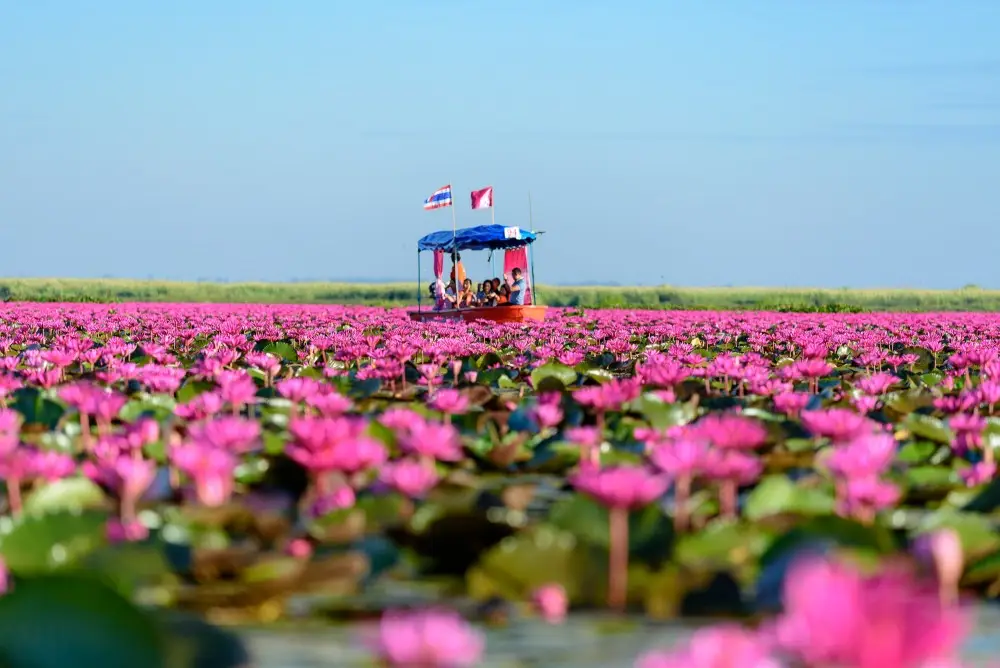
Red Lotus Sea Udon Thani, also known as the Red Lotus Sea of Nong Han Kumphawapi, is one of the most remarkable natural attractions in northeastern Thailand. Located around Ban Diem Pier in Chiang Wae Subdistrict, Kumphawapi District, Udon Thani Province, this vast freshwater wetland becomes a breathtaking pink landscape during the cool season, when thousands of red-pink water lilies bloom across the surface of Nong Han Lake. The sight is so wide and vivid that locals and travelers call it the “Red Lotus Sea”, a name that perfectly captures the feeling of floating through a living sea of flowers.
The best time to visit the Red Lotus Sea is from December to February, when the lotus flowers bloom most beautifully. The ideal time of day is early morning, especially from 06.00 to 10.00, when the flowers are fully open, the air is cool, and the soft morning light creates the most impressive scenery. After late morning, the flowers gradually close their petals, so timing is essential. Many visitors arrive at Ban Diem Pier before sunrise in order to board the first boats and watch the sun rise over the lotus-covered water. The combination of pink flowers, morning mist, fishing boats, and golden light creates one of the most memorable winter travel scenes in Udon Thani.
Nong Han Kumphawapi is a large natural freshwater lake covering about 22,500 rai, or around 36 square kilometers. It is an important wetland ecosystem with fish, water birds, aquatic plants, and local communities living around its shores. The lake is not only a tourist attraction but also a source of food, income, and cultural identity for nearby villages. Local people have long depended on the lake for fishing, collecting aquatic plants, preparing local dishes, and creating products from lotus-related materials. When the lotus season arrives, many villagers also earn income from boat tours, food stalls, homestays, and community-based tourism services.
The red lotus flowers here grow naturally in Nong Han rather than being planted as an artificial tourist display. This is what makes the Red Lotus Sea feel so authentic. During the cool season, the plants rise from the water, spread their round leaves, and bloom in large natural clusters. Some areas are densely covered with flowers, while other parts open into water channels where boats can pass through. As the boat moves, the scenery constantly changes. Travelers may see wide fields of pink flowers in one direction, reflections of the sky in another, and birds flying low across the wetland.
Ban Diem Pier is one of the main and most popular departure points for Red Lotus Sea boat tours. Located in Chiang Wae Subdistrict, it serves as a community tourism hub during the blooming season. Around the pier, visitors can find local boats, food stalls, cafés, small hotels, homestays, community shops, and travel services. The pier is especially convenient for travelers who want to stay overnight nearby and wake up early for a sunrise boat trip. It is also closely connected with the local tourism economy, as many families in Ban Diem and Chiang Wae earn seasonal income from boats, food, accommodation, and local products.
The main activity at the Red Lotus Sea is a boat tour across Nong Han Lake. Visitors can choose between smaller boats for couples or two travelers and larger boats suitable for families or small groups. A typical boat trip lasts around 1 to 1.5 hours. The boatmen, who know the lake well, take travelers out from the pier to the areas where the lotus flowers are most concentrated. Along the way, visitors can enjoy the open water, lotus fields, birds, local fishing scenes, and the peaceful atmosphere of the lake in the morning.
The boat ride is the heart of the experience. Because visitors sit close to the water level, the flowers appear almost within reach, and the view feels immersive rather than distant. The boat slowly moves through channels between the lotus clusters, offering different angles for photography. Early morning sunlight makes the petals glow softly, while the round leaves floating on the water create a natural pattern across the lake. On clear days, sunrise over the Red Lotus Sea is especially impressive. This is why photographers, couples, and nature lovers often plan to arrive before dawn.
The Red Lotus Sea is also valuable as a wetland ecosystem. Nong Han Kumphawapi is home to many species of fish, aquatic plants, and water birds. During a boat trip, travelers may see birds feeding, flying, or resting among the plants. This makes the destination suitable not only for flower viewing but also for birdwatching, nature study, family travel, and slow tourism. Children can learn about wetlands, plants, birds, and traditional fishing life, while adults can enjoy the calm atmosphere and wide-open landscape.
Beyond its natural beauty, the Red Lotus Sea is linked with local Isan folklore and cultural memory, especially stories associated with Nong Han and the legend of Pha Daeng and Nang Ai. For local communities, Nong Han is not only a body of water. It is a cultural landscape filled with stories, beliefs, livelihoods, and shared memory. This cultural layer gives the lake deeper meaning. Visitors who take time to learn about the local stories will understand that the Red Lotus Sea is more than a photogenic destination; it is part of the identity of the communities surrounding Nong Han Kumphawapi.
The modern community-based tourism development of Ban Diem began to take clearer shape around 2005, when local people organized boat services and tourism activities through a community enterprise. The Ban Diem Red Lotus Sea tourism group helped create a more systematic way to welcome visitors, manage boats, and distribute income among local families. Over time, the area became one of Udon Thani’s most famous winter landmarks. What began as a local natural phenomenon recognized by villagers gradually became a nationally known attraction for Thai and international travelers.
Choosing the right pier is an important part of planning a visit. Ban Diem Pier is popular because it has many boats, nearby food options, accommodation, and easy access to local attractions. Other piers around Nong Han include Ban Chiang Wae Pier, Ban Chae Lae Pier, and Ban Don Khong Pier. All of these piers connect visitors to the Red Lotus Sea, but Ban Diem remains one of the most convenient choices for first-time visitors, sunrise travelers, and those who want services close to the pier.
The recommended arrival time is around 05.30 to 06.30 for travelers who want to see sunrise and capture the best morning light. Visitors who prefer a more relaxed schedule can arrive around 07.00 to 08.00, but it is better not to arrive too late because the flowers begin to close as the sun becomes stronger. A morning visit also allows travelers to enjoy cooler weather, take better photographs, and continue to nearby attractions after returning from the boat trip.
Boat service fees are generally based on boat size. A small boat for about 2 passengers is usually around 300 baht per trip, while a larger boat for about 6 passengers is usually around 500 baht per trip. The trip takes around 1 to 1.5 hours. These fees are for the boat tour rather than an admission ticket to the lake. Travelers should prepare cash, especially when arriving early in the morning, because small operators and community boat services may not always rely on digital payment systems.
After the boat trip, visitors can enjoy breakfast, coffee, and local food around Ban Diem Pier. Food stalls and restaurants in the area often serve simple breakfast dishes, local Isan food, coffee, and lotus-inspired items. Some menus use parts of the lotus plant or are inspired by the local environment, such as lotus tea, lotus stem dishes, and local fish from Nong Han. This adds another layer to the travel experience, allowing visitors to taste the local food culture connected with the lake.
A nearby place worth visiting after the boat tour is Wat Mahathat Thep Chinda, also known as Phra That Ban Diem. It is close to Ban Diem Pier and serves as an important spiritual site for the local community. Many visitors stop here before or after the boat trip to pay respect and learn more about the religious life of the village. A short trip to the Red Lotus Sea can therefore include nature, photography, breakfast, local products, and a temple visit within the same community area.
The main areas around the Red Lotus Sea can be understood as several practical zones: Ban Diem Pier, the boat route through the lotus fields, the sunrise viewing area, the birdwatching and wetland ecosystem area, the community food and shop area, nearby homestays and small hotels, and the temple area near Phra That Ban Diem. These are not formal amusement-park-style zones, but understanding them helps travelers plan their visit more efficiently and enjoy the destination with better context.
For travelers who want a smooth early-morning experience, staying overnight near the pier is highly recommended. Nearby accommodation includes small hotels, resorts, homestays, and community-style lodging such as Ma Der Bua Hotel, Village Homestay, Bua Daeng Homestay Resort, Graham & Donlaya Homestay, and Hormduk Resort. Staying close to Ban Diem Pier makes it easier to wake up early and reach the boats before sunrise. Travelers who prefer larger hotels or more urban facilities can stay in Kumphawapi town or Udon Thani city and drive to the pier before dawn.
Getting to the Red Lotus Sea is convenient by private car, rental car, or hired van. From Udon Thani city, drive toward Kumphawapi District on Mittraphap Road, then continue on local roads toward Chiang Wae Subdistrict and Ban Diem Pier. From Khon Kaen, drive north along Mittraphap Road toward Udon Thani and follow the signs for the Red Lotus Sea around Kumphawapi. Another route passes the Kumphawapi junction and continues toward the rural road leading toward Prachak Sinlapakhom District before turning into Ban Diem. Road signs are available in many parts of the route, but using navigation is still recommended.
Getting There from Udon Thani city is best done by car. The road journey is suitable for a half-day or full-day trip, but travelers who want to see sunrise should leave very early or stay overnight near the pier. From Khon Kaen, follow Mittraphap Road toward Udon Thani, pass Kumphawapi District, and follow signs to the Red Lotus Sea and Ban Diem Pier. The route is generally accessible, but early-morning driving should be done carefully. Allow enough time for parking, choosing a boat, wearing a life jacket, and preparing your camera before departure.
Travelers using public transport can take a train to Kumphawapi Railway Station and continue by local transport or hired vehicle to Ban Diem Pier. This option requires careful timing because the best lotus-viewing period is early in the morning. If arriving too late, visitors may miss the full bloom period of the day. For foreign travelers or small groups, hiring a car with a driver from Udon Thani city is often the most convenient option. It also allows the trip to be combined with Wat Santi Wanaram, Udon Thani city attractions, or local restaurants.
Responsible travel is important at the Red Lotus Sea. Visitors should wear life jackets during the boat trip, avoid standing or changing seats while the boat is moving, avoid picking lotus flowers, never throw rubbish into the water, and follow the boatman’s instructions. Nong Han is an important wetland ecosystem, so protecting the water, flowers, birds, and local environment helps preserve the destination for future seasons.
For photography, prepare your camera or phone before boarding because the best light lasts only for a short time. Popular photo angles include close-up lotus shots, boats moving through the flowers, sunrise over the lake, reflections on the water, and local fishing scenes. Light-colored clothing such as white, cream, beige, or soft earth tones photographs well against the pink lotus fields. Since the tour takes place on a boat, travelers should also protect cameras and phones from splashes.
The Red Lotus Sea suits many types of travelers. Couples come for romantic morning photographs, families come for nature learning, photographers come for sunrise and wide lake views, birdwatchers come for the wetland ecosystem, and cultural travelers come for the connection between Ban Diem, Nong Han, and local Isan stories. This diversity is one reason the destination remains one of the most popular winter attractions in Udon Thani.
Compared with many flower fields in Thailand, the Red Lotus Sea offers a more immersive experience because visitors must travel by boat into the wetland landscape. The flowers are not viewed only from a walkway or garden path. Instead, travelers move through the environment itself. The sound of the boat, the cool morning air, the open water, the birds, and the changing light make the experience feel alive. The lotus flowers, local boats, fishing life, and community services all form one complete travel story.
A one-day itinerary can begin with an early departure from Udon Thani city, arriving at Ban Diem Pier before 06.00. After a 1 to 1.5-hour boat trip, visitors can have breakfast or coffee near the pier, visit Phra That Ban Diem, and continue to Wat Santi Wanaram or other attractions in Kumphawapi. Those with more time can return to Udon Thani city for the city pillar shrine, Udon Thani Museum, local markets, or evening food areas. Staying overnight near the pier makes the experience more relaxed, especially for travelers who want sunrise photography.
Overall, Red Lotus Sea Udon Thani is a destination that combines natural beauty, wetland ecology, local livelihood, community tourism, folklore, and peaceful winter atmosphere. It is not simply a place to photograph lotus flowers. It is a morning journey into Nong Han Kumphawapi, where pink blossoms, boats, birds, water, sunlight, and village life come together. With good timing, careful planning, and respect for the local environment, the Red Lotus Sea can become one of the most memorable travel experiences in northeastern Thailand.
| Name | Red Lotus Sea Nong Han Kumphawapi |
| Location | Nong Han Kumphawapi, Chiang Wae Subdistrict, Kumphawapi District, Udon Thani Province |
| Address | Ban Diem Pier, Moo 5, Chiang Wae Subdistrict, Kumphawapi District, Udon Thani 41110, Thailand |
| Coordinates | Ban Diem Pier Area, Chiang Wae Subdistrict, Kumphawapi District, Udon Thani Province |
| Highlights | Morning boat tour through vast red-pink lotus fields, sunrise views, water birds, wetland scenery, and Ban Diem community life |
| History | Community-based tourism developed more systematically around 2005 through the Ban Diem Red Lotus Sea tourism community enterprise |
| Name Origin | The name comes from the sight of red-pink lotus flowers blooming across Nong Han Lake until the water surface appears like a vast pink-red sea |
| Distinctive Features | A large natural freshwater wetland of about 22,500 rai with fish, water birds, aquatic plants, and seasonal red-pink lotus flowers |
| Travel Information | From Udon Thani city, drive toward Kumphawapi District on Mittraphap Road, then continue to Chiang Wae Subdistrict and Ban Diem Pier. From Khon Kaen, drive north along Mittraphap Road toward Udon Thani and follow Red Lotus Sea signs around Kumphawapi. |
| Current Status | Open as a nature and community-based tourism attraction during the Red Lotus Sea season at Nong Han Kumphawapi, Udon Thani |
| Open Days | Daily During The Red Lotus Season |
| Opening Hours | 06.00 – 11.00 |
| Best Time To Visit | December – February, especially 06.00 – 10.00 for full bloom and soft morning light |
| Boat Tour Fees | Small boat about 300 baht per trip; large boat about 500 baht per trip; boat tour duration about 1 – 1.5 hours |
| Facilities | Boat pier, tour boats, life jackets, parking area, restaurants, cafés, community shops, restrooms, and nearby accommodation |
| Main Areas / Zones | Ban Diem Pier Lotus Boat Route Sunrise Viewing Area Birdwatching And Wetland Ecosystem Area Community Food And Shop Area Homestay And Accommodation Area Wat Mahathat Thep Chinda / Phra That Ban Diem |
| Caretaker / Community Group | Ban Diem Red Lotus Sea Tourism Community Enterprise, chaired by Mr. Paisit Sukrom |
| Main Contact Number | Ban Diem Pier Tel. 08 9395 0871 Ban Chiang Wae Pier Tel. 08 8310 4767 Ban Chae Lae Pier Tel. 09 3334 9975 Ban Don Khong Pier Tel. 09 3931 4179 TAT Udon Thani Office Tel. 0 4232 5407 |
| Official Website / Official Page | TAT Udon Thani Office Facebook Page Tourism Authority Of Thailand Website |
| Nearby Tourist Attractions | 1. Wat Mahathat Thep Chinda / Phra That Ban Diem, about 1 km 2. Ban Chiang Wae Community Tourism Area, about 2 km 3. Wat Santi Wanaram Lotus-Shaped Temple, about 28 km 4. Kumphawapi Monkey Park, about 18 km 5. Ho Chi Minh Museum Udon Thani, about 45 km 6. Udon Thani City Pillar Shrine, about 48 km 7. Udon Thani Museum, about 49 km |
| Nearby Restaurants | 1. Ma Der Bua Red Lotus Sea, about 1 km, Tel. 081-974-3560 2. Ban Diem Pier Community Food Stalls, about 1 km 3. Tam Tu Pu Kumphawapi, about 18 km, Tel. 097-170-0679 4. Saeb Nua At Kumphawapi, about 18 km, Tel. 083-351-2395 5. PunThai Coffee Kumphawapi, about 19 km, Tel. 062-601-2022 6. PunThai Coffee Kumphawapi Hospital, about 19 km, Tel. 061-031-3406 7. Hia Aun Tom Lueat Mu, about 24 km |
| Nearby Accommodations | 1. Ma Der Bua Hotel, about 1 km, Tel. 081-974-3560 2. Village Homestay, about 2 km, Tel. 098-747-6716 3. Bua Daeng Homestay Resort, about 2 km, Tel. 083-614-0916 4. Graham & Donlaya Homestay, about 1 km, Tel. 081-775-4208 5. Hormduk Resort, about 4 km, Tel. 087-008-8134 6. KP Hotel Udonthani, about 22 km, Tel. 042-250250, 090-2549345 |
Frequently Asked Questions (FAQ)
Q: Where is the Red Lotus Sea in Udon Thani located?
A: The Red Lotus Sea is located at Nong Han Kumphawapi, around Ban Diem Pier in Chiang Wae Subdistrict, Kumphawapi District, Udon Thani Province.
Q: Which month is best for visiting the Red Lotus Sea?
A: The best months are December to February, when the red-pink lotus flowers bloom most beautifully across Nong Han Lake.
Q: What time should travelers arrive at Ban Diem Pier?
A: Travelers should arrive around 05.30 – 06.30 to catch sunrise and see the lotus flowers fully open in the morning.
Q: Is there an entrance fee for the Red Lotus Sea?
A: The main cost is the boat tour fee. A small boat is about 300 baht per trip, while a larger boat is about 500 baht per trip.
Q: How long does the boat tour take?
A: A typical boat tour takes about 1 to 1.5 hours, depending on the boat type, route, and conditions on the lake.
Q: Who is the Red Lotus Sea suitable for?
A: It is suitable for couples, families, photographers, birdwatchers, nature lovers, and travelers interested in local community life around Nong Han Kumphawapi.
Q: Are there accommodations near Ban Diem Pier?
A: Yes. Nearby options include Ma Der Bua Hotel, Village Homestay, Bua Daeng Homestay Resort, Graham & Donlaya Homestay, and Hormduk Resort.
Q: What attractions can be visited after the Red Lotus Sea?
A: Nearby attractions include Wat Mahathat Thep Chinda, Ban Chiang Wae community tourism area, Wat Santi Wanaram, Kumphawapi Monkey Park, Udon Thani Museum, and the Udon Thani City Pillar Shrine.
 Category: ●Nature and Wildlife
 Group: ●River, Canal
Last Update : 1 MonthAgo
 Last Update : 1 MonthAgo
 Click to Access the Navigation Map GPS
Red Lotus Sea Map
Gellery
Recommend

 Art, Culture and Heritage
 Historical Sites and Monuments(1)
 Landmarks and Memorials(1)
 Art, Craft Centres, Tradition(2)
 Museums(2)
 Places of Worship
 Temple(21)
 Other Sacred Sites(8)
 Suburban Living
 Village, Community(3)
 National Parks and Marine Reserves(3)
 Mountain (Doi)(1)
 Dam, Reservoir, Lake(8)
 Waterfalls(6)
 Caves(1)
River, Canal(4)
Caves(1)
River, Canal(4)
 Islands(1)
 Other natural attractions(1)
 Entertainment and Agricultural
 Farms, Parks and Ecotourism(3)
 Waterpark(1)
 Shopping
 Shopping and Night Market(1)


