
lovethailand home >Northeastern Travel Attractions >Udon Thani Travel Attractions >Ban Phu >Muang Phan > Phra Phutthabat Bua Ban
TL;DR: Phra Phutthabat Bua Ban is located at Ban Phai Lom, Mueang Phan Subdistrict, Ban Phue District, Udon Thani Province, open Daily, hours 08.00 – 16.00.
Phra Phutthabat Bua Ban
Open Days: Daily
Opening Hours: 08.00 – 16.00
Phra Phutthabat Bua Ban in Udon Thani Province is an important Buddhist footprint shrine and ancient religious site in Ban Phai Lom, Mueang Phan Subdistrict, Ban Phue District. Located at Wat Phra Phutthabat Bua Ban, the site stands on a sandstone hill landscape and contains an old Buddha footprint replica, a Lan Xang-style stupa covering the footprint, Tham Phra cave, wooden Buddha images in Lan Xang style, carved sandstone Buddha images facing the 4 directions, and a large group of sandstone sema boundary stones. These elements make Phra Phutthabat Bua Ban a meaningful destination for visitors who want to worship, study ancient Buddhist art, and understand the deep cultural roots of upper northeastern Thailand.
The site is respected by local residents and by travelers who pass through Ban Phue District. It is not a large commercial attraction, but its cultural value is high because several historical layers exist in the same place. The sandstone sema stones are connected with late Dvaravati and early Lopburi artistic traditions, while the Buddha footprint replica and the stupa that covers it reflect later Lan Xang Buddhist devotion. This combination makes Phra Phutthabat Bua Ban a compact but highly informative heritage site where visitors can observe how sacred landscapes were reused and reinterpreted across different periods.
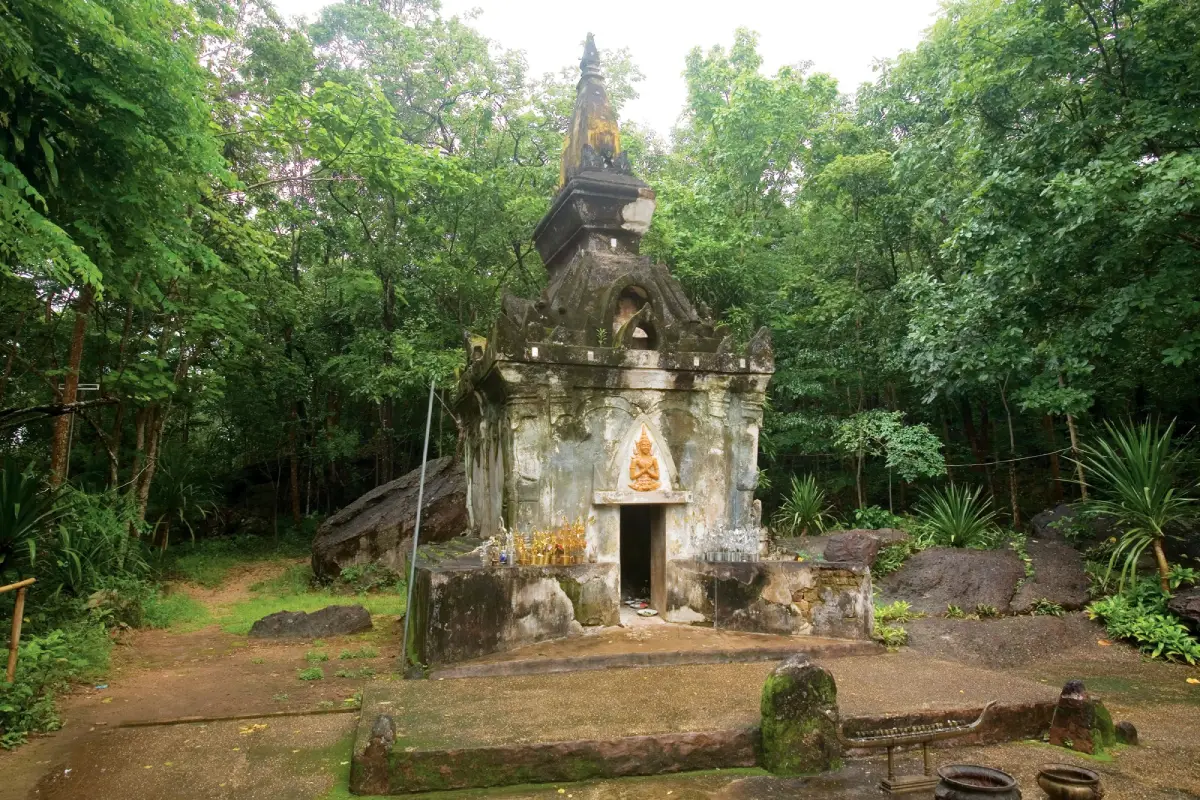
Wat Phra Phutthabat Bua Ban was established in 1911. The original Buddha footprint was a natural depression in the stone floor shaped like a human foot. Later, a replica of the footprint was created and placed over the original natural form, and a stupa was built over it. The replica footprint is made of plaster, with a smooth golden surface and straight-edged outline. It is about 140 centimeters long, about 65 centimeters wide at the toe end, and about 53 centimeters wide at the heel end. Unlike many symbolic Buddha footprints that contain Dharma wheels or auspicious motifs, the sole of this footprint is plain.
The stupa covering the footprint is a Lan Xang-style structure with a square indented form. It has a single entrance on the eastern side. The stupa measures about 2 meters on each side and is about 6 meters high. Its design is simple, compact, and peaceful rather than monumental. Its purpose is clear: to protect and honor the Buddha footprint. This relationship between natural stone, sacred footprint, and protective architecture shows how Buddhist communities transformed natural formations into sacred places through devotion and architectural framing.
The name “Bua Ban” has a graceful and auspicious meaning. In Buddhist culture, the lotus symbolizes purity, awakening, and the possibility of rising above worldly impurity. When the name of the footprint is associated with a blooming lotus, the site becomes connected with spiritual growth and inner clarity. Visitors who come to worship do not come only to see an old footprint; they also come to experience calmness and reflect on the Buddhist meaning of purity and awakening.
Around Phra Phutthabat Bua Ban are many sandstone sema boundary stones. These sema stones are arranged in 8 directions, and some positions contain 2 stones placed in layers. There are 31 stones in total. Some remain standing, some have fallen, and several are partly buried. Many of the stones are carved with human figures, celestial beings, apsara-like figures, and ancient decorative forms. These carvings are identified with late Dvaravati and early Lopburi artistic traditions. Their presence indicates that this area was once an important sacred or ritual zone of a prosperous ancient community capable of producing large and refined sandstone sculpture.
Sandstone sema stones are highly important in northeastern Thai archaeology because they marked sacred Buddhist ritual boundaries. The discovery of many sema stones at Phra Phutthabat Bua Ban shows that the site had religious importance long before the modern temple was established. The carvings also reveal a religious world shaped by celestial imagery, sacred persons, and Buddhist ritual space. Visitors who observe the stones carefully can see differences in form, carving style, erosion, and placement, all of which help tell the long history of the site.
The 8-direction arrangement of the sema stones shows that the sacred space was organized systematically. The paired stones in some locations may reflect repeated use, later adjustment, or special attention to certain ritual points. When walking through the area, visitors can observe how each stone differs in height, surface texture, weathering, and position. These differences are not minor details; they are part of the historical record preserved in the landscape itself.
To the north of the footprint stupa is a rocky area known as Tham Phra, or Buddha Cave. This area contains wooden Buddha images in Lan Xang style and carved sandstone Buddha images facing the 4 directions, with a brick-and-plaster mondop structure also associated with Lan Xang art. These objects show that after the earlier Dvaravati and Lopburi-period sacred activity faded, Lao Lan Xang communities continued to use and renew the site. Phra Phutthabat Bua Ban therefore preserves more than one historical period in a single sacred landscape.
The later Lan Xang layer of the site reflects wider cultural movements in the Mekong region. Communities connected with Lan Xang culture entered and settled in this area, bringing with them Buddhist architecture, wooden Buddha images, and local devotional practices. Later movements of Lao Phuan groups also shaped the cultural landscape of Ban Phue. This history explains why Phra Phutthabat Bua Ban contains both older sandstone boundary stones and later Lan Xang Buddhist elements.
The natural setting is also essential to the meaning of the site. Phra Phutthabat Bua Ban stands in a sandstone hill environment, with rock surfaces, a cave-like shelter, and open stone areas. The site feels different from an urban temple because its sacred quality comes directly from the landscape. The rocks, cave, sema stones, and stupa all work together to create an atmosphere of quiet antiquity. Visitors who enjoy both heritage and nature will find many details worth observing.
Phra Phutthabat Bua Ban belongs to the wider cultural landscape of Ban Phue, which also includes Phu Phrabat Historical Park, Phra Phutthabat Bua Bok, Ho Nang Usa, and several prehistoric rock art and sandstone heritage sites. Ban Phue is one of Udon Thani’s most important cultural districts because it preserves evidence of human activity from prehistoric times through the Dvaravati, Lopburi, Lan Xang, and later local community periods. Phra Phutthabat Bua Ban is one part of this larger story of how people used sandstone hills as sacred and cultural spaces.
For visitors interested in Dvaravati and Lopburi art, the sema stones are the most important feature to study. They are not merely decorative stones. They mark a sacred Buddhist ritual area and show how people in the past organized religious space. The 8-direction arrangement reflects a systematic understanding of sacred boundaries, while the paired stones in some locations suggest reuse or development over time. Their carved images preserve ancient religious ideas in stone.
For visitors interested in Lan Xang art, the stupa covering the footprint and the wooden Buddha images in Tham Phra are especially important. Lan Xang art often expresses calmness, strength, and simplicity. At Phra Phutthabat Bua Ban, these elements stand in direct relationship with the older sacred landscape. This makes the site an excellent example of how one sacred place can continue to attract devotion across centuries, even when the communities and artistic traditions around it change.
Phra Phutthabat Bua Ban is also a useful place for understanding heritage conservation. Many important objects are outdoors and exposed to sunlight, rain, moisture, soil movement, plant roots, and human contact. Visitors should avoid touching, climbing, rubbing, or moving the sema stones, stupa, footprint area, or any ancient stone fragments. Respectful distance and careful movement help preserve the archaeological record for future generations.
For worshippers, a meaningful visit can begin with paying respect to the Buddha footprint inside the stupa. The Buddha footprint is an important Buddhist symbol because it represents the presence of the Buddha and the imprint of the Dharma in the human world. Although the present footprint is a later replica placed over an original natural depression, local devotion gives the place strong spiritual meaning. After worship, visitors can walk quietly around the stupa, Tham Phra, and the sema stones.
Tham Phra is also worth careful attention because it reveals the Lan Xang Buddhist layer of the site. The wooden Buddha images and the sandstone Buddha images facing the 4 directions show how Buddhist devotion was adapted to a natural rocky setting. Caves and rock shelters were often treated as quiet, spiritually powerful spaces in northeastern Thailand and the Mekong region. At Phra Phutthabat Bua Ban, the cave area helps connect meditation, landscape, and sacred image worship in a compact space.
Phra Phutthabat Bua Ban is suitable for students, teachers, local historians, cultural travelers, and visitors interested in ancient religious landscapes. A single visit can introduce many topics: Buddha footprints in Buddhist belief, sandstone sema stones, late Dvaravati art, early Lopburi art, Lan Xang architecture, sacred boundaries, rock landscapes, and the role of temples in northeastern Thai communities. This makes the site more than a worship stop; it is a learning space within a living temple compound.
The best time to visit is in the morning. The weather is cooler, the light is suitable for observing stone surfaces, and the site is calmer. Afternoon visits are also possible, but visitors should bring drinking water, a hat, or an umbrella because some areas are exposed to the sun. Those who want to study the site properly should allow about 1 to 2 hours, rather than treating it as a quick photo stop.
Visitors should dress modestly and behave respectfully. This is both a temple and an archaeological site. Speak softly, avoid climbing the stupa, do not touch the Buddha footprint unnecessarily, do not place objects on ancient stones, and do not leave litter. Families with children should guide them carefully, as the site includes uneven stone surfaces and fragile heritage objects.
Getting There from Udon Thani city requires planning. Travel along the Udon Thani–Ban Tio route for about 64 km, continue from Ban Tio to Ban Phai Lom for about 14 km, and then walk about 2 km to the site. The route is most suitable for private cars, rental cars, or hired local transport. Visitors unfamiliar with the area should travel in the morning and allow enough time, as parts of the route pass through rural and upland areas.
Phra Phutthabat Bua Ban can be combined with Phu Phrabat Historical Park, Phra Phutthabat Bua Bok, Ho Nang Usa, and the Thai Phuan Ban Phue community in the same cultural route. Travelers with a full day can visit Phu Phrabat in the morning, continue to Phra Phutthabat Bua Bok, and then visit Phra Phutthabat Bua Ban. Those who want a slower and deeper experience can stay in Ban Phue or Udon Thani city and divide the area into a 2-day itinerary.
Phra Phutthabat Bua Ban is open daily from 08.00 to 16.00. Daytime visits are recommended because the ancient stones, stupa, cave area, and walking route are easier to see clearly. Main travel expenses depend on transport, food, and local services. Donations at the temple are voluntary. Visitors should bring water, comfortable walking shoes, and sun protection, especially during the hot season.
For Thai visitors, Phra Phutthabat Bua Ban opens a deeper view of Udon Thani as a province of archaeology, sacred landscapes, and local Buddhist heritage. For foreign travelers, it offers a valuable example of a Buddhist footprint shrine, Dvaravati boundary stones, Lan Xang architecture, and a sacred sandstone landscape in northeastern Thailand. The site helps explain how religious places in Thailand can remain meaningful across many centuries.
Phra Phutthabat Bua Ban deserves a place in a cultural itinerary of Ban Phue District, especially for travelers interested in Buddha footprints, ancient monuments, sandstone sema stones, Dvaravati art, Lopburi art, Lan Xang art, and the sandstone landscapes of Udon Thani. It requires more effort to reach than attractions in the city center, but the reward is a quiet, meaningful, and historically rich experience. Visitors who spend time observing the site will understand how faith, stone, nature, and community memory continue to shape this sacred place.
| Name | Phra Phutthabat Bua Ban / Wat Phra Phutthabat Bua Ban |
| Location | Ban Phai Lom, Mueang Phan Subdistrict, Ban Phue District, Udon Thani Province |
| Address | Wat Phra Phutthabat Bua Ban, Ban Phai Lom, Mueang Phan Subdistrict, Ban Phue District, Udon Thani 41160, Thailand |
| Coordinates | 17.627266959, 102.350539532 |
| Highlights | Ancient Buddha footprint replica, Lan Xang-style stupa, Tham Phra cave, Lan Xang wooden Buddha images, sandstone Buddha images facing the 4 directions, and 31 sandstone sema boundary stones |
| History | Wat Phra Phutthabat Bua Ban was established in 1911. The Buddha footprint replica and covering stupa belong to Lan Xang Buddhist tradition around the 22nd–24th Buddhist centuries, while the sandstone sema stones are associated with late Dvaravati and early Lopburi art. |
| Name Origin | The name Bua Ban, meaning blooming lotus, reflects the Buddhist symbolism of purity, awakening, and faith connected with the sacred Buddha footprint. |
| Distinctive Features | The footprint replica is plastered, smooth, and golden, about 140 cm long, about 65 cm wide at the toe end, and about 53 cm wide at the heel end. The sole is plain and without decorative motifs, and the footprint is covered by an indented square Lan Xang-style stupa. |
| Key Evidence | Buddha footprint, stupa covering the footprint, Tham Phra cave, Lan Xang wooden Buddha images, sandstone Buddha images facing the 4 directions, and 31 sandstone sema stones carved with human figures, celestial beings, apsara-like figures, and ancient motifs |
| Travel Information | From Udon Thani city, travel along the Udon Thani–Ban Tio route for about 64 km, continue from Ban Tio to Ban Phai Lom for about 14 km, and walk about 2 km to the site. Private car, rental car, or hired local transport is recommended. |
| Current Status | Open for worship and cultural visits as a local Buddhist temple and important ancient monument in Ban Phue District, Udon Thani Province |
| Open Days | Daily |
| Opening Hours | 08.00 – 16.00 |
| Facilities | Worship area, walking route around the ancient site, temple compound, sema stone viewing area, and parking area depending on temple and community conditions |
| Main Areas / Zones | Buddha footprint replica Stupa covering the Buddha footprint Tham Phra cave Lan Xang wooden Buddha images and sandstone Buddha images facing the 4 directions Group of 31 sandstone sema stones Sandstone hill and surrounding rock landscape |
| Abbot | Phra Khru Siri Rattanakhun |
| Nearby Tourist Attractions | 1. Tham Phra and sandstone sema group inside the temple, about 0.2 km 2. Phra Phutthabat Bua Bok, about 16 km 3. Phu Phrabat Historical Park, about 18 km 4. Ho Nang Usa, about 18 km 5. Thai Phuan Ban Phue Community, about 22 km |
| Nearby Restaurants | 1. Jungle Cafe Ban Phue Branch, about 22 km, Tel. 086-396-3624 2. PunThai Coffee Chonnabot Bamrung Road Ban Phue, about 22 km, Tel. 080-071-9270 3. Pim Made-To-Order Food, about 23 km, Tel. 083-843-7638 4. Nakhon Pathom Noodle And Made-To-Order Food Branch 1 Ban Phue, about 23 km, Tel. 092-746-6292 5. BaanYa Cafe’ - Moto-O Ban Phue, about 22 km |
| Nearby Accommodations | 1. Oonrak Resort Ban Phue, about 22 km, Tel. 061-196-9897 2. Thararin Resort Ban Phue, about 23 km, Tel. 088-552-0872 3. Patchawan Resort, about 23 km, Tel. 099-536-1129, 082-532-6632 4. Nongmai Resort Ban Phue, about 24 km, Tel. 042-219-633 5. Patchawan Resort, about 23 km, Tel. 042-282-349, 081-768-5186 |
Frequently Asked Questions (FAQ)
Q: Where is Phra Phutthabat Bua Ban located?
A: Phra Phutthabat Bua Ban is located at Wat Phra Phutthabat Bua Ban in Ban Phai Lom, Mueang Phan Subdistrict, Ban Phue District, Udon Thani Province.
Q: What are the opening hours of Phra Phutthabat Bua Ban?
A: Phra Phutthabat Bua Ban is open daily from 08.00 to 16.00.
Q: Why is Phra Phutthabat Bua Ban important?
A: It is an important Buddhist and archaeological site with a Buddha footprint replica, a Lan Xang-style stupa, Tham Phra cave, wooden Buddha images, and sandstone sema stones from late Dvaravati and early Lopburi artistic traditions.
Q: What are the sema stones at Phra Phutthabat Bua Ban like?
A: The sema stones are made of sandstone. There are 31 stones arranged in 8 directions, with some positions containing paired stones. Many are carved with human figures, celestial beings, apsara-like figures, and ancient motifs.
Q: How can travelers get from Udon Thani city to Phra Phutthabat Bua Ban?
A: Travel along the Udon Thani–Ban Tio route for about 64 km, continue from Ban Tio to Ban Phai Lom for about 14 km, and walk about 2 km to the site. Private car, rental car, or hired local transport is recommended.
Q: What nearby attractions can be combined with Phra Phutthabat Bua Ban?
A: Visitors can combine the trip with Phra Phutthabat Bua Bok, Phu Phrabat Historical Park, Ho Nang Usa, and the Thai Phuan Ban Phue community.
Q: How should visitors dress at Phra Phutthabat Bua Ban?
A: Visitors should dress modestly, speak softly, avoid climbing the stupa, avoid touching or rubbing the sema stones, and avoid placing objects on ancient remains.
Q: Who should visit Phra Phutthabat Bua Ban?
A: It is suitable for worshippers, cultural travelers, history lovers, students, and visitors interested in Buddha footprints, ancient sandstone sema stones, Dvaravati art, Lopburi art, Lan Xang art, and the cultural landscape of Ban Phue.
 Category: ●Places of Worship
 Group: ●Other Sacred Sites
Last Update : 1 MonthAgo
 Last Update : 1 MonthAgo
 Click to Access the Navigation Map GPS
Phra Phutthabat Bua Ban Map
Recommend

 Art, Culture and Heritage
 Historical Sites and Monuments(1)
 Landmarks and Memorials(1)
 Art, Craft Centres, Tradition(2)
 Museums(2)
 Temple(21)
Other Sacred Sites(8)
Temple(21)
Other Sacred Sites(8)
 Suburban Living
 Village, Community(3)
 Nature and Wildlife
 National Parks and Marine Reserves(3)
 Mountain (Doi)(1)
 Dam, Reservoir, Lake(8)
 Waterfalls(6)
 Caves(1)
 River, Canal(4)
 Islands(1)
 Other natural attractions(1)
 Entertainment and Agricultural
 Farms, Parks and Ecotourism(3)
 Waterpark(1)
 Shopping
 Shopping and Night Market(1)


