
lovethailand home >Northeastern Travel Attractions >Udon Thani Travel Attractions >Kum Phawapi >Tum Tai > Phra That Don Kaew
TL;DR: Phra That Don Kaew is located at Wat Maha That Chedi, Ban Don Kaew, Village No. 5, Kumphawapi Subdistrict, Kumphawapi District, Udon Thani Province, open Daily, hours 08.00 – 17.00.
Phra That Don Kaew
Open Days: Daily
Opening Hours: 08.00 – 17.00
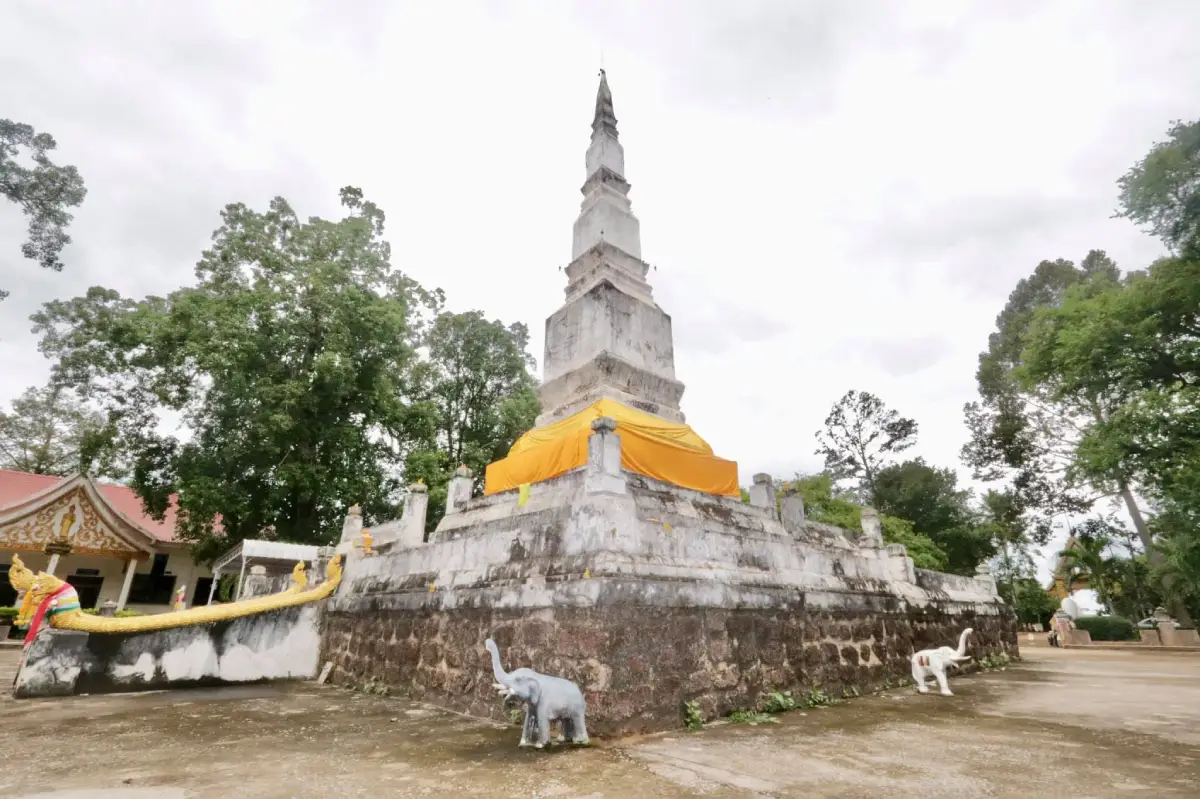
Phra That Don Kaew, also known as Phra Maha That Chedi of Udon Thani, is an ancient Buddhist stupa and an important sacred site in Ban Don Kaew, Village No. 5, Kumphawapi Subdistrict, Kumphawapi District, Udon Thani Province. The stupa stands at the center of Wat Maha That Chedi, about 50 km from Udon Thani city. This historic site is closely connected with the ancient Don Kaew community, Nong Han Kumphawapi, the Lam Pao cultural landscape, local Buddhist legends, and archaeological evidence such as sandstone boundary stones, stone pillars, red sandstone Buddha images, and bronze Buddha images. The stupa has a square-based form similar to Phra That Phanom and rises to about 18 wa. Its 2-tiered structure is decorated with carved scenes related to the life of the Buddha, hell, heaven, the Buddha, disciples, celestial beings, and religious figures. For travelers, it is a meaningful place to worship, study ancient northeastern Thai Buddhist art, and experience a quieter historical side of Udon Thani.
Phra That Don Kaew is valuable as both a place of devotion and a place of learning. Visitors can pay respect to the stupa, walk around the base, observe the circumambulatory terrace, study the sandstone boundary stones, and explore the peaceful compound of Wat Maha That Chedi. The site also helps visitors understand the ancient community of Don Kaew, which was a small raised island within the Nong Han Noi Kumphawapi landscape. The area was surrounded by water and earthworks, with higher and lower landforms inside. This pattern resembles several ancient Dvaravati-period settlements in northeastern Thailand, where moats, embankments, sacred boundaries, and religious monuments formed an integrated cultural landscape. Phra That Don Kaew is therefore not merely a stupa inside a temple; it is the spiritual heart of an ancient settlement.
The origin story of Phra That Don Kaew is connected with a legend of arahants traveling to worship Phra That Phanom. Local tradition says that a group of arahants passed through the Lam Pao river route on their way to Phra That Phanom. They stopped and rested at Don Kaew, where one of the arahants became seriously ill and attained nirvana. The remaining arahants performed the cremation and built a stupa to enshrine the relics. This story turned Don Kaew into a sacred place in community memory. It also explains why the stupa has long been respected as a relic monument associated with enlightened monks.
From around the 11th Buddhist century onward, groups of people settled in the Don Kaew area and placed sandstone boundary stones around the stupa and across the wider sacred zone. These boundary stones are among the most important pieces of evidence at the site. They show that Don Kaew functioned as a Buddhist ritual area and sacred center. Some stones carry carved images, while others show traces of inscriptions that have become too worn to read clearly. Their shapes vary: some are flat rectangular slabs, some are large round stones, and some combine a round lower part with a thick rectangular upper section. This variety makes Phra That Don Kaew an important site for studying Dvaravati Buddhist art in northeastern Thailand.
Don Kaew itself is a small island-like landform within the Nong Han Noi Kumphawapi area, which is linked to Lam Pao and the wider water system of Kumphawapi. The area is ecologically rich and suitable for long-term settlement because it combines water, raised land, and access to wider regional routes. This geographical setting helps explain why an ancient community developed here and why Phra That Don Kaew became a sacred monument of local importance.
After the Dvaravati period, Don Kaew continued to be inhabited and its sacred site was restored by later communities. Lao settlers migrated from Roi Et and Chaiyaphum and established themselves at Don Kaew under the leadership of Thao Chin. They restored the stupa, and an ancient Lao inscription at the base of the stupa records that the restoration was completed in 1898. This evidence shows that Phra That Don Kaew was not abandoned permanently, but was preserved, restored, and reinterpreted by successive generations of local people.
Around 1928, several community groups settled in Don Kaew, most of them Lao Wiang people. The villagers established a temple for Buddhist religious practice and named it Wat Maha That Chedi. The name reflects the importance of the main stupa as the heart of the temple and the community. By building the temple around the stupa and maintaining the sacred area, local people ensured that Phra That Don Kaew remained central to Ban Don Kaew until the present day.
In 1970, Phra Khru Sangkarak, also known as Luang Pho Chon, who was the abbot at that time, worked with villagers of Ban Don Kaew to restore and strengthen the stupa. This restoration was important because it helped preserve the old monument for later generations. Around the same period, archaeology students from Silpakorn University, led by Pairoj Angsanakul, studied the age of the boundary stones, stone pillars, and stupa. Their work confirmed the great antiquity of the monument and the Dvaravati-period significance of the surrounding sandstone boundary stones. These studies strengthened the status of Phra That Don Kaew as an important archaeological learning site in Udon Thani.
The stupa is square in plan and stands on 2 laterite base levels. The first base is about 14 meters wide on each side and about 1.25 meters high, with stairways on the east and west. The second base is about 10 meters wide on each side and about 1.50 meters high, with stairways on all 4 sides. This upper level also functions as a circumambulatory terrace, allowing visitors to walk around the stupa. The main body of the monument is built of brick and plaster over a square base, with lotus-petal stucco decoration at the 4 corners and low-relief carvings around the structure. These features give the monument both architectural strength and religious meaning.
The main body of Phra That Don Kaew rises in 3 superimposed square tiers, separated by inverted lotus, upright lotus, and bead-like molding elements. Its form reflects Lan Xang architectural influence and resembles the wooden stupa tradition of northeastern Thailand. It also shows a relationship with the form and symbolism of Pha That Luang in Vientiane. The upper part ends in a narrow, pointed spire, giving the stupa a firm but elegant vertical profile typical of old northeastern Buddhist monuments.
The carved reliefs on the stupa are among the most important details to observe. They include themes from the life of the Buddha, hell, heaven, the Buddha himself, disciples, celestial beings, and human figures. These carvings were not created merely as decoration. In ancient Buddhist communities, visual narratives helped teach moral lessons, karma, good conduct, spiritual aspiration, and Buddhist cosmology to people who might not read written texts. The stupa therefore functioned as both a sacred monument and a visual teaching space.
The construction materials of the stupa include sandstone blocks, brick, plaster, and laterite. The sandstone blocks are rectangular and about 1 sok long. The exterior is plastered, which is understood as a later repair or restoration. The use of different materials suggests that the monument has passed through several periods of construction and repair. In this sense, the stupa itself is an architectural record of changing local communities and continued Buddhist devotion.
Around the stupa are sandstone boundary stones and stone pillars set in the 8 directions. Some are 2 to 4 meters high, and some are located 15 to 20 sen from the stupa. Other groups of boundary stones are found farther away, about 500 meters from the main monument. These stones defined the sacred ritual boundary of the area. One important stone shows a lotus base and what appears to be a pair of elephants paying respect to a female figure at the center, interpreted in connection with the Buddha’s birth scene. Such carvings are valuable evidence of local Buddhist art and religious belief.
Phra That Don Kaew is also connected with the broader folklore of Pha Daeng and Nang Ai, one of the most famous legends of the Nong Han Kumphawapi area. The surrounding landscape is associated with stories of ancient cities, love, fate, naga beings, and the transformation of land into a great lake. Although Phra That Don Kaew is already important as an archaeological site, its connection with Nong Han and local folklore gives it a deeper cultural dimension. Visitors are not simply seeing an old stupa; they are entering a landscape shaped by belief, memory, water, and settlement.
Today, Phra That Don Kaew remains part of Wat Maha That Chedi and Ban Don Kaew community. Local people continue to respect the stupa as a sacred landmark of the village. Travelers who visit can see the relationship between the temple, ancient monument, community, and Nong Han Kumphawapi landscape. The atmosphere is quieter than major tourist attractions, making it suitable for visitors who appreciate peaceful places, historical detail, Buddhist art, and local heritage.
A meaningful visit should take at least 45 minutes to 1 hour. Visitors can walk around the stupa, study the base, observe the relief carvings, examine the boundary stones, and appreciate the temple surroundings. Those interested in ancient art should move slowly, as many details are easy to miss. The shapes of the boundary stones, traces of damage and restoration, faded carvings, plaster surfaces, and different materials all reveal the long life of the monument.
For worshippers, the visit can begin with paying respect to the stupa and making a quiet prayer. Walking around the circumambulatory terrace helps visitors understand the structure and proportions of the stupa. When approaching the boundary stones and stone pillars, visitors should avoid touching, climbing, or moving anything. These ancient objects are fragile and form part of the archaeological identity of the site. Respecting them is part of respectful worship.
As a learning destination, Phra That Don Kaew is suitable for students, teachers, cultural travelers, local historians, and anyone interested in northeastern Thai heritage. A single visit can connect many topics: ancient stupa architecture, Dvaravati sandstone boundary stones, sacred boundaries, moated settlements, Buddhist legends, the story of arahant relics, Lao Wiang settlement, and the cultural geography of Nong Han Kumphawapi. Few small sites in Udon Thani offer so many layers of history and meaning in one place.
Photographers should visit in the morning or late afternoon. Morning light is soft and suitable for worship and quiet observation, while late afternoon light emphasizes the form of the stupa and the texture of old stone. Because the site is both a temple and an archaeological area, photography should be done respectfully. Do not climb onto structures, stand on sacred elements, or take photos that disturb worshippers.
Visitors should dress modestly and behave respectfully. This is still a Buddhist temple and sacred community site. Avoid loud noise, do not climb the stupa, do not touch relief carvings or boundary stones unnecessarily, do not move temple objects, and do not leave litter. Families traveling with children should guide them carefully, as some ancient objects are fragile and some ground surfaces may be uneven.
Phra That Don Kaew can be combined with other attractions in Kumphawapi. Nearby places include Kumphawapi Natural Park, also known as the Monkey Park, Red Lotus Lake at Nong Han Kumphawapi, Wat Si Nakhararam, local markets, and other cultural stops in the district. During the cool season or lotus blooming season, visitors can begin the morning with a boat trip on Red Lotus Lake, then continue to Phra That Don Kaew later in the morning or afternoon. This route combines nature, culture, Buddhist heritage, and local community life in one day.
Getting There from Udon Thani city is straightforward by private car. Take Highway 2 and Highway 2350 toward Kumphawapi District. In Kumphawapi, turn left near the Natural Park or Monkey Park and continue along the road to Phra That Don Kaew and Ban Don Kaew for about 3.4 km. The distance from Udon Thani city is about 50 km, and the drive takes around 1 hour depending on traffic. The route is best suited for private cars, rental cars, or hired local transport. Travelers without a vehicle should plan ahead, as direct public transport to the temple is limited.
From Kumphawapi town, the site is close enough for a half-day cultural visit. Travelers can use Chawalit Road or the main local road toward the Natural Park, then continue to the road leading to Ban Don Kaew. Those planning to visit Red Lotus Lake should check their route carefully because the lake has several boat piers, while Phra That Don Kaew is located in Ban Don Kaew, Kumphawapi Subdistrict. Good route planning helps save time.
Phra That Don Kaew is open daily from 08.00 to 17.00. Daytime visits are recommended because the architectural details and boundary stones are easier to see and local roads are more convenient. There is no confirmed admission-fee information from the main travel sources, and donations may be made according to personal faith. Visitors should bring drinking water, a hat, or an umbrella, especially during the hot season.
The main things not to miss are the square-based stupa, the laterite base, the Buddhist relief carvings, the sandstone boundary stones, the stone pillars, and the setting of Don Kaew as an ancient community within the Nong Han Kumphawapi landscape. If time allows, visitors can also explore nearby communities and local food in Kumphawapi to better understand the district beyond the archaeological site.
For Thai travelers, Phra That Don Kaew reveals Udon Thani as a province with deep cultural heritage beyond Red Lotus Lake and modern city life. For foreign travelers, it is an excellent example of a Buddhist stupa in northeastern Thailand shaped by Dvaravati, Lan Xang, Lao Wiang, and local community traditions. The site can be understood as a sacred Buddhist stupa, an ancient cultural landscape, and living community heritage.
Phra That Don Kaew is therefore much more than a small temple stop in Kumphawapi. It is evidence of an ancient settlement, an old sacred stupa with distinctive architecture, a place preserving sandstone boundary stones and stone pillars, and a spiritual landmark for Ban Don Kaew community. Visitors who come here gain merit, peace, historical understanding, and a deeper appreciation of the cultural landscape of Nong Han Kumphawapi. For anyone planning a complete cultural trip in Udon Thani, Phra That Don Kaew deserves a place on the itinerary.
| Name | Phra That Don Kaew / Phra Maha That Chedi, Udon Thani |
| Location | Wat Maha That Chedi, Ban Don Kaew, Village No. 5, Kumphawapi Subdistrict, Kumphawapi District, Udon Thani Province |
| Address | Ban Don Kaew, Village No. 5, Kumphawapi Subdistrict, Kumphawapi District, Udon Thani 41110, Thailand |
| Highlights | Ancient square-shaped stupa similar to Phra That Phanom, about 18 wa high, with Buddhist relief carvings and Dvaravati sandstone boundary stones around the site |
| History | Connected with the ancient Don Kaew community, Dvaravati-period sacred boundaries, Lam Pao cultural landscape, and Nong Han Kumphawapi. Later restored by Lao Wiang communities, with an ancient Lao inscription recording restoration completion in 1898. |
| Name Origin | The name comes from Don Kaew, a raised island-like area in Nong Han Noi Kumphawapi where the Phra Maha That Chedi of the community is located. |
| Distinctive Features | Square stupa standing on 2 laterite base levels, with 3 superimposed square tiers showing Lan Xang influence and similarities to northeastern wooden stupa forms and Pha That Luang in Vientiane |
| Key Evidence | Sandstone boundary stones, stone pillars, red sandstone Buddha images, bronze Buddha images, low-relief carvings, images of the Buddha, disciples, celestial beings, and human figures on the stupa |
| Travel Information | From Udon Thani city, take Highway 2 and Highway 2350 to Kumphawapi District. Turn left near the Natural Park or Monkey Park and continue along the Phra That Don Kaew-Ban Don Kaew road for about 3.4 km. The distance from Udon Thani city is about 50 km. |
| Current Status | Open for worship and cultural visits as an important Buddhist and archaeological site in Kumphawapi District, Udon Thani Province |
| Open Days | Daily |
| Opening Hours | 08.00 – 17.00 |
| Facilities | Worship area, walking area around the stupa, Wat Maha That Chedi compound, and parking area within the temple grounds depending on local conditions |
| Main Areas / Zones | Phra That Don Kaew stupa Laterite base and circumambulatory terrace Sandstone boundary stones and stone pillars around the stupa Wat Maha That Chedi compound Ancient Don Kaew community landscape |
| Caretaker | Wat Maha That Chedi, Ban Don Kaew community, and Kumphawapi Subdistrict Administrative Organization |
| Main Contact Number | Kumphawapi Subdistrict Administrative Organization, Tel. 042-111470 |
| Nearby Tourist Attractions | 1. Kumphawapi Natural Park / Monkey Park, about 4 km 2. Wat Si Nakhararam Kumphawapi, about 6 km 3. Kumphawapi Market, about 7 km 4. Red Lotus Lake, Nong Han Kumphawapi, about 24 km 5. Chao Pu-Ya Shrine, Kumphawapi District, about 7 km |
| Nearby Restaurants | 1. Tam Tu Pu Kumphawapi, about 7 km, Tel. 097-170-0679 2. Shabu Eimdee Kumphawapi, about 7 km, Tel. 086-630-9933 3. Zab Nua @ Kumphawapi, about 8 km, Tel. 083-351-2395 4. Five Star Lotus Kumphawapi, about 8 km, Tel. 089-011-8060 5. PunThai Coffee Kumphawapi Hospital, about 8 km, Tel. 061-031-3406 |
| Nearby Accommodations | 1. Kumphawapi Resort, about 7 km, Tel. 042-334-499 2. KP Hotel Udonthani, about 13 km, Tel. 042-332-222 3. KP Hotel Udonthani, about 13 km, Tel. 042-250-250, 080-389-1839 4. Ma Der Bua Hotel, about 24 km, Tel. 081-974-3560 5. Mee Place Kumphawapi, about 15 km |
Frequently Asked Questions (FAQ)
Q: Where is Phra That Don Kaew located?
A: Phra That Don Kaew is located at Wat Maha That Chedi in Ban Don Kaew, Village No. 5, Kumphawapi Subdistrict, Kumphawapi District, Udon Thani Province, about 50 km from Udon Thani city.
Q: What are the opening hours of Phra That Don Kaew?
A: Phra That Don Kaew is open daily from 08.00 to 17.00.
Q: Why is Phra That Don Kaew important?
A: It is an ancient sacred stupa of the Don Kaew community, with Dvaravati sandstone boundary stones, stone pillars, Buddhist relief carvings, and a square-shaped stupa connected with local faith and Kumphawapi history.
Q: What is distinctive about Phra That Don Kaew?
A: The stupa has a square form similar to Phra That Phanom, rises to about 18 wa, and features relief carvings related to the Buddha’s life, hell, heaven, disciples, celestial beings, and Buddhist figures.
Q: How can travelers get from Udon Thani city to Phra That Don Kaew?
A: Take Highway 2 and Highway 2350 toward Kumphawapi District, turn near the Natural Park or Monkey Park, and continue along the Phra That Don Kaew-Ban Don Kaew road for about 3.4 km.
Q: What attractions can be combined with Phra That Don Kaew?
A: Visitors can combine the trip with Kumphawapi Natural Park, Wat Si Nakhararam, Kumphawapi Market, Red Lotus Lake at Nong Han Kumphawapi, and Chao Pu-Ya Shrine in Kumphawapi.
Q: How should visitors dress when visiting Phra That Don Kaew?
A: Visitors should dress modestly, behave calmly, avoid climbing the stupa, avoid touching boundary stones or carvings unnecessarily, and keep the temple area clean.
Q: Who is Phra That Don Kaew suitable for?
A: It is suitable for worshippers, cultural travelers, history lovers, students, and anyone interested in ancient northeastern Buddhist art, Dvaravati boundary stones, and the heritage of Kumphawapi.
 Category: ●Places of Worship
 Group: ●Other Sacred Sites
Last Update : 1 MonthAgo
 Last Update : 1 MonthAgo
 Click to Access the Navigation Map GPS
Phra That Don Kaew Map
Recommend

 Art, Culture and Heritage
 Historical Sites and Monuments(1)
 Landmarks and Memorials(1)
 Art, Craft Centres, Tradition(2)
 Museums(2)
 Temple(21)
Other Sacred Sites(8)
Temple(21)
Other Sacred Sites(8)
 Suburban Living
 Village, Community(3)
 Nature and Wildlife
 National Parks and Marine Reserves(3)
 Mountain (Doi)(1)
 Dam, Reservoir, Lake(8)
 Waterfalls(6)
 Caves(1)
 River, Canal(4)
 Islands(1)
 Other natural attractions(1)
 Entertainment and Agricultural
 Farms, Parks and Ecotourism(3)
 Waterpark(1)
 Shopping
 Shopping and Night Market(1)


