
lovethailand home >Northeastern Travel Attractions >Nong Khai Travel Attractions >Sang Khom >Pha Tang > Wat Tham Sri Mongkhon (Wat Tham Piang Din)
TL;DR: Wat Tham Sri Mongkhon (Wat Tham Piang Din) is located at Ban Dong Tong, Pha Tang Subdistrict, Sangkhom District, Nong Khai Province, open Daily, hours 08.00 – 16.00 / Cave Entry Before 15.00.
Wat Tham Sri Mongkhon (Wat Tham Piang Din)
Open Days: Daily
Opening Hours: 08.00 – 16.00 / Cave Entry Before 15.00
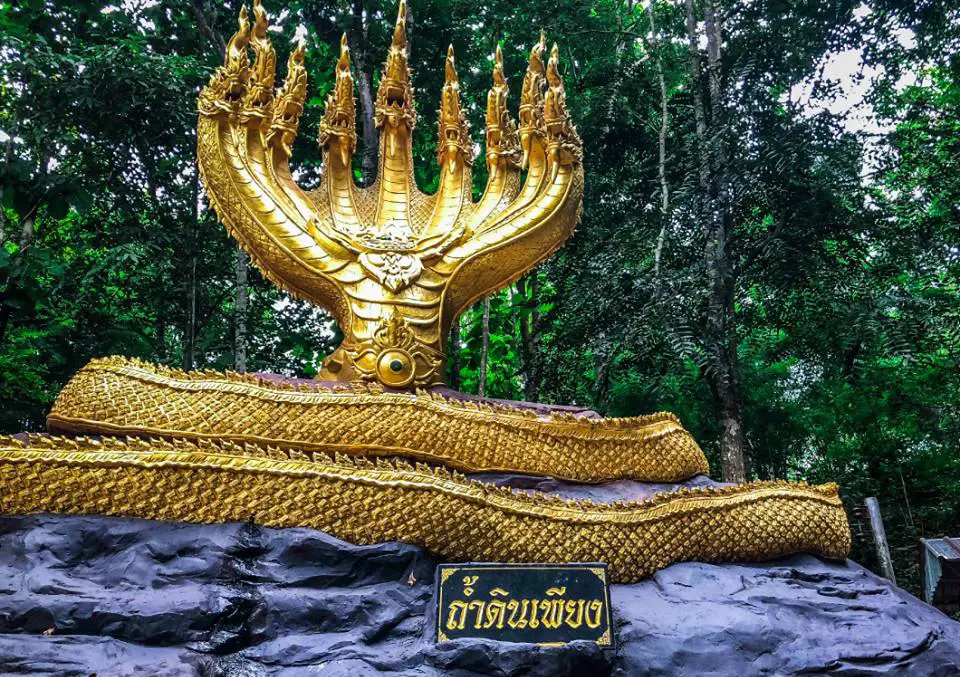
Wat Tham Sri Mongkhon, also known as Wat Tham Din Phiang or Din Phiang Cave, is one of the most distinctive spiritual and adventure destinations in Nong Khai Province. The temple is located at Ban Dong Tong, Pha Tang Subdistrict, Sangkhom District, along the upper Mekong travel route of Nong Khai. Its most important feature is Din Phiang Cave, a natural underground cave closely associated with Naga legends, the mythical underwater city, and local Buddhist belief. Unlike a wide and easy tourist cave, Din Phiang Cave is narrow, damp, winding, and physically challenging, giving visitors the feeling of entering a hidden underground world beneath the Mekong cultural landscape.
The cave is the origin of the temple’s popular name. Local people often call it Tham Phaya Nak, or Naga Cave, because its underground passages are filled with narrow holes and twisting tunnels that resemble the movement paths of a giant serpent. Inside the cave, visitors encounter damp floors, flowing water, low ceilings, tight passages, natural rock formations, and symbolic spaces interpreted through local belief. Some sections require visitors to bend down, crawl, or move slowly through small openings. This makes the cave both a sacred place and a soft-adventure experience.
According to local belief, Din Phiang Cave is connected with a hidden route beneath the Mekong River. One story says that wandering monks from Laos once crossed into Thailand through this cave without using a boat. The route could only be seen by monks or practitioners with deep spiritual discipline and meditative power. This belief gives the cave a strong Buddhist meaning. It is not only a geological formation, but also a sacred passage associated with meditation, spiritual attainment, the Mekong River, and unseen worlds.
Another popular legend tells of a Naga princess who came from the underwater realm and fell in love with a prince in the human world. When the end of Buddhist Lent arrived, she had to return to the Naga realm beneath the waters. The prince followed her and discovered her true nature as a Naga. Their separation is said to be connected with this cave. This story adds emotional depth to the site and explains why the cave is regarded as more than a natural attraction. It is a place where love, faith, mythology, and the Mekong imagination come together.
Before entering the cave, visitors usually pay respect at the shrine of Pho Pu In Nakarat and Mae Ya Ket Nakarat near the entrance. This act reflects local etiquette and reverence for the guardian spirits and Naga figures associated with the cave. A proper visit begins with respect at the temple, worship at the cave-front shrine, listening carefully to the guide, and then entering the cave in an orderly way. This sequence helps visitors understand that Din Phiang Cave is both a sacred space and a physically demanding natural site.
Inside the cave, the atmosphere strongly resembles the legendary underwater city of the Naga as imagined in local belief. The passages are damp and narrow, with water flowing or seeping through certain areas. Rock forms appear like pillars, chambers, symbolic coffins, curved walls, and hidden rooms. Colored lights in some areas create a mysterious atmosphere as they fall on the wet rock surfaces. Moving through the cave can feel like passing into another layer of reality, somewhere between a natural underground system and the imagined realm of the Naga.
The cave route is not extremely long, but it is physically demanding because of the narrow passages and wet surfaces. Some parts require bending down, some require crawling, and some require careful balance. Visitors should wear modest clothing that allows movement, avoid carrying large bags, and accept that clothes may become wet or dirty. A spare change of clothes in the car is useful. The experience is best suited for travelers who are comfortable with tight spaces, uneven ground, and slow guided movement.
Visitors must enter Din Phiang Cave with a guide. The cave has multiple connected passages, and entering alone can be dangerous. Temple staff or local guides help visitors move through the correct route, identify slippery areas, explain where to bend or crawl, and manage the timing of the visit. Visitors with knee, back, balance, mobility, or claustrophobia issues should carefully assess their condition before entering the cave. Safety is central to the experience.
Din Phiang Cave is ideal for travelers who enjoy spiritual adventure. It is not a conventional sightseeing spot where visitors simply walk along a smooth path. The cave must be experienced with the whole body: the damp ground, the low ceiling, the sound of water, the narrow openings, and the feeling of moving through darkness. After emerging from the cave, many visitors feel as if they have completed a symbolic journey from the ordinary world into the Naga realm and back again.
From a natural perspective, the cave is interesting because of its underground passages, water flow, damp environment, and unusual rock shapes. From a cultural perspective, these same features help explain why local people associate the cave with Naga belief. In Isan and Mekong culture, the Naga is closely linked with water, fertility, sacred rivers, protection, and the underground world. Din Phiang Cave brings all these ideas into a physical landscape that visitors can directly experience.
The temple’s location in Pha Tang Subdistrict, Sangkhom District, makes it easy to combine with other Mekong attractions. Nearby destinations include Wat Pha Tak Suea, Pha Tak Suea Skywalk, Than Thong Waterfall, Phu Huai Isan, Than Thip Waterfall, and the Mekong riverside area of Sangkhom town. This makes Wat Tham Sri Mongkhon suitable for a full-day route or an overnight trip in the upper Nong Khai Mekong region. Travelers who stay overnight in Sangkhom can enjoy the cave, riverside views, waterfalls, and sunrise viewpoints at a slower pace.
Getting There is easiest by private car, rental car, or hired local transport. From Nong Khai city, take Highway 211 along the Mekong River toward Si Chiang Mai and Sangkhom District. After about 96 km, visitors reach the Ban Dong Tong area in Pha Tang Subdistrict, where a sign points to Wat Tham Sri Mongkhon or Din Phiang Cave. From that junction, continue for about 14 km to the temple. The final section leads into a quieter local route, so visitors should drive carefully, especially during the rainy season or in low-light conditions.
Travelers coming from Sangkhom town can follow the Mekong-side route toward Pha Tang Subdistrict and then turn inland toward the temple. Those coming from Si Chiang Mai pass several important sites before reaching the cave route, including Wat Aranyabanphot, Wat Hin Mak Peng, and Than Thong Waterfall. Public transport is limited, so visitors without their own vehicle should arrange local transport in advance and agree on a return time. This is especially important because the temple is not located directly in the town center.
The best time to visit is from morning to early afternoon. Arriving early gives enough time to contact the guide, pay respect at the shrine, enter the cave, and walk through the temple without rushing. Cave entry should be completed before 15.00 for safety and proper timing. Travelers starting from Nong Khai city should leave in the morning because the route is long and there are many possible stops along the Mekong road.
Season affects the experience. During the rainy season or after heavy rain, the cave can be wetter and more slippery. Visitors should prepare clothing that can get dirty, move slowly, and follow the guide closely. The cool season is more comfortable for a wider Sangkhom route, especially when combining the cave with viewpoints and waterfalls. In the hot season, visitors should avoid rushing and bring enough drinking water for the journey outside the cave.
Clothing should be modest and practical. Long but flexible pants, a comfortable shirt, and minimal accessories are suitable. Avoid loose clothing that may catch on rocks. Some parts of the cave require visitors to remove shoes, so footwear should be easy to take off and carry. A small towel, spare clothes, and a bag for wet items are useful. Visitors should not bring large backpacks into the cave because the passages are narrow.
Temple and cave etiquette are important. Visitors should speak quietly, avoid joking loudly inside the cave, avoid touching sacred objects unnecessarily, and never scratch or write on cave walls. No one should separate from the group or move beyond the guide’s instructions. The cave is both a natural site and a sacred local belief space. Respectful behavior protects both visitors and the cultural meaning of the place.
The main zones of the site include the temple worship area, the Naga shrine in front of the cave, the cave entrance, the underground passages, the internal sacred points, and the exit route leading back to the temple area. The visit therefore has a clear symbolic movement: from the temple above ground, down into the hidden cave, through the underground Naga-like passages, and back into open light. This makes the experience highly distinctive compared with ordinary temple visits.
For photography, the most recognizable scenes are the temple entrance sign, the Din Phiang Cave sign, Naga sculptures near the entrance, the cave-front shrine, and selected cave walls where light falls on the rock surface. Photography should never interfere with safety. Visitors should not block narrow passages, use flash in a disturbing way, or stop in unsafe positions. In this cave, moving safely is more important than getting difficult photos.
Wat Tham Sri Mongkhon is also an excellent place to introduce foreign visitors to Naga culture. The Naga here is not only represented by sculpture or temple decoration. The cave itself makes the legend feel physical. The narrow tunnels, water, darkness, and underground passages help visitors understand why local people associate the site with the underwater Naga realm. When this is explained together with the Mekong River, the cultural meaning of the cave becomes much clearer.
A popular route combines Din Phiang Cave with Wat Pha Tak Suea and the Pha Tak Suea Skywalk. Wat Pha Tak Suea offers a high viewpoint over the Mekong River and Laos, while Din Phiang Cave offers an underground sacred journey connected with Naga belief. Visiting both places in one day gives travelers two contrasting views of the Mekong cultural landscape: the river from above and the imagined underwater world below.
Than Thong Waterfall and Than Thip Waterfall can also be added to the route, especially during the rainy season and early cool season. These natural attractions give balance to the cave visit. Travelers can enter the cave in the morning, have lunch in Sangkhom town, and continue to a waterfall or viewpoint in the afternoon. This kind of route works well for visitors who enjoy nature, temples, local belief, and slow travel.
Phu Huai Isan is suitable for travelers staying overnight in Sangkhom. It is known for sunrise, mist, and views over the Mekong landscape. A strong overnight itinerary can include Wat Tham Sri Mongkhon and Wat Pha Tak Suea on the first day, a night in Sangkhom, and a sunrise trip to Phu Huai Isan the next morning. This allows visitors to experience caves, temples, riverside scenery, and mountain viewpoints without rushing.
Food is easiest to arrange in Sangkhom town or along the Mekong riverside. Restaurants in the area serve Thai food, Isan dishes, Mekong fish, local meals, cafés, and simple made-to-order dishes. Because the temple area is not in the town center, visitors should plan meals before or after the cave visit. Changing clothes after the cave before entering restaurants is practical, especially if clothing becomes wet or muddy.
Accommodation is available in Pha Tang Subdistrict and Sangkhom District. Choices include Mekong riverside resorts, small local hotels, village-style accommodation, and forest or nature-oriented resorts. Staying in Sangkhom is recommended for travelers who want to visit the cave without rushing, combine it with Wat Pha Tak Suea, and see the sunrise viewpoint on the next morning. Travelers who return to Nong Khai city in one day should start early and avoid driving late at night.
Families with children and elderly visitors should consider the cave conditions carefully. The temple area and cave-front shrine can be visited comfortably, but the full cave route is not suitable for everyone. Children must be closely supervised, and elderly visitors with mobility concerns may choose to wait outside the cave. The safest visit is one that respects the physical limits of each person.
Overall, Wat Tham Sri Mongkhon or Wat Tham Din Phiang is one of the most memorable places in Nong Khai for travelers interested in Naga belief, sacred caves, soft adventure, and Mekong culture. The site combines a Buddhist temple, cave shrine, underground passages, local legends, water, rock formations, and guided exploration. With proper preparation and respectful behavior, a visit here becomes far more than a cave walk. It becomes a journey into one of Nong Khai’s most powerful Naga legends.
| Name | Wat Tham Sri Mongkhon / Wat Tham Din Phiang / Din Phiang Cave / Naga Cave |
| Location | Ban Dong Tong, Pha Tang Subdistrict, Sangkhom District, Nong Khai Province |
| Address | Ban Dong Tong, Pha Tang Subdistrict, Sangkhom District, Nong Khai 43160, Thailand |
| Coordinates | 17.961181, 102.302456 |
| Highlights | Din Phiang Cave, Naga Cave, underground passages resembling the Naga realm, flowing water inside the cave, shrine of Pho Pu In Nakarat and Mae Ya Ket Nakarat, and guided cave exploration |
| History / Significance | Registered as a Mahanikaya local Buddhist temple in 1938. The cave is associated with Naga legends, the underwater realm, and stories of Lao wandering monks traveling through hidden routes beneath the Mekong River |
| Name Origin | The name Din Phiang comes from the cave entrance being level with the ground, while the cave itself opens into complex underground passages associated with Naga belief |
| Distinctive Features | Damp underground cave with water flowing year-round, narrow passages, connected chambers, unusual rock formations, and a guided route that may require bending or crawling |
| Important Sacred Areas | Shrine of Pho Pu In Nakarat Shrine of Mae Ya Ket Nakarat Din Phiang Cave Entrance Underground Cave Passages Sacred Points Inside The Cave Naga Sculptures and Temple Worship Area |
| Main Areas / Zones | Temple Worship Zone Naga Shrine Zone In Front Of The Cave Din Phiang Cave Entrance Zone Underground Passage And Crawling Route Zone Sacred Points Inside The Cave Cave Exit And Upper Temple Courtyard Guide Waiting And Preparation Area |
| Caretaker / Cave Guide | Temple staff and local cave guides, Tel. 09-3067-7959 |
| Travel Information | From Nong Khai city, take Highway 211 along the Mekong River for about 96 km to Ban Dong Tong, Pha Tang Subdistrict. Follow the sign to Wat Tham Sri Mongkhon for another 14 km |
| Current Status | Active local Buddhist temple and guided cave attraction open to visitors under temple rules |
| Open Days | Daily |
| Opening Hours | 08.00 – 16.00 / Cave Entry Before 15.00 |
| Admission / Guide Fee | Guided cave tour fee: 100 Baht Per Group |
| Facilities | Worship area, guide waiting area, parking, toilets, cave-front shrine, and guided cave route under temple rules |
| Local Administrative Contact | Pha Tang Subdistrict Administrative Organization, Tel. 042-424855 |
| Visitor Rules | Enter only with a guide, stay with the group, do not enter the cave alone, do not write on cave walls, do not climb rocks, dress modestly and practically, and assess physical readiness before entering |
| Nearby Tourist Attractions | 1. Wat Pha Tak Suea / Pha Tak Suea Skywalk, about 5 km 2. Than Thong Waterfall, about 15 km 3. Sangkhom Town and Mekong Riverside, about 20 km 4. Phu Huai Isan, about 27 km 5. Than Thip Waterfall, about 30 km 6. Wat Hin Mak Peng, about 35 km |
| Nearby Restaurants | 1. Sam Phan Chok Na Sangkhom, about 13 km, Tel. 084-224-7551 2. Hug Khong Na Sangkhom, about 19 km, Tel. 095-192-3897 3. Thantawan Restaurant Sangkhom, about 20 km, Tel. 042-441-433 4. Pak Nam Kung Phao Restaurant, about 20 km, Tel. 042-441-346 5. Sathani Plai Na @ Sangkhom, about 20 km, Tel. 098-482-7439, 080-654-3781 6. Je Na Ton Duea Restaurant, about 21 km, Tel. 085-223-9099 |
| Nearby Accommodations | 1. Banmai Rimkong Resort, about 10 km, Tel. 086-630-6176, 042-441-560 2. Sangkhom Village Nong Khai, about 13 km, Tel. 089-617-3636 3. Sand & River Hotel Nongkhai, about 14 km, Tel. 095-375-5999 4. Forest Park Resort Sangkhom Nong Khai, about 22 km, Tel. 098-002-0870 5. Vera Costa Hotel, about 38 km, Tel. 095-250-4456 |
Frequently Asked Questions (FAQ)
Q: Where is Wat Tham Sri Mongkhon or Wat Tham Din Phiang located?
A: It is located at Ban Dong Tong, Pha Tang Subdistrict, Sangkhom District, Nong Khai Province. The temple is known for Din Phiang Cave or Naga Cave.
Q: What are the opening days and hours of Wat Tham Sri Mongkhon?
A: The temple is open daily from 08.00 to 16.00. Cave entry should be completed before 15.00 for safety and proper guided timing.
Q: Is there an admission fee for Din Phiang Cave?
A: The guided cave tour fee is 100 Baht per group. Visitors can contact the cave guide at 09-3067-7959.
Q: What is the main highlight of Din Phiang Cave?
A: The main highlight is the damp underground cave system with narrow passages, flowing water, unusual rock formations, and local belief connecting the cave with the Naga realm.
Q: Do visitors need a guide to enter the cave?
A: Yes. A guide is required because the cave has complex passages, narrow spaces, wet floors, and sections where visitors must bend or crawl.
Q: Who should avoid entering Din Phiang Cave?
A: Visitors with claustrophobia, knee or back problems, mobility issues, balance problems, certain medical conditions, elderly visitors with limited movement, and very young children should assess their readiness carefully before entering.
Q: How can travelers get to Wat Tham Sri Mongkhon?
A: From Nong Khai city, take Highway 211 along the Mekong River toward Sangkhom. At Ban Dong Tong in Pha Tang Subdistrict, follow the sign to Wat Tham Sri Mongkhon for about 14 km.
Q: What nearby attractions can be visited with Wat Tham Sri Mongkhon?
A: Nearby attractions include Wat Pha Tak Suea, Pha Tak Suea Skywalk, Than Thong Waterfall, Sangkhom Mekong riverside, Phu Huai Isan, Than Thip Waterfall, and Wat Hin Mak Peng.
 Category: ●Places of Worship
 Group: ●Temple
Last Update : 3 MonthAgo
 Last Update : 3 MonthAgo
 Click to Access the Navigation Map GPS
Wat Tham Sri Mongkhon (Wat Tham Piang Din) Map
Recommend

 Art, Culture and Heritage
 Historical Sites and Monuments(1)
 Landmarks and Memorials(2)
 Art, Craft Centres, Tradition(1)
 Educational Places
 Educational Gardens, Farm(1)
Temple(16)
Educational Gardens, Farm(1)
Temple(16)
 Mosque(1)
 Other Sacred Sites(8)
 Suburban Living
 Village, Community(3)
 Local Market(4)
 Nature and Wildlife
 National Parks and Marine Reserves(2)
 Dam, Reservoir, Lake(2)
 Waterfalls(4)
 River, Canal(8)
 Bays and Beaches(1)
 Entertainment and Agricultural
 Farms, Parks and Ecotourism(2)
 Shopping
 Shopping and Night Market(1)
 Travel Articles, Recipes
 Travel Review, Food Review(1)


