
lovethailand home >Northeastern Travel Attractions >Nong Bua Lamphu Travel Attractions >Muang Nong Bua Lamphu >Lam Phu > Wat Si Khun Mueang
TL;DR: Wat Si Khun Mueang is located at Ban Nuea, Wararatchaphakdi Road, Moo 5, Lam Phu Subdistrict, Mueang Nong Bua Lam Phu District, Nong Bua Lam Phu Province, open Daily, hours 08.00 – 17.00.
Wat Si Khun Mueang
Open Days: Daily
Opening Hours: 08.00 – 17.00
Wat Si Khun Mueang in Nong Bua Lam Phu Province is one of the most historically meaningful temples in the city. It is an old Buddhist temple connected with local history, Lan Xang cultural memory, archaeological remains, sacred water traditions, and the story of King Chai Chetthathirat. The temple is best known for Luang Pho Phra Chai Chettha, an important Buddha image deeply respected by local people, as well as its old ordination hall, ancient sim structure, stone boundary markers, sacred well, and traces of Khmer, Lawa, Lao, and northeastern Buddhist art. The temple is open daily from 08.00 to 17.00 and is suitable for travelers who want to understand Nong Bua Lam Phu through a real historical and spiritual site in the heart of the city.
Wat Si Khun Mueang is located in Ban Nuea, Wararatchaphakdi Road, Moo 5, Lam Phu Subdistrict, Mueang Nong Bua Lam Phu District, Nong Bua Lam Phu Province. It belongs to the Mahanikaya Buddhist order and remains an active community temple. The temple is not only a place for merit-making and Buddhist worship, but also a living historical site where visitors can see layers of local memory preserved through architecture, sacred objects, oral history, and annual religious activities. Because of its central location in Mueang Nong Bua Lam Phu, it can easily be included in a cultural walking or driving route around the old town area.
The temple was formerly known as “Wat Khon Chum Nam Ok Bo”, a name closely linked to the ancient sacred well inside the temple compound. The old name can be understood as a reference to people gathering around a well where water emerged. This name reflects the importance of water in early settlement life, religious belief, and community formation. The well was not merely a source of water; it became a sacred point in the landscape and played a role in local ritual memory. For this reason, the former name of the temple helps explain why this area became spiritually and socially significant long before the modern city developed.
The community around Wat Si Khun Mueang has been associated with ancient settlement traces. Although the earliest inhabitants of this area cannot be clearly identified by ethnicity, archaeological and cultural evidence indicates that the site was important before the later historical town took shape. Inside and around the temple are stone boundary markers, remains of an old ordination hall, an ancient sim or ritual building, and artistic features linked with Khmer, Lawa, Lao, and Lan Xang cultural influence. These elements make the temple an important place for understanding how Nong Bua Lam Phu developed within the wider cultural zone of the Mekong region and upper northeastern Thailand.
The history of Wat Si Khun Mueang is strongly associated with King Chai Chetthathirat, ruler of the Lan Xang kingdom and Vientiane. Around B.E. 2109, during a period when Vientiane faced military pressure from Burmese forces, King Chai Chetthathirat led his army across the Mekong River and moved into the right-bank region. Local historical memory connects this movement with the Phu Kuk area, now associated with Suwannakhuha District. According to the local narrative, a reconnaissance unit led by Phaya Fa Mue Lek discovered traces of an old town in a strategic location and reported the site to the king. This led to the selection of the area as a suitable base.
When King Chai Chetthathirat arrived at the old settlement area, he restored an existing temple and renamed it Wat Si Khun Mueang. The name carries an auspicious meaning. “Si” suggests grace, prosperity, and sacred blessing, while “Khun Mueang” conveys the idea of enriching and strengthening the city. The temple name therefore expresses more than a religious identity; it reflects the role of the temple as a spiritual foundation for the town. For local people, Wat Si Khun Mueang has long been seen as a temple that supports the well-being, dignity, and historical continuity of Nong Bua Lam Phu.
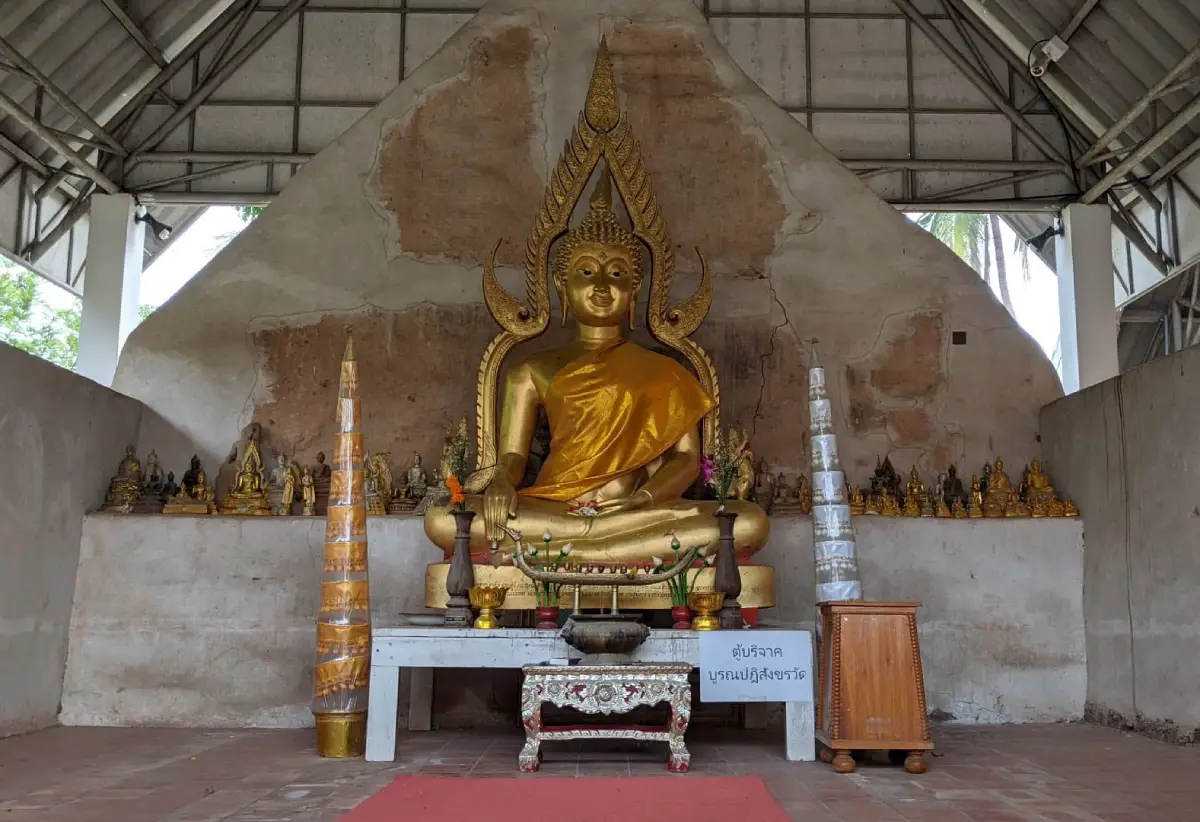
The most important sacred image in the temple is Luang Pho Phra Chai Chettha. This Buddha image is deeply revered by people in Nong Bua Lam Phu and serves as a spiritual link between the temple, the old city, and the historical memory of King Chai Chetthathirat. Visitors usually begin their visit by paying respect to Luang Pho Phra Chai Chettha before walking around the old structures and archaeological features inside the temple compound. For local worshippers, the image is not only an object of devotion, but also a symbol of the city’s historical roots and Buddhist identity.
Luang Pho Phra Chai Chettha represents the continuity of faith across generations. Through this image, the story of Lan Xang, the movement of people, the establishment of old settlements, and the role of Buddhism in community life can still be felt today. A visit to Wat Si Khun Mueang therefore allows travelers to experience both devotion and history at the same time. The temple is meaningful not only because it is old, but because its sacred image, architecture, water source, and stories remain connected with the living memory of the local community.
Another important feature of Wat Si Khun Mueang is the sacred well. Built with brick and known for holding water throughout the year, the well has long been respected by the community. Local belief connects it with the historical period around B.E. 2106 and with ceremonial use in important civic and religious rites. The water from the well carries symbolic significance. It helps explain the temple’s former name and also shows how water, faith, and urban settlement were closely connected in the cultural landscape of Nong Bua Lam Phu.
The sacred well also helps visitors understand the nature of ancient communities in northeastern Thailand. Old towns depended on reliable water sources not only for daily life, but also for ritual activities and social organization. A well that had water throughout the year could naturally become a center of gathering, belief, and settlement. Wat Si Khun Mueang is therefore a strong example of the relationship between water, temple, town, and people in the cultural history of the Isan region.
The old ordination hall and ancient sim structure are also important points of interest. Their remains reflect the development of Buddhist ritual space in the area before and after the formation of the later town. The artistic characteristics associated with Khmer, Lawa, Lao, and Lan Xang influence show that Nong Bua Lam Phu was part of a broader cultural network rather than an isolated settlement. The stone boundary markers found at the temple further indicate the presence of a sacred Buddhist ritual zone. Visitors interested in archaeology and Buddhist art should take time to observe these details carefully.
Stone boundary markers, or sema stones, are significant in Buddhist culture because they mark sacred areas used for monastic ceremonies. Their presence at Wat Si Khun Mueang confirms that the temple area has long been associated with religious practice. They also make the temple valuable for the study of Buddhist history in northeastern Thailand. For travelers who enjoy historical sites, these quiet details are often more meaningful than large decorative structures, because they reveal how sacred space was defined and used in the past.
In the early Rattanakosin period, the history of Nong Bua Lam Phu was also connected with Phra Wo and Phra Ta, leaders from Vientiane who migrated with families and followers after conflict with the ruler of Vientiane. They settled in Nong Bua Lum Phu, which later became known as Nakhon Khuean Khan Kap Kaeo Bua Ban. During this period, Wat Si Khun Mueang continued to function as an important temple within the old town. It was popularly known as “Wat Nai”, meaning the inner temple, because it was associated with the area inside the old town enclosure.
The name “Wat Nai” is important because it shows that Wat Si Khun Mueang was not a peripheral temple. It was connected with the inner structure of the old city, the local administration area, community life, and civic rituals. This status is consistent with the temple’s sacred image, its holy well, its ancient structures, and its role in the memory of the old town. For this reason, Wat Si Khun Mueang is one of the best places for visitors to understand the older identity of Nong Bua Lam Phu.
Today, Wat Si Khun Mueang remains an active Buddhist temple with resident monks. Phra Maha Noppadon Mahawiro serves as the abbot and is associated with current temple and community religious activities. During the Songkran or Thai New Year period, the temple is connected with the ceremonial bathing of Phra Chai Chetthathirat and the traditional paying of respect to the abbot. These activities show that the temple is not merely an archaeological site, but a living place of worship where old traditions continue to be practiced by the community.
The Songkran bathing ceremony related to Phra Chai Chetthathirat is especially meaningful because it links Buddhist devotion with local history. The ceremony is a way for people to seek blessings, express respect for an important sacred image, and continue the memory of King Chai Chetthathirat. For visitors, this tradition reveals how a historical temple can remain alive through seasonal rituals, communal participation, and continuing faith.
Inside the temple, the atmosphere is calm, simple, and closely connected with local life. Wat Si Khun Mueang does not impress visitors through grand scale alone. Its charm comes from the density of historical meaning within a modest temple compound. Important areas include the worship space for Luang Pho Phra Chai Chettha, the old ordination hall and sim area, the sacred well, the stone sema markers, the pavilion, and spaces used for Buddhist activities. Visitors should walk respectfully because the temple is still an active religious site.
For travelers interested in local history, Wat Si Khun Mueang presents several layers of Nong Bua Lam Phu in one place. It connects ancient settlement traces, Khmer-Lawa-Lao cultural influence, the sacred well tradition, King Chai Chetthathirat, Phra Wo and Phra Ta, and the old identity of Nakhon Khuean Khan Kap Kaeo Bua Ban. When these elements are viewed together, the temple becomes more than a place for a short stop. It becomes a cultural gateway to the history of the province.
Cultural travelers should spend at least 30 minutes to 1 hour at the temple. This allows enough time to pay respect to the Buddha image, observe the old structures, and understand the context of the site. Photography is possible, but visitors should avoid disturbing monks, worshippers, or religious activities. Modest clothing is recommended. Visitors should not climb on, touch, or move ancient objects, and should treat the sacred well and old boundary markers with respect.
Getting There is convenient because Wat Si Khun Mueang is located in Mueang Nong Bua Lam Phu. Travelers can drive directly to the temple by using its name or the coordinates 17.2203816, 102.4495221. The route inside the city is straightforward and suitable for a half-day cultural visit. Travelers arriving by public transport can get off in Nong Bua Lam Phu town and continue by local transport, taxi, or ride-hailing service depending on availability.
Travelers coming from Udon Thani can follow the Udon Thani – Nong Bua Lam Phu route into the city. The journey normally takes around 1 hour depending on traffic conditions. Visitors coming from Loei or nearby provinces can also enter Nong Bua Lam Phu town and continue to Wararatchaphakdi Road. The temple can be combined with Wat Mahachai, Wat Pho Si, the King Naresuan Shrine, the 150 Million Year Old Stone Shell Museum, and Namtok Thao To Forest Park for a well-rounded one-day route.
One of the strongest reasons to visit Wat Si Khun Mueang is that it allows travelers to experience history through a real place rather than through text alone. The stories of King Chai Chetthathirat, Phra Wo and Phra Ta, Nong Bua Lum Phu, and Nakhon Khuean Khan Kap Kaeo Bua Ban become easier to understand when seen alongside the temple’s sacred image, ancient boundary stones, holy well, and old ritual spaces. The temple demonstrates how history can remain present in streets, temples, communities, and ceremonies.
Wat Si Khun Mueang is suitable for families, students, researchers, cultural travelers, and visitors interested in Isan history. Children and young learners can discover Buddhist heritage, sacred water traditions, and local history in an accessible setting. Adults can visit for merit-making, quiet reflection, and historical learning. International travelers interested in the Mekong region will find the temple valuable because it clearly shows the relationship between northeastern Thai Buddhist culture and the wider Lan Xang cultural world.
The overall atmosphere of Wat Si Khun Mueang is peaceful and local. Visitors should not rush through the site, because its value lies in layered stories rather than dramatic scale. The former name connected with the sacred well, the history of King Chai Chetthathirat, the revered Buddha image, the ancient boundary stones, and the temple’s identity as an inner temple of the old town all help explain why this site matters. Once these details are understood, a visit to Wat Si Khun Mueang becomes far more meaningful.
There is no general admission fee for worship and normal visits. Visitors may make donations according to personal faith. The best preparation is to dress modestly, bring drinking water during hot weather, and visit in the morning or late afternoon for more comfortable walking conditions. The northeastern climate can be hot during midday, so a slower visit is recommended.
Around the temple, travelers can find local restaurants, coffee shops, and city hotels within a short distance. Staying in Mueang Nong Bua Lam Phu is convenient for visitors who want to explore the province at a slower pace. The temple can serve as the cultural starting point for a broader itinerary that includes old-town landmarks, local food, nature sites, and provincial heritage attractions.
Wat Si Khun Mueang should be included in any cultural travel plan for Nong Bua Lam Phu. Its importance does not come from size, but from the richness of history preserved in one compact temple compound. From its former name Wat Khon Chum Nam Ok Bo to Luang Pho Phra Chai Chettha, the sacred well, sema stones, old ordination hall, and its role as an inner temple of the old town, Wat Si Khun Mueang remains one of the province’s most meaningful cultural and spiritual landmarks.
| Name | Wat Si Khun Mueang |
| Location | Ban Nuea, Wararatchaphakdi Road, Moo 5, Lam Phu Subdistrict, Mueang Nong Bua Lam Phu District, Nong Bua Lam Phu Province |
| Address | 6C7R+398, Lam Phu, Mueang Nong Bua Lam Phu District, Nong Bua Lam Phu 39000, Thailand |
| Coordinates | 17.2203816, 102.4495221 |
| Highlights | Luang Pho Phra Chai Chettha, old ordination hall, stone sema markers, sacred well, and traces of Khmer, Lawa, Lao, and Lan Xang cultural influence |
| History | An old temple of Nong Bua Lam Phu associated with King Chai Chetthathirat, Lan Xang history, Nong Bua Lum Phu, and Nakhon Khuean Khan Kap Kaeo Bua Ban |
| Name Origin | Formerly called Wat Khon Chum Nam Ok Bo, a name linked with the sacred well; later renamed Wat Si Khun Mueang, an auspicious name meaning a temple that enriches and supports the city |
| Distinctive Features | A historic city temple combining a revered Buddha image, ancient remains, sacred water tradition, sema stones, and local urban history in one compound |
| Travel Information | Conveniently accessible from Mueang Nong Bua Lam Phu by private car, local transport, taxi, or ride-hailing service; visitors can use the temple name or coordinates 17.2203816, 102.4495221 |
| Current Status | An active community temple and important spiritual site of Nong Bua Lam Phu, open daily for worship and cultural visits |
| Open Days | Daily |
| Opening Hours | 08.00 – 17.00 |
| Fees | No general admission fee for worship and normal visits |
| Facilities | Worship area, pavilion, religious activity area, parking space around the temple, and walking points for observing ancient remains |
| Main Areas / Zones | 1. Luang Pho Phra Chai Chettha worship area 2. Old ordination hall and sim area 3. Sacred well 4. Stone sema markers 5. Pavilion and community religious activity area |
| Abbot / Caretaker | Phra Maha Noppadon Mahawiro |
| Main Contact Number | 087-926-1157 |
| Official Website / Official Page | Wat Si Khun Mueang, Mueang Nong Bua Lam Phu official Facebook page |
| Nearby Tourist Attractions | 1. Wat Mahachai, 1 km 2. Wat Pho Si, 1 km 3. King Naresuan Shrine, 2 km 4. Nong Bua Lake and old town area, 2 km 5. Namtok Thao To Forest Park, 6 km 6. 150 Million Year Old Stone Shell Museum, 12 km |
| Nearby Restaurants | 1. Som Tam Boonrod Nong Bua Lam Phu, 2 km, Tel. 042-312-930, 093-092-5587 2. A Sor @ 5.59, 2 km, Tel. 092-564-3645, 098-434-2645 3. Huen Hom Coffee, 2 km 4. The Container Coffee, 3 km 5. Nordic House & Coffee, 4 km, Tel. 080-313-4564 6. Wagyu Sushi Burn Makro Nong Bua Lam Phu, 4 km, Tel. 098-296-0228 |
| Nearby Accommodations | 1. Rungrod Grand Hotel, 3 km, Tel. 093-321-1199 2. Nong Bua Green View Hotel, 4 km, Tel. 042-312-449, 099-468-7999 3. Nongbua Garden View, 4 km 4. Nattapong Grand Hotel, 5 km, Tel. 086-459-8744 5. Chofa House, 5 km |
Frequently Asked Questions (FAQ)
Q: Where is Wat Si Khun Mueang located?
A: Wat Si Khun Mueang is located in Ban Nuea, Wararatchaphakdi Road, Moo 5, Lam Phu Subdistrict, Mueang Nong Bua Lam Phu District, Nong Bua Lam Phu Province.
Q: What are the opening days and hours of Wat Si Khun Mueang?
A: The temple is open daily from 08.00 to 17.00.
Q: Is there an admission fee for Wat Si Khun Mueang?
A: There is no general admission fee for worship and normal visits. Visitors may make donations according to personal faith.
Q: What should visitors see inside Wat Si Khun Mueang?
A: Important highlights include Luang Pho Phra Chai Chettha, the old ordination hall, ancient sim area, stone sema markers, and the sacred well.
Q: How is Wat Si Khun Mueang connected with King Chai Chetthathirat?
A: Local history connects the temple with King Chai Chetthathirat of Lan Xang, who restored the old temple and gave it the auspicious name Wat Si Khun Mueang.
Q: Who is the abbot of Wat Si Khun Mueang?
A: The abbot of Wat Si Khun Mueang is Phra Maha Noppadon Mahawiro.
Q: What should visitors wear when visiting the temple?
A: Visitors should dress modestly, behave respectfully, avoid loud noise, and should not touch ancient objects or archaeological remains inside the temple.
Q: What nearby places can be visited together with Wat Si Khun Mueang?
A: Nearby places include Wat Mahachai, Wat Pho Si, King Naresuan Shrine, Namtok Thao To Forest Park, and the 150 Million Year Old Stone Shell Museum.
 Category: ●Places of Worship
 Group: ●Temple
Last Update : 4 WeekAgo
 Last Update : 4 WeekAgo
 Click to Access the Navigation Map GPS
Wat Si Khun Mueang Map

 Art, Culture and Heritage
 Historical Sites and Monuments(4)
 Landmarks and Memorials(1)
 Art, Craft Centres, Tradition(1)
 Museums(3)
Temple(10)
Museums(3)
Temple(10)
 Other Sacred Sites(6)
 Suburban Living
 Village, Community(3)
 Nature and Wildlife
 National Parks and Marine Reserves(3)
 Mountain (Doi)(5)
 Dam, Reservoir, Lake(5)
 Waterfalls(1)
 Caves(6)
 River, Canal(2)
 Bays and Beaches(1)
 Other natural attractions(3)


