
lovethailand home >Northeastern Travel Attractions >Nakhon Phanom Travel Attractions >Phon Sawan >Na Khamin > Tai So Yo and Kaleung Cultural Center
TL;DR: Tai So Yo and Kaleung Cultural Center is located at Ban Khok Na Di, Moo 6, Na Khamin Subdistrict, Phon Sawan District, Nakhon Phanom Province, open Daily, hours 08:00 – 17:00.
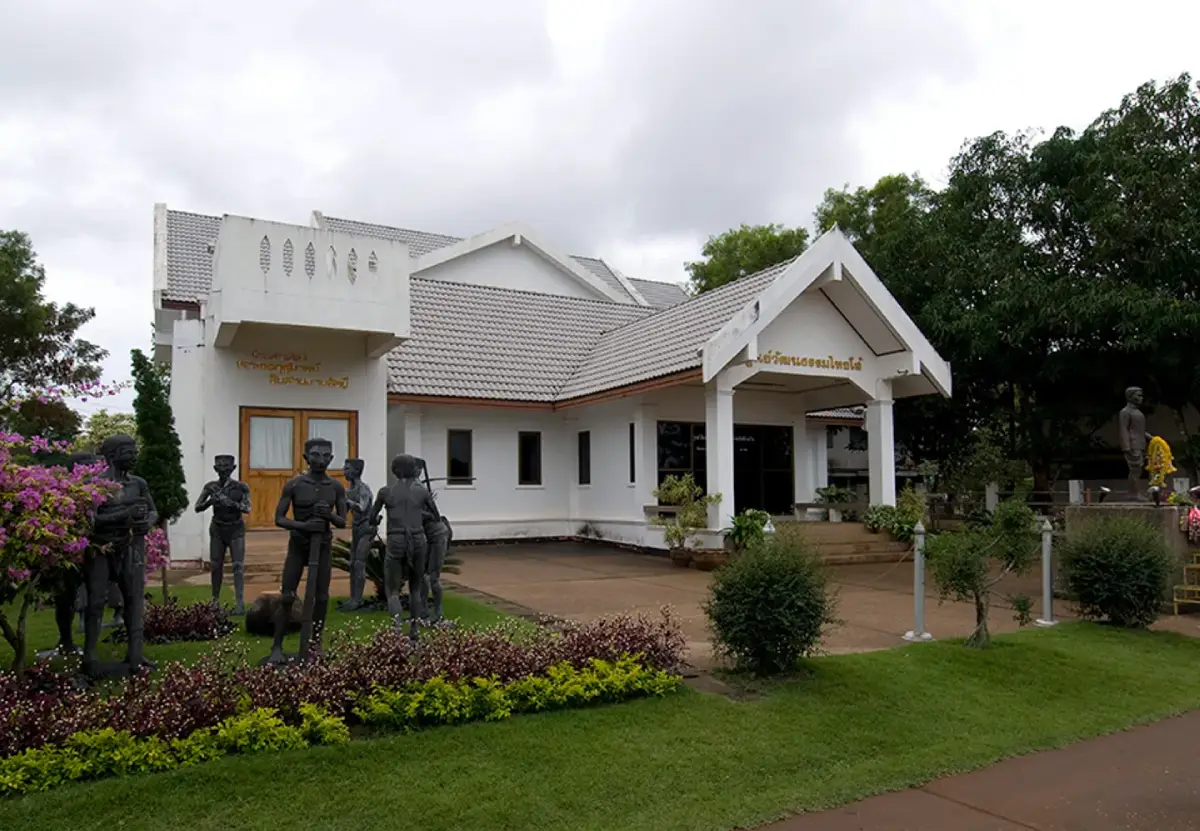
Tai So Yo and Kaleung Cultural Center
Open Days: Daily
Opening Hours: 08:00 – 17:00
The Tai So, Yo and Kaleung Cultural Center in Nakhon Phanom is located at Ban Khok Na Di, Moo 6, Na Khamin Subdistrict, Phon Sawan District, Nakhon Phanom Province. It was established through cooperation between the residents of Na Khamin and the Na Khamin Subdistrict Administrative Organization to collect, preserve and transmit the cultural heritage of three long-established ethnic communities: the Tai So, Tai Yo and Kaleung. The center is therefore more than a place where cultural objects are kept. It is a community learning space presenting local languages, beliefs, rituals, textiles, agricultural knowledge and memories of coexistence among different groups in upper northeastern Thailand.
The Tai So, Yo and Kaleung Cultural Center is a community-based cultural learning center at Ban Khok Na Di in Phon Sawan District. It preserves the heritage of the Tai So, Tai Yo and Kaleung people, who have lived together in Na Khamin Subdistrict for generations. Published visitor information lists the center as open daily from 08:00 to 17:00. Groups, schools and researchers should contact the Na Khamin Subdistrict Administrative Organization before traveling so that a local guide and suitable learning activities can be arranged. Its principal value lies in presenting three cultural traditions in one place while respecting the different languages, beliefs and histories of each community.
The center’s Thai name appears in public information in two forms: “Tai So, Nor and Kaleung Cultural Center” and “Tai So, Yo and Kaleung Cultural Center.” The spelling “ณ้อ” appears in the published name of the attraction, while the ethnic community is more commonly written in Thai as “ญ้อ” and transliterated into English as Tai Yo. Both forms refer to the same cultural community in this context. This English version uses Tai Yo when discussing the ethnic group while retaining the established local identity of the center.
Na Khamin is a rural subdistrict of Phon Sawan District distinguished by its ethnolinguistic diversity. Villages are located among rice fields, gardens, waterways, Buddhist temples and sacred community sites. Residents are connected through marriage, kinship, agricultural labor, religious activities and local administration. Although the Tai So, Tai Yo and Kaleung have their own linguistic and cultural features, generations of coexistence have encouraged the exchange of food, textiles, music, ritual practices and practical knowledge. The cultural center helps visitors understand both the characteristics preserved by each group and the shared ways of life that developed through daily contact.
The center at Ban Khok Na Di was created because much of the community’s knowledge does not exist in formal written documents. It survives in the memories and practices of elders: local vocabulary, khwan-blessing formulas, ritual sequences, textile designs, natural dyeing, agricultural tools, recipes and narratives of settlement. When elders pass away and younger residents leave the village for education or employment, knowledge that has never been recorded can disappear. A community cultural center provides a place where this knowledge can be collected, interpreted and transmitted to children, students and visitors.
The value of the center cannot be measured only by the number of objects displayed. Much of the heritage of the Tai So, Tai Yo and Kaleung is intangible. It includes language, music, dance, beliefs concerning khwan or vital essence, respect for ancestors, etiquette in sacred areas and the social meaning of preparing food together. Understanding such heritage requires explanations from community members, oral narratives, demonstrations and observation of how knowledge remains connected with everyday life. In this respect, the center differs from a large institutional museum because the people interpreting the traditions still have direct family and community relationships with them.
The Tai So are an important ethnic community of upper Isan, with settlements in Nakhon Phanom, Sakon Nakhon and Mukdahan provinces. Their history is connected with communities east of the Mekong River and with movements of people across the region. The So language belongs to the Austroasiatic language family, making it structurally different from Thai and Lao. Pronunciation and vocabulary can vary among villages, and many Tai So people now use their heritage language together with Isan Lao and standard Thai according to the situation.
Language is central to Tai So identity because kinship terms, ritual expressions, names of tools and descriptions of the natural environment often carry meanings that cannot be translated fully into standard Thai. Using So at home allows children to understand community etiquette, forms of respect and relationships among relatives. When younger generations use the language less frequently, ritual songs and specialized vocabulary can also decline. The cultural center therefore supports the idea that a local language is a form of knowledge and cultural memory rather than merely a household dialect.
The Tai So worldview includes beliefs concerning khwan, ancestral spirits and protective powers associated with the environment. Community well-being depends on an appropriate relationship among individuals, families, agricultural land and sacred forces. When illness, anxiety or a frightening event is believed to have disturbed a person’s khwan, relatives may hold a blessing or Yao ceremony led by a ritual specialist. Such ceremonies have spiritual and social dimensions. Family members gather to express concern, encourage the person and reaffirm their responsibility toward one another.
The Tai So Yao ceremony demonstrates the relationship among language, music, belief and emotional healing. A ritual specialist may use sung recitation, khaen mouth-organ music, offerings and inherited formulas. Some communities also hold an annual Saeng Sanam ceremony involving people who have previously participated in Yao practices with the same ritual specialist. The gathering renews relationships among the specialist, the ritual teacher, former participants and their families. Yao is an important form of cultural heritage, but physical illness should also be assessed and treated through professional healthcare.
Ban Khok Na Di and surrounding communities maintain relationships with sacred village areas such as ancestral shrines. Annual offerings allow residents to gather, remember community rules and express gratitude toward figures believed to protect the settlement. Respect for a village shrine is not necessarily separate from Buddhism. Residents may make merit at temples, observe Buddhist festivals and respect monks while continuing to hold khwan and ancestral ceremonies according to older traditions.
Textile knowledge is another important part of Tai So heritage in Na Khamin. Ban Khok Na Di has local knowledge holders and weaving groups associated with the continuation of community textile traditions. Preparing yarn, planning designs, tying patterns, dyeing and weaving require patience and considerable skill. A textile therefore records both the expertise of its maker and the relationships through which knowledge is transmitted. Mothers, grandmothers, daughters and members of weaving groups often learn by sitting and working together. The center can explain that local textiles are connected with household income, ritual occasions, clothing and community pride.
The expression “Pha Ko So” appears in records of local textile heritage connected with knowledgeable weavers in Ban Khok Na Di. Techniques, names and interpretations may vary among individual artisans. Visitors interested in textiles should ask producers about the pattern, materials, dyes, weaving time and occasions for which a piece is used. Buying directly from a community weaving group supports local livelihoods and gives artisans a practical reason to continue teaching their skills to younger people.
The Tai Yo are another important community in Na Khamin. The Tai Yo language belongs to the Tai language group and is related to Lao and Isan speech, but it has its own pronunciation and vocabulary. Tai Yo settlements are found in several parts of upper northeastern Thailand, particularly in areas historically connected with the Mekong region. Villages were commonly established near farmland, waterways and Buddhist temples, which served as centers for merit-making, education and community meetings.
Tai Yo culture emphasizes family, kinship, Buddhist merit-making and cooperation during the agricultural season and important life events. Knowledge of food, textiles, songs and oral history has traditionally been transmitted through daily practice rather than formal textbooks. Learning about the Tai Yo therefore involves more than looking at clothing. Visitors should listen to the language, notice local names for objects and understand how relationships among households, temples and agricultural land structure community life.
Traditional Tai Yo clothing reflects both local textile skill and the practical requirements of a tropical agricultural environment. Women wore woven skirts and shoulder cloths, while men used shirts and trousers suitable for physical work. Ceremonial clothing was generally more elaborate than everyday dress. Modern clothing now dominates daily life, but handwoven textiles and ethnic costumes remain important during festivals, performances and occasions when communities present their identity to visitors.
The Kaleung are also found in upper northeastern Thailand, including Nakhon Phanom, Sakon Nakhon and neighboring areas. Their language belongs to the Tai language group and has distinctive pronunciation and vocabulary. Many Kaleung speakers can also communicate in Isan and standard Thai. This ability to move between languages reflects long-term interaction with neighboring communities, but it can place pressure on the use of Kaleung within the family if younger speakers are not encouraged to learn it.
Kaleung livelihoods have traditionally been connected with rice farming, gardening, animal raising and the careful use of local natural resources. Knowledge of seasons, seeds, water, medicinal plants and wild foods forms an important part of daily life. Buddhist temples, merit-making and ancestral respect also shape community culture, although local vocabulary and ritual details remain distinctive. Including Kaleung heritage in the center prevents Na Khamin from being interpreted through the history of only one ethnic group.
After generations of coexistence, cultural boundaries among the Tai So, Tai Yo and Kaleung are not completely rigid. A family may include relatives from more than one community, use different languages with different people and participate in the same Buddhist festivals. Recipes, textile ideas and music may circulate among neighboring households. Some cultural forms share broader Isan characteristics, yet careful observation reveals differences in vocabulary, melodies, ritual meanings and techniques. The center therefore has the important task of explaining cultural interaction without erasing the identity of any community.
A clear presentation of the three communities should begin by explaining how each group identifies itself, which language it speaks, how it settled in the area and which features are considered distinctive. The center can then discuss shared practices such as rice farming, Buddhist merit-making, respect for elders, communal meals and dependence on local natural resources. This approach prevents visitors from assuming either that all groups are identical or that difference necessarily creates separation. Na Khamin demonstrates how cultural diversity can become a foundation for cooperation.
Settlement narratives are especially valuable because they explain when families entered the area, why particular locations were chosen and how communities developed relationships with neighboring villages. Some information appears in administrative records, while many details remain in the oral histories of elders. Recording personal names, former village names, routes of migration, important events and older vocabulary gives local history greater depth than a simple chronological list of dates.
Oral history should not be dismissed merely because some details differ from written documents. Narratives reveal which events a community remembers, which people it honors and how residents understand their relationship with the landscape. Comparing accounts from several families with maps, documents and old objects can produce a more complete historical picture. A community cultural center can therefore preserve voices that are rarely represented in official provincial histories.
Language preservation is crucial because the decline of a language also reduces access to specialized knowledge. Recording vocabulary, conversations, lullabies, songs and oral narratives from all three communities helps future generations hear authentic pronunciation. Labels that include local names alongside Thai and activities in which elders teach basic expressions allow language to remain active rather than confined to archives. Living preservation means using language to greet people, tell stories, sing and communicate during real community activities.
Local food provides another accessible way to understand the relationship between people and the environment. Ingredients from rice fields, gardens, forests and waterways are prepared according to the season. Family recipes may share similarities while differing in seasoning, preservation and social use. Food for a merit-making event is prepared in large quantities through collective labor. Gathering ingredients, lighting fires, cooking, arranging trays and distributing food all express generosity and mutual assistance.
Food activities at the center are most meaningful when they explain the origins of a dish rather than offering only a tasting experience. Community members can describe when ingredients are available, which dishes are prepared for Buddhist festivals, which are served to guests and which methods preserve seasonal abundance. Such interpretation connects food with local economic history and adaptation while supporting farmers, cooks and small businesses.
Music and dance make cultural heritage accessible to younger audiences. Khaen music, drums, cymbals and local songs can communicate emotion and community identity without lengthy explanations. Nevertheless, performances should include information about movements, clothing and the occasions on which they are traditionally presented. Inviting musicians and dancers to explain their experiences helps visitors understand that rehearsal, memory and coordination are part of maintaining heritage.
Agricultural knowledge deserves recognition as cultural heritage alongside textiles and performance. Farmers read soil, water, wind, seasonal change and animal behavior when planning cultivation. Tools are designed for specific tasks and materials available in the area. Seed saving, labor exchange and the sharing of harvests reveal systems of community relationship. Agricultural objects and stories can therefore demonstrate that ethnic identity is expressed in everyday work as well as in ceremonial life.
Sacred landscapes, including temples, ancestral shrines, community forests and water sources, shape relationships between residents and the environment. Traditional restrictions can limit excessive resource use, while annual ceremonies bring people together to maintain communal sites. Explaining these beliefs respectfully allows visitors to see them as value systems involving responsibility toward ancestors, the community and nature rather than dismissing them as superstition.
Young people are essential to the future of the center. Children can serve as guides, interview elders, photograph objects, compile vocabulary and participate in craft demonstrations. These activities make them active owners of the learning process. A young person who can explain the differences among the Tai So, Tai Yo and Kaleung gains confidence in their own family history while learning to respect neighboring identities. Cultural preservation can therefore develop communication skills, pride and civic responsibility.
Local schools can use the center as a community classroom for history, language, art, social studies and vocational learning. Students may compare textile designs, map village sites, record vocabulary or interview experts in food and farming. Field-based learning demonstrates that knowledge is not limited to textbooks and that village elders can be specialized teachers. Student projects displayed at the center can also add new information and encourage regular content renewal.
Universities, researchers and cultural specialists should work with the community ethically. Clear permission should be obtained before recording voices, photographing rituals or publishing personal information. Copies of photographs, audio and research documents should be returned to the community. Knowledge should not be removed from the village in a form that local people cannot access. Proper recognition of knowledge holders and artisans ensures that research benefits the community rather than only the outside researcher.
Digital archives can protect old photographs, documents and recordings from physical loss, but files must be organized with names, dates, locations and descriptions. Several backup copies should be maintained, and access rights should be considered because some ritual knowledge or family history may not be appropriate for public release. Responsible preservation balances access with the rights of the people who own and transmit the information.
Visitors should begin by learning why the center was established and how Na Khamin developed as a multiethnic subdistrict. They can then study each community by observing its self-identification, language, history, clothing, beliefs and practical knowledge. When a local guide is available, useful questions include how language use has changed, when traditional clothing is still worn and which ceremonies remain active. These questions connect historical information with the realities of contemporary community life.
Visitors should pay attention to the difference between everyday tools and ceremonial objects. Agricultural equipment, containers and textiles may appear simple but demonstrate careful material selection and design. Offerings, ceremonial clothing and sacred objects may have restrictions on handling. Nothing should be touched or moved without permission, even when no formal warning sign is displayed.
Permission should be requested before photographing individuals, elders, ritual demonstrations or culturally sensitive objects. Visitors should not ask a ritual specialist to repeat an action solely for a dramatic image. Responsible cultural photography should include context: an elder teaching a child, the preparation of materials or the collective work behind a craft. Images should not present community members as exotic objects for outside consumption.
Schools, study groups and organized tours should contact the Na Khamin Subdistrict Administrative Organization before arrival. Although published visitor information lists the center as open daily from 08:00 to 17:00, a community center may rely on rotating local caretakers whose availability depends on village responsibilities. Advance contact allows the community to arrange access, a guide, a demonstration or an appropriate welcome and reduces the risk of arriving during an internal activity.
Morning is generally the most comfortable time to visit because temperatures are lower and travelers have sufficient time to continue to nearby attractions. At least one to two hours should be allowed for listening to local explanations and exploring the learning space. Textile demonstrations or community activities require additional time. Arriving well before closing also prevents the visit from placing unnecessary pressure on caretakers.
The cool season from approximately November to February is suitable for traveling in Nakhon Phanom. Mornings and evenings are often comfortable, while the rainy season can slow travel on rural roads. Visitors traveling during the hot season should carry water, a hat and sun protection because some activities may take place outdoors. Checking weather and road conditions before departure is advisable.
Getting There from Nakhon Phanom city involves traveling toward Phon Sawan District and continuing to Na Khamin Subdistrict and Ban Khok Na Di. The distance from the provincial city to the Na Khamin area is approximately 41 kilometers. The center is located in Ban Khok Na Di, Moo 6, near Rural Road 4018. A private or rental car is the most convenient option, particularly for travelers planning to visit additional cultural sites in Phon Sawan District.
Travelers using public transport should first reach Phon Sawan town and then arrange local transport or contact the center’s caretaker for the final journey to Ban Khok Na Di. Interprovincial buses do not enter the cultural center directly. Saving the coordinates 17.523866, 104.483129 on a mobile device is useful, but drivers of large vehicles should confirm the route because navigation systems may select narrow rural roads.
A one-day cultural route can begin in the morning at the Tai So, Yo and Kaleung Cultural Center, followed by the ancestral shrine of Ban Khok Na Di. Travelers can then continue to Phra That Phon Sawan at Wat Pracha Samakkhi in Phon Sawan town, have lunch locally and spend the afternoon at the Wat Phon Sai Community Museum in Ban Phon Chan. This itinerary connects a subdistrict-level multiethnic center with another important Tai So community in the same district.
Travelers with additional time may continue north toward Wat Phra That Tha Uthen and the Third Thai-Lao Friendship Bridge. Such a route demonstrates the relationship between inland agricultural communities and the Mekong corridor. The river has long influenced migration, trade, language and cultural exchange in Nakhon Phanom. Visiting several locations helps explain why the province contains many interconnected ethnic communities.
Most nearby restaurants and cafés are concentrated in Phon Sawan town. Travelers should plan meals before or after the center visit and confirm opening hours on the day of travel. Small local businesses may change closing days according to family and community obligations. Accommodation close to Ban Khok Na Di is limited. Visitors can choose a resort in the Phon Sawan area or stay in Nakhon Phanom city or Tha Uthen when they require a broader range of hotel services.
Responsible cultural tourism should direct benefits toward local people. Purchasing textiles from weaving groups, eating at locally owned restaurants, using community guides and supporting activities organized by residents all help distribute income. Aggressive bargaining over handmade textiles should be avoided because the price includes the time required to prepare yarn, dye, design and weave a piece, sometimes over several weeks.
The center should remain a space in which the community decides what may be presented publicly and what should remain private. Some rituals concern illness, grief or family relationships and should not be staged for entertainment without consent. Demonstrations for visitors should be designed by community members and clearly distinguished from private ceremonial practice. This allows tourism to support preservation without compromising dignity and privacy.
The center is collectively cared for by the Ban Khok Na Di community and the Na Khamin Subdistrict Administrative Organization. The local authority supports administration, coordination and public information, while community members hold and interpret the cultural knowledge. The current chief executive of the Na Khamin Subdistrict Administrative Organization is Mrs. Sumaree Tawanah. Visitors planning a group visit should contact the administrative office at 042-530917.
A major future challenge is helping younger residents see that heritage can remain relevant to modern life and employment. Preservation should not mean storing old objects without use. Young people can produce digital media, create community maps, record local vocabulary, develop textile products and design educational activities. Combining technology with the knowledge of elders allows heritage to reach new audiences without losing its essential meaning.
Sustainable operation also requires regular maintenance of the building, textiles, paper, wood and other materials. Humidity, insects, dust and tropical heat can damage community collections. Appropriate storage, termite inspection, cleaning and condition records are essential. This work may not be visible to visitors, but it determines whether cultural materials survive for future generations.
The Tai So, Yo and Kaleung Cultural Center is important to Nakhon Phanom because it demonstrates that the Mekong border province has no single cultural identity. The province developed through migration, settlement and interaction among people speaking different languages. Villages, temples, markets and farmland together form a complex cultural landscape. Learning about the Tai So, Tai Yo and Kaleung allows travelers to understand Nakhon Phanom beyond its riverfront scenery and major Buddhist monuments.
The center also shows that ethnic diversity is a contemporary reality rather than an artifact of the past. Members of all three communities study, work, form families and participate in a modern economy. Using smartphones, the internet and standard Thai does not immediately erase older identities, but it requires communities to make conscious decisions about what to preserve. A cultural center provides a shared space in which these decisions can involve several generations.
For travelers, the visit is most rewarding when approached as an opportunity to learn rather than merely to collect photographs. Listening to elders, noticing differences in language, asking about textile designs and respecting community etiquette creates a more meaningful experience. Demonstrations may not be available every day because they depend on prior coordination and community availability. Even so, conversation and observation within the actual village environment offer an experience very different from a commercial tourist attraction.
The center functions as a shared house of memory for three ethnic communities. It allows Na Khamin residents to explore their own roots while helping outsiders understand that coexistence does not require cultural uniformity. The Tai So retain their language and ritual heritage, the Tai Yo preserve their speech and kinship traditions, and the Kaleung maintain distinctive knowledge and identity. Presenting these histories together demonstrates that cultural difference can exist alongside a strong sense of belonging to the same local community.
Preserving the center is not the responsibility of a single organization. Elders, young people, families, weaving groups, schools, temples, local government and visitors all have different roles. Elders transmit knowledge, youth record and communicate it, public institutions maintain facilities and visitors create value through respectful learning. When these elements work together, the Tai So, Yo and Kaleung Cultural Center can continue to transmit language, knowledge and community dignity to future generations.
| Name | Tai So, Yo and Kaleung Cultural Center |
| Local Thai Name | ศูนย์วัฒนธรรมไทโส้ ณ้อ กะเลิง / ศูนย์วัฒนธรรมไทโส้ ญ้อ กะเลิง |
| Location | Ban Khok Na Di, Moo 6, Na Khamin Subdistrict, Phon Sawan District, Nakhon Phanom Province |
| Address | Ban Khok Na Di, Moo 6, Na Khamin, Phon Sawan, Nakhon Phanom 48190, Thailand |
| Coordinates | 17.523866, 104.483129 |
| Purpose | To collect, preserve and transmit the cultural heritage of the Tai So, Tai Yo and Kaleung communities of Na Khamin Subdistrict |
| Main Ethnic Communities | 1. Tai So 2. Tai Yo 3. Kaleung |
| Highlights | A community learning center presenting three ethnic traditions through language, beliefs, rituals, textiles, agriculture and local ways of life |
| Learning Areas and Themes | 1. History of Ban Khok Na Di and the establishment of the center 2. Tai So culture and language 3. Tai Yo culture and language 4. Kaleung culture and language 5. Textiles, crafts and livelihood knowledge 6. Beliefs, rituals and sacred community landscapes 7. Community activities and intergenerational knowledge transmission |
| Caretakers | Ban Khok Na Di community in cooperation with the Na Khamin Subdistrict Administrative Organization; current local chief executive: Mrs. Sumaree Tawanah |
| Main Contact Number | Na Khamin Subdistrict Administrative Organization: 042-530917 |
| Open Days | Daily |
| Opening Hours | 08:00 – 17:00 |
| Group Visits | Advance coordination with the Na Khamin Subdistrict Administrative Organization is recommended to arrange a local guide and confirm access |
| Travel Information | Approximately 41 km from Nakhon Phanom city via Phon Sawan District and Na Khamin Subdistrict. The center is near Rural Road 4018. A private or rental car is the most convenient option. |
| Current Status | Operating as a community cultural and learning center according to published visitor information |
| Nearby Tourist Attractions | 1. Ban Khok Na Di Ancestral Shrine, approximately 1 km 2. Phra That Phon Sawan at Wat Pracha Samakkhi, approximately 10 km 3. Wat Phon Sai Community Museum, Ban Phon Chan, approximately 18 km, Tel. 084-7851913, 087-9453125 4. Wat Phra That Tha Uthen, approximately 35 km 5. Third Thai-Lao Friendship Bridge, approximately 38 km |
| Nearby Restaurants | 1. Annawa Cafe, Phon Sawan, approximately 10 km, Tel. 092-4736909 2. The Best Cafe, Phon Sawan, approximately 10 km, Tel. 084-9792123 3. Hug Coffee, Phon Sawan, approximately 10 km 4. Baan Mee Dee, Phon Sawan, approximately 10 km 5. E-ka Cafe, Phon Bok, approximately 16 km, Tel. 099-7277431 |
| Nearby Accommodations | 1. At Phon Charoen Chic Resort, approximately 11 km, Tel. 094-4835418, 098-5146511 2. Plearn Resort Nakhon Phanom, approximately 28 km, Tel. 087-3733556 3. Private Place Hotel Tha Uthen, approximately 35 km, Tel. 089-5706798, 086-3756456 4. TaamJai Resort Nakhon Phanom, approximately 35 km, Tel. 063-3730381 5. R2 Hotel Nakhon Phanom, approximately 45 km, Tel. 042-522999, 083-6692999 |
Frequently Asked Questions (FAQ)
Q: Where is the Tai So, Yo and Kaleung Cultural Center located?
A: It is located at Ban Khok Na Di, Moo 6, Na Khamin Subdistrict, Phon Sawan District, Nakhon Phanom Province, at coordinates 17.523866, 104.483129.
Q: Why was the cultural center established?
A: It was established by Na Khamin residents and the local administrative organization to preserve and transmit the cultures of the Tai So, Tai Yo and Kaleung communities.
Q: Do the Thai spellings “ณ้อ” and “ญ้อ” refer to the same community?
A: Yes. The center’s name appears with the spelling “ณ้อ,” while the ethnic community is more commonly written as “ญ้อ” and translated as Tai Yo.
Q: When is the center open?
A: Published visitor information lists the center as open daily from 08:00 to 17:00. Organized groups should contact the Na Khamin Subdistrict Administrative Organization before traveling.
Q: What can visitors learn at the center?
A: Visitors can learn about local history, language, beliefs, rituals, textiles, crafts, food, agriculture and the coexistence of the Tai So, Tai Yo and Kaleung communities.
Q: Is photography permitted inside the center?
A: Visitors should request permission before photographing people, ritual objects or cultural demonstrations and should not handle objects without approval.
Q: How can travelers reach the center from Nakhon Phanom city?
A: Travel toward Phon Sawan District, continue through Na Khamin Subdistrict and follow the route to Ban Khok Na Di. The journey is approximately 41 km, and a private or rental car is the most convenient option.
 Category: ●Art, Culture and Heritage
 Group: ●Art, Craft Centres, Tradition
Last Update : 4 MonthAgo
 Last Update : 4 MonthAgo
 Click to Access the Navigation Map GPS
Tai So Yo and Kaleung Cultural Center Map
Recommend

 Historical Sites and Monuments(3)
 Landmarks and Memorials(2)
Art, Craft Centres, Tradition(3)
 Museums(3)
 Educational Places
 Library(1)
 University
 Public university(2)
 Places of Worship
 Temple(23)
 Church(1)
 Other Sacred Sites(11)
 Suburban Living
 Village, Community(5)
 Nature and Wildlife
 National Parks and Marine Reserves(1)
 Dam, Reservoir, Lake(5)
 Waterfalls(2)
 River, Canal(3)
 Bays and Beaches(3)
 Other natural attractions(2)
 Entertainment and Agricultural
 Zoos and Aquariums(1)
 Farms, Parks and Ecotourism(2)
 Shopping
 Shopping and Night Market(1)
 Travel Articles, Recipes
 Travel Review, Food Review(1)


