
lovethailand home >Northeastern Travel Attractions >Nakhon Phanom Travel Attractions >Tha Uthen >Woen Phra Bat > Phra Phutthabat Woen Pla
TL;DR: Phra Phutthabat Woen Pla is located at Ban Woen Phra Bat, Woen Phra Bat Subdistrict, Tha Uthen District, Nakhon Phanom Province, open Daily, hours 08.30 – 16.30.
Phra Phutthabat Woen Pla
Open Days: Daily
Opening Hours: 08.30 – 16.30
Admission Fee: Free admission; visitors may make a voluntary donation toward the temple’s maintenance.
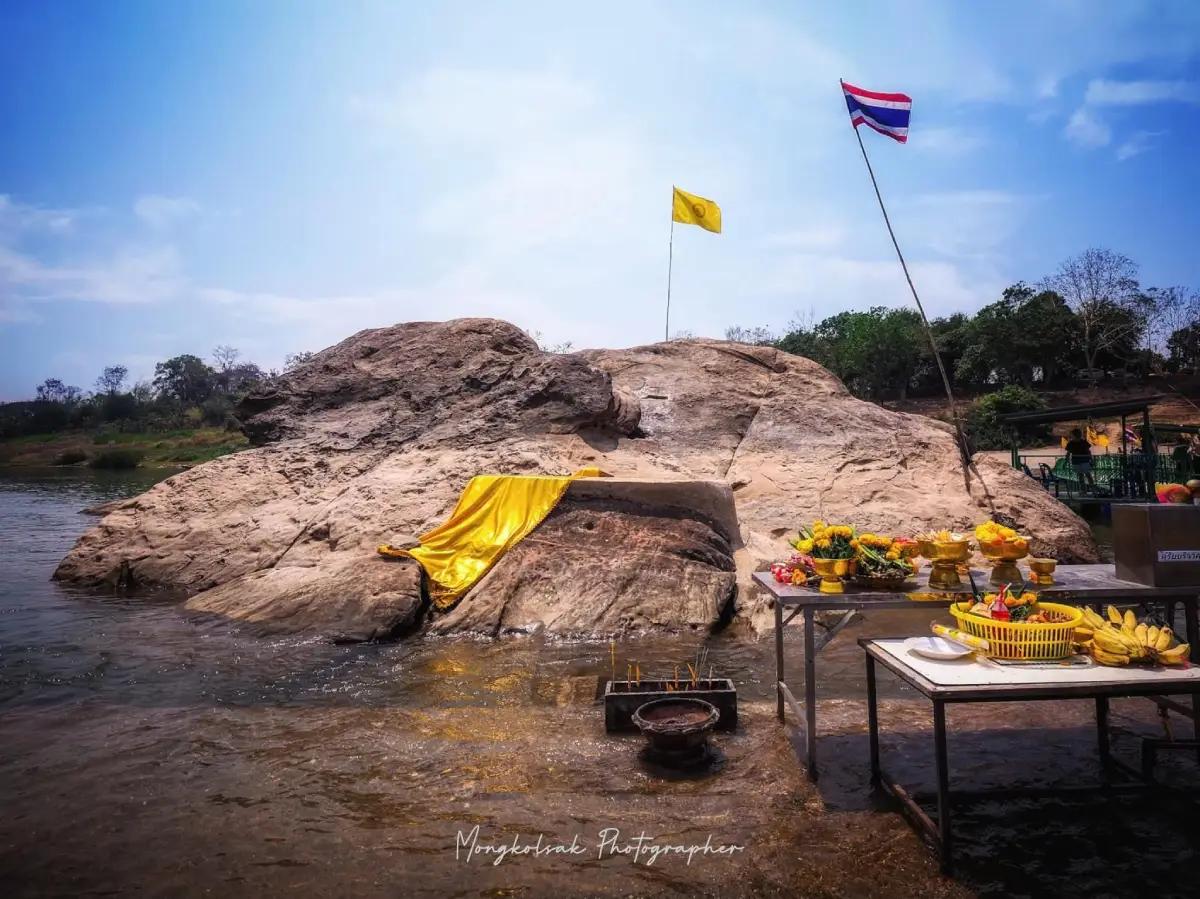
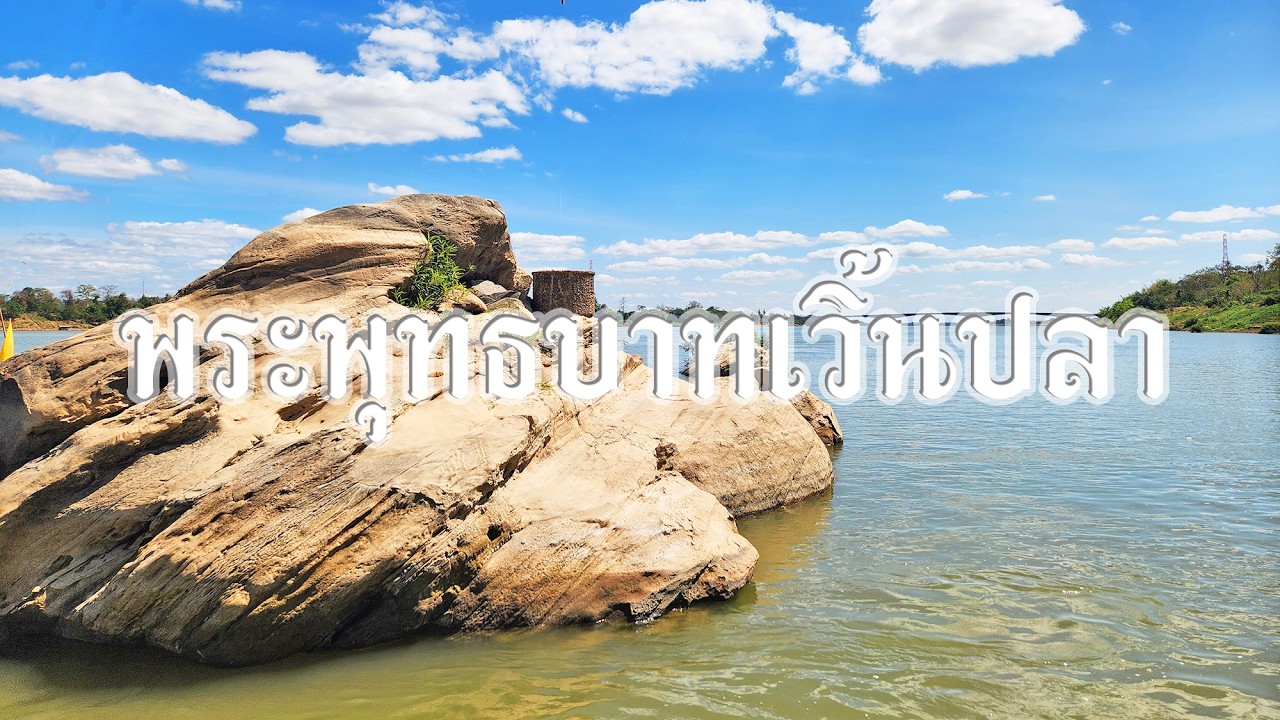
Phra Phutthabat Woen Pla in Nakhon Phanom Province is a sacred Buddha footprint found on a rocky outcrop in the middle of the Mekong River. It lies within the care of Wat Phra Bat Woen Pla in Ban Woen Phra Bat, Woen Phra Bat Subdistrict, Tha Uthen District, Nakhon Phanom Province. Unlike most Buddha footprints, which are enshrined on mountaintops, inside mondops, or within religious buildings, this footprint rests amid the flowing waters of the Mekong, approximately 100 meters from the riverbank. It becomes clearly visible only when the water level falls during the dry season, particularly from March to April.
The site is simultaneously a place of worship, an archaeological site, a learning center for local legends, and a distinctive viewpoint over the Mekong River. Its importance extends far beyond the physical markings on the rock. It encompasses the story told in the Urangadhatu legend, beliefs surrounding Phaya Pla Pak Kham, the history of a temple founded by the Kaleung community, the annual Songkran pilgrimage tradition, and cooperation among the temple, villagers, municipality, and relevant authorities in building temporary access routes so that the public can worship safely.
Wat Phra Bat Woen Pla stands beside the Mekong River, approximately 15 kilometers from central Nakhon Phanom along Highway 212 on the Nakhon Phanom–Tha Uthen route. The surrounding riverside community has long depended on the Mekong for agriculture, fishing, transportation, trade, and Buddhist customs. From the temple grounds, visitors can look across the broad river toward the landscape of the Lao People’s Democratic Republic. The atmosphere combines religious serenity with the beauty of a borderland river vista.
In the local language, the word “woen” refers to a whirlpool, a deep river pool, or a section of water where the current swirls and the depth differs from nearby areas. The word “pla,” meaning fish, is connected to the legend of Phaya Pla Pak Kham, believed to have lived in this river pool. Together, “Woen Pla” means the pool or whirlpool inhabited by the legendary fish lord. The name was later applied to the Buddha footprint, the temple, the village, and the subdistrict, becoming a defining element of local identity.
The story of Phra Phutthabat Woen Pla appears in the Urangadhatu legend, a Buddhist literary tradition that recounts the history and sacred significance of Phra That Phanom as well as places associated with the Buddha’s journey through the Mekong Basin. According to the legend, when the Buddha visited this land, the naga and Phaya Pla Pak Kham approached him with devotion and asked for a sacred representation to worship. The Buddha therefore left his footprint on a rock in the middle of the Mekong River.
Phaya Pla Pak Kham is not portrayed merely as an enormous aquatic creature. The figure represents a being seeking spiritual refuge and an opportunity to accumulate merit. Some versions of the story explain that in a previous life the fish lord had been a monk during the era of Kassapa Buddha. After committing a minor offense involving the use of water without formally acknowledging the transgression, he was reborn as a great fish. When he encountered the present Buddha, he requested a footprint as a reminder of the Dhamma and as a cause leading toward freedom from suffering.
The legend reflects an important Buddhist principle: all living beings can possess faith, accumulate merit, and aspire to liberation. The fish lord symbolizes life still swimming through the cycle of rebirth, while the Buddha footprint represents the path of wisdom and the practice of following the Buddha’s teachings. Worshipping the footprint is therefore not simply an act of venerating a mark on stone. It reminds devotees to observe moral precepts, perform good deeds, and live mindfully.
In Buddhist art, the Buddha footprint served as a symbolic representation of the Buddha during periods when human-form Buddha images were not yet widely produced. A footprint indicated that the Buddha had passed through a place and also represented the path that Buddhists should follow. Although the Buddha entered Parinirvana, the Dhamma and the way of practice remain. Paying respect to a Buddha footprint is therefore both an expression of reverence and a commitment to follow the path of morality, meditation, and wisdom.
The Woen Pla Buddha footprint appears on the surface of a large rock in the Mekong River, near a rocky rise locally called “Don Phra Bat.” Two principal formations can be seen. The upper mark resembles a rectangle measuring approximately 55 centimeters wide and 2.05 meters long. The lower area has a relatively smooth surface with circular depressions and formations interpreted by local people as five toes, with the great toe positioned toward the lower part of the mark.
The rock has been shaped over a long period by river currents, erosion, sediment, and changing water levels. Its surface therefore contains natural grooves, hollows, and fractures. The community has interpreted these features through legends and faith passed down over many generations. The value of the site lies both in the physical characteristics of the rock and in the cultural meaning that the community has attached to it.
During the rainy season or whenever the Mekong rises, the rocky outcrop and the original Buddha footprint are submerged and cannot be reached. Local belief holds that, during this period, the footprint is worshipped by nagas, the legendary fish lord, and other beings beneath the river. When the dry season arrives and the rock emerges above the water, human visitors can travel out to pay respect. This belief connects the human world with the sacred underwater realm of local cosmology.
The period during which the footprint is visible differs from year to year. It depends on rainfall, upstream water levels, river currents, climate conditions, and water management throughout the Mekong Basin. In some years the rock begins to emerge in February; in others, visitors must wait until late March or near Songkran. A dry-season visit therefore does not guarantee that the original footprint will be accessible on any particular day.
The best general period for seeing the original Buddha footprint is from March to April, especially before the rainy season begins. Visitors should nevertheless telephone the temple before traveling. Even after the rock has emerged, the current may remain strong, the water level may change rapidly, or the temporary route may not yet have opened. Access is permitted only after the temple, community, and responsible authorities have assessed conditions as safe.
When the water level is considered safe, the temple and community may install a steel bridge, a floating walkway, or a boat shuttle from the temple pier to the rock. The access method may vary each year according to river conditions. Visitors must use only the route provided. Private boats should not approach the worship area without permission, and no one should swim or wade toward the rock because the Mekong has powerful currents and rapidly changing depths.
The temporary bridge makes the site more accessible to older visitors and the general public, but all users must follow safety rules strictly. Large groups should not crowd onto the bridge at once. Running, jumping, stopping for photographs in a way that blocks movement, or leaning against the rail for long periods is prohibited. When staff provide life jackets or limit the number of people per crossing, visitors must comply without exception.
Parents must hold children’s hands at all times while on the bridge or a boat, and young children should not be taken out when winds are strong or the river is unsettled. Older people, visitors using walking sticks, and anyone with balance difficulties should assess their physical condition before crossing because the bridge may move with the waves. The rock itself has uneven levels and may be slippery from water, algae, or spilled offerings.
When the original footprint cannot be reached, a replica inside the temple remains available for worship throughout the year. The replica allows rainy-season visitors, older people, wheelchair users, and those unable to cross the bridge to make merit and learn the legend. No one should risk entering the river when the temple has closed the route; worship offered calmly within the temple carries the same spiritual value.
Wat Phra Bat Woen Pla was formerly known as “Wat Pho Chai.” The temple site was once a riverside forest containing a large bodhi tree. Mr. Khot Asa Chaichanasri, also known locally as Pho Khot Asa, a leader of the Kaleung community, organized villagers to clear the land and build a temple. They named it Wat Pho Chai after the bodhi tree they found there. The tree has been preserved as a living reminder of the temple’s foundation and the collective effort of the community.
The Kaleung are an ethnic group of the Mekong Basin with their own language, customs, beliefs, and local knowledge, connected to communities in Nakhon Phanom, Sakon Nakhon, and nearby areas. The temple’s establishment under a Kaleung leader demonstrates the role of local people in creating a religious center. The temple served not only as a residence for monks but also as a venue for merit-making festivals, knowledge transmission, community meetings, and the strengthening of relationships among families.
As the Buddha footprint in the Mekong became better known and attracted more pilgrims, the temple was renamed Wat Phra Bat Woen Pla to reflect its principal sacred site. The new name immediately links the temple with the Urangadhatu legend and the Mekong landscape. The former name, Wat Pho Chai, nevertheless remains important to community history because it explains the temple’s origins before the area developed into a visitor destination.
The temple has been led by a succession of abbots. Monks in each period have contributed to religious construction, the care of the footprint, improvements to temple access, and coordination of the annual festival. The current abbot is Phra Athikan Anusorn Pabhakaro, who oversees monastic affairs, religious buildings, the reception of pilgrims, and the organization of access to the original footprint in cooperation with the community and government agencies.
The publicly listed visitor coordinator is Mr. Sukhin Si Pheng, the temple’s lay manager, telephone 092-438-6797. Travelers should call this number to ask about the water level, bridge or boat status, visiting times, group arrangements, and the pilgrimage festival, especially during March and April when visitor numbers increase. Calling in advance reduces the risk of arriving only to discover that the rock cannot be reached.
Woen Phra Bat Subdistrict Municipality supports public information, local development, festival organization, and visitor services. The municipality can be contacted at 042-192-699 and 042-192-599. Cooperation among the municipality, temple, community leaders, district officials, navigation authorities, and volunteers is essential because the worship area lies within an international river.
The grounds of Wat Phra Bat Woen Pla contain traces of an archaeological site and an old chedi under conservation care. These structures indicate that the temple area had religious significance long before modern visitor access was developed. Visitors should view the remains from an appropriate distance, avoid climbing their bases, scraping plaster, applying gold leaf outside designated areas, or moving bricks, stones, and fragments found within the grounds.
The first area visitors encounter is the temple entrance and parking zone. It accommodates cars, vans, and small buses according to available capacity. During the annual festival or long holiday periods, vehicles may be directed to temporary parking outside the temple, followed by a walk to the grounds. Drivers should not block gates, monastic areas, emergency routes, or paths used to transport equipment to the pier.
The next zone contains religious buildings and worship points within the temple, including Buddha images and the replica footprint. When the river is high, visitors can worship, make merit, present offerings to the Sangha, and study information about the Buddha footprint in this area. Shoes should be removed before entering buildings, belongings kept orderly, voices lowered, and feet never extended toward Buddha images or monks.
The old bodhi tree area is associated with the history of Wat Pho Chai. The bodhi tree holds special meaning in Buddhism because the Buddha attained enlightenment beneath a tree of this species. Visitors may rest nearby and learn about the community, but they should not hammer nails into the trunk, tie excessive materials around it, or break off leaves and branches as souvenirs. Anyone wishing to make an offering should use the area arranged by the temple and avoid damaging the tree.
The archaeological zone and old chedi are also worth exploring. Details in the bases, building plans, and construction materials reflect the temple’s development through different periods. Although some remains are modest in size and not elaborately decorated, they have value as evidence of the community’s history. Photographers should not place tripods on archaeological foundations or use the structures as seats or surfaces for luggage.
The riverside terrace serves as both a viewpoint and a preparation area before traveling to the original footprint. When the water falls, visitors can see the rock, the temporary bridge or boat embarkation point, and local fishing boats. Winds are often stronger here than inside the temple grounds, so hats, umbrellas, and loose belongings should be secured. Children must not approach the riverbank without adult supervision.
The pier or seasonal bridge connection is a controlled access zone whenever pilgrimage to the footprint is permitted. Staff may organize queues, divide visitors into groups, or establish one-way walking routes to prevent congestion. Offerings should be prepared before boarding or stepping onto the bridge. Visitors should carry as little as possible and keep one hand free for the railing. Anyone who feels dizzy or fears open water should worship from the riverbank or use the replica inside the temple.
The most important point is the rock in the river where the Buddha footprint appears. Space on the rock is limited and the surface is uneven, so worship must proceed in an orderly manner. Flowers should be placed only in containers or designated areas. Incense must not be burned directly on the rock outside permitted points, and perfume, oil, or wax should never be poured into its grooves. Flour, powder, paint, or other substances must not be used to make the outline appear more clearly.
Pouring substances onto the footprint can stain the rock, make the surface more slippery, and harm the river environment. Offerings containing plastic, foam, wire, or ribbon must not be abandoned on the outcrop because they will become river waste when the water rises. Visitors should choose a modest amount of natural flowers and take all packaging back to shore.
Worship may begin by placing the palms together, reciting “Namo Tassa” three times, and recollecting the Buddha, Dhamma, and Sangha. A respectful personal prayer can then be offered. Devotees may pray for peace, safety, good health, progress, or success, while also committing themselves to good conduct, moral precepts, and non-harm. The essential meaning of following the Buddha’s footprint is to apply Buddhist principles in daily life.
Common offerings include flowers, incense, candles, garlands, and a modest quantity of clean water for bathing the footprint. On crowded days, however, the temple may restrict incense burning or ritual bathing to reduce slippery conditions and pollution. Visitors can pay respect with empty hands and a composed mind; a complete set of offerings is not required.
Circumambulating the footprint on the rock is unsuitable when crowds are heavy or the surface is wet. Worshippers should follow the route designated by staff and never move beyond barriers onto other sections of the outcrop. Touching the footprint or standing as close to it as possible is not the central purpose of worship. Composure, safety, and consideration for fellow visitors are more important.
Groups wishing to hold ceremonies such as chanting, presenting robes, organizing a procession, or filming a program should coordinate with the temple in advance. Amplifiers, tables, chairs, and large equipment must not be taken onto the bridge or rock without permission. The mid-river site has strict limitations involving weight, safety, and navigation, so officials must determine how the space can be used.
The Phra Phutthabat Woen Pla Worship Festival is an important tradition of Woen Phra Bat Subdistrict and Tha Uthen District. It is held during Songkran each year, generally when the Mekong has fallen and the footprint is visible above the water. The festival brings together worship of the footprint, ritual bathing, Thai New Year merit-making, the pouring of scented water to ask blessings from elders, and community cultural activities.
Older information often lists the festival as taking place from 12 to 14 April, but the schedule may change each year according to water levels and community planning. In 2026, the worship festival was held from 12 to 15 April. Travelers in later years should check a new announcement from Woen Phra Bat Subdistrict Municipality or Wat Phra Bat Woen Pla rather than treating the previous year’s dates as permanent.
Festival activities may include alms-giving, a procession or ritual bathing of Buddha images, worship at the footprint, the rod nam dam hua ceremony for elders, cultural performances, folk games, and community programs. Details vary from year to year. Some editions include a procession from the village to the temple, Buddhist flags and colorful banners along the route, and areas selling local food and products.
The ritual bathing of the Buddha footprint reflects the meaning of water during Songkran as a symbol of purity, coolness, abundance, and an auspicious beginning to the new year. When connected with the fish-lord legend and a sacred place in the middle of the Mekong, water assumes several roles at once: a natural element, sacred space, and ritual medium.
The annual festival also enables younger generations to learn community history. Elders pass on stories of Wat Pho Chai, Pho Khot Asa, Phaya Pla Pak Kham, and earlier journeys to worship the footprint. Local authorities support safety, traffic management, cleanliness, and public information. Sustaining the tradition therefore requires not only belief but also careful management appropriate to growing visitor numbers.
During the festival, traffic may become heavy around the temple and on the road into the village. Travelers should arrive before ceremonies begin, avoid roadside parking that prevents vehicles from passing, and carry drinking water and sun protection. Queues for the bridge may be long. Older visitors should have access to a place to sit, and families should establish a meeting point in case members become separated.
If the river remains too high in a particular year and the original footprint cannot be opened, the festival can still take place within the temple using the replica and ceremonial areas on shore. This change does not diminish the event’s importance. Its core purposes are merit-making, the transmission of legend, respect for elders, and community unity—not risking a mid-river journey in unsafe conditions.
Phra Phutthabat Woen Pla is also central to the identity of Woen Phra Bat Subdistrict Municipality. Images of the legendary fish, Phra That Phanom, and the Mekong appear in local symbols and narratives, demonstrating how the community connects itself with Buddhism, the river ecosystem, and the cultural history of Nakhon Phanom.
The Mekong is not merely a backdrop to the footprint. It determines the rhythm of the site throughout the year. When the water is high, the footprint disappears and activity returns to the temple on shore. When the river falls, the midstream pilgrimage route opens again. This cycle encourages visitors to recognize the relationship between faith and nature and to understand that people must adapt to the environment rather than attempt to control the river completely.
The river supports fish, waterbirds, and many other forms of life. Visitors should not throw large quantities of food into the water, release non-native fish or aquatic animals, or discard anything that could damage the ecosystem. Releasing animals as an act of merit should follow the advice of fisheries authorities or the temple because some species are unsuitable for the Mekong and may disturb native wildlife.
From the riverside terrace, photographs can include the temple, rock outcrop, temporary bridge, decorative flags, and the Lao landscape. Morning light is generally soft and the temperature more comfortable, while afternoon glare from the water can be intense. Photographers should bring sun protection, remain cautious near the river’s edge, avoid blocking paths with tripods, and keep equipment away from archaeological remains.
Drone use around the temple and Mekong requires permission from the temple and compliance with aviation law. The area lies close to an international border and navigation route. Drones should not fly above monks, ritual participants, temporary bridges, or passenger boats. Noise and downdraft can disrupt ceremonies, distract visitors, and increase risks for people standing in confined areas over the water.
Anyone planning a documentary, advertisement, or commercial video should notify the temple in advance, explaining the purpose, crew size, and equipment. Legends and rituals should be presented respectfully, without staged scenes that distort local beliefs, and performers must never stand on the footprint. Responsible presentation helps preserve a positive relationship between media producers and the community.
International travelers are welcome to visit the temple and learn about the Buddha footprint regardless of their religion. Clothing should cover the shoulders and knees. Shoes must be removed before entering religious buildings, Buddha images and monks should not be touched, and feet should not be pointed toward sacred objects. Women should not hand objects directly to a monk; offerings should be placed on a receiving cloth or handled according to guidance from temple staff.
When explaining the footprint to international visitors, its legendary meaning should be distinguished clearly from physical study of the rock. The community reveres the footprint through the Urangadhatu legend and treats it as a symbol of the Buddha’s visit. The site’s value lies in faith, cultural heritage, landscape, and living tradition. Its importance can be understood without attempting to prove the legend scientifically.
Parents can use the visit to teach children about the life of the Buddha, the Urangadhatu literary tradition, local language, river ecology, and water safety. Children can learn what the word “woen” means, why the footprint appears only in certain seasons, and why the community builds a temporary rather than permanent bridge. Learning on site connects history, religion, geography, and environmental studies.
Families should avoid bringing children during extreme heat or peak crowds. If crossing the bridge, children should wear secure footwear, carry no toys, and avoid using phones while walking. Parents must never hold a child outside the railing to take a photograph, even if the view appears better, because currents and bridge movement can change without warning.
Older visitors can worship more comfortably inside the temple than by traveling into the river. Some sections of the grounds are level, but stairs, thresholds, and uneven ramps remain. Wheelchair users should have assistance and contact the temple beforehand. Even when the original footprint is visible, worshipping the replica and viewing the rock from the riverside terrace is safer if the bridge is unsuitable for an individual’s physical condition.
Visitors with heart disease, respiratory conditions, dizziness, or fear of being above open water should avoid floating bridges and boat travel. Regular medication should be carried, and companions should be informed of relevant conditions. Pilgrimage should never come at the expense of health, and Buddhism does not require direct physical contact with the original footprint in order to gain merit.
The most comfortable general visiting periods are 08.30–10.30 and 15.00–16.30. Mornings are cooler and may provide an opportunity to speak with monks or caretakers. Later in the afternoon, light over the river is attractive and the heat begins to ease. When bridge or boat access is operating, however, the temple may establish different crossing sessions. On-site announcements always take priority.
The cool season from November to February is suitable for enjoying the temple and Mekong scenery. Mornings and evenings are generally pleasant, although the original footprint may remain submerged early in the season. In some years the river begins to fall by late February. Travelers interested mainly in scenery and culture, rather than reaching the original footprint, can visit comfortably during the cool season.
March and April offer the greatest chance of seeing the footprint, but they are also hot months. Daytime temperatures can be high and the bridge may have little or no shade. Visitors should wear breathable clothing, carry water and a hat, and use sunscreen. Long periods of waiting in direct sunlight should be avoided, especially by older people and children.
During the rainy season, roughly from May to October, the original footprint is usually submerged and inaccessible. The temple grounds become greener and the river carries more water. Visitors should worship inside the temple and stay away from the bank during heavy rain because riverside soil may soften and the current can be stronger than it appears from the surface.
Facilities within the temple include parking subject to available space, the replica Buddha footprint, merit-making areas, seating, and community shops that operate at varying times. During the annual festival, additional food stalls, first-aid points, security personnel, and parking areas may be provided. Visitors should carry a reasonable amount of cash because some small vendors may not accept electronic payments.
Pets should not be taken onto the bridge or rock because they may become frightened by the water, escape from a leash, or disturb worshippers. Pets brought to the temple should remain in permitted areas under close control, and owners must remove waste. Entry into religious buildings should be discussed with the temple, except where a trained assistance animal is essential for a person with a disability.
Responsible tourism begins with reducing waste, using reusable containers, and never throwing flowers or offerings into the river. Visitors can support local restaurants, accommodation, and community products so that tourism income reaches local residents. This support helps the community maintain the temple, continue its traditions, and provide safety systems for the pilgrimage route.
Phra Phutthabat Woen Pla can be combined with a visit to the Third Thai–Lao Friendship Bridge, approximately 6 kilometers away by road. The bridge links Nakhon Phanom with Khammouane Province in Laos and symbolizes cross-border travel and trade. Visitors may view it from publicly accessible areas but should not park or walk into controlled border-checkpoint zones without authorization.
Wat Traiphum and Phra Bang are approximately 9 kilometers away. Phra Bang is a revered standing Buddha image in the gesture of calming the ocean, created in Lan Xang artistic style and respected by the people of Tha Uthen. Viewing the image requires advance permission from the abbot or caretaker because it is kept in a vihara with controlled opening. Wat Traiphum can be contacted at 097-454-3492.
Phumi-Mun Mang and the old Tha Uthen community are also approximately 9 kilometers away. The area introduces visitors to the Tai Yo people, traditional houses, settlement history, and riverside life. Anyone walking through the community should respect residents’ privacy, avoid photographing inside homes without permission, and purchase products from local businesses to support conservation.
Phra That Tha Uthen is approximately 10 kilometers away and is regarded as the birthday stupa for people born on Friday. It was built by Phra Ajarn Si That Yanasampanno between 1911 and 1916. The tall, slender, square-shaped stupa was influenced by Phra That Phanom. Phra Phutthabat Woen Pla, Phra Bang, and Phra That Tha Uthen can be combined into a half-day or full-day route.
The Phaya Si Sattanakharat Plaza in central Nakhon Phanom is approximately 16 kilometers away. This Mekong riverside landmark is associated with naga belief. Traveling from the Buddha footprint to the naga monument reveals the diversity of Mekong Basin traditions, from Phaya Pla Pak Kham and the sacred footprint to the naga believed to protect the river.
Nearby dining options include Mekong fish restaurants, Isan food, cafes, and breakfast venues. Pen Pla Pen Restaurant is approximately 5 kilometers away and serves Thai, Isan, and fish dishes. It can be contacted at 081-119-7663 and is suitable for families or groups wishing to eat before continuing into Tha Uthen town.
Hom Coffee Tha Uthen is approximately 8 kilometers away on the route into the community and serves coffee and other drinks. Contact: 081-927-2750. HA-O Cafe x Guesthouse is approximately 9 kilometers away and offers coffee, desserts, drinks, and a small number of rooms. Contact: 086-515-3675. Both are useful places to escape the heat or meet before walking through the old community.
Tom Fish Noodle Tha Uthen is approximately 10 kilometers away, behind Wat Phra That Tha Uthen. Its menu includes fish noodles, yen ta fo, and tom yum. Contact: 087-946-9123 or 097-302-8564. Small restaurants may close after ingredients sell out, so groups should telephone in advance.
Uthen Thara Resort is approximately 10 kilometers away and has a riverside breakfast and beverage area. Contact: 081-031-4528. Typical offerings include pan-fried eggs, rice porridge, Vietnamese-style rice noodle soup, and coffee. Non-guests should check the food service hours before traveling because they may differ from accommodation check-in times.
Travelers wishing to stay overnight near Phra Phutthabat Woen Pla can choose accommodation in Tha Uthen town, where restaurants, shops, and fuel stations are more convenient. HA-O Cafe x Guesthouse is approximately 9 kilometers away, contact 086-515-3675, and suits travelers seeking compact accommodation within easy walking distance of the community.
Uthen Thara Resort is approximately 10 kilometers away, contact 081-031-4528, and offers a riverside atmosphere suitable for sunrise views. Tha Uthen Rim Khong Hotel is approximately 10 kilometers away, contact 084-428-9883. Sun River Hotel Tha Uthen is also in the town area, approximately 10 kilometers away, contact 093-152-9564.
Travelers preferring central Nakhon Phanom can stay at Fortune View Khong Hotel Nakhon Phanom, approximately 17 kilometers away, contact 042-513-564 or 083-989-1465. Staying in the city suits visitors who want to explore the Phaya Si Sattanakharat Plaza, the walking street, and evening dining before leaving for Wat Phra Bat Woen Pla the following morning.
Accommodation should be selected according to the travel plan. Staying in Tha Uthen reduces morning travel time for visitors hoping to see the footprint early. Central Nakhon Phanom provides a wider range of transport, restaurants, and attractions. Older travelers should ask about lifts, ground-floor rooms, bathroom accessibility, and parking before booking.
Getting There from central Nakhon Phanom, follow Highway 212 toward Tha Uthen District for approximately 15 kilometers. After passing Ban Woen Phra Bat School, look for the turn into the community and continue for approximately 2 kilometers to the temple. The final section passes through a village and agricultural land, so drivers should slow down and watch for motorcycles, children, and domestic animals.
From Tha Uthen town, take Highway 212 south toward Nakhon Phanom, then turn into Woen Phra Bat Subdistrict. The distance is approximately 9–10 kilometers. Navigation users should search for “Wat Phra Bat Woen Pla” or “Phra Phutthabat Woen Pla” and confirm that the map pin is in Tha Uthen District, Nakhon Phanom Province, to avoid being directed to another Buddha footprint temple elsewhere in Thailand.
Direct public transport to the temple is limited. A private car, rental car, taxi, or hired vehicle with an agreed return time is more practical. Travelers using a bus toward Tha Uthen may need to get off on Highway 212 and arrange another vehicle into the village, which is inconvenient with luggage or older companions.
Drivers arriving from Nakhon Phanom Airport should connect through the city or a road leading to Highway 212 and continue north toward Tha Uthen. Extra time should be allowed for collecting a rental car, buying fuel, and locating the village turn. Afternoon arrivals should call to confirm whether access sessions to the original footprint are still operating because the temple’s opening hours do not mean that the bridge or boats run until closing every day.
A half-day route can begin in central Nakhon Phanom in the morning, reaching Wat Phra Bat Woen Pla around 08.30. Allow 1–2 hours for worship and exploring the grounds, continue to the Third Thai–Lao Friendship Bridge, have lunch in Tha Uthen, and visit Phra That Tha Uthen before returning to the city.
A full-day route can add Wat Traiphum and Phra Bang, Phumi-Mun Mang, the old Tha Uthen community, the local market, and the Mekong riverside road. An appointment to see Phra Bang should be arranged in advance, and too many stops should not be packed into the day. When the original footprint is open, waiting and crossing may take longer than expected, so the schedule should remain flexible.
Visitors traveling during the annual festival should consider staying at least 1 night to avoid a long drive after exposure to heat and queues. An overnight stay in Tha Uthen also creates an opportunity to see sunrise over the river, enjoy a local breakfast, and walk through the community before crowds build.
Before departure, check the weather forecast, river level, bridge-opening announcement, and ceremony schedule with the temple. If there is a storm, strong wind, heavy rain, or an official route closure, all plans to enter the river must be canceled immediately, regardless of the distance already traveled. The safety of pilgrims, officials, and boat operators takes priority over photographs or physical access to the original footprint.
Phra Phutthabat Woen Pla is an important example of a sacred place shaped by the seasons. The footprint is not visible throughout the year, so waiting for the river to fall becomes part of the experience. The community observes the Mekong, plans its festival, and adjusts access systems according to nature. This uncertainty reinforces the understanding that people are part of the river basin rather than masters of its changing waters.
The site also brings together several forms of heritage: legends preserved in palm-leaf traditions, marks on the rock, old chedis and archaeological remains, a temple founded by the Kaleung community, Songkran customs, a borderland landscape, and practical knowledge of river safety. Within one location, visitors can learn about religion, history, language, ethnicity, geography, and the environment.
Conserving Phra Phutthabat Woen Pla means protecting both the physical rock and the meanings passed down by the community. A large permanent structure in the middle of the river could affect currents, navigation, and scenery, so temporary bridges or seasonal connections are used instead. Visitors should understand that some inconvenience is part of maintaining a balance between access and protection.
Future visitor management should continue to prioritize limits on bridge capacity, waste control, reduced use of plastic offerings, multilingual information, and annual documentation of the footprint’s condition. Travelers can contribute by following rules, reporting damage to officials, and sharing accurate information without encouraging others to ignore safety measures.
Visitors who approach the site respectfully encounter an experience unlike that of an ordinary temple: learning the legend of Phaya Pla Pak Kham, watching the rock appear and disappear with the river, hearing stories of the Kaleung community, and walking carefully across a temporary bridge over the Mekong. Together, these elements turn worship into a practice of patience, mindfulness, and respect for nature.
Phra Phutthabat Woen Pla is therefore more than a mark on rock or a seasonal photography point. It is a center of the Urangadhatu legend, community faith, and knowledge of living with the Mekong. Whether visitors reach the original footprint or worship the replica inside the temple, the underlying lesson remains the same: following the Buddha’s path begins with heedfulness, compassion, and good conduct in everyday life.
| Name | Phra Phutthabat Woen Pla at Wat Phra Bat Woen Pla |
| Thai Name | พระพุทธบาทเวินปลา วัดพระบาทเวินปลา |
| Location | Ban Woen Phra Bat, Woen Phra Bat Subdistrict, Tha Uthen District, Nakhon Phanom Province |
| Key Characteristic | A Buddha footprint on a rocky outcrop in the middle of the Mekong River, approximately 100 meters from the riverbank and around 200 meters from the main temple area |
| Name Origin | “Woen” means a deep river pool or whirlpool, while “Pla” refers to Phaya Pla Pak Kham in the Urangadhatu legend |
| Principal Legend | The Buddha left his footprint on the rock at the request of Phaya Pla Pak Kham, creating a sacred representation for worship |
| Footprint Dimensions | The upper mark is approximately 55 cm wide and 2.05 m long; the lower area contains circular depressions and formations interpreted as five toes |
| Former Temple Name | Wat Pho Chai |
| Temple Founder | Mr. Khot Asa Chaichanasri, known as Pho Khot Asa, a Kaleung community leader, together with local residents |
| Heritage Status | The temple grounds contain traces of old structures and a chedi maintained as archaeological heritage |
| Abbot | Phra Athikan Anusorn Pabhakaro |
| Temple Lay Manager / Visitor Coordinator | Mr. Sukhin Si Pheng, Tel. 092-438-6797 |
| Local Authority | Woen Phra Bat Subdistrict Municipality, Tel. 042-192-699, 042-192-599 |
| Open Days | Daily |
| Opening Hours | 08.30 – 16.30 |
| Admission Fee | Free admission; voluntary donations for temple maintenance are welcome |
| Conditions for Reaching the Original Footprint | Access is possible only when the Mekong level has fallen, the rock is exposed, and the temple opens a bridge or transport service under its safety measures |
| Best Chance to See the Original Footprint | Generally March–April, although the timing may be earlier or later depending on the river level each year |
| High-Water Period | The original footprint is submerged; visitors can worship the replica inside the temple |
| Main Areas / Zones | 1. Worship building and replica Buddha footprint 2. Bodhi tree and Wat Pho Chai historical area 3. Old chedi and archaeological zone 4. Mekong River viewpoint terrace 5. Seasonal pier or bridge connection point 6. Mid-river rock and original Buddha footprint 7. Merit-making and Sangha-offering area 8. Monastic quarters |
| Major Annual Tradition | The Phra Phutthabat Woen Pla Worship Festival during Songkran; in 2026 it was held from 12–15 April |
| Traditional Activities | Alms-giving, bathing Buddha images, worshipping the footprint, rod nam dam hua blessings for elders, cultural performances, and community activities |
| Facilities | Parking subject to available space, worship points, rest areas, community shops, and seasonal safety equipment when the mid-river route is open |
| Safety Precautions | Do not enter the water or attempt to walk out independently, ignore bridge-closure notices, or pour oil, paint, powder, or other materials onto the footprint; children and older people require close supervision |
| Travel Information | From central Nakhon Phanom, follow Highway 212 toward Tha Uthen for approximately 15 km, pass Ban Woen Phra Bat School, turn into the community, and continue approximately 2 km to the temple |
| Current Status | The temple is open normally; access to the original footprint must be confirmed through current river conditions and temple announcements before travel |
| Nearby Tourist Attractions | 1. Third Thai–Lao Friendship Bridge, approximately 6 km 2. Wat Traiphum and Phra Bang, approximately 9 km, Tel. 097-454-3492 3. Phumi-Mun Mang and Old Tha Uthen Community, approximately 9 km 4. Phra That Tha Uthen, approximately 10 km, Tel. 042-581-484 5. Phaya Si Sattanakharat Plaza, approximately 16 km |
| Nearby Restaurants | 1. Pen Pla Pen Restaurant, approximately 5 km, Tel. 081-119-7663 2. Hom Coffee Tha Uthen, approximately 8 km, Tel. 081-927-2750 3. HA-O Cafe x Guesthouse, approximately 9 km, Tel. 086-515-3675 4. Tom Fish Noodle Tha Uthen, approximately 10 km, Tel. 087-946-9123, 097-302-8564 5. Uthen Thara Resort Breakfast Area, approximately 10 km, Tel. 081-031-4528 |
| Nearby Accommodation | 1. HA-O Cafe x Guesthouse, approximately 9 km, Tel. 086-515-3675 2. Uthen Thara Resort, approximately 10 km, Tel. 081-031-4528 3. Tha Uthen Rim Khong Hotel, approximately 10 km, Tel. 084-428-9883 4. Sun River Hotel Tha Uthen, approximately 10 km, Tel. 093-152-9564 5. Fortune View Khong Hotel Nakhon Phanom, approximately 17 km, Tel. 042-513-564, 083-989-1465 |
Frequently Asked Questions (FAQ)
Q: Is Phra Phutthabat Woen Pla open every day?
A: Wat Phra Bat Woen Pla is open daily from 08.30 to 16.30. Access to the original footprint in the Mekong depends on the river level, weather, and whether the temple has opened the seasonal route.
Q: Is there an admission fee for Phra Phutthabat Woen Pla?
A: Admission is free. Visitors may make a voluntary donation to support temple maintenance and care of the site.
Q: When can visitors see the original Buddha footprint?
A: The best general chance is during March and April, when the Mekong level falls. Visitors must telephone the temple before traveling because the timing of the rock’s emergence differs each year.
Q: Can visitors still worship when the Mekong is high?
A: Yes. The replica Buddha footprint and Buddha images inside the temple remain available for worship even when the original footprint is submerged and the mid-river route is closed.
Q: What is the legend of Phra Phutthabat Woen Pla?
A: The Urangadhatu legend states that Phaya Pla Pak Kham asked for a sacred representation of the Buddha. The Buddha therefore left his footprint on a rock in the middle of the Mekong River.
Q: When is the Phra Phutthabat Woen Pla Worship Festival held?
A: It is held during Songkran each year, although dates may change according to the river level. In 2026, the festival took place from 12 to 15 April.
Q: How should visitors prepare to cross the bridge to the original footprint?
A: Wear secure footwear, carry minimal belongings, follow staff limits on the number of people, use a life jacket when instructed, and avoid taking children or older people with poor balance onto the bridge during strong winds.
Q: How do visitors travel from central Nakhon Phanom to Phra Phutthabat Woen Pla?
A: Follow Highway 212 toward Tha Uthen for approximately 15 kilometers. After passing Ban Woen Phra Bat School, turn into the community and continue approximately 2 kilometers to the temple.
 Category: ●Places of Worship
 Group: ●Other Sacred Sites
Last Update : 4 MonthAgo
 Last Update : 4 MonthAgo
 Click to Access the Navigation Map GPS
Phra Phutthabat Woen Pla Map
Recommend

 Art, Culture and Heritage
 Historical Sites and Monuments(3)
 Landmarks and Memorials(3)
 Art, Craft Centres, Tradition(3)
 Museums(3)
 Educational Places
 Library(1)
 University
 Public university(2)
 Temple(23)
 Church(1)
Other Sacred Sites(11)
 Suburban Living
 Village, Community(5)
 Nature and Wildlife
 National Parks and Marine Reserves(1)
 Dam, Reservoir, Lake(5)
 Waterfalls(2)
 Caves(1)
 River, Canal(3)
 Bays and Beaches(3)
 Other natural attractions(2)
 Entertainment and Agricultural
 Zoos and Aquariums(1)
 Farms, Parks and Ecotourism(2)
 Shopping
 Shopping and Night Market(1)
 Travel Articles, Recipes
 Travel Review, Food Review(1)


