
lovethailand home >Northeastern Travel Attractions >Nakhon Phanom Travel Attractions >Muang Nakhon Phanom >Na Ratchakhwai > Pa Don Pu Ta
TL;DR: Pa Don Pu Ta is located at Ban Song, Moo 4, Na Ratchakhwai Subdistrict, Mueang Nakhon Phanom District, Nakhon Phanom Province 48000, Thailand, open Daily, hours 08.00 – 17.00.
Pa Don Pu Ta
Open Days: Daily
Opening Hours: 08.00 – 17.00
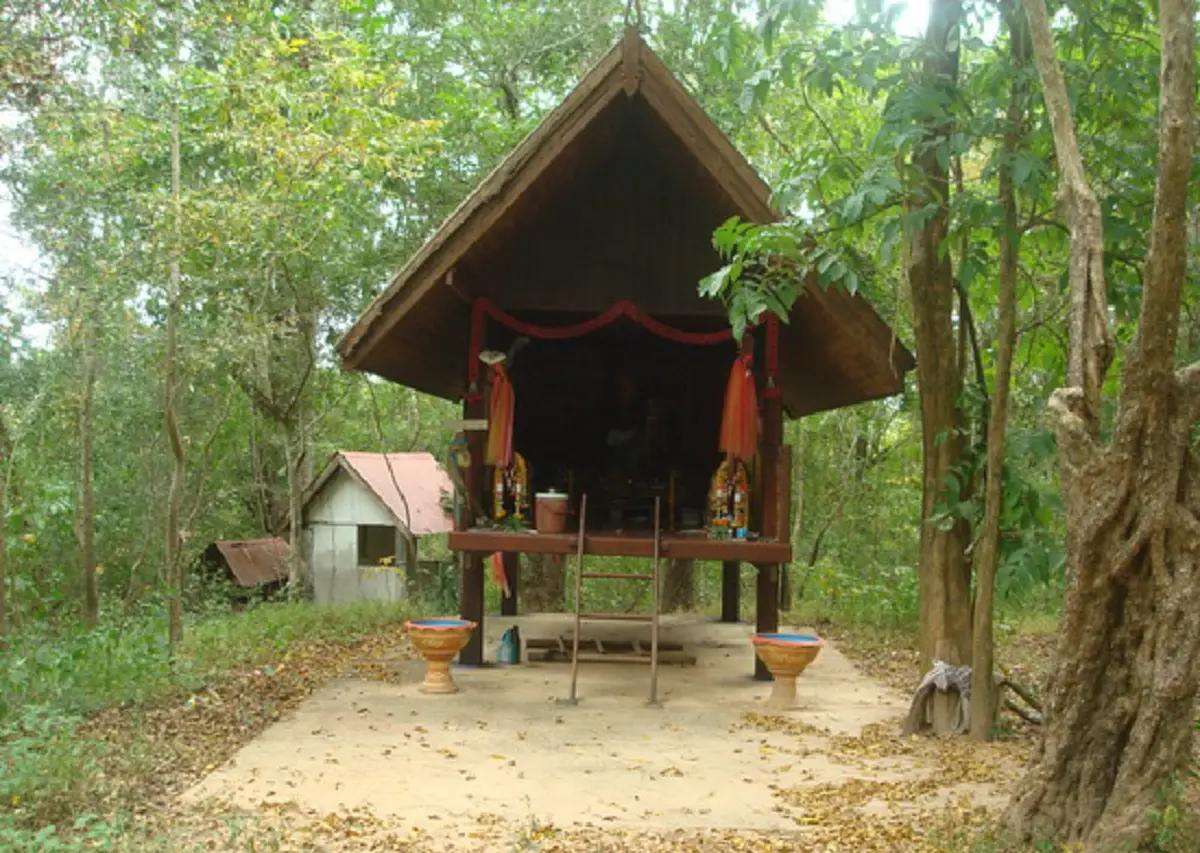
Pa Don Pu Ta at Ban Song, Moo 4, Na Ratchakhwai Subdistrict is a community-conserved forest in Mueang Nakhon Phanom District, Nakhon Phanom Province. Its most distinctive natural feature is the presence of rare wild orchids growing within a relatively undisturbed forest environment. This is not a landscaped commercial orchid garden. The plants grow as part of a living ecosystem, and visitors must not collect, uproot, touch, reposition, or damage any orchid or other vegetation. Travelers should reach Ban Song by private vehicle or hired transport and ask the community or Na Ratchakhwai Subdistrict Administrative Organization for current access instructions before entering the forest.
The importance of Pa Don Pu Ta extends far beyond its orchids. The forest represents a close relationship between nature, ancestral belief, community memory, and local resource management. It is not regarded merely as a patch of greenery or a tourist attraction. For local communities in northeastern Thailand, a Don Pu Ta forest traditionally forms part of the spiritual landscape of the village. It is associated with ancestral guardian spirits believed to protect the settlement, its residents, agricultural land, and collective well-being.
Pa Don Pu Ta is located in the Ban Song area, officially designated as Moo 4 of Na Ratchakhwai Subdistrict. The wider subdistrict lies close to Nakhon Phanom city and consists largely of villages, farmland, roads, and low-lying agricultural landscapes. A surviving community forest within such surroundings carries considerable ecological value. It provides shade, humidity, organic matter, shelter, and a relatively stable habitat for plants, insects, birds, and other organisms that cannot thrive in intensively cultivated or continuously disturbed areas.
In the Isan language and cultural context, the word “don” generally refers to raised land that is less likely to flood, while “pu ta” refers to ancestral guardian spirits or protective spirits of the village. A Don Pu Ta is therefore a raised forested area dedicated to these guardians. The community treats it as sacred ground and follows inherited rules concerning what may or may not be done within its boundaries.
Across northeastern Thailand, Don Pu Ta forests have historically helped regulate the relationship between people and natural resources. Respect for the guardian spirit created strong social restrictions against felling trees, hunting animals, encroaching on the forest, or behaving disrespectfully. These cultural rules often protected vegetation and wildlife long before modern expressions such as biodiversity conservation, community forestry, protected habitats, and ecosystem management became common.
Practices vary from one community to another. Some Don Pu Ta forests contain a guardian shrine, some have a ritual specialist known locally as a cham, thao cham, or kha cham, and some hold an annual ceremony connected with the agricultural calendar. Visitors must not assume that customs recorded in another province apply identically at Ban Song. The correct approach is to ask local representatives where visitors may walk, which areas are restricted, whether photography is appropriate, and whether a community ceremony is taking place on the intended date.
Existing information about the Ban Song forest describes it as a conserved area rich in rare orchids. This detail suggests that the forest still retains environmental conditions capable of supporting sensitive native plants. Wild orchids depend on much more than the presence of a host tree. They may require particular humidity, light levels, bark conditions, air movement, fungi, pollinators, and surrounding vegetation. Protecting the orchids therefore requires conservation of the entire habitat rather than protection of individual flowers alone.
Wild orchids may grow on branches, trunks, bark crevices, rocks, or the forest floor, depending on the species and its ecological requirements. No publicly available botanical inventory currently identifies the orchid species recorded at Pa Don Pu Ta, Ban Song. Visitors should therefore avoid assigning species names based only on photographs or superficial appearance. Accurate orchid identification may require examination of flowers, leaves, roots, pseudobulbs, growth patterns, seasonal characteristics, and other botanical details by a qualified specialist.
The flowering period is one of the most vulnerable stages in an orchid's life cycle. Moving a branch to improve a photograph, touching a flower, holding a stem toward the camera, stepping on plants around the host tree, or breaking a flower spike may cause lasting damage. Some wild orchids grow for years before reaching flowering maturity. A single broken inflorescence may remove not only that season's flowers but also an important opportunity for pollination, seed production, and natural regeneration.
Travelers should not expect every orchid to flower at the same time. Different species respond differently to rainfall, temperature, humidity, daylight, and seasonal cycles. Some may flower near the beginning of the rainy season, while others may bloom later in the year or during relatively dry months. A visit should therefore be valued as an opportunity to observe a living forest rather than as a guaranteed flower-viewing event. Even an orchid in a non-flowering stage remains an important part of the ecosystem.
The rainy season brings lush vegetation, high humidity, active plant growth, and a visually rich forest atmosphere. It also creates slippery ground, mud, standing water, mosquitoes, and the possibility of sudden storms. Visitors should check the weather, wear closed shoes with reliable traction, and postpone the trip during heavy rain, thunderstorms, or strong winds. The dry season generally provides easier walking conditions, but the risk of fire becomes more serious. Smoking, lighting fires, burning incense outside approved ritual practices, and discarding cigarette ends must be avoided.
Morning is normally the most suitable time to visit. Temperatures are lower, natural light is softer, and visitors have sufficient time to leave well before dark. Although the listed visiting hours are 08.00 to 17.00, Pa Don Pu Ta is not a commercial attraction with a staffed ticket gate throughout the day. Visitors should enter during daylight, inform local residents before starting, remain with their group, and avoid staying in the forest until evening.
Small groups are more appropriate than large tour parties. They create less noise, require less space, are easier to supervise, and reduce trampling beside the route. Schools, universities, photography groups, and organized study tours should contact Na Ratchakhwai Subdistrict Administrative Organization and Ban Song community representatives in advance. The number of participants, walking route, meeting point, safety arrangements, and local guidance should be agreed upon before arrival.
The forest should not be treated merely as a photographic background. Its true value lies in the relationships among vegetation, animals, soil, water, humidity, microorganisms, and community practice. Many plants may not possess large flowers or visually dramatic forms, yet they provide shade, retain moisture, reduce soil erosion, shelter insects, and contribute organic matter. Decomposers in the soil recycle fallen leaves and return nutrients to the ecosystem. These less visible processes support the orchids and every other organism in the forest.
The canopy moderates sunlight and prevents the forest floor from heating as rapidly as open land. Leaf litter and decaying organic material help retain moisture. Because temperature and humidity change more gradually beneath the trees, sensitive plants gain a more stable microhabitat. Removing even one large tree may open the canopy to stronger sunlight and wind, changing local conditions for orchids and understory plants even when those smaller plants are not directly cut.
Removing a wild orchid to grow at home is not a form of conservation. Many collected plants die because domestic conditions cannot reproduce the humidity, fungi, bark, airflow, light cycle, and ecological relationships of the original habitat. Uprooting a plant damages its roots and removes reproductive material from the wild population. Responsible visitors should take photographs and memories home, leaving every plant exactly where it grows.
The same rule applies to seed pods, branches, leaves, stones, fallen wood, and other natural objects. Something that appears unimportant to a visitor may provide food, shelter, moisture, or reproductive material for another organism. The safest principle is to remove nothing from the forest and leave nothing behind. All litter must be carried out, including tissues, food packaging, plastic, bottles, and organic food waste that could attract animals or alter their feeding behavior.
Orchid photography should be conducted from an appropriate distance. A zoom lens is preferable when a plant cannot be approached without leaving the established route. Visitors should not bend branches, remove surrounding vegetation, climb trees, or stand on roots to obtain a better angle. Repeated flash photography close to insects or animals should be avoided. Exact coordinates of rare orchids should not be published publicly, because detailed location data can increase the risk of illegal collection.
Noise should be kept to a minimum. Portable speakers, loud music, shouting, and calling across the forest disturb wildlife and conflict with the atmosphere of a sacred community space. Mobile telephones should be placed on silent or vibration mode. Quiet observation allows visitors to notice bird calls, insect activity, moving leaves, variations in light, and other features that are easily missed when the forest is treated as a place for entertainment rather than attentive learning.
From a cultural perspective, Pa Don Pu Ta demonstrates a form of conservation created through community belief rather than imposed entirely through government regulation. Respect for ancestors gave the rules social authority. Villagers understood that certain trees should not be cut, particular areas should not be occupied, and some activities required collective permission. The sacred status of the forest consequently helped maintain an ecological refuge within the agricultural landscape.
From a contemporary environmental perspective, the forest possesses both cultural and biological significance. Belief creates a protected social boundary, while the forest provides shade, moisture, genetic resources, and habitat. Even when residents no longer depend on forest products in the same manner as earlier generations, the site continues to preserve evidence of how local society organized its relationship with nature and collective responsibility.
Developing the forest as a learning destination requires caution. Unmanaged growth in visitor numbers can lead to litter, shortcuts, trampling, damage to orchids, disruption of ceremonies, and pressure for unnecessary construction. A small-scale, community-guided model is more appropriate than mass tourism. Visitors should receive clear information before entry, follow a route selected by local people, and understand that conservation takes priority over convenience or entertainment.
For nature enthusiasts, the forest is suitable for studying relationships rather than simply collecting species names. Visitors can observe differences between the forest edge and shaded interior, the direction of sunlight, moisture on bark, the growth of epiphytes, accumulated leaf litter, and signs of insects. These observations reveal that an orchid is not an isolated decorative plant but a participant in a complex network of living and non-living elements.
Students can learn about local wisdom, community rules, forest succession, plant reproduction, the ecological role of large trees, and the consequences of collecting wild plants. Suitable activities include listening to community knowledge, writing field notes, sketching, and taking non-invasive photographs. Collecting specimens, pulling leaves for school projects, or organizing competitive plant searches should never take place without formal permission and qualified supervision.
Families bringing children must supervise them closely. Forest ground may contain roots, loose branches, thorns, insects, and slippery sections. Children should not run, climb trees, or handle unknown plants and animals. The visit offers an opportunity to explain that appreciation of nature does not require touching or ownership. Carrying litter out of the forest and remaining on the recommended route are practical environmental lessons that children can understand immediately.
Older visitors and people with limited mobility should ask about access conditions before traveling. A community forest may not have paved paths, handrails, accessible toilets, rest shelters, or other facilities expected at a major tourist attraction. Ground conditions can become significantly more difficult after rain. Visitors who are unable to walk safely into the forest may still learn about Pa Don Pu Ta through conversations with community representatives in Ban Song.
Recommended equipment includes drinking water, a hat, long sleeves, long trousers, closed shoes, insect repellent, personal medication, and a bag for carrying litter out. A fully charged telephone is useful, although mobile coverage should not be treated as guaranteed in every part of a natural area. Strong-smelling food should not be consumed inside the forest, and no scraps should be left behind even when they are biodegradable.
Clothing should be modest and appropriate for both forest conditions and the cultural sensitivity of the site. Long clothing reduces insect bites and scratches. Sandals and shoes with smooth soles are unsuitable. Long jewelry, loose straps, and unsecured equipment may catch on vegetation. Neutral clothing is not compulsory, but subdued colors generally cause less visual disturbance and are more suitable for wildlife observation.
Visitors should never walk alone or separate from their group. They should not leave the route recommended by the community. If a snake, wasp nest, unfamiliar animal, or potentially irritating plant is encountered, the correct response is to stop, keep a safe distance, and allow space for the organism. No one should attempt to catch, chase, feed, or relocate wildlife. In the event of an injury, the priority is to leave safely and obtain assistance rather than continue toward a photographic destination.
Trips should be postponed during thunderstorms, strong winds, or other unsafe weather. Trees and branches may fall even when they appear healthy. Muddy paths can deteriorate rapidly, and lightning presents a serious hazard. Respecting nature includes accepting that access is not appropriate under every condition. Changing the itinerary is a responsible decision, not a failed journey.
The important spaces within Pa Don Pu Ta can be understood in 3 broad categories, although these should not be interpreted as an officially surveyed zoning plan. The first is the village approach and forest edge, where visitors make contact and prepare. The second is the conservation forest and orchid habitat, where movement should follow community instructions. The third is the sacred or reserved area, where access, photography, and behavior are governed by local custom.
The forest edge is a transition zone exposed to more sunlight, wind, dust, noise, and human activity than the interior. Vegetation may differ significantly from that beneath the canopy. This area is also vulnerable to parking, road expansion, litter, and the creation of informal access points. Vehicles should be left only where residents recommend. Drivers must not park on vegetation, obstruct agricultural access, or continue along an unverified dirt track into the forest.
Within the conservation area, visitors should walk in single file and avoid stepping sideways for photographs. Trees must not be marked, scratched, nailed, tied with personal ribbons, or used to support signs and equipment. Any professional survey requiring markers, measuring devices, or monitoring equipment should be formally coordinated so that nothing is installed or left behind without community approval.
The sacred section requires the greatest cultural sensitivity. Visitors do not need to share the community's beliefs, but they must respect the authority of the people who care for the site. Ritual objects must not be touched or moved. Visitors should not make jokes, stage dramatic photographs, imitate ceremonies, or make personal vows without guidance. When a community ceremony is taking place, outsiders should wait for instructions concerning observation, participation, and photography.
In practical terms, the forest is cared for by Ban Song community, Moo 4, in cooperation with local leaders and Na Ratchakhwai Subdistrict Administrative Organization. The community leadership information published by the local authority identifies Mr. Seksan Wisetsunthorn as the Kamnan, or subdistrict headman, based in Ban Song. Organized groups, researchers, film crews, and educational institutions should contact the subdistrict administrative office at 042-051-061 before traveling.
Advance coordination provides more than directions. It allows visitors to learn whether current weather and ground conditions are suitable, whether a ceremony or community activity is scheduled, whether the access route has changed after rain, and whether a local guide is necessary. These factors can vary seasonally. Contacting the community is therefore an essential part of responsible travel rather than an unnecessary inconvenience.
No formal admission-rate announcement has been published by the local authority, and the forest does not operate as a conventional ticketed attraction. Visitors should nevertheless ask before traveling. Guided walks, educational sessions, filming, or special group activities may involve locally agreed expenses. The absence of a ticket booth does not mean that anyone may enter without notification or disregard community rules.
Getting There from central Nakhon Phanom is most practical by private car, rental car, or hired vehicle. Travel toward Na Ratchakhwai Subdistrict and Ban Song, Moo 4. The subdistrict is located relatively close to the district center, but the forest entrance does not have a clearly published official tourist pin. Upon reaching Ban Song, ask community representatives where to park and which route to use. Do not rely solely on satellite imagery or follow an unfamiliar agricultural track without local confirmation.
Most connecting roads within Na Ratchakhwai Subdistrict are paved or concrete, although some local approaches may vary in condition and can deteriorate after heavy rain. Ordinary passenger cars should avoid muddy or flooded tracks. Vehicles must not be driven beyond the point approved by residents. Drivers should reduce speed when passing houses and watch for pedestrians, motorcycles, domestic animals, farm machinery, and local traffic.
Travelers without a private vehicle can hire a car or taxi from Nakhon Phanom city, but the return journey should be arranged in advance. Ban Song does not function as a regular tourist transport hub, and an available vehicle cannot be assumed at all times. Keep the driver's number, agree on a collection time, and allow additional time for contacting community representatives. Hiring a vehicle to wait or return at an agreed time is more reliable than depending entirely on an application-based service.
A half-day itinerary is appropriate. Leave Nakhon Phanom city in the morning, meet a community contact in Ban Song, listen to an introduction about the forest and its rules, and enter only along the recommended route. After leaving, check that all litter and equipment have been removed. The journey can then continue to a restaurant, temple, museum, or riverside attraction in Mueang Nakhon Phanom District.
Nearby places that can be combined with the visit include Wat Si Bua Ban in Na Ratchakhwai, the World of Mekong Freshwater Aquarium in Nong Yat, the Ho Chi Minh Memorial and Thai-Vietnamese Friendship Village at Ban Na Chok, the Phaya Si Sattanakharat riverside landmark, and Wat Mahathat with Phra That Nakhon. Together, these destinations introduce travelers to the natural, spiritual, historical, and urban dimensions of Nakhon Phanom.
Wat Si Bua Ban provides a nearby connection with the Buddhist life of Na Ratchakhwai community. The freshwater aquarium expands the ecological theme from forest habitats to the Mekong basin and is particularly suitable for families traveling with children. Opening days, admission charges, and exhibition availability at the aquarium should be checked separately because they are independent of Pa Don Pu Ta.
The Ho Chi Minh Memorial and Thai-Vietnamese Friendship Village illustrate the historical relationship between Nakhon Phanom and Vietnamese communities. Phaya Si Sattanakharat and the Mekong riverside are suitable for the late afternoon or evening after returning from Ban Song. Beginning the day in a small cultural forest and ending beside the Mekong provides a broader understanding of the province than visiting only one category of attraction.
Most restaurants and accommodations are located in or near Nakhon Phanom city. Travelers seeking a nature-oriented atmosphere may consider Jungle Space Village, while those interested in Vietnamese and regional dishes can consider Sabaidee Nakhon Phanom, Rabiang Khong, or other riverside restaurants. Telephone confirmation is advisable because opening hours, private events, and table availability may change.
Accommodation options include boutique hotels, mid-sized properties, and Mekong riverside hotels. Staying in the city allows travelers to depart for Ban Song in the morning and return for an evening walk by the river. Selection should be based on the complete itinerary rather than distance alone. Travelers using Nakhon Phanom Airport should also account for airport transfer time when choosing a hotel.
Facilities inside Pa Don Pu Ta are limited and should not be compared with those of a national park or urban garden. Visitors should not expect shops, paved trails, charging points, staffed information desks, accessible toilets, or permanent tourist services. Food, water, and restroom needs should be addressed before entry. Self-sufficient preparation reduces pressure to construct additional facilities inside a sensitive forest.
Researchers, botanists, professional photographers, and media crews require a level of coordination beyond ordinary visitation. Tripods, lighting, sound equipment, monitoring devices, GPS recording, specimen collection, and prolonged occupation of one location can create impacts or involve legal and community restrictions. A clear activity plan should be submitted to the local authority. Educational or documentary objectives do not automatically authorize access, collection, or disturbance.
Public descriptions of the forest should credit the community and avoid presenting Don Pu Ta belief as a frightening supernatural curiosity. It is a cultural heritage system with social, ethical, and environmental functions. Writers and visitors should use respectful language, avoid dismissing the belief as superstition, and refrain from exaggerating stories merely to attract attention.
At the same time, describing the site only as sacred without discussing ecology would present an incomplete picture. Cultural restrictions have practical environmental consequences. Trees protected from cutting preserve shade and humidity. A relatively undisturbed habitat supports orchids and other organisms. Belief and biodiversity are therefore connected through observable conditions within the forest.
Future challenges may include land-use change, road expansion, fire, waste, invasive plants, illegal collection, and the decline of local knowledge transmission. Conservation must therefore protect both the physical forest and the cultural system that supports it. Trees cannot be fully protected if the community rules and stories that gave the forest meaning disappear. Likewise, ceremonies alone cannot sustain the site if its ecological condition is allowed to deteriorate.
Visitors influence the future of the forest through seemingly small decisions. Refusing to collect orchids, keeping rare-plant coordinates private, using local guidance, purchasing services responsibly, and sharing accurate information all reduce risk. By contrast, entering without notice, publishing precise plant locations, creating shortcuts, or staging damaging photographs can produce consequences long after a single visit has ended.
The most appropriate principle is to enter as a guest rather than an owner. Listen before deciding, follow local instructions even when they are less convenient, and accept that access may be limited when the forest is not ready to receive visitors. This approach may produce fewer dramatic photographs, but it provides a deeper understanding of the relationship between Isan communities, ancestral guardians, and conserved woodland.
Pa Don Pu Ta, Ban Song, is best suited to travelers interested in small natural habitats, cultural forests, wild orchids, local knowledge, and quiet educational travel. Its appeal does not depend on monumental architecture or adventure activities. Its significance lies in a forest that has survived through shared responsibility and belief. Orchids, old trees, sacred space, and Ban Song community life form one connected story that should not be separated for tourism purposes.
Before departure, contact Na Ratchakhwai Subdistrict Administrative Organization, confirm current access conditions, ask for the appropriate Ban Song representative, and prepare for limited facilities. Inside the forest, remain quiet, stay on the advised route, collect nothing, leave nothing, and depart before dark. These simple actions help preserve Pa Don Pu Ta as a community conservation area, a habitat for rare orchids, and a living cultural inheritance for future generations.
| Name | Pa Don Pu Ta, Ban Song, Moo 4 |
| Thai Name | ป่าดอนปู่ตา บ้านซอง หมู่ 4 |
| Location | Ban Song, Moo 4, Na Ratchakhwai Subdistrict, Mueang Nakhon Phanom District, Nakhon Phanom Province 48000, Thailand |
| Site Type | Community conservation forest, Isan cultural forest, and sacred community space associated with ancestral guardian belief |
| Highlights | A relatively undisturbed community forest supporting rare wild orchids and illustrating the relationship between biodiversity conservation and belief in ancestral village guardians |
| Name Origin | “Don” refers to raised land that is less vulnerable to flooding, while “Pu Ta” refers to ancestral or protective guardian spirits of the community |
| Distinctive Features | Natural forest cover, shade, humidity, epiphytic vegetation, understory plants, and habitat conditions suitable for wild orchids |
| Cultural Importance | Represents an Isan conservation tradition in which belief, taboos, and community agreements protect trees, wildlife, and sacred land |
| Main Areas / Zones | 1. Village approach and forest edge for contact and preparation 2. Conservation forest and wild-orchid habitat 3. Sacred or community-reserved area accessible only according to local guidance |
| Caretaker / Local Coordinator | Ban Song community, Moo 4, in cooperation with local leaders and Na Ratchakhwai Subdistrict Administrative Organization; Mr. Seksan Wisetsunthorn is the Kamnan of Na Ratchakhwai based in Ban Song |
| Main Contact Number | Na Ratchakhwai Subdistrict Administrative Organization: 042-051-061 |
| Open Days | Daily |
| Opening Hours | 08.00 – 17.00; daylight visits and advance community contact are recommended |
| Fees | No formal admission rate has been announced. Contact the local coordinator regarding guided visits, educational activities, filming, or organized groups |
| Facilities | Facilities are limited. Visitors should bring drinking water, sun and insect protection, appropriate footwear, and use restroom facilities before entering |
| Recommended Visiting Period | Morning during safe weather. The rainy season provides lush vegetation but slippery conditions; orchid flowering times vary by species and climate |
| Essential Visitor Rules | Do not collect or touch orchids, cut trees, hunt animals, light fires, create excessive noise, leave the advised route, publish precise rare-plant coordinates, or leave litter |
| Travel Information | Travel from Nakhon Phanom city by private car, rental car, or hired vehicle to Ban Song, Moo 4. Ask local representatives where to park and enter; do not drive into the forest without permission |
| Current Status | Community conservation forest. Access is subject to local rules, route conditions, weather, ceremonies, and the readiness of the area |
| Nearby Tourist Attractions | 1. Wat Si Bua Ban, approximately 5 km, Tel. 086-463-8500 2. World of Mekong Freshwater Aquarium, approximately 10 km, Tel. 042-511-535 3. Ho Chi Minh Memorial and Thai-Vietnamese Friendship Village at Ban Na Chok, approximately 12 km 4. Phaya Si Sattanakharat and the Mekong riverside plaza, approximately 14 km 5. Wat Mahathat and Phra That Nakhon, approximately 14 km |
| Nearby Restaurants | 1. Jungle Space Village, approximately 10 km, Tel. 098-258-0709 2. Sabaidee Nakhon Phanom, approximately 14 km, Tel. 042-064-200 3. Rabiang Khong Nakhon Phanom, approximately 14 km, Tel. 092-865-5889 4. View Khong Restaurant at Fortune View Khong Hotel, approximately 15 km, Tel. 042-513-564 5. Tiew Tem Toh Na Nakhon Phanom, approximately 15 km, Tel. 087-696-9979 |
| Nearby Accommodations | 1. Boondara Boutique Hotel, approximately 10 km, Tel. 042-530-946 2. Fortune View Khong Hotel Nakhon Phanom, approximately 14 km, Tel. 042-513-564 3. VELA Dhi Nakhon Phanom, approximately 15 km, Tel. 042-515-919 4. Fortune River View Hotel Nakhon Phanom, approximately 15 km, Tel. 042-522-334 5. The River Hotel Nakhon Phanom, approximately 15 km, Tel. 042-522-999 |
Frequently Asked Questions (FAQ)
Q: Where is Pa Don Pu Ta, Moo 4 located?
A: It is located in Ban Song, Moo 4, Na Ratchakhwai Subdistrict, Mueang Nakhon Phanom District, Nakhon Phanom Province. Ask a local representative for the current entrance route upon reaching Ban Song.
Q: On which days and at what times can Pa Don Pu Ta be visited?
A: The listed visiting schedule is daily from 08.00 to 17.00. Daylight visits and advance community contact are recommended because the forest does not operate with a permanently staffed tourist entrance.
Q: Is there an admission fee for Pa Don Pu Ta?
A: No formal admission rate has been announced by the local authority. Guided walks, educational activities, filming, and organized groups should ask the local coordinator about any applicable arrangements or expenses.
Q: Can rare orchids be seen throughout the year?
A: Orchid plants may be present in their natural habitat, but flowering periods differ according to species, rainfall, humidity, temperature, and seasonal conditions. No date guarantees that every orchid will be in flower.
Q: May visitors touch or collect orchids in the forest?
A: No. Orchids and all other plants must not be touched, cut, uprooted, collected, or repositioned. Photographs should be taken from a distance that does not disturb the plant or surrounding habitat.
Q: What should visitors prepare before entering Pa Don Pu Ta?
A: Wear long sleeves, long trousers, and closed shoes. Bring drinking water, a hat, insect repellent, personal medication, and a bag for carrying litter out. Check the weather and notify a community representative before entering.
Q: Can travelers reach Pa Don Pu Ta without a private vehicle?
A: A hired car or taxi can be arranged from Nakhon Phanom city, but the return journey should be booked in advance because regular tourist transport is not continuously available in Ban Song.
Q: Whom should travelers contact before visiting?
A: Contact Na Ratchakhwai Subdistrict Administrative Organization at 042-051-061 for current access conditions, local coordination in Ban Song, and the latest visitor instructions.
 Category: ●Nature and Wildlife
 Group: ●Other natural attractions
Last Update : 1 MonthAgo
 Last Update : 1 MonthAgo
 Click to Access the Navigation Map GPS
 Art, Culture and Heritage
 Historical Sites and Monuments(3)
 Landmarks and Memorials(2)
 Art, Craft Centres, Tradition(3)
 Museums(3)
 Educational Places
 Library(1)
 Places of Worship
 Temple(23)
 Church(1)
 Other Sacred Sites(11)
 Suburban Living
 Village, Community(5)
 National Parks and Marine Reserves(1)
 Dam, Reservoir, Lake(5)
 Waterfalls(2)
 River, Canal(3)
 Bays and Beaches(3)
Other natural attractions(2)
Bays and Beaches(3)
Other natural attractions(2)
 Entertainment and Agricultural
 Zoos and Aquariums(1)
 Farms, Parks and Ecotourism(2)
 Shopping
 Shopping and Night Market(1)


