
lovethailand home >Northeastern Travel Attractions >Nakhon Phanom Travel Attractions >Muang Nakhon Phanom >Nai Muang > Nakhon Phanom Governor’s Residence Museum
TL;DR: Nakhon Phanom Governor’s Residence Museum is located at Sunthon Wichit Road, Nai Mueang Subdistrict, Mueang Nakhon Phanom District, Nakhon Phanom Province, open Wednesday – Sunday; closed on Monday, Tuesday and public holidays, hours 09:00 – 16:30.
Nakhon Phanom Governor’s Residence Museum
Open Days: Wednesday – Sunday; closed on Monday, Tuesday and public holidays
Opening Hours: 09:00 – 16:30
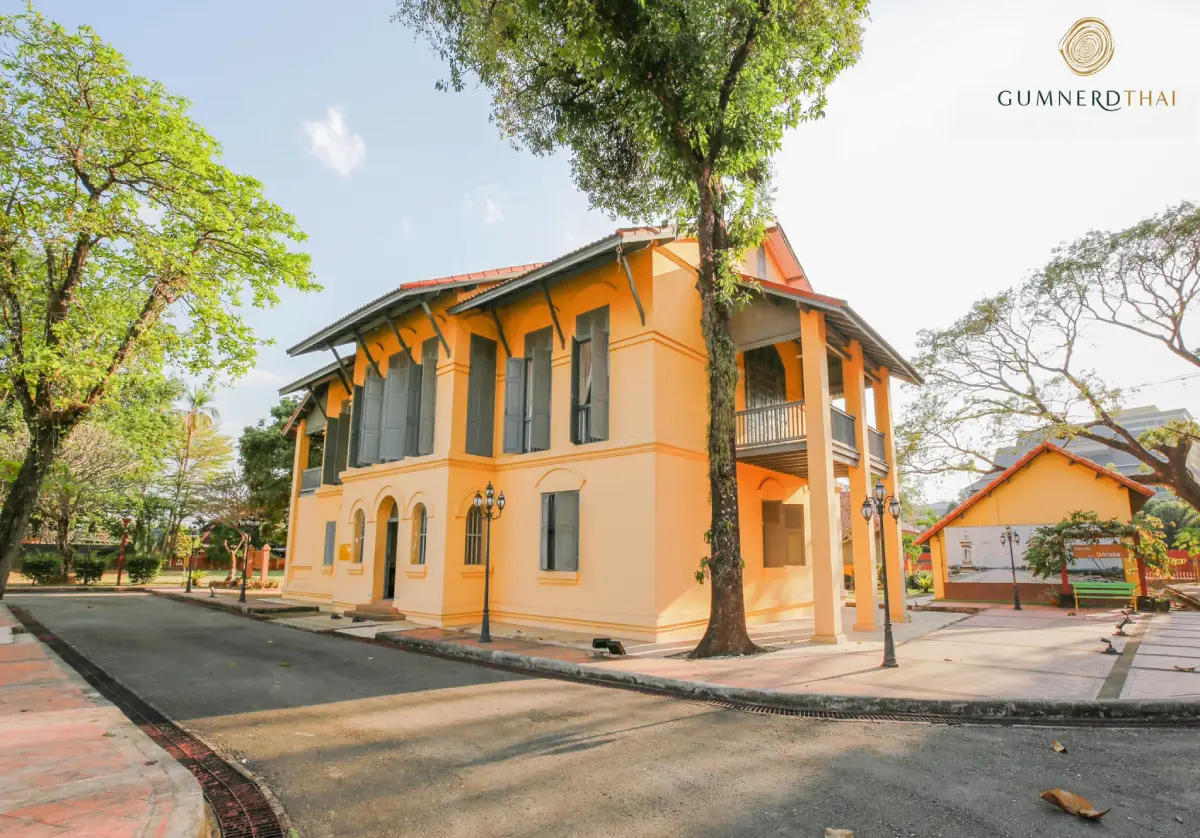
The Nakhon Phanom Governor’s Residence Museum, commonly called the Former Nakhon Phanom Governor’s Residence, stands on Sunthon Wichit Road in Nai Mueang Subdistrict, Mueang Nakhon Phanom District. The elegant pale-yellow building, with its green doors, tall windows and rounded arches, is one of the most recognizable historic landmarks on the Mekong riverfront. It is simultaneously a protected historic building, a place of royal and provincial memory, and a local museum presenting the history, communities, traditions and cultural development of Nakhon Phanom.
The museum is important for more than the beauty of its colonial architecture. The building records the transition of Nakhon Phanom from an old Mekong border town into a modern Thai province. It began as the private residence of an important local administrator, later became the official home of successive provincial governors, and was used as the royal overnight residence of King Bhumibol Adulyadej and Queen Sirikit during their visit to Nakhon Phanom on 12 – 13 November 1955. Today, its rooms have been transformed into exhibitions explaining these interconnected historical layers.
Essential Information: The Former Nakhon Phanom Governor’s Residence is a colonial-style building more than a century old, constructed around 1912 – 1914. It was originally the private home of Phraya Phanom Khanurak before being purchased for use as the provincial governor’s residence. The museum now presents the history of Nakhon Phanom, former administrators, ethnic communities, the 1955 royal visit, the Royal Coronation, the illuminated fire-boat tradition and the historic governor’s kitchen. It is open Wednesday to Sunday from 09:00 to 16:30, and admission is free.
In Thai administrative culture, a “chuan” is the official residence of a senior provincial official. The building therefore served purposes beyond domestic accommodation. It was a formal reception venue, a place for administrative discussions, a setting for provincial ceremonies and an important point of contact between the governor, visiting officials and local residents. Converting the former residence into a museum allows visitors to study political and social history within the actual rooms where provincial life once took place.
The location on Sunthon Wichit Road is central to the meaning of the building. This road follows the Mekong River and connects historic temples, Christian institutions, old commercial neighborhoods, government buildings and civic spaces. When the residence was constructed in the early twentieth century, the Mekong was still a primary route for transport, trade and communication. The property therefore stood close to one of the most important movement corridors in the region and within view of the mountains of Khammouane Province in Laos.
The residence was constructed approximately between 1912 and 1914, during the reign of King Vajiravudh. Its original owner was Phraya Phanom Khanurak, also known as Ui Nakhonthap, an important administrator associated with Nakhon Phanom. He commissioned a Vietnamese builder named Kuba Charoen to undertake the project. The employment of Vietnamese craftsmen reflects the movement of skilled labor across the Mekong region. Vietnamese builders were widely respected for masonry, carpentry and their ability to adapt European building forms to the tropical environment of mainland Southeast Asia.
The property initially functioned as a private family residence. In 1925, the Ministry of Interior purchased it for use as the official residence of the Nakhon Phanom governor. From that point onward, it became directly connected with the administration of the province. Successive governors lived, received guests and performed official duties there. Interior arrangements changed according to the needs of different periods, but the main architectural form survived remarkably well.
The residence is generally described as Western colonial architecture influenced by French building traditions in Indochina. Comparable buildings can be found in historic towns in Thailand, Laos, Cambodia and Vietnam. Some older tourism descriptions loosely associate the building with the Franco-Thai or Indochina War. Its construction in 1912 – 1914, however, occurred decades before the 1940 – 1941 conflict. The French influence is better understood as part of the wider circulation of colonial architectural ideas, construction knowledge and Vietnamese craftsmanship throughout the Mekong region.
The main building has two storeys and was constructed with brick masonry and thick load-bearing walls. These walls provide structural strength while reducing the transfer of daytime heat into the interior. The pale-yellow exterior is contrasted with green doors and windows. Numerous openings are framed by semicircular arches, while restrained stucco details above the windows and doors add visual rhythm without overwhelming the building’s balanced proportions.
The ground floor is finished with patterned cement tiles, a material commonly used in significant early modern buildings. The upper floor has tongue-and-groove timber boards, while durable takhian wood was used in important structural and joinery components. A gently pitched gable roof covered with tiles protects the walls from rain and direct sunlight. This combination of Western masonry, local timber, high ceilings and climate-responsive openings demonstrates how colonial architectural forms were modified for northeastern Thailand.
Tall doors and windows allow air to move through the rooms and capture breezes from the Mekong. High ceilings encourage warm air to rise, while roof overhangs and the thickness of the walls reduce solar heat. Before mechanical air-conditioning, these elements were essential to the comfort of residents and guests. Visitors today can still experience how ventilation, shade and building orientation created a workable interior environment in a hot and humid climate.
The color scheme has become part of the museum’s visual identity. Yellow walls create a warm appearance and allow the building to stand out against the surrounding lawn, while green shutters introduce a vivid contrast. Morning and late-afternoon light reveal the texture of the masonry, the shadow of the arches and the depth of the openings. For photographers, the exterior is highly attractive, but its visual appeal should be appreciated together with the craftsmanship, materials and historical functions preserved inside.
The property includes a lawn, trees and service structures behind the principal residence. These surrounding elements show that the governor’s residence was once a complete domestic and administrative compound. The front portion had a formal and representational character, while the rear accommodated food preparation, staff work and daily services. Exploring the relationship among these areas provides a more accurate understanding of life in an official residence than viewing the main façade alone.
One of the most important events in the building’s history was the royal visit of King Bhumibol Adulyadej and Queen Sirikit on 12 – 13 November 1955. The visit formed part of an extensive journey to meet residents of northeastern Thailand. At a time when travel between Bangkok and distant provinces was considerably more difficult than it is today, the royal journey carried deep emotional and political significance. Thousands of local residents gathered to welcome Their Majesties and express loyalty and affection.
Provincial officials prepared the residence carefully before the royal arrival. Rooms were arranged, appropriate furnishings were installed and numerous administrative details were coordinated over approximately one month. The museum now interprets the royal overnight stay through rooms connected to the original setting. This allows visitors to understand not only the ceremonial moment but also the planning, labor and cooperation required behind the scenes.
A particularly moving story from the visit concerns Mae Thao Tum Chanthanit, an elderly Nakhon Phanom resident who waited in strong sunlight with a lotus intended as a royal offering. By the time she was able to present it, the flower had wilted, but the sincerity of her gesture became one of the most memorable images associated with the royal visit. The museum uses this story to communicate the emotional relationship between the monarchy and residents of a distant provincial community.
After decades of use as the governor’s official home, the building ceased functioning as a permanent residence around 1984 because of its age and deteriorating condition. Like many historic structures, it faced threats from moisture, termites, decaying timber, roof damage and cracking masonry. Provincial authorities and cultural agencies nevertheless recognized that its architectural and historical significance justified conservation rather than demolition.
The Fine Arts Department registered the former residence as a historic site in 2005. Restoration followed, requiring careful study of the walls, timber floors, roofing, openings, colors and evidence of earlier use. Conservation had to balance structural safety with the retention of authentic materials and proportions. The project demonstrates how a historic building can be returned to active public use without losing the architectural characteristics that make it significant.
Following restoration, the building was adapted as a museum under the interpretive concept “Tales of Nakhon’s Past.” Rather than presenting only the history of the residence, the exhibitions use the building as a gateway to the geography, administration, ethnic diversity, royal history and cultural traditions of Nakhon Phanom. The authentic rooms, staircase and windows strengthen the interpretation because visitors move through the same physical spaces once used by governors, guests and officials.
A visit is best begun outside. Visitors can study the sequence of arches, the contrasting colors, the height of the windows, the roof overhang and the relationship between the residence and its garden. Walking around the building reveals the contrast between the formal front and the service areas at the rear. Understanding this external layout makes it easier to interpret the original functions of the rooms once inside.
The ground-floor exhibitions introduce the geography and early history of Nakhon Phanom. The province’s identity is inseparable from the Mekong River and the mountain range visible across the water in Khammouane, Laos. The name Nakhon Phanom is commonly interpreted as a city associated with mountains. The landscape has shaped settlement, trade, migration, agriculture, religion and family connections across the international border.
The exhibition on notable governors and administrators explains how the political organization of the area changed. Earlier Mekong towns were governed through local rulers and networks of tributary communities. Later reforms introduced a more centralized system of provincial administration. The residence embodies this transition because it began as the private home of an influential local administrator and later became the formal residence of governors within the modern state system.
The cultural diversity gallery presents Nakhon Phanom as the home of numerous communities, including Lao-speaking groups, Phu Tai, Tai Yo, Tai So, Kaleung, Tai Saek and people of Vietnamese descent. Their languages, clothing, food, music and rituals contribute to the identity of the province. The exhibition encourages visitors to understand Nakhon Phanom not as a culturally uniform place, but as a town formed through migration, intermarriage, trade and everyday interaction.
The Vietnamese community is especially relevant to the architecture of the residence. Vietnamese craftsmen contributed to the construction of many European-influenced buildings along the Mekong, while later Vietnamese migrants shaped local trade, food and Christian institutions. Visiting the governor’s residence together with Saint Anna Nong Saeng Catholic Cathedral provides a useful introduction to the connection among architecture, migration and cross-border cultural networks.
Several rooms interpret the 1955 royal visit. One introduces the journey and its historical context, another recreates the overnight accommodation, and another focuses on the crowds of citizens who came to welcome Their Majesties. Presenting the event from several perspectives allows visitors to consider the royal itinerary, the preparations made by officials and the personal experiences of ordinary residents.
The Royal Overnight Room deserves careful attention. Its furnishings and arrangement evoke the period when the residence was prepared for the King and Queen. Although the present display is an interpretation, its placement within the original room creates a stronger sense of historical immediacy than objects displayed in a modern gallery. Visitors can imagine the activity that filled the compound before the royal arrival and the responsibility carried by provincial staff.
The room presenting the record of Than Sanga focuses on an official involved in preparing the residence. This story is significant because it expands the museum’s historical narrative beyond nationally prominent figures. It recognizes the administrators, workers and local residents whose planning and labor made a major provincial event possible. Such interpretation demonstrates that history is produced by the combined actions of many people.
A gallery concerning the Royal Coronation connects the historic residence with the continuing role of the monarchy in contemporary Thailand. It prevents the museum’s story from ending in 1955 and illustrates how historic museums can respond to later national events without altering the architectural integrity of the building.
The rotating exhibition room allows the museum to present temporary subjects such as historic photography, notable residents, provincial anniversaries, art and commemorative activities. A flexible space is valuable in a local museum because it encourages residents to return and enables collaboration with schools, artists, collectors and cultural organizations.
A rear exhibition building contains “Huen Huea Fai,” an interpretation of the Nakhon Phanom illuminated fire-boat tradition. Its four sections explore the continuation of the tradition, the beauty of the illuminated boats, the spiritual meaning of fire and the collective effort of Nakhon Phanom residents. The exhibition explains that the annual event is not merely a competition between decorative structures. It is associated with Buddhist devotion, respect for the river and communal cooperation.
The illuminated fire-boat festival takes place around the end of Buddhist Lent. Large fire boats require knowledge of structural design, decorative planning, lighting and coordinated movement. Community members spend weeks preparing frames, patterns and illumination systems before the boats are launched onto the Mekong. The final spectacle is therefore the visible result of faith, artistic creativity and shared labor. The museum enables travelers visiting outside the festival season to understand this complex preparation.
The local expression “Huen Huea Fai” suggests a house of knowledge devoted to fire boats. Photographs, models, materials and interpretive panels trace the development of the tradition from simpler forms to the large illuminated structures seen today. Materials and technology have changed, but the central importance of community participation and the relationship with the Mekong remain constant.
The historic governor’s kitchen adds an important domestic dimension. It recreates the preparation area and displays equipment associated with cooking and official hospitality. A governor’s residence had to feed the household, visiting officials and guests at ceremonial events. This required cooks, assistants and careful planning. The story of an old bread oven used during preparations for the royal visit demonstrates how national history depended on ordinary forms of work performed behind the formal rooms.
The kitchen also provides a starting point for understanding the food history of Nakhon Phanom. Isan, Lao, Vietnamese and Western influences meet in the local diet. Bread, Vietnamese sausages, fermented pork dishes, noodle soups and Vietnamese-style meals became part of the city’s culinary identity alongside northeastern Thai food and Mekong fish. Eating in the historic riverfront area after visiting the museum allows travelers to connect the exhibition with present-day urban life.
The building itself is the museum’s largest and most important artifact. Timber joints, floorboards, thick walls, shutters, door hardware and arched openings all reveal construction knowledge. Architecture students can examine how foreign forms were adapted to sunlight, rain and river breezes. Social historians can study how formal reception rooms, private areas and service spaces were arranged to express hierarchy and function.
Conserving a historic building does not mean making every surface appear new. Irregular textures, worn timber and visible repairs can provide evidence of age and use. If all materials were replaced and every surface made perfectly uniform, visitors would struggle to distinguish original fabric from later additions. Appropriate conservation protects safety while allowing the building to retain historical authenticity.
Visitors should walk carefully on the upper timber floor, avoid running or leaning against old windows and refrain from touching objects without permission. Photography should follow the signs and instructions provided by museum staff, particularly regarding flash, tripods and professional equipment. Commercial photography, research recording and organized media production should be arranged with the Nakhon Phanom Provincial Office in advance.
The main building has two storeys, and access to the upper floor is by staircase. Elderly visitors, people with limited mobility and families with young children should take particular care. Those unable to use the stairs can still explore the exterior architecture, the ground-floor galleries, the rear exhibitions and the garden. Contacting the museum before arrival is advisable when accessibility assistance is required.
The most comfortable times to visit are soon after opening or during the later afternoon. Morning air along the Mekong is generally pleasant, while afternoon light produces strong shadows around the arches and shutters. A minimum of 60 to 90 minutes should be allowed for the exhibitions. Visitors who wish to read all interpretation, photograph the exterior and explore the rear buildings should reserve approximately two hours.
November through February is particularly suitable for exploring Nakhon Phanom on foot because the weather is generally cooler. Clear mornings often provide impressive views of the mountains across the Mekong. During the hot season, visitors should carry water and sun protection. In the rainy season, outdoor surfaces may become slippery, and an umbrella is useful because many nearby attractions are reached by walking along the riverfront.
Getting There is straightforward from central Nakhon Phanom. Follow Sunthon Wichit Road along the Mekong River. The museum stands near Saint Anna Nong Saeng Catholic Cathedral and the Aiyara Riverine Hotel. Drivers should follow local parking signs and avoid blocking the historic compound. Travelers staying in the riverfront district can reach the museum easily on foot or by bicycle, while local taxis and hired vehicles can stop nearby.
From Nakhon Phanom Airport, visitors can take a taxi, rental car or hotel transfer into the city. A rental vehicle is useful for continuing to Wat Phra That Phanom, the Ho Chi Minh Memorial or attractions outside the urban area. Travelers focusing on the old riverfront district can rely on walking, cycling and local transport for much of the day.
A convenient heritage walk can begin at the museum, continue to Saint Anna Nong Saeng Catholic Cathedral and then follow Sunthon Wichit Road toward the commemorative national library, the Vietnamese Memorial Clock Tower, Wat Okat Si Bua Ban and the Phaya Si Sattanakharat monument. Within a relatively short distance, the route includes colonial architecture, Christian history, Buddhist heritage, Vietnamese migration and beliefs associated with the Mekong and the naga.
Saint Anna Nong Saeng Catholic Cathedral stands close to the museum and represents the history of the Mekong Christian community. Its European-influenced architecture is closely connected with Vietnamese Catholic settlement. Visiting both sites helps travelers understand how building knowledge, religion and migration moved through regional networks even though the two buildings served very different functions.
The Vietnamese Memorial Clock Tower explains another chapter of migration. It commemorates members of the Vietnamese community who returned to Vietnam after political conditions changed. Today, the surrounding area contains cafés, restaurants and walking-street activities. The walk from the former governor’s residence to the clock tower therefore moves from an old administrative compound into a living commercial and social district.
Wat Okat Si Bua Ban houses Phra Tio and Phra Thiam, revered Buddha images associated with Nakhon Phanom. Continuing to the Phaya Si Sattanakharat monument introduces contemporary public devotion to the naga and the Mekong. Together, the governor’s residence, temple and riverfront monument illustrate the close relationship among political history, religion and the natural landscape.
Restaurants near the museum serve Vietnamese food, Isan dishes, breakfast and Mekong fish. Popular local choices include pan-fried eggs, stuffed bread, Vietnamese sausage, naem nueang, Vietnamese rice-noodle soup and regional northeastern dishes. Opening times should be checked before travel because breakfast restaurants may close early, while many riverfront restaurants operate mainly in the afternoon and evening.
Accommodation around the museum ranges from a hotel immediately beside the historic compound to small properties in the old town and larger riverside hotels. Staying near Sunthon Wichit Road is convenient for early-morning and evening walks. Guests can watch the sunrise over the mountains of Laos, cycle along the Mekong and return from nearby restaurants without needing a vehicle.
For families, the museum demonstrates that history is more than names and dates. Children can compare the cement tiles downstairs with the timber floor upstairs, observe the tall windows, study old photographs and learn how fire boats are constructed. Parents can encourage questions about ventilation, the separation of the kitchen from reception rooms and the reasons Nakhon Phanom developed such a diverse population.
Schools and organized study groups should contact the museum or the provincial office in advance. Useful study themes include colonial architecture, royal visits, ethnic diversity, photography and the construction of illuminated fire boats. After the museum visit, students can survey other historic buildings on Sunthon Wichit Road and create a heritage map of the old city.
For local residents, the museum is a repository of shared memory rather than only a tourist attraction. Photographs, documents and personal stories allow younger generations to understand their city, while older visitors can reconnect with events known through family narratives. Rotating exhibitions and special activities provide opportunities for schools, communities and cultural organizations to contribute new interpretations.
The museum also increases the cultural value of the Mekong riverfront. Visitors gain historical context rather than seeing the river only as scenery. After learning about administration, Vietnamese migration and ethnic diversity, the surrounding churches, temples, restaurants and old buildings become parts of a connected urban narrative.
The restoration of the residence demonstrates why historic buildings remain relevant to modern cities. Development pressure often encourages the replacement of old structures, but this museum shows that conservation can support education, tourism and local identity. Protecting heritage does not prevent development; it allows a city to use its history as a resource for a more distinctive future.
Visitors should confirm opening arrangements before traveling during long holiday periods. Although the normal schedule is Wednesday to Sunday, maintenance, public holidays, government activities or special events can occasionally affect access. Advance contact is particularly useful for travelers coming from outside the province, large school groups, elderly visitors and anyone requesting a guided explanation.
The museum is best experienced slowly. Begin with the exterior, continue through the city-history galleries, climb to the rooms interpreting the royal visit, explore the fire-boat exhibition and historic kitchen, and then return to the lawn for a final view of the building. After understanding the exhibitions, the façade appears differently because visitors know who once lived there, how the rooms were used and why the residence is important to the province.
The Nakhon Phanom Governor’s Residence Museum is therefore much more than an attractive colonial building beside the Mekong. Within one compound, it brings together Vietnamese craftsmanship, the development of provincial administration, daily life in an official residence, a royal visit, local loyalty, ethnic diversity, the fire-boat tradition and culinary history. A visit provides an unusually complete introduction to Nakhon Phanom as a city shaped by multiple peoples and overlapping histories.
Although the residence is more than a century old, its proportions, arches, colors and timberwork remain impressive. The building stays alive not simply because it was restored, but because people can enter, learn, ask questions and connect its history with the contemporary city. Each visitor who passes through the green doors, climbs the wooden staircase or looks toward the Mekong adds a new layer of meaning without erasing the past.
For travelers seeking a deeper understanding of Nakhon Phanom, the museum is an ideal starting point. Its exhibitions establish the historical context needed to interpret the rest of the city. After learning about provincial governors, the royal visit, Vietnamese settlement, ethnic communities and Mekong traditions, nearby attractions become more than isolated sightseeing stops. They become parts of a continuing story that can still be experienced throughout the riverfront today.
| Name | Nakhon Phanom Governor’s Residence Museum / Former Nakhon Phanom Governor’s Residence |
| Location | Sunthon Wichit Road, Nai Mueang Subdistrict, Mueang Nakhon Phanom District, Nakhon Phanom Province |
| Address | Sunthon Wichit Road, Nai Mueang, Mueang Nakhon Phanom, Nakhon Phanom 48000, Thailand |
| Site Type | Local history museum, registered historic site and conserved architectural landmark |
| Construction Period | Approximately 1912 – 1914 |
| Original Owner | Phraya Phanom Khanurak, also known as Ui Nakhonthap |
| Builder | Kuba Charoen, a Vietnamese craftsman, with builders from the Mekong region |
| Architectural Style | Western colonial architecture influenced by French Indochina and adapted to the tropical climate of the Mekong region |
| Distinctive Features | Two-storey masonry building with yellow walls, green doors and windows, semicircular arches, patterned cement tiles downstairs, tongue-and-groove timber flooring upstairs and a tiled gable roof |
| Major Historical Event | Royal overnight residence of King Bhumibol Adulyadej and Queen Sirikit on 12 – 13 November 1955 |
| Historic Status | Registered by the Fine Arts Department as a historic site in 2005 and subsequently restored for museum use |
| Exhibition Concept | “Tales of Nakhon’s Past,” presenting the city’s history, administration, cultural diversity and important events |
| Main Building Galleries | 1. Local Foundations of Nakhon 2. Notable Governors and Administrators 3. Cultural Diversity 4. The Royal Visit 5. The Royal Overnight Stay 6. Citizens Welcoming Their Majesties 7. Royal Coronation Gallery 8. The Record of Than Sanga 9. Rotating Exhibition Gallery |
| Huen Huea Fai Galleries | 1. Continuing the Tradition 2. The Beauty of the Fire Boats 3. Flames of Faith 4. United People of Nakhon |
| Other Areas | Historic governor’s kitchen, service buildings, lawn and exterior architectural viewing area |
| Caretaker | Nakhon Phanom Provincial Office and museum staff |
| Open Days | Wednesday – Sunday; closed on Monday, Tuesday and public holidays |
| Opening Hours | 09:00 – 16:30 |
| Admission Fee | Free admission |
| Facilities | Restrooms, resting area, lawn and indoor and outdoor exhibitions; the upper floor is accessed by stairs |
| Recommended Visit Duration | Approximately 1 – 2 hours |
| Travel Information | Located on the Mekong riverfront in central Nakhon Phanom. Accessible by car, local taxi, bicycle or on foot from accommodation in the riverfront district. |
| Current Status | Operating as a museum and an important historical attraction in Nakhon Phanom |
| Main Contact Numbers | Nakhon Phanom Provincial Office: 042-511287 Museum Contact: 089-5737829 |
| Nearby Tourist Attractions | 1. Saint Anna Nong Saeng Catholic Cathedral, 0.4 km 2. Queen Sirikit Commemorative National Library, Nakhon Phanom, 0.8 km 3. Vietnamese Memorial Clock Tower, 1 km 4. Wat Okat Si Bua Ban, 1.5 km 5. Phaya Si Sattanakharat Monument, 2 km |
| Nearby Restaurants | 1. Sabaidee@Nakhon Phanom, 1 km, Tel. 042-064200 2. Ruen Rim Nam, 2 km, Tel. 082-1077241, 088-6807609 3. Im Boon Breakfast, 2 km, Tel. 062-1465649 4. Kitchen Khong The River Front, 3 km, Tel. 085-9247898 5. Ped Rim Khong, 3 km, Tel. 081-8731274 |
| Nearby Accommodations | 1. Aiyara Riverine Hotel, 0.1 km, Tel. 088-1905888, 042-190888 2. Porpiang Hotel, 0.8 km, Tel. 042-515444, 099-6698992 3. Landmark Nakhon Phanom Hotel, 2 km, Tel. 091-7403001 4. U-Home Hotel, 3 km, Tel. 042-514789, 042-514779 5. Fortune View Khong Hotel Nakhon Phanom, 3 km, Tel. 042-513564, 083-9891465 |
Frequently Asked Questions (FAQ)
Q: On which days is the Nakhon Phanom Governor’s Residence Museum open?
A: The museum is open Wednesday to Sunday from 09:00 to 16:30. It is closed on Monday, Tuesday and public holidays. Visitors should confirm the schedule before traveling during extended holiday periods.
Q: Is there an admission fee?
A: No. Admission to the museum and its regular exhibitions is free.
Q: How old is the building?
A: The residence was constructed approximately between 1912 and 1914, making it more than 100 years old.
Q: Why does the residence have French-influenced architecture?
A: Its design reflects colonial architectural forms that circulated through French Indochina and the Mekong region. Vietnamese craftsmen adapted these forms to local materials and the tropical climate.
Q: What can visitors see inside the museum?
A: Exhibitions cover the history of Nakhon Phanom, former governors, ethnic communities, the 1955 royal visit and overnight stay, the Royal Coronation, the illuminated fire-boat tradition and the historic governor’s kitchen.
Q: How much time should visitors allow?
A: Approximately 1 to 2 hours is recommended for the two-storey main building, the Huen Huea Fai galleries, the historic kitchen and the exterior architecture.
Q: Can visitors walk to other nearby attractions?
A: Yes. Saint Anna Nong Saeng Catholic Cathedral, the Vietnamese Memorial Clock Tower, Wat Okat Si Bua Ban and the Phaya Si Sattanakharat monument can be included in a convenient riverfront walking or cycling route.
Q: Is the museum accessible to wheelchair users?
A: The exterior, rear buildings and ground-floor exhibitions can be visited more easily, but access to the second floor is by staircase. Visitors requiring assistance should contact the museum before arrival.
 Category: ●Art, Culture and Heritage
 Group: ●Museums
Last Update : 4 MonthAgo
 Last Update : 4 MonthAgo

 Click to Access the Navigation Map GPS
Nakhon Phanom Governor’s Residence Museum Map
Recommend

 Historical Sites and Monuments(3)
 Landmarks and Memorials(3)
 Art, Craft Centres, Tradition(3)
Museums(3)
 Educational Places
 Library(1)
 University
 Public university(2)
 Places of Worship
 Temple(23)
 Church(1)
 Other Sacred Sites(11)
 Suburban Living
 Village, Community(5)
 Nature and Wildlife
 National Parks and Marine Reserves(1)
 Dam, Reservoir, Lake(5)
 Waterfalls(2)
 Caves(1)
 River, Canal(3)
 Bays and Beaches(3)
 Other natural attractions(2)
 Entertainment and Agricultural
 Zoos and Aquariums(1)
 Farms, Parks and Ecotourism(2)
 Shopping
 Shopping and Night Market(1)
 Department Store(2)
 Travel Articles, Recipes
 Travel Review, Food Review(1)


