
lovethailand home >Northeastern Travel Attractions >Nakhon Phanom Travel Attractions >Muang Nakhon Phanom >Nai Muang > Wat Okat Si Bua Ban
TL;DR: Wat Okat Si Bua Ban is located at Beside the Mekong River near Nakhon Phanom Walking Street, the Vietnamese Memorial Clock Tower, and the Indochina Market, open Daily, hours 09.00 – 20.00.
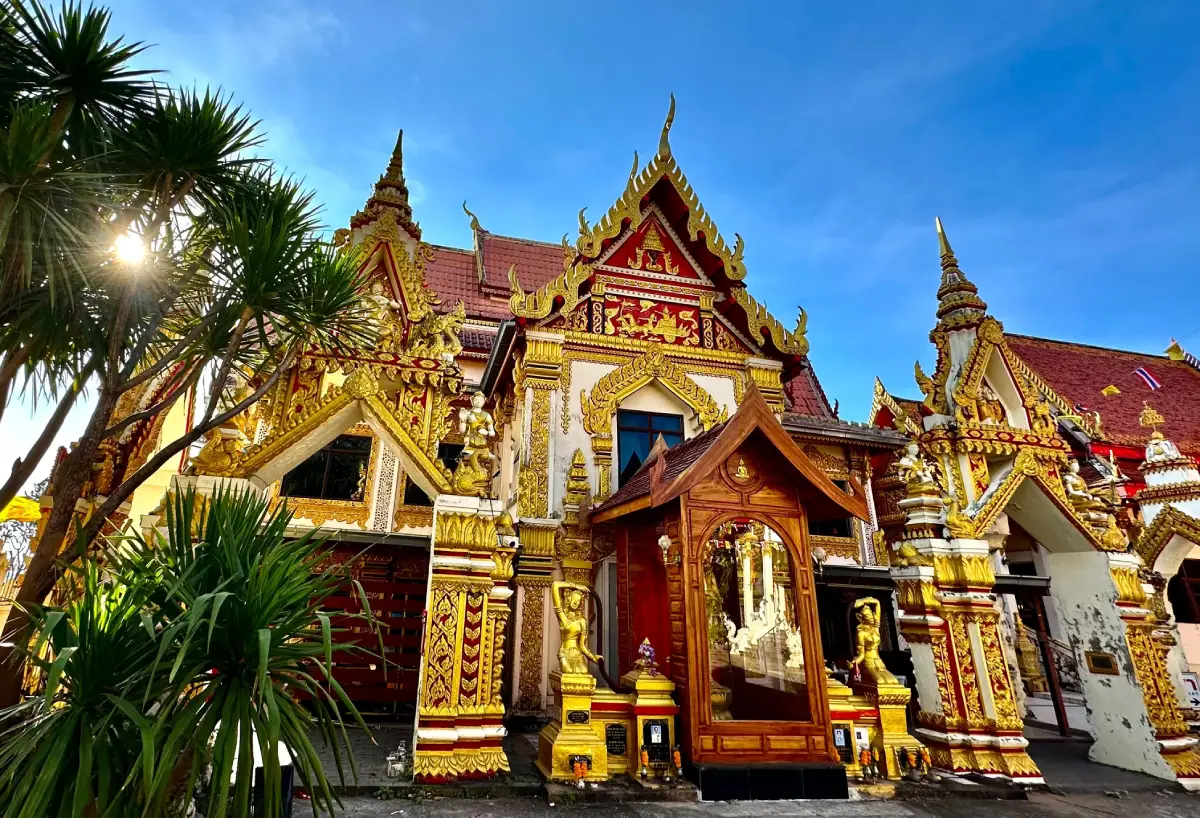
Wat Okat Si Bua Ban
Open Days: Daily
Opening Hours: 09.00 – 20.00
Admission Fee: Free admission
Wat Okat Si Bua Ban in Nakhon Phanom is one of the oldest and most important Buddhist temples in the provincial capital. It stands at 552 Sunthon Wichit Road in Nai Mueang Subdistrict, beside the Mekong River and within walking distance of Nakhon Phanom Walking Street, the Vietnamese Memorial Clock Tower, the Indochina Market, and the tourist-boat pier. The temple’s principal treasures are Phra Tio and Phra Thiam, two revered Lan Xang-style Buddha images enshrined together in a central shrine. Phra Tio is carved from tio wood and covered with gold, measuring approximately 30 centimetres across the lap and 60 centimetres high. An inscription records its creation in 785 CE, corresponding to 1328 BE. Phra Thiam closely resembles it in form and size and, according to local tradition, was created during the reign of King Khattiyawongsa. Other important features include Buddhist murals, an old sermon hall decorated with 56 stucco scenes from the Chinese classic Romance of the Three Kingdoms, numerous khong gateways, ancestral reliquary monuments, the Chao Pho Muen shrine, and ceremonial areas used by the local community.
The temple’s position beside the Mekong has shaped its role throughout its history. The road in front of the compound connects with the waterfront promenade, old commercial districts, markets, and river transport. In earlier centuries, the Mekong served simultaneously as a transport route, a trading corridor, and a channel of cultural exchange among Thai, Lao, Vietnamese, and Chinese communities. Wat Okat Si Bua Ban therefore developed as more than a place for Buddhist ceremonies. It became a centre of shared memory in a border city where people from several cultural backgrounds established homes and maintained connections across the river.
Modern visitors can immediately observe the relationship between sacred space and urban life. Outside the temple are shops, hotels, historic buildings, restaurants, and the riverside promenade. Inside the compound, however, the atmosphere remains calm and is organised around Buddha images, ceremonial structures, and architecture from several periods. The contrast between the active city outside and the quieter temple grounds makes Wat Okat Si Bua Ban suitable for worship, historical study, art appreciation, and a peaceful pause while exploring central Nakhon Phanom.
The temple was founded in 1451 CE, corresponding to 1994 BE, giving it a documented history of more than 570 years. Local residents originally called it Wat Si Bua Ban, while some historical accounts refer to it as Wat Phra Si Bua Ban Phra Chao Tio, a name emphasising its association with the revered Phra Tio image. The monastery later acquired the name Wat Okat while retaining Si Bua Ban as a connection with its earlier identity. The complete name Wat Okat Si Bua Ban therefore preserves several stages in the temple’s history.
The phrase Si Bua Ban evokes an auspicious lotus in full bloom. In Buddhist symbolism, the lotus represents the development of a mind that rises above defilement, just as the flower emerges clean above muddy water. The word Okat has been understood locally as referring to a fortunate place or an opportunity to create merit. Together, the name suggests purity, spiritual development, and the temple’s function as a place where the community gathers to perform beneficial actions.
Historical records state that the temple received its formal monastic boundary in 1738 CE, corresponding to 2281 BE. This recognition permitted formal Sangha ceremonies to be conducted in the ordination hall. The same period is associated with renovation, the construction of important religious buildings, and the transfer of revered Buddha images to the temple. Local accounts mention a ruler or royal son named Phromma who supported the ordination hall and the principal image. These developments transformed Wat Si Bua Ban into an important urban monastery and prepared the foundation for its later role as Wat Okat Si Bua Ban.
The temple belongs to the Maha Nikaya order and remains an active monastery with resident monks, daily chanting, Buddhist ceremonies, education, and community activities. Its current abbot is Phra Khru Si Pariyattikan, Arun Thitametho, a sixth-level Pali scholar with a doctoral qualification. He also serves as the ecclesiastical chief of Mueang Nakhon Phanom District. His responsibilities include temple administration, Buddhist education, coordination among local monasteries, and the organisation of ceremonies serving communities throughout the district.
The spiritual centre of the temple is the shrine containing Phra Tio and Phra Thiam. When viewed from the front of the shrine, Phra Tio is positioned to the right of Phra Thiam. The images are worshipped together and are normally referred to as a pair, Phra Tio–Phra Thiam. Although their histories and methods of construction differ, generations of devotion have united them as a single symbol of stability, protection, and the identity of Nakhon Phanom.
Phra Tio is represented in the diamond-form Mara-Vijaya posture, generally described as the posture of subduing Mara. The Buddha sits in meditation with the right hand resting over the knee and pointing toward the ground, recalling the moment when the earth was invoked as witness to the accumulated merit that defeated Mara’s armies. The posture represents determination, mental stability, and victory over defilement. It encourages worshippers to overcome greed, anger, delusion, and carelessness rather than interpreting victory only as success over external opponents.
The image is carved from tio wood and covered with gold. It measures approximately 30 centimetres across the lap and about 60 centimetres in height. Although relatively small, its proportions and finish give it a dignified presence. The use of wood reflects the knowledge of Mekong craftsmen who understood how to select timber and prepare it for religious carving. Gold covering increased the visual splendour of the image and marked its exceptional status within the community. Under the controlled light of the shrine, the gold surface gives the Buddha image a luminous appearance.
An inscription on Phra Tio records the year 785 CE, or 1328 BE. According to this date, the image is more than 1,200 years old and predates the establishment of Wat Okat Si Bua Ban by several centuries. This indicates that the Buddha image was probably enshrined at other sacred sites before being transferred to the present temple. The relocation of important images was common in Mekong history because cities, political centres, settlements, and religious institutions changed over time.
Local tradition attributes the creation of Phra Tio to a ruler of the ancient city of Si Khotrabun. Si Khotrabun is a major name in the cultural history of the central Mekong region and is associated with territories around present-day Nakhon Phanom and Khammouane Province in Laos. Its cultural domain was not limited by modern national borders. Communities on both sides of the river shared languages, religious traditions, artistic styles, and family connections. Phra Tio therefore links Nakhon Phanom with the wider heritage of Si Khotrabun and the Lan Xang cultural world.
A traditional story explains how the image received its name. A ruler wished to move a large takhian log for boat construction. Smaller tio logs were placed underneath as rollers, but one piece repeatedly slipped or sprang out from beneath the heavy timber. The movement produced a sound remembered as “tio, tio.” The unusual event was interpreted as a sign, and the piece of tio wood was selected for carving into a Buddha image. The completed image became known as Phra Tio after the wood from which it was made.
The legend is valuable not only as a supernatural story but also as a record of community life. Boat construction required large timber, collective labour, and knowledge of transporting heavy materials. Carving a Buddha image required a specialist familiar with wood, religious proportions, and finishing techniques. The story therefore combines river transport, boat building, woodworking, and Buddhist devotion. Phra Tio represents both a sacred image and the material culture of people whose lives depended on the Mekong.
Phra Thiam closely resembles Phra Tio and is enshrined beside it. The Thai word thiam means to equal, imitate, or create a counterpart. According to local tradition, a fire occurred during the reign of King Khattiyawongsa at the place where Phra Tio was kept. Because the original image was believed to have been destroyed, craftsmen were ordered to make a replacement matching its appearance and dimensions as closely as possible.
The story continues that the original Phra Tio was later recovered from the Mekong River or an area near the water. It was returned and enshrined beside the newly created image. The replacement consequently became known as Phra Thiam because it had been made as an equivalent of the original. The narrative of disappearance and return gives the paired installation a deeper meaning involving loss, preservation, recovery, and the community’s refusal to allow an important religious inheritance to vanish.
Although the two images appear similar, their materials and surface treatment are not identical. Phra Tio is made of tio wood with gold covering, while Phra Thiam follows the regional practice of applying lacquer and gold to a carved wooden image. Their side-by-side installation allows students of art to compare proportions, facial features, crowns, bases, and finishing methods. Visitors must not touch either image or its base because oils and moisture from human hands can damage old lacquer, gold, and timber.
Phra Tio and Phra Thiam are recognised as guardian Buddha images of Nakhon Phanom. The term does not need to imply protection without human responsibility. The images function as a shared focus that reminds rulers, residents, and communities to uphold compassion, honesty, cooperation, and social duty. A peaceful city depends both on religious aspiration and on the responsible conduct of the people who live in it.
Worshippers should remove their shoes before entering the shrine, dress respectfully, and speak quietly. Flowers, incense, candles, or donations may be offered only in the places designated by the temple. Visitors may recite the traditional homage three times and reflect on the Buddha, Dhamma, and Sangha. Personal aspirations are most meaningful when directed toward wisdom, emotional strength, ethical conduct, and the determination to fulfil one’s responsibilities. Worshippers should not crowd others or place offerings directly on historic surfaces.
The principal annual ceremony associated with the pair is the bathing of Phra Tio and Phra Thiam. It is held around the full moon of the sixth lunar month, generally corresponding with Visakha Bucha, according to the programme announced each year. The Buddha images are ceremonially placed on palanquins or an ornamental platform and carried through parts of the town so residents can pay respect. They are then installed in a designated ceremonial area where the public participates in bathing according to procedures arranged by the temple.
The bathing ceremony has both Buddhist and community meaning. Bathing a Buddha image expresses reverence, spiritual cleansing, and the intention to begin a new seasonal cycle with goodwill. Local belief also connects the ritual with fertility and timely rainfall because communities of the Mekong basin depend on water for agriculture, fishing, and daily life. Offering water to the Buddha images therefore symbolises gratitude for the natural environment and a communal wish for seasonal balance.
Participants should use water prepared by the temple, pour only a moderate amount, and follow the specified route. Historic wooden images cannot be treated like modern statues. Timber, lacquer, gold leaf, and decorative layers can deteriorate through repeated exposure to moisture. The temple may therefore use a replica or a controlled method that protects the originals. Visitors must follow instructions and should never pour water directly onto the historic images without authorisation.
Another major tradition is Bun Samha Mueang, held during the seventh lunar month. Samha means cleansing or purification. The ceremony is intended to promote order, wellbeing, and harmony in the city. Activities include Buddhist chanting, offerings, merit-making for guardian spirits and ancestors, and ceremonies at the Chao Pho Muen shrine or other places connected with the city’s protective traditions. Participation expresses community solidarity and a shared intention to begin a new period positively.
Bun Samha Mueang clearly demonstrates the relationship between Buddhism and local belief. Monks lead chanting and teach Buddhist principles, while residents prepare ceremonial objects, clean the area, remember ancestors, and pay respect to local guardians. This combination does not necessarily weaken Buddhist practice. Instead, it shows how a community connects compassion, merit-making, social cooperation, ancestral memory, and the identity of its home territory.
During Songkran, the area around Wat Okat Si Bua Ban and the Mekong riverfront becomes part of wider municipal activities. Residents make merit, pay respect to elders, and take part in cultural events before walking toward the clock tower, market streets, and riverfront plazas. The temple links religious observance with the public festival. Travellers visiting during major events should allow extra time and should not park where they might block processions or community access.
Beyond Phra Tio and Phra Thiam, the ordination hall is important for its architecture and murals. It contains the principal Buddha image and paintings of the Buddha’s life, Jataka stories, and related Buddhist narratives. Such murals historically served as visual teaching material. People who could not read complex religious texts could learn through sequences of figures, buildings, landscapes, and events painted on the walls.
The beams and upper wall areas contain images of celestial beings in glass pavilions. The ceiling has a red ground decorated with gold stars, while the columns carry colourful krajang patterns. Red and gold create a formal and sacred atmosphere associated with heavenly realms. The krajang ornament divides surfaces and gives rhythm to the interior. Visitors should examine the complete decorative scheme from a distance before moving closer to study individual details.
The murals are not simply decoration. They preserve information about the ideas, taste, and technical ability of the artists who created or restored them. Clothing, architecture, utensils, and landscapes may reflect the society familiar to the painters. Even when the subject is a Buddhist narrative, artists often insert elements from their own environment, turning religious paintings into valuable records of social and cultural history.
Shoes must be removed before entering the ordination hall. Mobile phones should be silenced, and visitors should avoid pointing their feet toward the principal image or monks. Flash photography must not be used because repeated exposure to strong light can accelerate colour deterioration. The walls must not be touched, bags should not be leaned against paintings, and offerings should never be moved to improve a photograph. When a ceremony is taking place, visitors should wait outside or participate quietly.
Another exceptional structure is the old two-storey sermon hall, a reinforced-concrete building approaching 90 years of age. Its walls contain 56 low- and high-relief stucco scenes from the Chinese classic Romance of the Three Kingdoms. The reliefs are associated with Vietnamese craftsmen who lived and worked in Nakhon Phanom. They depict characters, military campaigns, negotiations, loyalty, strategy, and moral choices, making the building unlike an ordinary Thai temple sermon hall.
The presence of Three Kingdoms imagery in a Buddhist temple reflects Nakhon Phanom’s multicultural history. Thai, Lao, Vietnamese, and Chinese communities lived together in the city. Vietnamese craftsmen encountered Chinese narratives through their own cultural environment and reproduced them in a Thai Buddhist setting. The reliefs are therefore the result of several layers of exchange and cannot be confined to a single national tradition. Preserving the building is important to the history of religion, craftsmanship, migration, and cultural interaction.
Romance of the Three Kingdoms addresses power, loyalty, strategy, gratitude, ambition, and the consequences of difficult decisions. Although it is not a Buddhist scripture, its stories can be interpreted as moral lessons. Some characters demonstrate loyalty and sacrifice, while others suffer because of uncontrolled ambition or misuse of authority. Displaying these narratives in a sermon hall allowed the community to consider ethical conduct through literature widely known across East and Southeast Asia.
The old sermon hall and its reliefs are not continuously open as an independent exhibition. Visitors who wish to study the images should contact the temple in advance, particularly educational groups, researchers, or professional photographers. Coordination prevents entry during ceremonies or maintenance and makes it possible for a caretaker to explain the narrative sequence and the significance of individual scenes.
The temple is also distinguished by numerous khong gateways positioned around the compound and ordination-hall area. Approximately 11 gateways have been recorded. They mark boundaries, create formal approaches to sacred spaces, and enrich the visual identity of the temple. Their forms include tower-like tops, stucco ornament, deities, naga figures, and mythological animals. Walking between the gates reveals differences in design and craftsmanship from various periods.
One western gateway contains figures of Virupaksha and naga guardians. Some residents informally call it the ghost gate because of its proximity to a route once associated with funeral movement. In Buddhist iconography, however, Virupaksha is one of the Four Great Kings, guardian of the western direction and lord of the nagas. The gate therefore symbolises protection of sacred territory rather than a frightening supernatural entrance.
Understanding the gateway correctly prevents interpretation based only on a popular nickname. Guardian figures, giants, devas, and nagas in Buddhist architecture do not automatically represent evil. Their placement, direction, and associated symbols usually explain their protective function. Careful interpretation helps visitors appreciate the art and reduces the spread of misleading stories online.
Small reliquary stupas containing the ashes of local ancestors stand around the ordination hall in a formation resembling an enclosure. Because the temple occupies a limited urban site, these monuments serve both as family memorials and as a boundary around the sacred building. They demonstrate that the monastery belongs not only to monks but also to local families who entrust ancestral memory to the temple and return regularly to dedicate merit.
Visitors should move carefully around the reliquary monuments. They must not lean on them, open them, place bags on them, or climb them for photographs. When a family is performing a private merit-making ceremony, photography should be avoided unless permission is given. Although the monuments stand in a public temple, they preserve personal and family memory and deserve respectful treatment.
The temple also contains the Chao Pho Muen shrine, associated with local beliefs concerning the protection of the city and the memory of community ancestors. The shrine is involved in Bun Samha Mueang and other ceremonies intended to promote communal wellbeing. Visitors should make offerings only in designated areas and must not attach cloth, incense, candles, or personal objects to trees and architecture without permission.
Phra Chao Sela, sometimes called Luang Pho Sila, is another important Buddha image connected with the temple. Its name suggests stone and permanence. Although Phra Tio and Phra Thiam attract the greatest attention, visiting the principal image and other sacred objects provides a more complete understanding of the monastery’s development through several historical periods.
For practical orientation, the principal areas include the Phra Tio–Phra Thiam shrine, the ordination hall and murals, the old sermon hall with the Three Kingdoms reliefs, the khong gateways, the ancestral reliquary monuments, the Chao Pho Muen shrine, ceremonial courtyards, and the monastic residential area. These are not commercial tourist zones. Religious functions, the privacy of resident monks, and restrictions protecting old buildings must always take priority.
A suitable route begins at the central shrine with worship of Phra Tio and Phra Thiam. Visitors can then enter the ordination hall to pay respect to the principal Buddha and examine the murals, continue around the khong gateways and ancestral monuments, and visit the Chao Pho Muen shrine and ceremonial area. When access has been arranged in advance, the old sermon hall and its Three Kingdoms reliefs should be visited at the end. This sequence moves from the central focus of devotion to art and community history.
The period from approximately 09.00 to 11.00 is suitable for entering buildings because temperatures are lower and natural light reveals the gold and wooden surfaces of the Buddha images. Late afternoon from around 16.00 to 18.00 is convenient for worship followed by a walk to the clock tower, walking street, and Mekong promenade. Although the general compound remains accessible into the evening, individual buildings may close according to temple activities and caretaker availability.
Photography should rely on natural light, especially inside the shrine, ordination hall, and historic structures. From the central courtyard, visitors can photograph the shrine and gateway together. Views from the street show the relationship between temple and town. Tripods must not obstruct walkways, drones require prior permission, and monks or people participating in ceremonies should not be photographed at close range without consent.
The cool season from November to February is generally the most comfortable period for exploring central Nakhon Phanom. Mornings and evenings are mild, and breezes from the Mekong create a pleasant atmosphere around the temple. During the hot season from March to May, early morning or late afternoon visits are preferable, and drinking water is useful. During the rainy season, sudden showers are possible, and tiled surfaces or steps of older buildings can become slippery.
Clothing should cover the shoulders and knees. Very sheer or excessively tight clothing should be avoided. Shoes must be removed before entering buildings containing Buddha images. Mobile phones should be silenced, and visitors should not point their feet toward Buddha images or monks. Women should not touch monks or hand objects directly to them; offerings should be placed on a receiving cloth or passed through a male assistant.
No admission fee is charged. Visitors may make voluntary donations for temple maintenance and conservation through clearly marked donation boxes or official channels. Money should not be handed to individuals who cannot demonstrate that they represent the temple. Educational groups, researchers, or visitors requesting access to the old sermon hall should contact the temple or abbot in advance.
Facilities include worship areas, donation points, toilets, shaded resting spaces, and limited parking. Because the temple occupies a compact site in the historic urban district, parking becomes restricted on Buddhist observance days, weekends, and during festivals. Travellers staying near the walking street are encouraged to walk, while drivers should park only in authorised areas and must not obstruct neighbouring houses or businesses.
Families can use the temple to teach children about wooden Buddha images, urban legends, mural painting, and multicultural history. Children should not run close to sacred images, touch reliefs, or climb memorial structures. Older visitors should take breaks and watch for changes in floor level. Wheelchair users can access several exterior courtyard areas, although raised buildings and old stairways may require assistance.
Getting There from central Nakhon Phanom is straightforward. Follow Sunthon Wichit Road along the Mekong River. The temple is beside the old commercial district near the Vietnamese Memorial Clock Tower, Walking Street, and Indochina Market. Visitors staying nearby can walk in a few minutes. Bicycles, local three-wheeled vehicles, hired transport, motorcycles, and private cars can all reach the road in front of the temple. Digital-map users should enter the full name “Wat Okat Si Bua Ban Nakhon Phanom.”
Nakhon Phanom Airport is approximately 17–19 kilometres away by road, with a normal journey time of around 25–30 minutes. Rental cars, hotel transfers, and hired transport are available. Nakhon Phanom Bus Terminal is about 4 kilometres from the temple and is connected by local transport. Travellers carrying large luggage should leave it at their accommodation because the temple does not provide tourist baggage storage.
Allow approximately 1–2 hours to worship at the paired shrine, see the ordination hall, examine the gateways, and explore the historic areas. Additional time is required when access to the old sermon hall has been arranged. Visitors with a strong interest in art can spend half a day combining the temple with the Vietnamese Memorial Clock Tower, Walking Street, Indochina Market, and the Mekong waterfront.
The tourist-boat pier and Mekong promenade are approximately 0.1–0.2 kilometres away. Visitors can enjoy river views, see the Lao bank, and relax after worship. Nakhon Phanom Walking Street and the Vietnamese Memorial Clock Tower are about 0.2 kilometres away. The surrounding neighbourhood contains old buildings, cafés, restaurants, souvenirs, and market activities on designated days, making it particularly attractive in the late afternoon and evening.
The Phaya Si Sattanakharat Monument is approximately 0.3 kilometres away. Its large brass naga sculpture has become a contemporary symbol of Nakhon Phanom. Combining the temple with the naga plaza introduces two major forms of Mekong belief: devotion to guardian Buddha images and respect for the naga as a symbolic protector of the river.
Wat Mahathat and Phra That Nakhon are approximately 1.3 kilometres away. Phra That Nakhon is traditionally associated with people born on Saturday and also stands near the Mekong. Visitors can walk, cycle, or take a local vehicle between the two temples. Wat Phra In Plaeng is about 1.6 kilometres away, while the former governor’s residence is around 1.8 kilometres away, allowing all of them to form part of an urban heritage route.
Saint Anna Nong Saeng Church is approximately 2.5 kilometres from the temple. Its Catholic architecture is associated with Nakhon Phanom’s Vietnamese Christian community. Visiting a Buddhist temple, local guardian shrine, Vietnamese memorial, and Catholic church within the same city route reveals the long history of coexistence among different religious and ethnic communities along the Mekong.
Nearby restaurants offer local breakfast, Vietnamese cuisine, Isan food, Thai dishes, and riverside dining. Café Le Landmark is very close to the temple and is convenient for coffee or a light meal. Kloem serves Thai food in the central district. Pornthep Breakfast is known for pan-fried eggs, tom sen noodle soup, and Vietnamese-style rice noodle soup. Nang Naem Nueang specialises in Vietnamese food, while Sabaidee @ Nakhon Phanom and View Khong are suitable for meals in a riverside atmosphere.
Accommodation is available in several styles. Landmark Nakhonphanom Hotel stands very close to the temple and is convenient for the clock tower and walking street. Chic-Chidkong is a small riverside boutique property. The Square Hotel and Porpiang Hotel are within walking distance. Fortune Viewkhong and Fortune River View suit travellers seeking larger hotels and Mekong views. Staying in this district reduces parking difficulties and makes early-morning or evening temple visits easy.
Conservation of Phra Tio and Phra Thiam requires control of humidity, temperature, insects, light, and physical contact. Their wooden cores, lacquer, gold leaf, and decorative surfaces are vulnerable to deterioration. The temple must monitor the shrine environment and carefully manage bathing ceremonies or movement of the images. Visitors help by avoiding touch, flash photography, and placement of objects near the statues.
The old buildings and Three Kingdoms reliefs are affected by river humidity, dust, traffic vibration, and deterioration of concrete and plaster. Climbing, touching, or leaning on the walls can break small details. Even when a relief appears strong, visitors should keep a safe distance. Publishing accurate photographs with the correct building name and explanation can increase public appreciation and support for conservation.
Wat Okat Si Bua Ban is valuable to historians because it connects Si Khotrabun, Lan Xang, Nakhon Phanom, and Mekong communities. It is valuable to art historians for its wooden Buddha images, murals, relief sculpture, and gateways. It is valuable to anthropologists for the bathing ceremony, Bun Samha Mueang, and the ancestral memorials surrounding the ordination hall. Most importantly, it remains an active community institution rather than a museum separated from everyday life.
The status of Phra Tio and Phra Thiam as guardian images does not arise from age or material alone. It results from generations of worship, storytelling, ceremonial practice, and conservation. The pair connects past and present, history and belief, and religious space with the city. A thoughtful visit therefore reveals more than an opportunity to request blessings; it demonstrates how a community creates and maintains shared meaning.
Before leaving, visitors may sit quietly and reflect on the meaning of the Mara-Vijaya posture. The Buddha defeated Mara through accumulated virtue and awareness rather than anger or physical force. Phra Tio and Phra Thiam can therefore remind people to confront difficulty with reason, patience, and ethical conduct. Merit-making becomes more meaningful when it is followed by constructive action outside the temple.
Wat Okat Si Bua Ban deserves at least 1–2 hours rather than a brief photographic stop. Beyond Phra Tio and Phra Thiam, the compound preserves the history of a centuries-old monastery, Buddhist murals, the remarkable Three Kingdoms reliefs, khong gateways, local guardian traditions, and ceremonies still practised by the community. Travellers who move respectfully and examine these details will gain a deeper understanding of Nakhon Phanom through one of its most meaningful historic temples.
| Name | Wat Okat Si Bua Ban, Nakhon Phanom |
| Former Name | Wat Si Bua Ban; historical tradition also uses the name Wat Phra Si Bua Ban Phra Chao Tio |
| Location | Beside the Mekong River near Nakhon Phanom Walking Street, the Vietnamese Memorial Clock Tower, and the Indochina Market |
| Address | 552 Sunthon Wichit Road, Nai Mueang Subdistrict, Mueang Nakhon Phanom District, Nakhon Phanom 48000, Thailand |
| Coordinates | 17.401997, 104.788697 |
| Monastic Order | Maha Nikaya |
| History | Founded in 1451 CE, corresponding to 1994 BE, and granted a formal monastic boundary in 1738 CE. It is one of the historic guardian temples of Nakhon Phanom. |
| Highlights | Phra Tio and Phra Thiam, Buddhist murals, 56 Three Kingdoms stucco reliefs in the old sermon hall, and multiple khong gateways |
| Phra Tio | A wooden Buddha image in the Mara-Vijaya posture, carved from tio wood and covered with gold. It measures approximately 30 cm across the lap and 60 cm high and bears an inscription dated 785 CE, corresponding to 1328 BE. |
| Phra Thiam | A Buddha image closely resembling Phra Tio. According to local tradition, it was created during the reign of King Khattiyawongsa as a replacement when Phra Tio was believed to have been lost, before both images were enshrined together. |
| Religious Significance | Phra Tio and Phra Thiam are revered as guardian Buddha images and major spiritual symbols of Nakhon Phanom. |
| Abbot | Phra Khru Si Pariyattikan (Arun Thitametho, Pali Level 6), Ph.D., Ecclesiastical Chief of Mueang Nakhon Phanom District |
| Important Traditions | 1. Procession and bathing ceremony for Phra Tio and Phra Thiam around the full moon of the sixth lunar month or Visakha Bucha 2. Bun Samha Mueang during the seventh lunar month 3. Songkran and major Buddhist observance-day activities |
| Main Areas / Zones | 1. Phra Tio–Phra Thiam shrine 2. Ordination hall and Buddhist murals 3. Old sermon hall with 56 Three Kingdoms reliefs 4. Khong and Brahma gateways 5. Ancestral reliquary monuments around the ordination hall 6. Chao Pho Muen shrine 7. Ceremonial courtyard and monastic area |
| Important Art | Lan Xang wooden Buddha images, Jataka and Buddhist murals, red ceiling with gold stars, celestial figures in glass pavilions, krajang ornament, and Three Kingdoms reliefs by Vietnamese craftsmen |
| Old Sermon Hall Access | Advance coordination with the temple is required, particularly for educational groups, detailed viewing of the reliefs, and academic photography. |
| Travel Information | Follow Sunthon Wichit Road along the Mekong. The temple is near the Vietnamese Memorial Clock Tower, Walking Street, and Indochina Market and is accessible on foot, by bicycle, local three-wheeled vehicle, hired transport, or private car. |
| Open Days | Daily |
| Opening Hours | 09.00 – 20.00; individual buildings open according to temple activities and caretaker availability |
| Admission Fee | Free admission; voluntary donations are accepted. |
| Facilities | Worship areas, donation points, toilets, shaded resting areas, and limited parking |
| Current Status | An active Buddhist monastery with resident monks and continuing community ceremonies |
| Main Contact Number | 081-873-2909 |
| Nearby Tourist Attractions | 1. Mekong Tourist-Boat Pier, about 0.1 km 2. Nakhon Phanom Walking Street and Indochina Market, about 0.2 km 3. Vietnamese Memorial Clock Tower, about 0.2 km 4. Mekong Promenade and City Embankment, about 0.2 km 5. Phaya Si Sattanakharat Monument, about 0.3 km 6. Nakhon Phanom National Library, about 1.2 km 7. Wat Mahathat and Phra That Nakhon, about 1.3 km 8. Wat Phra In Plaeng, about 1.6 km 9. Former Nakhon Phanom Governor’s Residence, about 1.8 km 10. Saint Anna Nong Saeng Church, about 2.5 km |
| Nearby Restaurants | 1. Café Le Landmark, about 0.1 km, Tel. 091-006-8246 2. Kloem Restaurant, about 0.8 km, Tel. 042-512-470 3. Pornthep Breakfast, Branch 1, about 1 km, Tel. 093-546-1596, 088-340-4562 4. Nang Naem Nueang, about 1.3 km, Tel. 042-512-424 5. Sabaidee @ Nakhon Phanom, about 1.5 km, Tel. 042-064-200 6. View Khong Restaurant at Fortune Viewkhong Hotel, about 1.8 km, Tel. 042-513-564, 083-989-1465 |
| Nearby Accommodations | 1. Landmark Nakhonphanom Hotel, about 0.1 km, Tel. 091-740-3001 2. Chic-Chidkong Boutique Hotel, about 0.2 km, Tel. 088-969-4265 3. The Square Hotel Nakhon Phanom, about 0.3 km, Tel. 081-261-1011, 042-511-888 4. Porpiang Hotel, about 0.5 km 5. The Nest Hotel Nakhon Phanom, about 1.7 km 6. Fortune Viewkhong Nakhon Phanom, about 1.8 km, Tel. 042-513-564, 083-989-1465 7. Fortune River View Nakhon Phanom, about 2.2 km, Tel. 042-522-334 |
Frequently Asked Questions (FAQ)
Q: Where is Wat Okat Si Bua Ban located?
A: The temple is at 552 Sunthon Wichit Road, Nai Mueang Subdistrict, Mueang Nakhon Phanom District, beside the Mekong River and close to Walking Street, the Vietnamese Memorial Clock Tower, and the Indochina Market.
Q: What are the opening hours, and is there an admission fee?
A: The temple is open daily from 09.00 to 20.00. Admission is free, while some historic buildings and display areas open according to temple activities and caretaker availability.
Q: What are the characteristics and significance of Phra Tio?
A: Phra Tio is a wooden Buddha image in the Mara-Vijaya posture, carved from tio wood and covered with gold. It measures approximately 30 centimetres across the lap and 60 centimetres high, bears an inscription dated 785 CE, and is revered as a guardian image of Nakhon Phanom.
Q: Why was Phra Thiam created?
A: According to local tradition, Phra Thiam was created during the reign of King Khattiyawongsa as a replacement when Phra Tio was believed to have been lost in a fire. After the original image was recovered, both were enshrined together.
Q: When is the Phra Tio–Phra Thiam bathing ceremony held?
A: The ceremony is held around the full moon of the sixth lunar month or Visakha Bucha, according to the annual temple programme. The images are carried in procession and the public participates in a controlled bathing ritual.
Q: Where are the Three Kingdoms stucco reliefs?
A: The 56 Three Kingdoms reliefs decorate the old two-storey sermon hall. Visitors should contact the temple in advance because the building is not continuously open as an independent exhibition.
Q: How much time should visitors allow at Wat Okat Si Bua Ban?
A: Allow approximately 1–2 hours to worship at the paired shrine, see the ordination hall and murals, and explore the gateways and historic areas. Additional time is required for a pre-arranged visit to the old sermon hall.
Q: Which attractions can be combined with the temple visit?
A: Visitors can walk to the tourist-boat pier, Walking Street, Vietnamese Memorial Clock Tower, Indochina Market, Phaya Si Sattanakharat Monument, and Mekong promenade, or continue to Wat Mahathat, the former governor’s residence, and Saint Anna Nong Saeng Church.
 Category: ●Places of Worship
 Group: ●Temple
Last Update : 4 MonthAgo
 Last Update : 4 MonthAgo

 Click to Access the Navigation Map GPS
Wat Okat Si Bua Ban Map
Recommend

 Art, Culture and Heritage
 Historical Sites and Monuments(3)
 Landmarks and Memorials(3)
 Art, Craft Centres, Tradition(3)
 Museums(3)
 Educational Places
 Library(1)
 University
 Public university(2)
Temple(23)
 Church(1)
 Other Sacred Sites(11)
 Suburban Living
 Village, Community(5)
 Nature and Wildlife
 National Parks and Marine Reserves(1)
 Dam, Reservoir, Lake(5)
 Waterfalls(2)
 Caves(1)
 River, Canal(3)
 Bays and Beaches(3)
 Other natural attractions(2)
 Entertainment and Agricultural
 Zoos and Aquariums(1)
 Farms, Parks and Ecotourism(2)
 Shopping
 Shopping and Night Market(1)
 Travel Articles, Recipes
 Travel Review, Food Review(1)


