
lovethailand home >Northeastern Travel Attractions >Nakhon Phanom Travel Attractions >Muang Nakhon Phanom >Nai Muang > Wat Si Thep Pradittharam
TL;DR: Wat Si Thep Pradittharam is located at Si Thep Road, opposite Municipal Community School 3, central Nakhon Phanom, open Daily, hours 08.00 – 17.00.
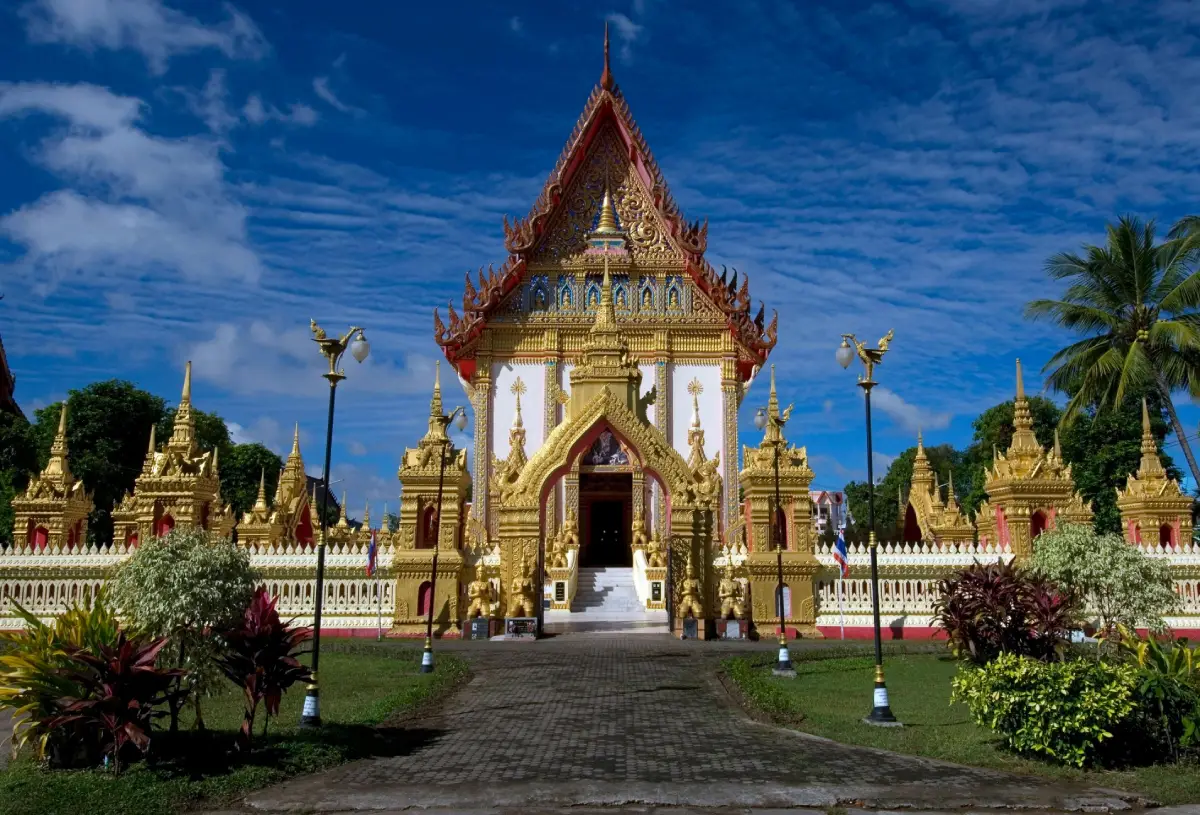
Wat Si Thep Pradittharam
Open Days: Daily
Opening Hours: 08.00 – 17.00
Wat Si Thep Pradittharam in Nakhon Phanom is a historic Dhammayut Buddhist temple at 386 Si Thep Road, Nai Mueang Subdistrict, Mueang Nakhon Phanom District. Located opposite Municipal Community School 3, the temple was founded in 1859 by the city ruler Thongthip Mangkhalakhiri. Originally known as Wat Si Khun Mueang, it later became abandoned before being restored by Luang Pu Chan Khemiyo, formally known as Phra Thep Sitthachan. Major attractions include Phra Saeng, an important Lan Xang-style Buddha image, Buddhist murals inside the ordination hall, elaborate exterior stucco, Luang Pu Chan’s reliquary stupa, a museum preserving his personal objects and biography, and a historic building constructed in 1921 that received an architectural conservation award from the Association of Siamese Architects under Royal Patronage.
Wat Si Thep Pradittharam is one of the most informative places for understanding the history of Nakhon Phanom. Within a single temple compound, visitors encounter the foundation of an old urban community, the revival of an abandoned monastery, the establishment of the Dhammayut order in the province, the development of modern religious and secular education, Lan Xang Buddhist art, murals depicting the life of the Buddha, the meditation tradition associated with Ajahn Sao Kantasilo, and buildings representing several periods of architectural development. The temple can be visited for worship, cultural learning, art appreciation, and a deeper understanding of Nakhon Phanom beyond its better-known Mekong riverfront landmarks.
The temple stands on Si Thep Road within Nakhon Phanom Municipality, a short distance from Sunthon Wichit Road and the Mekong River. The surrounding neighbourhood includes an old residential community, schools, local restaurants, shops, and hotels. This urban location makes the temple easier to reach than religious sites outside the provincial capital. Travellers staying in central Nakhon Phanom can arrive on foot, by bicycle, local three-wheeled vehicle, hired transport, motorcycle, or private car.
The temple was founded in 1859 during the reign of King Mongkut, Rama IV. Thongthip Mangkhalakhiri, the ruler of the city, initiated its construction. The original name, Wat Si Khun Mueang, expressed ideas of virtue, auspiciousness, and the wellbeing of the town. During its early period, the monastery served as a spiritual centre for the surrounding community. Changes in the number of resident monks, building maintenance, and local settlement patterns later caused the temple to fall into abandonment.
A major turning point occurred in the early twentieth century when Phraya Sunthon Thepkit Charak, the governor of Nakhon Phanom, decided that the province needed a stable temple belonging to the Dhammayut order. He invited Phra Chan Khemiyo to restore Wat Si Khun Mueang. Luang Pu Chan began working in the area around 1902 and carried out systematic restoration by 1906. Monks returned to reside in the temple, religious education was organised, and the monastery again became an active part of the city.
The restoration was important to the history of Buddhism in Nakhon Phanom because Wat Si Khun Mueang became the province’s first Dhammayut temple. Luang Pu Chan did not limit his work to repairing buildings. He established monastic discipline, organised education, trained monks and novices, and rebuilt relationships between the temple and the local population. When the monastery became firmly established, it was renamed Wat Si Thep Pradittharam.
The name Wat Si Thep Pradittharam conveys the idea of an auspicious monastery created and established through collective effort. It also preserves a connection with Phraya Sunthon Thepkit Charak, who supported the restoration and invited Luang Pu Chan to lead the revived community. The new name did not erase the history of Wat Si Khun Mueang. Instead, the two names represent different stages in the life of the same religious institution.
Luang Pu Chan Khemiyo was born in 1881 in Tha Uthen District, Nakhon Phanom Province. His birth name was Chan Suwannamajo. He entered monastic life at an early age, becoming a novice at the age of 10 on 9 April 1891. During his novice years, he studied traditional scriptures, Khmer script, and Tham script under Phra Ajahn Khen Uttamo. This linguistic and scriptural education later supported his work as a teacher and organiser of religious study.
At the age of 20, he was ordained as a Buddhist monk in 1902 and received the monastic name Khemiyo. He studied meditation with Phra Ajahn Sidat Yanasampanno and later became a disciple of Ajahn Sao Kantasilo, one of the most influential meditation masters in northeastern Thailand. Training within this tradition gave Luang Pu Chan a strong commitment to discipline, mental cultivation, simplicity, and careful observance of the monastic code.
Luang Pu Chan’s contribution to Nakhon Phanom extended beyond meditation practice and temple administration. He is remembered as a pioneer of modern education in both secular and religious fields. The temple provided instruction in Buddhist doctrine, languages, literacy, and practical knowledge during a period when formal schools were not yet widely available. Wat Si Thep Pradittharam therefore functioned as a place of worship, a community school, a centre for training monks and novices, and a place where cultural knowledge was transmitted.
Luang Pu Chan remained in the monkhood for more than 70 years and received progressively higher ecclesiastical titles, eventually becoming Phra Thep Sitthachan. People throughout Nakhon Phanom respected him for his disciplined conduct, knowledge, meditation practice, and public service. He passed away on 2 February 1973 at the age of 92. The strength of public devotion transformed the anniversary of his death into an annual teacher-remembrance ceremony held on 2 February.
On 22 November 1979, a royally sponsored cremation ceremony was held for Phra Thep Sitthachan. King Bhumibol Adulyadej, Rama IX, presided over the presentation of monastic robes before the coffin, while Queen Sirikit placed the ceremonial sandalwood flower. The royal ceremony demonstrated the exceptional respect accorded to Luang Pu Chan and recognised his contribution to Buddhism, education, and the people of Nakhon Phanom.
The current abbot is Phra Si Wisutthinayok, also known as Phra Maha Dom Panyatharo, a ninth-level Pali scholar. He also serves as the Dhammayut ecclesiastical governor of Nakhon Phanom Province. Wat Si Thep Pradittharam continues to host monastic administration, Buddhist education, chanting ceremonies, Kathina activities, remembrance events, and public-benefit programmes. Its present role combines the functions of a neighbourhood temple and a provincial centre for Dhammayut affairs.
The most important Buddha image inside the ordination hall is Phra Saeng, a Lan Xang-style image in the posture of subduing Mara. The image reflects the shared artistic culture of communities throughout the Mekong basin, including northeastern Thailand and Laos. Its peaceful expression, formal seated posture, and Lan Xang proportions give it both religious importance and considerable artistic value.
Local tradition connects Phra Saeng with a group of highly revered Buddha images known as Phra Suk, Phra Soem, and Phra Sai. Phra Sai is enshrined at Wat Pho Chai in Nong Khai Province. Although each image has a different history of movement and enshrinement, the shared legend reflects community memory concerning sacred images, shifting centres of political authority, and cultural connections across the Mekong River.
The name Phra Saeng suggests auspicious light and the illumination of wisdom. Worshippers often pray for clarity, mindfulness, and the ability to make sound decisions. A respectful visit should begin with reflection on the qualities of the Buddha rather than an exclusive focus on material wishes. Visitors may offer flowers, incense, or candles in the areas designated by the temple, make a voluntary donation, and sit quietly without disturbing people who are chanting or meditating.
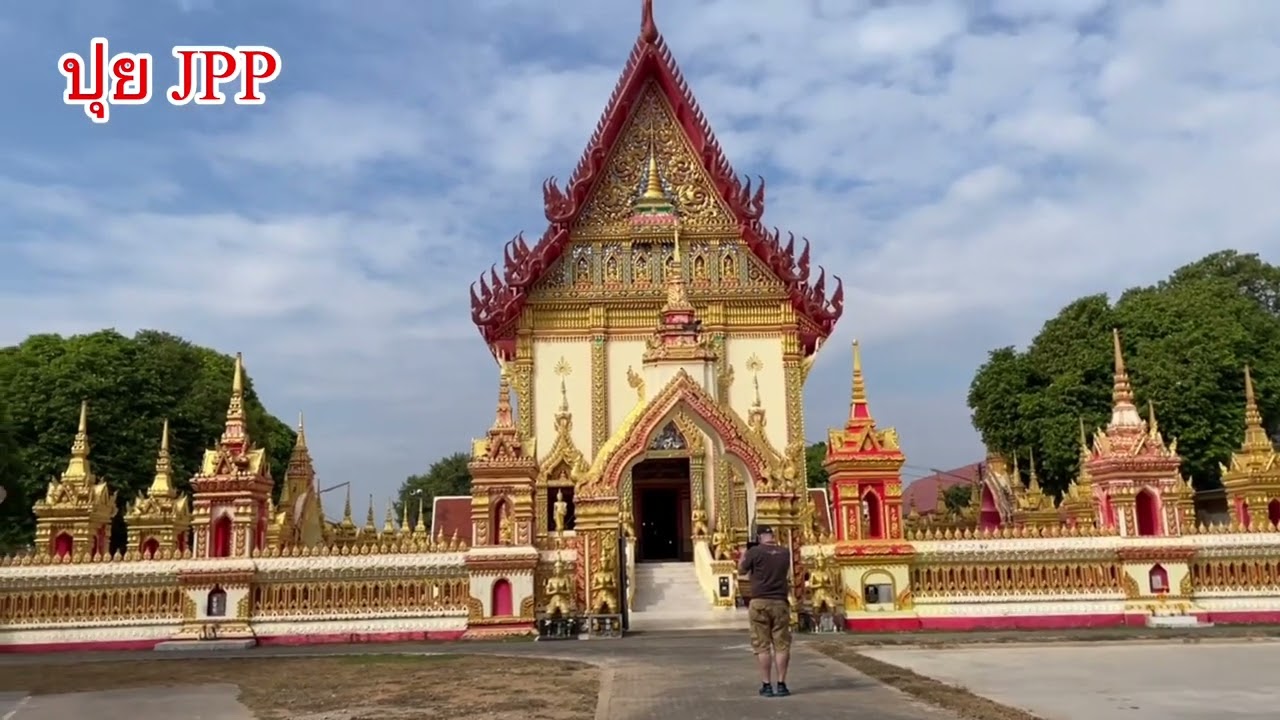
The ordination hall is distinguished by colour, stucco ornament, and architectural features associated with northeastern Thai and Lan Xang traditions. Its entrance, gable, and exterior surfaces are richly composed. Viewed through the curved opening of the temple gateway, the building forms a balanced architectural scene. Numerous thep phanom figures, representing celestial beings with their hands joined in respect, appear in the exterior decoration.
A large high-relief composition on the rear of the ordination hall depicts celestial beings inviting the Bodhisattva from Tusita Heaven to descend and be born in the human world. The subject relates to the future Buddha’s decision to take birth before attaining enlightenment. The figures, jewellery, gestures, and overall composition show how local craftsmen translated Buddhist narratives into architectural sculpture that could be understood visually by worshippers.
The interior murals depicting episodes from the life of the Buddha are another major reason to visit Wat Si Thep Pradittharam. Murals traditionally served as visual teaching material, communicating religious narratives and moral principles to communities in which literacy was not universal. Through figures, costumes, landscapes, buildings, and sequences of events, the paintings transform the walls of the ordination hall into a visual Buddhist text.
Visitors should first observe the complete mural arrangement from a distance before examining individual details, colours, lines, and figures. The walls must not be touched, and flash photography should be avoided. Moisture, oils from human hands, strong light, and physical contact can accelerate deterioration. Maintaining a respectful distance and following temple instructions are essential parts of protecting the paintings.
Beside the ordination hall stands a stupa containing the ashes of Luang Pu Chan Khemiyo. It serves as a memorial to the monk who restored the abandoned temple and laid important foundations for education in Nakhon Phanom. Disciples and local residents come to pay respect, dedicate merit, and reflect on his example. Visitors should speak quietly, avoid climbing or placing objects on the base, and leave clear space for worshippers.
The annual Teacher Remembrance Day is held on 2 February, the anniversary of Luang Pu Chan’s death. Activities include alms-giving, Buddhist chanting, the offering of meals to monks, sermons, and ceremonies dedicating merit to the former abbot. The tradition remains active. On 2 February 2026, the temple held the 53rd anniversary ceremony commemorating Phra Thep Sitthachan, confirming the continuing strength of local devotion.
The Luang Pu Chan Museum was established to preserve his biography, personal objects, and the collective memory of his followers. Construction began in 2005 through the cooperation of the Luang Pu Chan Foundation, the Rotary Club of Nakhon Phanom, local leaders, and Buddhist devotees. The building was completed in late 2006 and formally opened in early 2007. It was designed as a single-storey Thai-inspired concrete hall with marble flooring and required a construction budget of approximately 5.2 million baht.
Inside the museum is a life-size image of Luang Pu Chan on a marble platform, together with an oil portrait, monastic requisites, and objects related to his life. Exhibits include robes, an alms bowl, sandals, a walking stick, betel-chewing equipment, a mother-of-pearl table, ecclesiastical appointment documents, and ceremonial fans from several reigns. These objects help explain monastic life, ecclesiastical administration, and the relationship between the temple and Thai public institutions.
After years of use, the museum developed roof leakage and other structural problems. A major restoration project began in 2023. The roof level was raised, additional upper architectural elements were introduced, and the structure was developed into the Phra Thep Sitthachan Museum Stupa. The renewed design combines colonial-influenced forms with Lan Xang artistic elements, reflecting both the history of Nakhon Phanom and the broader culture of the Mekong region.
On 11 October 2025, the temple held a ceremony to install a golden lotus finial and a nine-tiered ceremonial umbrella on the museum stupa. The main structure rises approximately 37 metres and reaches about 39 metres including the finial. The ceremonial umbrella is approximately 2 metres high and is crowned with a golden lotus created through donations from disciples and members of the public.
The renewed museum area also contains a white-jade Buddha image from Myanmar weighing more than one tonne and measuring 49 inches across the lap. Its form was modelled on Phra Saeng in the ordination hall. A life-size image of Luang Pu Chan is also enshrined in the building. The jade image connects devotion to Phra Saeng with the museum, while the image of Luang Pu Chan provides a focus for remembering his contribution.
The temple also contains a historic building constructed in 1921, during the period when the monastery was developing under Luang Pu Chan’s leadership. It received an architectural conservation award in the category of religious monuments and temples from the Association of Siamese Architects under Royal Patronage. The award recognises the building’s architectural character, craftsmanship, historical use, and the community’s efforts to preserve it.
The value of the 1921 building extends beyond its external appearance. It preserves memories of education, sermons, meetings, and temple activities spanning many decades. Buildings that remain in religious use often contain evidence of adaptation and repair from several periods. Successful conservation must therefore balance original materials, structural safety, and continued use by monks and the community.
For practical orientation, the temple can be understood as several interconnected areas: the ordination hall and Phra Saeng; the mural and exterior stucco area; Luang Pu Chan’s reliquary stupa; the Phra Thep Sitthachan Museum Stupa; the 1921 conservation building; the sermon hall and ceremonial grounds; and the monastic residential area. These are not commercial tourist zones. Visitors must respect religious functions and the privacy of resident monks.
A suitable visiting route begins with worship at Phra Saeng inside the ordination hall. Visitors can then examine the murals and exterior stucco, continue to Luang Pu Chan’s reliquary stupa, and enter the museum area when it is open. The route can conclude with the historic building and the wider temple grounds. This sequence helps connect the sacred Buddha image, Buddhist art, the biography of the influential abbot, and the architectural development of the monastery.
The general visiting period is approximately 08.00–17.00. The ordination hall, museum, and individual buildings may open according to ceremonies and caretaker availability. Groups, researchers, or visitors wishing to examine the museum in detail should contact the temple in advance at 061-152-6155. Advance contact allows the temple to arrange access and prevents conflict with monastic ceremonies.
No admission fee is charged. Visitors may make voluntary donations for temple maintenance, education, or restoration projects. Donations should be placed in official boxes or made through channels clearly identified by the temple. Anyone requiring a receipt or official acknowledgement should speak with an authorised temple representative.
The most comfortable time to visit is between 08.00 and 10.00, when temperatures are generally lower and natural light reveals the colours of the ordination hall and stucco details. Another suitable period is approximately 15.30–17.00, when the light becomes softer and visitors can continue to the Mekong riverfront afterward. Midday during the hot season can be intense, so water, a hat, and an umbrella are useful, although hats should be removed before worshipping inside the ordination hall.
The cool season from November to February is generally the best period for exploring central Nakhon Phanom. Morning and evening temperatures are comfortable, making it possible to walk or cycle between the temple and the riverfront. During the hot season, visitors should avoid the strongest midday sun. In the rainy season, sudden showers and slippery surfaces are possible, particularly around steps and older buildings.
Appropriate clothing should cover the shoulders and knees. Very sheer or excessively tight clothing should be avoided. Shoes must be removed before entering the ordination hall or other buildings containing sacred images. Mobile phones should be silenced, and feet should not be pointed toward Buddha images or monks. Women should not touch monks or hand objects to them directly.
Exterior photography is generally possible provided that walkways and worshippers are not obstructed. Before photographing inside the ordination hall or museum, visitors should check signs or ask a caretaker. Flash must not be used on murals, old documents, textiles, or light-sensitive objects. Offerings and exhibits should never be moved to improve a photograph. Drone operation requires temple permission and compliance with Thai aviation regulations.
Families can use the temple as an educational site for learning about Buddhism, Nakhon Phanom history, Lan Xang art, and architectural conservation. Children should not run inside the ordination hall, touch museum objects, or climb religious structures. Older visitors should take care around steps, changes in floor level, and wet surfaces. Wheelchair users can access several level areas of the courtyard, although assistance may be required for raised buildings.
Getting There from the Mekong riverfront or central Nakhon Phanom is straightforward. Follow Sunthon Wichit Road and connect to Si Thep Road. The temple is at number 386, opposite Municipal Community School 3. It can be reached by private car, motorcycle, local three-wheeled vehicle, hired transport, bicycle, or on foot from central hotels.
Nakhon Phanom Airport is approximately 16–18 kilometres from the temple by road, with a normal travel time of about 20–30 minutes. Rental cars, hotel transfers, and hired transport are available. Nakhon Phanom Bus Terminal is approximately 3–4 kilometres away and is connected to the temple by local transport. Digital-map users should enter the complete name “Wat Si Thep Pradittharam Nakhon Phanom” to avoid similarly named locations.
Parking inside the temple is limited, especially on Buddhist observance days, during Kathina, on 2 February, and during major ecclesiastical events. Vehicles should be left only in authorised areas and must not block entrances, monastic residences, the neighbouring school, or community houses. Walking or using local transport is often more convenient for travellers staying in central Nakhon Phanom.
Visitors should allow approximately 1–2 hours to worship at Phra Saeng, see the murals and stucco, visit Luang Pu Chan’s reliquary stupa, and explore the museum and historic architecture without rushing. A half-day route can begin at Wat Si Thep Pradittharam, continue to Wat Mahathat and Phra That Nakhon, and conclude at the Phaya Si Sattanakharat monument and Mekong promenade.
Wat Mahathat and Phra That Nakhon are approximately 1 kilometre away. Phra That Nakhon is the birthday stupa associated with people born on Saturday and stands beside the Mekong. Visiting both temples reveals the contrast between a Dhammayut monastery connected with Luang Pu Chan and an old urban temple centred on an important sacred stupa.
The Phaya Si Sattanakharat monument is approximately 1.5 kilometres from Wat Si Thep Pradittharam. The large brass naga sculpture is one of the most recognisable contemporary landmarks on the Nakhon Phanom riverfront. The open plaza is suitable for walking, photography, and enjoying Mekong views, particularly in the late afternoon and evening.
Wat Phra In Plaeng and Wat Okat Si Bua Ban are two other important temples in central Nakhon Phanom. Wat Okat Si Bua Ban is known for the revered Phra Tio and Phra Thiam Buddha images and is close to the Vietnamese Memorial Clock Tower. A multi-temple route introduces visitors to the diversity of sacred images and local legends within the provincial capital.
The Vietnamese Memorial Clock Tower, Nakhon Phanom Walking Street, and Indochina Market are approximately 2 kilometres away. This district reflects the history of the Vietnamese community, cross-border commerce, and Nakhon Phanom’s role as a Mekong trading city. Historic buildings, restaurants, cafés, souvenirs, and evening market activities make the area a suitable continuation after the temple visit.
The former Nakhon Phanom Governor’s Residence and Saint Anna Nong Saeng Church are situated farther north. The former residence presents aspects of provincial history and international relations, while Saint Anna Church reflects the heritage of the Vietnamese Catholic community. Combining these sites with Wat Si Thep Pradittharam demonstrates the coexistence of Thai, Lao, Vietnamese, Buddhist, and Christian traditions in Nakhon Phanom.
Pornthep Breakfast on Si Thep Road is located very close to the temple and is suitable for dishes such as pan-fried eggs, tom sen noodle soup, Vietnamese-style rice noodle soup, and Vietnamese specialities. Krua Si Thep offers Thai food and made-to-order dishes. Nang Naem Nueang specialises in Vietnamese cuisine, an important element of Nakhon Phanom’s food culture. Kloem, Sabaidee @ Nakhon Phanom, and riverside restaurants are practical options for lunch or dinner.
Accommodation is available in several price categories. HOP INN Nakhon Phanom is approximately 0.6 kilometres away and provides standard hotel facilities and parking. Si Thep Hotel is on the same road as the temple and suits travellers wishing to stay near the old neighbourhood. Landmark Nakhon Phanom Hotel is convenient for the clock-tower district, while Fortune Viewkhong and Fortune River View offer Mekong-side locations.
Conserving the temple requires cooperation among monks, residents, government agencies, specialists, and visitors. Historic buildings, murals, stucco, textiles, and museum objects are affected by humidity, dust, light, temperature, and human contact. Visitors can assist by avoiding touching paintings, climbing structures, using flash, scratching surfaces, or leaving rubbish.
Wat Si Thep Pradittharam remains an active community religious centre. Kathina, major Buddhist observances, chanting ceremonies, monastic events, and the annual Luang Pu Chan remembrance ceremony bring people to the temple throughout the year. Travellers encountering a ceremony should remain quiet, avoid restricted areas, and follow instructions from temple representatives.
For visitors interested in art, the temple offers a broad sequence of material: a Lan Xang Buddha image, narrative murals, thep phanom stucco, high-relief Buddhist sculpture, the 1921 historic building, and a modern museum stupa combining colonial and Lan Xang influences. These elements were created during different periods and for different purposes, allowing the compound to demonstrate the continuing evolution of religious art in Nakhon Phanom.
For those studying Thai monastic history, the temple is a significant starting point for understanding the Dhammayut order in Nakhon Phanom. Luang Pu Chan connected the meditation lineage of Ajahn Sao with education and urban temple administration. His work demonstrates that meditation monks could remain committed to disciplined practice while also developing schools, training younger monks, and serving the wider community.
For international travellers, Wat Si Thep Pradittharam presents a side of Nakhon Phanom that is less visible at modern riverfront landmarks. Behind the temple walls is a history extending to 1859, a Buddha image linked with Lan Xang legends, an influential monk associated with education, and an award-winning conservation building. Spending at least an hour here provides a deeper understanding of the city than a brief photographic stop.
Before leaving, visitors may return to Phra Saeng for a final moment of reflection on mindfulness, wisdom, and perseverance. They can then pay respect at Luang Pu Chan’s reliquary stupa and consider his disciplined life as a practical example. A temple visit does not need to end with a request for blessings; it can end with a personal commitment to apply Buddhist principles in daily life.
Wat Si Thep Pradittharam is therefore more than an attractive temple in central Nakhon Phanom. It brings together the history of Wat Si Khun Mueang, the restoration led by Luang Pu Chan, the Lan Xang tradition of Phra Saeng, Buddhist murals, a revered monk’s reliquary stupa, a biographical museum, award-winning heritage architecture, and the continuing activities of the modern monastic community. Visitors who approach the site respectfully and take time to examine its details will encounter the artistic, spiritual, and historical development of Nakhon Phanom within a single monastery.
| Name | Wat Si Thep Pradittharam, Nakhon Phanom |
| Former Name | Wat Si Khun Mueang |
| Location | Si Thep Road, opposite Municipal Community School 3, central Nakhon Phanom |
| Address | 386 Si Thep Road, Nai Mueang Subdistrict, Mueang Nakhon Phanom District, Nakhon Phanom 48000, Thailand |
| Coordinates | 17.395953, 104.788775 |
| Monastic Order | Dhammayut Nikaya; recognised as the first Dhammayut temple in Nakhon Phanom Province |
| History | Founded in 1859 by the city ruler Thongthip Mangkhalakhiri. Originally called Wat Si Khun Mueang, it became abandoned before Luang Pu Chan Khemiyo restored it between approximately 1902 and 1906 and renamed it Wat Si Thep Pradittharam. |
| Highlights | Phra Saeng, Buddhist murals, ordination-hall stucco, Luang Pu Chan’s reliquary stupa, the Phra Thep Sitthachan Museum, and the award-winning 1921 heritage building |
| Important Buddha Image | Phra Saeng, a Lan Xang-style Buddha image in the posture of subduing Mara, traditionally linked with Phra Suk, Phra Soem, and Phra Sai at Wat Pho Chai in Nong Khai |
| Luang Pu Chan | Phra Thep Sitthachan (Chan Khemiyo), the monk who restored the temple, established the Dhammayut tradition in the province, and contributed to secular and religious education in Nakhon Phanom |
| Abbot | Phra Si Wisutthinayok (Dom Panyatharo, Pali Level 9), Dhammayut ecclesiastical governor of Nakhon Phanom Province |
| Conservation Building | A historic building constructed in 1921 and recognised with an architectural conservation award in the religious-monument and temple category by the Association of Siamese Architects under Royal Patronage |
| Luang Pu Chan Museum | Displays a life-size image, monastic requisites, paintings, ecclesiastical appointment documents, ceremonial fans, and objects associated with Luang Pu Chan |
| Main Areas / Zones | 1. Ordination hall and Phra Saeng 2. Murals and exterior stucco 3. Luang Pu Chan’s reliquary stupa 4. Phra Thep Sitthachan Museum Stupa 5. The 1921 conservation building 6. Sermon hall and ceremonial grounds 7. Monastic residential area |
| Important Traditions | Luang Pu Chan Teacher Remembrance Day on 2 February, Kathina ceremonies, and major Buddhist observance-day activities |
| Travel Information | From the Mekong riverfront, connect from Sunthon Wichit Road to Si Thep Road. The temple is opposite Municipal Community School 3 and is accessible by private car, motorcycle, local three-wheeled vehicle, hired transport, bicycle, or on foot. |
| Open Days | Daily |
| Opening Hours | 08.00 – 17.00; opening times for individual buildings may depend on temple activities |
| Fees | No admission fee; voluntary donations are accepted. |
| Facilities | Worship and donation areas, toilets, shaded resting areas, and limited parking |
| Current Status | An active Buddhist temple with resident monks and regular religious activities |
| Main Contact Number | 061-152-6155 |
| Official Page | Facebook: Wat Si Thep Pradittharam – Luang Pu Chan Khemiyo |
| Nearby Tourist Attractions | 1. Wat Mahathat and Phra That Nakhon, about 1 km 2. Phaya Si Sattanakharat Monument, about 1.5 km 3. Wat Phra In Plaeng, about 1.5 km 4. Vietnamese Memorial Clock Tower and Nakhon Phanom Walking Street, about 2 km 5. Wat Okat Si Bua Ban, about 2 km 6. Former Nakhon Phanom Governor’s Residence, about 3 km 7. Saint Anna Nong Saeng Church, about 4 km |
| Nearby Restaurants | 1. Pornthep Breakfast, Branch 1, Si Thep Road, about 0.2 km, Tel. 093-546-1596, 088-340-4562 2. Krua Si Thep, about 1 km, Tel. 083-289-5783, 081-937-7117 3. Kloem Restaurant, about 1.5 km, Tel. 042-512-470 4. Nang Naem Nueang, about 1.7 km, Tel. 042-512-424 5. Sabaidee @ Nakhon Phanom, about 2 km, Tel. 042-064-200 6. View Khong Restaurant, about 2 km, Tel. 042-513-564, 083-989-1465 |
| Nearby Accommodations | 1. HOP INN Nakhon Phanom, about 0.6 km, Tel. 02-080-2222 2. Si Thep Hotel, about 0.8 km, Tel. 042-512-395 3. Landmark Nakhon Phanom Hotel, about 1.7 km, Tel. 091-740-3001 4. Fortune Viewkhong Nakhon Phanom, about 2 km, Tel. 042-513-564, 083-989-1465 5. Fortune River View Nakhon Phanom, about 2.5 km, Tel. 042-522-334 |
Frequently Asked Questions (FAQ)
Q: Where is Wat Si Thep Pradittharam located?
A: The temple is at 386 Si Thep Road, Nai Mueang Subdistrict, Mueang Nakhon Phanom District, opposite Municipal Community School 3 and a short distance from the Mekong riverfront.
Q: What are the opening hours, and is there an admission fee?
A: The temple is generally open daily from 08.00 to 17.00. Admission is free, although individual buildings may open according to temple ceremonies and caretaker availability.
Q: Why is Phra Saeng important?
A: Phra Saeng is a revered Lan Xang-style Buddha image in the posture of subduing Mara. Local tradition connects it with Phra Suk, Phra Soem, and Phra Sai at Wat Pho Chai in Nong Khai.
Q: Who was Luang Pu Chan Khemiyo?
A: Luang Pu Chan, formally known as Phra Thep Sitthachan, was a meditation monk and disciple of Ajahn Sao Kantasilo. He restored the abandoned temple, established the Dhammayut tradition in Nakhon Phanom, and contributed significantly to religious and secular education.
Q: What can visitors see inside the Luang Pu Chan Museum?
A: The museum displays a life-size image of Luang Pu Chan, monastic robes, an alms bowl, a walking stick, betel-chewing objects, paintings, ecclesiastical appointment documents, ceremonial fans, and other objects connected with his life.
Q: When was the award-winning heritage building constructed?
A: The historic building was constructed in 1921 and received an architectural conservation award in the religious-monument and temple category from the Association of Siamese Architects under Royal Patronage.
Q: How much time should visitors allow at the temple?
A: Allow approximately 1–2 hours to worship at Phra Saeng, see the murals and stucco, visit Luang Pu Chan’s reliquary stupa, and explore the museum and historic buildings.
Q: Which attractions can be combined with the temple visit?
A: Nearby options include Wat Mahathat, Phra That Nakhon, the Phaya Si Sattanakharat Monument, Wat Phra In Plaeng, the Vietnamese Memorial Clock Tower, Nakhon Phanom Walking Street, and the Mekong promenade.
 Category: ●Places of Worship
 Group: ●Temple
Last Update : 4 MonthAgo
 Last Update : 4 MonthAgo
 Click to Access the Navigation Map GPS
Wat Si Thep Pradittharam Map
Recommend

 Art, Culture and Heritage
 Historical Sites and Monuments(3)
 Landmarks and Memorials(3)
 Art, Craft Centres, Tradition(3)
 Museums(3)
 Educational Places
 Library(1)
 University
 Public university(2)
Temple(23)
 Church(1)
 Other Sacred Sites(11)
 Suburban Living
 Village, Community(5)
 Nature and Wildlife
 National Parks and Marine Reserves(1)
 Dam, Reservoir, Lake(5)
 Waterfalls(2)
 Caves(1)
 River, Canal(3)
 Bays and Beaches(3)
 Other natural attractions(2)
 Entertainment and Agricultural
 Zoos and Aquariums(1)
 Farms, Parks and Ecotourism(2)
 Shopping
 Shopping and Night Market(1)
 Travel Articles, Recipes
 Travel Review, Food Review(1)


