
lovethailand home >Northeastern Travel Attractions >Nakhon Phanom Travel Attractions >Muang Nakhon Phanom >Nai Muang > Communal Rice-Transplanting Tradition
TL;DR: Communal Rice-Transplanting Tradition, Nakhon Phanom attractions : Art, Culture and Heritage, Art, Craft Centres, Tradition.
Communal Rice-Transplanting Tradition
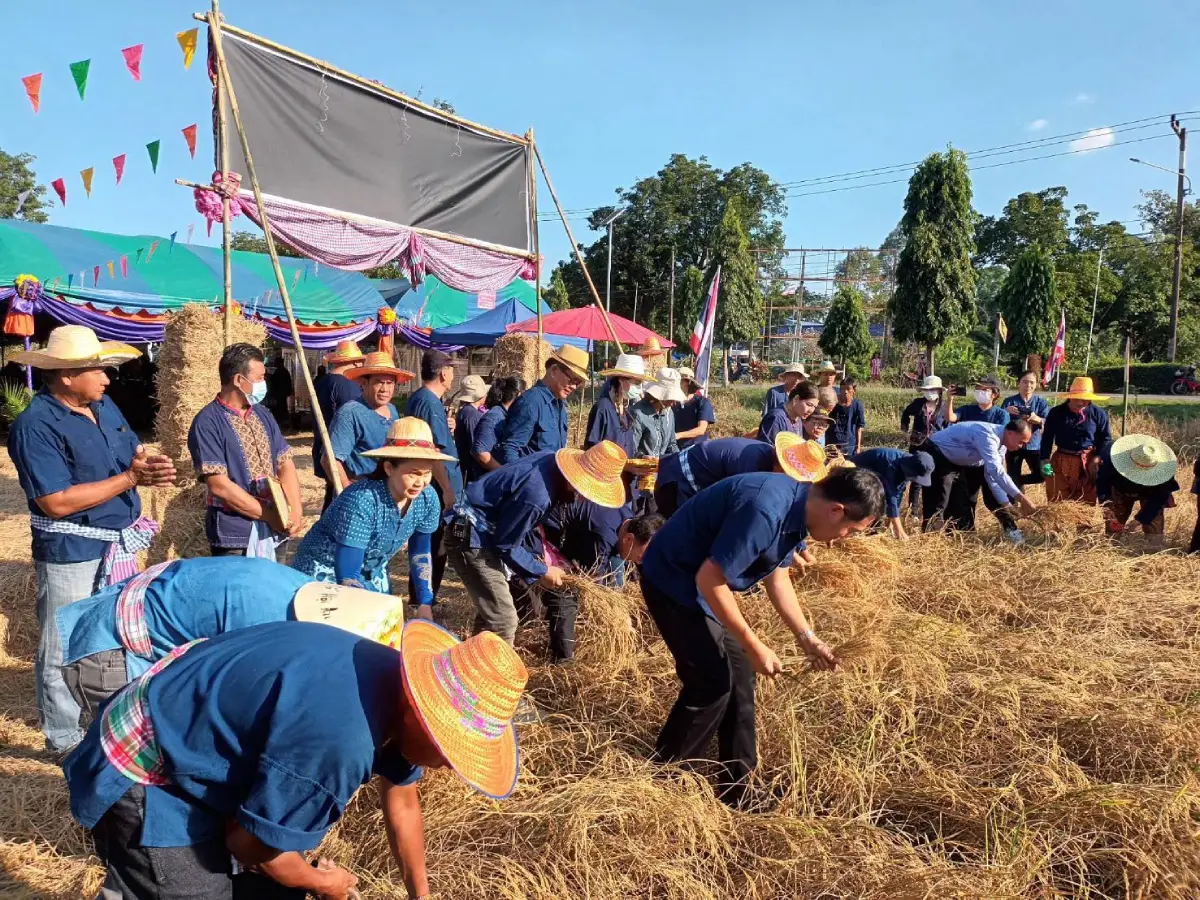
Open Days: The rice-transplanting cooperation tradition has no permanent opening day because it follows the farming season and the schedule of each community. The latest reference activity at the Faculty of Agriculture and Technology, Nakhon Phanom University, is scheduled for Wednesday, August 5, 2026.
Opening Hours: The latest reference activity begins at 13:00. The organizer did not publish a fixed finishing time.
The Communal Rice-Transplanting Tradition of Nakhon Phanom Province is an agricultural culture of northeastern Thailand in which villagers combine their labor, time, knowledge, and goodwill to help a household transplant its rice seedlings within the appropriate farming period. It is not a permanent festival venue or a tourist attraction that opens every day. The activity takes place seasonally in family fields, community farms, educational demonstration plots, and projects organized to preserve farming knowledge. Its central value is reciprocal labor and the principle that when one household faces a demanding task, the community does not leave that family to carry the burden alone.
Modern life is often organized around speed, individual schedules, and personal financial responsibility. As people become busier, their everyday relationships with neighbors can weaken without being noticed. Examining communal rice transplanting reveals how rural communities once created a form of social security through cooperation. Before labor contractors, large agricultural machines, and commercial farm services became widely available, relatives and neighbors formed the workforce that allowed a task too large for one family to be completed in a single day or within a short period.
The Thai expression “long khaek” in this context refers to inviting people to join a collective task. It is not a reference to an ethnic group. The field owner invites relatives, neighbors, friends, and households with which labor has previously been exchanged. When those helpers later need to transplant or harvest their own rice, the original host returns the assistance. This arrangement is commonly understood as exchanging labor rather than purchasing it. It depends on trust, responsibility, and the community’s memory of who has helped whom.
The tradition developed from the practical requirements of transplanted rice cultivation. After seedlings have grown to the proper stage, farmers must pull them from the nursery, arrange them into manageable bundles, and plant them in a prepared field with suitable soil and water conditions. This work must be completed within a period related to seedling age, rainfall, and field moisture. Seedlings left too long may become overgrown, develop tangled roots, or recover slowly after planting. If the field is too dry or too deeply flooded, the young rice may also fail to establish well. A large workforce available for a short time was therefore essential.
Nakhon Phanom has extensive agricultural areas and communities with a long relationship with rice cultivation. Settlements in rain-fed plains, river basins, and areas influenced by local water systems developed knowledge about planting seasons, rice varieties, soil preparation, and water management. Rice is more than a staple food. It is a household asset, a form of food security, an element of religious and community events, and a central connection between people and the natural environment. Transplanting season therefore carries social significance in addition to its technical agricultural purpose.
The timing of rice transplanting in Nakhon Phanom usually follows the beginning of the rainy season and the availability of water in each field. The exact period varies according to rainfall, field location, irrigation, seedling age, and the owner’s cultivation plan. Some communities begin preparing nurseries and transplanting in May, while others work in June, July, or August. A date announced for one year should never be treated as a permanent annual schedule. Visitors must rely on the current announcement of the field owner, community, school, or organizing institution.
In the past, arranging a communal workday required no complex communication system. A farmer could visit neighboring houses, ask relatives to pass on the message, or announce the plan during meetings at a temple, market, or local event. Once the community knew that a household’s field was ready, members selected a date that did not conflict with work already arranged for another family. Some villages organized a clear sequence, moving from one field to the next until each participating household had received sufficient assistance.
The core of the tradition is reciprocity. Helpers are not treated simply as hired workers but as people contributing labor that will later be returned. The exchange includes more than a measurable number of hours. It carries family obligations, neighborly trust, friendship, and a shared willingness to respond when someone faces difficulty. This system functions as a community safety net. If a household includes elderly members, experiences illness, lacks working-age labor, or has family members employed elsewhere, neighbors can prevent the planting season from being lost.
Before the communal workday, the field owner must prepare the land carefully. The soil is plowed, broken down, leveled, and surrounded by repaired field banks. Water must be controlled at a depth suitable for transplanting. An uneven field distributes water poorly. Some sections may become too dry to accept seedlings, while others may be so deep that young plants fall over. Good preparation allows a large group to work at the same time without stopping to correct basic field conditions.
Seedlings are raised in a nursery area where water can be managed easily. When they reach the appropriate stage, they are pulled gently from the soil, cleared of excess mud, aligned, and tied into bundles that can be carried or distributed through the field. Pulling must be done carefully to limit root damage, and seedlings should not remain exposed to strong sunlight for an extended period. The organizer therefore calculates the volume of seedlings in relation to field size and the number of workers so that transplanting does not stop while people wait for additional plants.
On the workday, participants gather in the morning or at the time set by the host. The organizer explains the boundaries, planting direction, locations of seedling bundles, rest areas, and safety concerns. Tasks are then assigned according to experience and ability. Skilled farmers may establish the first planting line. People who move confidently through mud distribute bundles. Older participants may prepare food, advise younger workers, or look after children. Beginners work beside experienced farmers and learn by observing the rhythm of selecting seedlings, stepping backward, and maintaining consistent spacing.
Traditional transplanting may begin with a guide rope, a visual line, or the judgment of an experienced farmer. A worker holds a bundle in one hand, separates a suitable number of seedlings with the other, and presses the roots into the mud deeply enough for the plants to stand without burying them so far that growth is delayed. The worker then steps backward and plants the next group. Moving backward prevents feet from crushing newly planted rice and allows the line ahead to remain visible.
To an observer on the field bank, transplanting can look like a simple repeated action. Working quickly while keeping straight rows, appropriate depth, and regular spacing requires considerable skill. Farmers must judge the number of seedlings per cluster, adjust the planting angle, and respond to hard soil, deep depressions, or very soft mud. If plants are placed too densely, they compete for light and nutrients. If spacing is excessive, the field may not use its productive area effectively. Such knowledge is most successfully transferred through practice rather than verbal explanation alone.
Working in a line requires a shared rhythm. A fast worker should not move so far ahead that the group becomes separated, while beginners receive advice from the people beside them. Conversation, joking, and laughter reduce the strain of bending and standing in mud for many hours. Some communities may include local singing or rhythmic conversation, but the tradition is not primarily a staged performance. Its purpose is to transform difficult work into a shared responsibility in which each participant is recognized.
Seedling distributors are as important as the people planting. In a large field, bundles must be placed continuously near the moving work line. If seedlings are left too far away, planters must walk back and lose time. If bundles are thrown carelessly, stems and roots may be damaged or scattered. Distributors watch the direction of movement, estimate how much material remains, and place new bundles within easy reach. The work demonstrates that collective success depends on connected supporting roles, not only on the most visible workers.
Food preparation completes the social meaning of the event. The host usually provides lunch, snacks, drinking water, or herbal beverages to thank those who have contributed their labor. Depending on household resources, the meal may include sticky rice, som tam, bamboo-shoot curry, larb, chicken soup, fish, local vegetables, chili dips, and seasonal fruit. The food is not regarded as a wage. It is hospitality and a celebration of work completed together.
A meal on the field bank or beneath nearby trees creates a relaxed space for people of different ages to talk. Conversations may concern rainfall, rice varieties, fertilizer prices, family health, relatives working in other provinces, or upcoming religious events. Communal transplanting therefore creates an informal communication network with practical value. People who rarely meet have an opportunity to work, eat, and exchange information again.
Belief in Mae Phosop, the spiritual personification of rice, forms part of rice culture in many Thai communities. Rice is considered life-giving and deserving of respectful treatment. Some families may ask permission from local sacred forces, offer a small ritual, or speak words of respect before cultivation begins. Practices differ between households and villages, however, and modern activities organized by schools or universities may emphasize agricultural learning rather than ritual. Participants should follow the host’s customs rather than adding ceremonies or making assumptions on behalf of the community.
Respect for nature is also expressed through practical knowledge of water, soil, and season. Farmers observe whether the rain has arrived early or late, whether natural water sources are sufficient, how well a field holds moisture, and which rice variety matches local conditions. An error in timing can affect the entire year’s harvest. The communal workday therefore becomes a setting where ecological knowledge passes from experienced farmers to younger people through direct observation of real conditions.
Reciprocal labor reduces the financial burden on households with limited cash. During periods of high demand, daily wages may rise, and a farm owner must cover labor, food, transport, and tools. Labor exchange allows families to use their available time and physical capacity in return for assistance from neighbors. The host still provides food and must later help others, but the immediate cash requirement is substantially reduced.
The system also distributes risk. If a family faces illness, an emergency, or an unexpected shortage of workers during the critical planting period, the labor network prevents the field from being abandoned. No written contract is required. Community expectations establish that a person receiving help will respond when another household’s turn arrives. The tradition therefore creates social discipline and continuing mutual responsibility rather than a one-time charitable gesture.
Within a family, the event allows several generations to work together. Children may begin by carrying water, collecting small bundles, or helping near the field bank. Working-age adults provide much of the physical labor. Older people teach techniques, prepare food, or advise the group on soil and water. Assigning tasks according to ability allows everyone to contribute without requiring every participant to perform the same work. It also shows younger generations that the knowledge of elderly farmers remains valuable.
Roles should not be represented as rigidly divided by gender. Women and men participate in nursery work, planting, carrying supplies, food preparation, tool management, and field planning according to family experience and local custom. Cultural interpretation should also recognize labor that is easily overlooked, including cooking, childcare, and organizing supplies. These supporting responsibilities allow field work to continue and are an essential part of the collective effort.
Communal transplanting creates an exchange between several forms of knowledge. Older farmers may recognize seedling maturity from appearance and texture. Middle-aged farmers may have experience with pumps, machinery, and production costs. Younger participants may use mobile weather forecasts, digital records, or online communication. When local knowledge and modern technology are combined, the tradition becomes a place to explore how cooperation can continue within contemporary agriculture rather than remaining a static image of the past.
In Nakhon Phanom, preservation also takes place through educational institutions and government-supported projects. The Faculty of Agriculture and Technology at Nakhon Phanom University has organized transplanting activities in demonstration fields so that students can experience farming, practice rice cultivation, and build relationships between senior and junior students. University activities make the tradition accessible to young people who may not have grown up in rice-farming households.
An official university record from 2020 described three demonstration areas: a Crop Science rice field, an integrated Animal Science plot, and a field behind the faculty’s learning-resource building. Lecturers, staff, and students from several academic levels joined the activity. Senior students prepared the nursery and seedlings before inviting new students to transplant. The rice was cultivated through an organic approach and was scheduled for harvest later in the production season.
This model connects the tradition with several modern disciplines. Crop Science students study rice varieties, germination, plant development, and pest management. Animal Science and integrated-farming students examine relationships among rice fields, livestock, and agricultural by-products. Agricultural machinery students can compare human labor with mechanical systems. Food students may follow the harvest into processing and food safety. One transplanting event can therefore become the beginning of learning across the entire rice value chain.
In 2025, the Faculty of Agriculture and Technology also worked with Nakhon Phanom Central Prison on a rice-transplanting activity inside the prison’s agricultural area. The program allowed incarcerated students to gain practical agricultural experience. A total of 161 male and female learners, staff members, and officers participated. The example demonstrates how the communal tradition can support vocational education, discipline, rehabilitation, and preparation for employment after release.
The latest reference schedule for 2026 is an activity linking the Faculty of Agriculture and Technology with the Faculty of Education at Nakhon Phanom University. It is scheduled for Wednesday, August 5, 2026, beginning at 13:00 in the Faculty of Agriculture and Technology rice field. The activity is designed to give participants direct experience of rice transplanting, introduce agricultural life, and strengthen relationships through shared physical work.
Travelers should understand that a university announcement does not turn the field into a permanent public attraction. Participation depends on the organizer’s invitation, registration, available equipment, field conditions, and authorization. Outside visitors, educational groups, journalists, and filmmakers should contact the Faculty of Agriculture and Technology in advance. Entering experimental plots or teaching areas without permission can damage crops, disrupt classes, and create safety concerns.
Activity areas are organized by function rather than as commercial tourist zones. They may include the nursery and seedling-pulling area, seedling-bundle distribution point, transplanting field, equipment station, washing area, and meal or rest space. At the faculty, fields historically used for activities include the Crop Science plot, the integrated Animal Science plot, and the field behind the learning-resource building. Clear organization prevents participants from walking across planted rows and supports equipment control and safety.
Participants should wear clothing that can become muddy, long sleeves or sun protection, a hat, and a change of clothes. Drinking water and a towel are useful. Boots may protect against sharp objects in some fields, but heavy clay can trap footwear and make walking difficult. Participants should follow the field owner’s advice and should not enter barefoot without understanding the condition of the ground, which may contain shells, branches, broken material, or other hazards.
Before work begins, organizers should identify deep-water areas, slippery field banks, restricted zones, first-aid points, and cleaning facilities. People with open wounds, serious skin conditions, or relevant health limitations should avoid direct contact with field water and mud. Everyone should wash before eating, avoid drinking untreated field water, and clean any cut immediately. Cultural preservation should be combined with modern hygiene and safety standards.
Good conduct means treating the field as productive land rather than a playground. Participants should not run, jump, throw mud at others, or step on seedlings for photographs. Beginners should ask for a demonstration before planting, avoid pulling more seedlings than necessary, and remove all plastic, packaging, and food waste. Respecting farmers means recognizing that every seedling represents money, time, risk, and hope for the household responsible for the crop.
Photography and video recording should be approved by the organizer and the people appearing in the images, particularly when children, students, or participants with privacy restrictions are involved. Photographers should not block planting lines or ask farmers to repeat actions solely for a staged image. Responsible documentation includes hands planting seedlings, the distribution of bundles, food preparation, and conversations between generations. Focusing only on people covered in mud can reduce a complex tradition to entertainment.
Agricultural change has reduced the frequency of traditional communal transplanting. Tractors, mechanical transplanters, seed broadcasters, and combine harvesters save labor and time. Rural families are smaller, working-age residents often migrate for employment, and elderly people increasingly manage fields. Hiring a contractor can be easier than waiting for neighbors to become available. Direct seeding also removes the nursery-pulling and transplanting stages from many production systems.
Mechanization does not eliminate the value of cooperation. Communities can still work together to prepare food, repair field banks, coordinate water, select seed, harvest, process rice, or support households with labor shortages. Even where machines perform the major task, cooperation is needed to schedule equipment, share fuel costs, repair access roads, and manage water between neighboring fields. The tradition can therefore evolve from an exchange of physical labor into an exchange of machines, knowledge, transport, and other resources.
Climate change also complicates the timing of planting. Rain may arrive late, stop for an extended period, or fall heavily within a short time. A field that normally retains sufficient moisture may dry before seedlings establish, while sudden flooding may submerge newly planted rice. Labor-exchange groups must become more flexible. Mobile communication, weather forecasts, pumps, and alternative dates help communities respond without losing the central principle of mutual support.
Preservation should not require farmers to abandon useful technology and return entirely to manual labor. If machinery reduces physical strain and keeps farming economically viable, a community can maintain a smaller learning plot for hand transplanting while using appropriate technology in its main production fields. This approach preserves skills and memory without imposing an unreasonable burden. A tradition remains alive when local people find it useful, not when it is reproduced only for outside photographs.
Schools can extend the activity beyond a single afternoon. Before entering the field, students can study rice growth, soil preparation, water systems, and production costs. During the activity, they can record the number of workers, planted area, and time required. Later, they can return to observe tillering, flowering, harvest, and processing. Following rice from seed to meal helps students understand that every serving depends on labor, knowledge, weather, and risk.
The tradition can also support interdisciplinary education. Mathematics can calculate field area, spacing, and yield. Science can examine soil, water, and photosynthesis. Language classes can record farming vocabulary and oral history. Social studies can analyze reciprocal labor and the rural economy. Art can document the landscape, while information technology can preserve images, sound, and data. Such learning prevents the tradition from being separated from contemporary life.
Cultural tourism must be managed responsibly. Organizers should state clearly whether participants are joining a genuine community workday or a demonstration field prepared for education. If the format has been modified for safety or visitor access, that should be explained honestly. Income from activities, meals, and products should reach the farmers, community groups, and knowledge holders who provide the experience rather than benefiting only an outside operator.
For international visitors, communal rice transplanting offers a direct introduction to Thai society, but interpretation must explain the meaning of the Thai term, the reciprocal labor system, and appropriate field conduct. Visitors should not view the activity only as an exotic form of entertainment. Understanding why people contribute labor without immediate wages reveals ideas of relationship, obligation, trust, and reciprocity that form the cultural core of the practice.
Local food can provide an additional cultural and economic benefit. Community groups may prepare meals, sell local rice, seasonal vegetables, processed products, or items made from natural materials. Food safety, allergen information, and responsible waste management remain essential. Reusable containers and reduced plastic consumption help the event reflect the environmental respect underlying agricultural life.
Communities can also document local knowledge holders, including specialists in nursery preparation, rice varieties, transplanting technique, communal cooking, and the organization of reciprocal work schedules. Audio and video records should be made with informed permission and should identify the people contributing knowledge. Proper documentation prevents the tradition from becoming a collection of unexplained photographs and gives younger residents access to vocabulary, techniques, and local narratives.
Sustainable preservation accepts that forms of participation will change. Younger people may be unable to contribute a full day but can join for several hours, prepare food, arrange transport, operate equipment, or support costs. Family members living in other provinces may help promote community rice or find markets for local products. The essential principle is that people do not abandon one another, not that every step must be performed exactly as it was several generations ago.
Getting There to the reference location at the Faculty of Agriculture and Technology, Nakhon Phanom University, is most convenient by private car, rental car, or local hired vehicle from Nakhon Phanom city. The faculty is at 103 Moo 3, Chayangkun Road, Kham Thao Subdistrict, Mueang Nakhon Phanom District. Travelers should search for the faculty’s full name because Nakhon Phanom University operates units in several locations. On arrival, visitors must contact the organizer before entering the rice field.
Travelers arriving at Nakhon Phanom Airport can rent a vehicle, arrange a driver, or use transport provided by their institution. Additional time should be allowed for registration and changing clothes. A trip may be combined with Nong Yat Freshwater Aquarium, the Ho Chi Minh Memorial, the Phaya Si Sattanakharat landmark, the Thai-Vietnamese Memorial Clock Tower, and the former Nakhon Phanom Governor’s Residence Museum, but the itinerary should not be so crowded that participants arrive after the work has begun.
The tradition is valuable not merely because it creates an attractive rural scene, but because it is a working system through which ordinary people support one another at a critical moment. Planting one cluster of seedlings is a small action. When many people repeat that action together, an entire field can be completed rapidly. The image demonstrates that cooperation is created not by slogans but by sharing another person’s burden through practical effort.
Although agricultural technology, machinery, and family structures continue to change, the principle of exchanging labor remains relevant to caring for elderly residents, repairing common spaces, responding to floods or storms, maintaining community gardens, and organizing public activities. Communal transplanting teaches more than a farming technique. It teaches how a society can notice and share the responsibilities of its members.
The communal rice-transplanting tradition of Nakhon Phanom is therefore a living cultural heritage connecting agriculture, food, belief, education, and community relationships. Preservation does not require rejecting technology. It requires retaining the meanings of sharing, responsibility, and refusing to leave a household behind. When communities, educational institutions, public agencies, and younger generations adapt the practice while respecting its cultural owners, it can remain a relevant lesson and source of inspiration for the future.
| Tradition Name | Communal Rice-Transplanting Tradition of Nakhon Phanom Province |
| Cultural Category | Agricultural culture and reciprocal community labor of northeastern Thailand |
| Event Format | A seasonal activity held in household, community, school, university, or institutional rice fields; it has no permanent venue or fixed annual date |
| Latest Reference Schedule | Wednesday, August 5, 2026, beginning at 13:00 at the Faculty of Agriculture and Technology rice field, Nakhon Phanom University |
| Reference Location | Faculty of Agriculture and Technology, Nakhon Phanom University, Kham Thao Subdistrict, Mueang Nakhon Phanom District |
| Address | 103 Moo 3, Chayangkun Road, Kham Thao Subdistrict, Mueang Nakhon Phanom District, Nakhon Phanom 48000, Thailand |
| Reference Coordinates | 17.28525, 104.78198 |
| Meaning of Long Khaek | Inviting relatives, neighbors, or community members to contribute labor, with assistance returned when another household later needs help |
| Highlights | Reduces labor and cash burdens, transfers rice-growing skills, strengthens relationships between generations, and preserves reciprocal community support |
| Main Process | Preparing soil and water, raising and pulling seedlings, inviting helpers, distributing bundles, transplanting in rows, providing food, cleaning equipment, and returning labor to other households |
| Common Food | Sticky rice, som tam, bamboo-shoot curry, larb, chicken soup, fish, local vegetables, chili dips, and dishes selected by the host household |
| Related Beliefs | Respect for rice, nature, and Mae Phosop; ritual details differ among families and communities |
| Reference Organizer and Caretaker | Faculty of Agriculture and Technology, Nakhon Phanom University; the 2026 reference activity is coordinated with the Faculty of Education |
| Main Contact Number | +66 42 532 471 |
| Official Website | https://agri.npu.ac.th/ |
| Current Status | The tradition continues through community, educational, and institutional activities, with a Nakhon Phanom University event scheduled for 2026 |
| Fees | There is no general admission ticket. Participation depends on the permission and announcement of the field owner, community, school, university, or organizing agency. |
| Facilities | Facilities vary by venue. University activities may use teaching fields, demonstration plots, service buildings, and rest areas according to organizer regulations. |
| Main Areas / Zones | 1. Seedling nursery and pulling area 2. Seedling-bundle collection and distribution point 3. Transplanting field 4. Equipment and washing area 5. Rest and meal area 6. Crop Science field, integrated Animal Science field, and the field behind the learning-resource building previously used by the faculty |
| Travel Information | Travel by private car, rental car, or hired vehicle from Nakhon Phanom city. Search for the Faculty of Agriculture and Technology, Nakhon Phanom University, and contact the organizer before entering the activity field. |
| Visitor Conduct | Obtain permission, wear suitable clothing, avoid stepping on seedlings or playing in ways that disrupt work, remove rubbish, and follow all safety instructions. |
| Distance Basis | Approximate road distances from the reference area at the Faculty of Agriculture and Technology, Nakhon Phanom University |
| Nearby Tourist Attractions | 1. Nong Yat Freshwater Aquarium, approximately 8 km 2. Ho Chi Minh Memorial at Ban Na Chok, approximately 11 km 3. Phaya Si Sattanakharat Plaza, approximately 15 km 4. Thai-Vietnamese Memorial Clock Tower, approximately 16 km 5. Former Nakhon Phanom Governor's Residence Museum, approximately 17 km |
| Nearby Restaurants | 1. KFC Big C Nakhon Phanom, approximately 9 km, Tel. +66 92 223 9542 2. MK Restaurants Lotus Nakhon Phanom, approximately 12 km, Tel. +66 83 099 6437 3. Sabaidee at Nakhon Phanom, approximately 15 km, Tel. +66 42 064 200 4. Pen Pla Pen, approximately 16 km, Tel. +66 87 634 7467 5. Kitchen Khong The River Front, approximately 17 km, Tel. +66 85 924 7898 |
| Nearby Accommodations | 1. Thai Lao Resort & Spa, approximately 7 km, Tel. +66 93 321 2577 2. R-Photo Hotel, approximately 9 km, Tel. +66 42 199 999 3. Blu Hotel Nakhon Phanom, approximately 14 km, Tel. +66 63 958 4403 4. Fortune River View Hotel Nakhon Phanom, approximately 15 km, Tel. +66 42 522 334 5. Mekong Heritage Hotel Nakhon Phanom, approximately 16 km, Tel. +66 42 511 189 |
Frequently Asked Questions (FAQ)
Q: What does the communal rice-transplanting tradition mean?
A: Relatives, neighbors, and community members help transplant rice in one household's field, and that household later returns the labor when other participating families need assistance.
Q: In which months is communal rice transplanting held in Nakhon Phanom?
A: The timing depends on rainfall, water, seedling development, and the local cultivation plan. Activities may occur between May and August, but the current date must be confirmed with the field owner or organizer.
Q: Can members of the public join the Nakhon Phanom University activity?
A: Participation depends on the organizer's announcement and authorization. Outside visitors should contact the Faculty of Agriculture and Technology before traveling and must not enter the field without permission.
Q: When is the latest reference activity scheduled?
A: The activity involving the Faculty of Agriculture and Technology and the Faculty of Education is scheduled for Wednesday, August 5, 2026, beginning at 13:00.
Q: Is there an admission or participation fee?
A: There is no general admission ticket. Participation rights and any costs for a specific activity are determined by the field owner, community, educational institution, or organizer.
Q: What should participants wear?
A: Wear clothes that can become muddy, long sleeves, sun protection, and a hat, and bring a change of clothes. Footwear should follow the organizer's advice and the condition of the field.
Q: Is the tradition still important in the age of agricultural machinery?
A: Yes. It remains important for community relationships, knowledge exchange, support for households with labor shortages, and cooperation in managing equipment, water, and other shared resources.
Q: How can foreign visitors learn about the tradition respectfully?
A: Join only an authorized activity, listen to local interpretation, follow field etiquette, seek consent before photographing people, and approach the experience as a lesson in cooperation rather than entertainment.
 Category: ●Art, Culture and Heritage
 Group: ●Art, Craft Centres, Tradition
Last Update : 3 MonthAgo
 Last Update : 3 MonthAgo

 Historical Sites and Monuments(3)
 Landmarks and Memorials(2)
Art, Craft Centres, Tradition(3)
Landmarks and Memorials(2)
Art, Craft Centres, Tradition(3)
 Museums(3)
 Educational Places
 Library(1)
 Places of Worship
 Temple(23)
 Church(1)
 Other Sacred Sites(11)
 Suburban Living
 Village, Community(5)
 Nature and Wildlife
 National Parks and Marine Reserves(1)
 Dam, Reservoir, Lake(5)
 Waterfalls(2)
 River, Canal(3)
 Bays and Beaches(3)
 Other natural attractions(2)
 Entertainment and Agricultural
 Zoos and Aquariums(1)
 Farms, Parks and Ecotourism(2)
 Shopping
 Shopping and Night Market(1)
 Travel Articles, Recipes
 Travel Review, Food Review(1)


