
lovethailand home >Northeastern Travel Attractions >Maha Sarakham Travel Attractions >Muang Maha Sarakham >Talat > Rajabhat Maha Sarakham University
TL;DR: Rajabhat Maha Sarakham University, Maha Sarakham attractions : University, Rajabhat University.
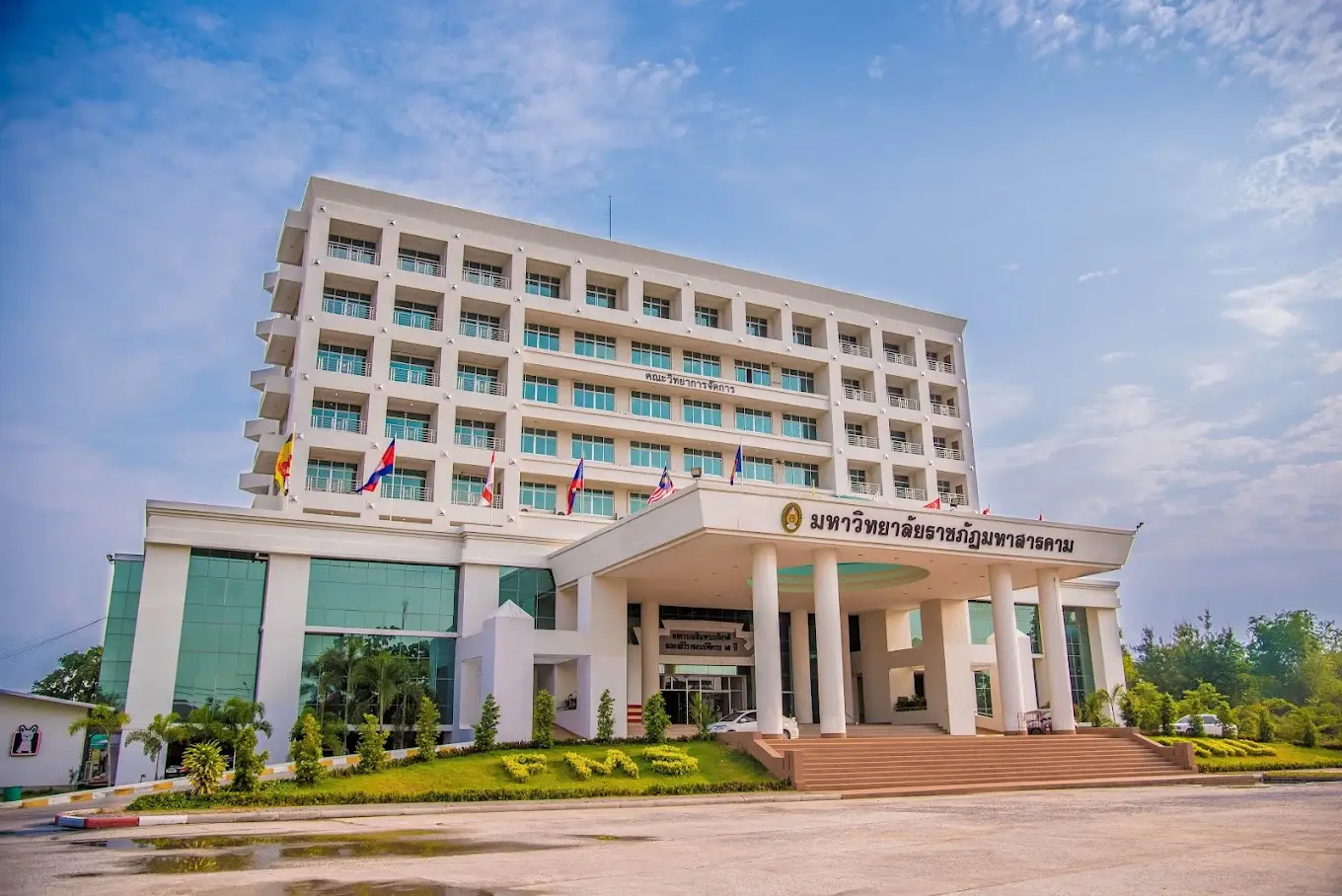
Rajabhat Maha Sarakham University
Open Days: Monday – Friday (Administrative Offices; Excluding Public Holidays)
Opening Hours: 08:30 – 16:30 (Administrative Office Hours)
Rajabhat Maha Sarakham University (RMU) is a public university located at 80 Nakhon Sawan Road, Talat Subdistrict, Mueang Maha Sarakham District, Maha Sarakham Province, Thailand. Its institutional history dates back to 1925, when it was established as an agricultural primary school. Over the following decades, it developed into a teacher-training institution, Maha Sarakham Teachers College, and Rajabhat Maha Sarakham Institute before officially becoming Rajabhat Maha Sarakham University on June 15, 2004. Today, the university offers education across a wide range of disciplines, including teacher education, science, technology, engineering, humanities, social sciences, agriculture, business, political science, and law. Its wider mission includes research, academic services, cultural preservation, and regional development.
The university is situated in Mueang Maha Sarakham, the provincial administrative and commercial center. Its campus brings together academic buildings, laboratories, a library, administrative offices, an auditorium, student facilities, and research-related spaces. These facilities support a learning environment in which teaching, practical training, research, and community engagement form interconnected parts of university life. RMU is therefore more than a place for obtaining academic qualifications; it also contributes to the development of schools, professional communities, and local organizations throughout Maha Sarakham and the surrounding region.
One of the defining characteristics of Rajabhat Maha Sarakham University is the continuity of its educational mission. The institution began with practical agricultural education, gradually became a center for teacher preparation, and subsequently expanded into a multidisciplinary public university. This development mirrors important changes in Thailand's education system, particularly the growing demand for teachers, wider access to higher education, and the application of academic knowledge to regional economic and social development.
The university's origins can be traced to 1925, when an agricultural primary school was established on land now associated with Maha Sarakham Technical College. The school provided practical instruction in crop cultivation, animal husbandry, handicrafts, and related skills. At the time, agriculture was central to everyday life across northeastern Thailand, and practical education was considered essential to improving livelihoods and strengthening local communities. The institution's earliest curriculum reflected these needs by emphasizing knowledge that learners could apply directly to work and daily life.
In 1927, the school relocated to the Khok I Doi area, approximately four kilometers west of the town center. This location later became the present-day university campus. The move was historically significant because it provided a lasting physical foundation for the expansion of the institution. Buildings, teaching facilities, and other educational infrastructure developed at the site over subsequent decades, making the campus itself an important part of the university's history.
In 1930, the institution was reorganized as a special primary school with a lower-level agricultural teacher-training division. Although the teacher-training division was discontinued in 1931, this period marked an early connection between practical agricultural education and the preparation of teachers. That connection would become increasingly important as Thailand expanded its formal education system and required more qualified teachers for provincial schools.
During the following decades, the institution developed further within the national teacher-training system. It eventually became Maha Sarakham Teacher Training School, serving the educational needs of the province and neighboring communities. Its graduates contributed to the expansion of schooling in northeastern Thailand, helping make formal education more accessible to children and young people outside the country's major metropolitan centers.
A major milestone occurred on May 1, 1962, when the institution was elevated to Maha Sarakham Teachers College. This transformation represented a substantial step forward in academic development, teacher preparation, and institutional administration. As a teachers college, the institution played an important role in preparing professional educators for schools throughout the region, strengthening its reputation and establishing an enduring academic identity centered on education.
The Teachers College Act of 1975 broadened the role of Thailand's teachers colleges and supported their development as higher education institutions. For Maha Sarakham Teachers College, the changes created opportunities to strengthen academic programs, develop teaching personnel, and expand educational facilities. These developments helped prepare the institution for its later transition into the Rajabhat system.
On February 14, 1992, Thailand's teachers colleges received the royally bestowed designation Rajabhat Institute. The term Rajabhat is commonly interpreted as "people of the King," expressing an educational ideal of service to the people. This new designation represented an important shift in identity, emphasizing the institutions' responsibilities to their communities and their broader contributions to society beyond teacher training alone.
On January 25, 1995, the institution acquired formal status as Rajabhat Maha Sarakham Institute under the Rajabhat Institute Act. In March of that year, the royal emblem was granted as a symbol of the Rajabhat institutes. The period marked a further strengthening of the institution's role within Thailand's higher education system and laid the groundwork for broader program development in the years that followed.
The most important legal transformation in the modern history of the institution occurred when the Rajabhat University Act B.E. 2547 came into effect on June 15, 2004. Rajabhat Maha Sarakham Institute consequently became Rajabhat Maha Sarakham University. The new university status enabled further development across undergraduate and postgraduate education, research, community services, and cultural preservation, while preserving the institution's long-standing commitment to local development.
It is important to distinguish the founding of the original institution in 1925 from the establishment of its present university status in 2004. The former marks the beginning of the educational organization that eventually became RMU, while the latter identifies the date on which it officially became a university under Thai law. Together, these milestones illustrate an institutional history extending across more than a century.
The university's name reflects both its place in the nationwide Rajabhat university network and its deep connection with Maha Sarakham Province. The term Rajabhat emphasizes education in the service of the people, while Maha Sarakham identifies the institution's geographical and cultural home. Its official English name is Rajabhat Maha Sarakham University, commonly abbreviated as RMU.
The university's identity is expressed through its emblem, institutional colors, and symbolic tree and flower. The official university colors are green and red. Green represents the abundance of knowledge and the growth of wisdom, while red symbolizes courage, perseverance, and sacrifice for the common good. These meanings reflect an educational philosophy in which academic achievement is connected with responsibility toward society.
The university's symbolic tree and flower are known locally as the Chan tree and Chan flower. The species, Butea monosperma, is also known in English as Flame of the Forest. In other parts of Thailand, the tree is commonly known as Thong Kwao. The choice of the northeastern Thai name Chan highlights the university's regional identity and its connection with the landscape and culture of Isan, or northeastern Thailand.
RMU's emblem follows the broader tradition of the Rajabhat university system and incorporates a royal symbol associated with the institutions' historical identity. Together with the university's name, colors, and symbolic tree, the emblem represents the continuity of its educational mission and its commitment to knowledge, cultural heritage, and public service.
In 2026, the university is led by Assistant Professor Dr. Natchanok Chansawang, its rector. The administration oversees academic development, research, institutional planning, community partnerships, and the continued improvement of educational services. These responsibilities are shared among faculties, academic support units, research organizations, and administrative departments throughout the university.
For the 2026 academic year, the undergraduate admission announcement identifies the Faculty of Education, Faculty of Science and Technology, Faculty of Engineering, Faculty of Humanities and Social Sciences, Faculty of Management Science, Faculty of Agricultural Technology, Faculty of Political Science and Public Administration, and Faculty of Law. The university also operates a Graduate School to coordinate master's and doctoral education. A Faculty of Nursing was formally established on January 30, 2026, marking an additional development in the institution's academic structure.
An important organizational change took effect on October 1, 2025, when the former Faculty of Information Technology was merged into the Faculty of Science and Technology. This change is relevant when comparing recent university information with older faculty directories or postgraduate program listings. Academic fields such as computer science, information technology, and digital technology remain important parts of the university's educational provision, but they should be understood within the updated organizational structure.
The Faculty of Education remains closely associated with RMU's historical foundations. Its undergraduate fields include Thai language, mathematics, chemistry, biology, physics, computer education, science education, early childhood education, primary education, special education, English education, social studies, physical education, and art education. These subjects prepare students for teaching-related careers while continuing the institution's long-standing contribution to the development of education in Thailand.
The Faculty of Science and Technology offers programs across basic sciences and applied disciplines. Fields include chemistry, biology, physics, mathematics, environmental science, community public health, applied statistics, biotechnology, computer science, information technology, multimedia and animation technology, and digital computing. This range of subjects provides opportunities for students interested in laboratory work, digital systems, scientific investigation, public health, and technological applications.
The Faculty of Engineering contributes professional and technical education in computer engineering, engineering management, electrical technology, industrial production technology, and related fields. Some programs provide pathways for students with relevant vocational qualifications, supporting continuing education and the development of technical expertise. Coursework combines engineering knowledge with the practical requirements of industrial and professional environments.
The Faculty of Humanities and Social Sciences brings together language studies, cultural studies, performing arts, music, visual arts, religion, and local development. Its academic fields are closely connected with communication, creativity, cultural identity, and the interpretation of society. These disciplines also support the preservation and contemporary development of Thailand's regional cultural heritage.
The Faculty of Management Science offers programs in marketing, management, hospitality and tourism, digital business, accounting, communication arts, and economics. Its Digital Business program is identified as a bilingual program in the university's 2026 undergraduate admission announcement. The faculty's academic fields prepare students for business and professional environments in which technology, communication, financial knowledge, and management skills are increasingly interconnected.
The Faculty of Agricultural Technology reflects the university's earliest educational roots. It offers fields such as agriculture, food technology, animal science, agricultural information technology, agribusiness, and veterinary technology and animal nursing. These subjects are relevant to the development of agricultural production, food processing, animal care, and rural enterprises, making the faculty an important connection between the institution's history and contemporary regional development needs.
The Faculty of Political Science and Public Administration provides education in politics, public administration, and local development administration. The Faculty of Law focuses on legal education. Together, these faculties contribute to professional knowledge concerning governance, public institutions, law, local administration, and the relationship between citizens and the state.
Postgraduate education is coordinated through the Graduate School and the university's academic faculties. Master's and doctoral study areas include educational administration, curriculum and instruction, mathematics education, research and educational evaluation, public administration, local development, information technology, business administration, music, and research on cultural and creative economies. These programs provide advanced study opportunities for educators, professionals, researchers, and individuals seeking specialist qualifications.
Research is an important part of RMU's wider mission. The Research and Development Institute works alongside the university's academic units to support research activities and the application of knowledge. As a regional public university, RMU is well positioned to connect academic investigation with the needs of schools, agricultural communities, local organizations, cultural institutions, and other sectors of society. Research and academic services therefore form a bridge between university learning and the practical challenges facing local communities.
Community engagement is another defining feature of the university. Through academic cooperation and the application of specialist knowledge, students and academic staff can contribute to educational improvement, professional development, local enterprises, and community initiatives. These activities also provide opportunities for students to gain practical experience and develop an understanding of the social environments in which they will eventually work.
Cultural preservation is supported by the university's Office of Arts and Culture and related academic departments. Activities associated with Buddhism, regional traditions, and local cultural knowledge help connect the institution with the wider community. They also encourage students to recognize that cultural heritage is not separate from contemporary life, but continues to influence local identity, social values, and community relationships.
One of the most meaningful educational traditions at RMU is the Wai Khru ceremony, during which students express respect and gratitude to their teachers. The university held its 2026 academic-year Wai Khru ceremony on July 9, 2026, at the 80th Birthday Anniversary Auditorium. The ceremony involved university administrators, lecturers, and students, and reflected the enduring importance of respect for teachers within Thai educational culture.
The university also organizes Buddhist cultural activities. In 2026, the Office of Arts and Culture held a merit-making and almsgiving event associated with Buddhist Lent at the university's religious pavilion. Activities of this kind allow students and staff to participate in cultural traditions while reinforcing connections between the university and the religious and social life of the surrounding community.
Among the university's most important administrative landmarks is the 72nd Birthday Anniversary Building, which houses several offices, including the Office of Academic Promotion and Registration on its second floor. Visitors who need academic records, registration assistance, or other related administrative services can use this building as their principal point of reference when arriving on campus.
The 80th Birthday Anniversary Auditorium is another significant campus facility. It is used for major ceremonies, academic events, and university activities that bring together large numbers of students and staff. For many students, the auditorium is associated with important shared experiences and ceremonies that contribute to a sense of belonging to the institution.
The university library, administered through the Office of Academic Resources and Information Technology, has a history of gradual development. In 2002, the name Bannarat Nakharin was bestowed upon the library building within the Rajabhat institutional network. Today, library and information services remain important resources for learning, academic research, and independent study.
Additional campus facilities include science laboratories, the Science and Applied Science Center, faculty buildings, the student affairs building, the Faculty of Law building, agricultural technology facilities, and the Human Resource Development Center for Local Development. These buildings serve different academic and administrative functions, and visitors should follow the relevant university regulations when entering specialist learning areas or research facilities.
For visitors interested in educational tourism, Rajabhat Maha Sarakham University offers a useful setting in which to learn about the history of teacher education and the development of Thailand's regional higher education institutions. The campus can also be relevant to school groups, researchers, and professional visitors arranging academic visits. Access to laboratories, teaching spaces, or organized activities should be coordinated with the responsible faculty or university office.
The university also contributes to the everyday economic and cultural life of Maha Sarakham. Students arriving from different provinces bring a variety of backgrounds and experiences to the city, while local accommodation providers, restaurants, shops, and transport services support students, families, and university visitors. This relationship illustrates the way a regional university can influence a provincial city beyond its formal academic activities.
Visitors can combine a university trip with cultural attractions in Mueang Maha Sarakham, including the Maha Sarakham City Pillar Shrine, Maha Sarakham City Museum, the city clock tower, Wat Mahachai, and Wat Phuttha Wanaram, also known as Wat Pa Wang Nam Yen. These places provide opportunities to explore local history, Buddhism, community traditions, and the cultural landscape of northeastern Thailand.
Getting There Rajabhat Maha Sarakham University is located at 80 Nakhon Sawan Road in central Maha Sarakham Province. Visitors arriving by private car can use digital maps to navigate to the main university campus. Parking is available in designated areas. According to the university's registration office, local bus routes 1, 2, and 3 pass the campus. Travelers arriving from other provinces can reach Maha Sarakham town and continue by local transport or a hired vehicle to Nakhon Sawan Road.
For administrative visits, the Office of Academic Promotion and Registration operates Monday through Friday, from 08:30 to 16:30, excluding public holidays. The office is located on the second floor of the 72nd Birthday Anniversary Building and can be contacted at 043-712164. These are administrative service hours rather than the opening and closing hours of the entire campus. Libraries, faculties, and other facilities may maintain separate schedules.
In summary, Rajabhat Maha Sarakham University is an institution with an important place in the history of education in northeastern Thailand. Its progression from an agricultural primary school in 1925 to a Rajabhat university in 2004 reflects the expansion of educational opportunities and the changing role of higher education in Thai society. Today, RMU continues to combine teaching, research, community service, and cultural preservation, maintaining a strong connection between academic knowledge and the needs of the region it serves.
Rajabhat Maha Sarakham University Summary Table
| University Name | Rajabhat Maha Sarakham University (มหาวิทยาลัยราชภัฏมหาสารคาม) |
| Abbreviation | RMU |
| University Type | Public University, Rajabhat University System |
| Address | 80 Nakhon Sawan Road, Talat Subdistrict, Mueang Maha Sarakham District, Maha Sarakham 44000, Thailand |
| Institutional Founding Year | 1925, As an Agricultural Primary School |
| University Establishment Date | June 15, 2004 |
| Historical Development | Agricultural Primary School → Teacher Training School → Maha Sarakham Teachers College → Rajabhat Maha Sarakham Institute → Rajabhat Maha Sarakham University |
| Rector | Assistant Professor Dr. Natchanok Chansawang |
| University Colors | Green and Red |
| Symbolic Tree and Flower | Chan Tree and Chan Flower (Butea monosperma, Flame of the Forest) |
| Faculties and Academic Units | Faculty of Education, Faculty of Science and Technology, Faculty of Engineering, Faculty of Humanities and Social Sciences, Faculty of Management Science, Faculty of Agricultural Technology, Faculty of Political Science and Public Administration, Faculty of Law, Faculty of Nursing (Established in 2026), and Graduate School |
| Academic Strengths | Teacher Education, Local Development, Science and Technology, Agriculture, Engineering, Management, and Social Sciences |
| Major University Offices | Office of Academic Promotion and Registration, Office of Academic Resources and Information Technology, Office of Arts and Culture, Research and Development Institute, and Student Affairs Division |
| Major Campus Facilities | 72nd Birthday Anniversary Building, 80th Birthday Anniversary Auditorium, Bannarat Nakharin Library, Student Affairs Building, Science Laboratories, and Faculty Buildings |
| University Traditions | Wai Khru Ceremony, Student Orientation Activities, Buddhist Cultural Events, and Cultural Heritage Programs |
| Administrative Open Days | Monday – Friday, Excluding Public Holidays |
| Administrative Opening Hours | 08:30 – 16:30 |
| Getting There | Private Car, Local Transport, Hired Vehicle, or Local Bus Routes 1, 2, and 3 |
| Facilities | Designated Parking Areas, Library, Classrooms, Laboratories, Auditorium, and Student Service Facilities |
| Attractions in the City | 1. Maha Sarakham City Pillar Shrine 2. Maha Sarakham City Museum 3. Maha Sarakham Clock Tower 4. Wat Mahachai 5. Wat Phuttha Wanaram (Wat Pa Wang Nam Yen) |
| Restaurants in the City | 1. Tumkratoei Mahasarakham 2. Somtam To Go 3. IN Mahasarakham 4. Yaowarat Restaurant 5. Farmsook Cafe |
| Accommodation in the City | 1. HOP INN Mahasarakham 2. Ketsara Hotel 3. Sita@home 4. Chuanchom Hotel 5. Khampu Resident |
| Academic Registration Office Phone | 043-712164 |
| Official Website | https://www.rmu.ac.th/ |
| Current Status | Operating Public University |
Rajabhat Maha Sarakham University Academic Programs, Academic Year 2026
| Faculty of Education | Bachelor's Degrees 1. Thai Language Education 2. Mathematics Education 3. Chemistry Education 4. Biology Education 5. Physics Education 6. Computer Education 7. Science Education 8. Early Childhood Education 9. Library Education and English 10. Chinese Language Teaching 11. Industrial Arts Education 12. Physical Education 13. Art Education 14. Primary Education 15. Special Education 16. English Education 17. Social Studies Education 18. Sports Management (Bachelor of Arts) 19. Sports Science (Bachelor of Science) Master's Degrees 1. Educational Administration 2. Early Childhood Education 3. Mathematics Education 4. Computer Education 5. Innovation in Physical Education and Sports 6. Exercise Science and Sports Teaching 7. Science Education 8. Educational Research and Evaluation 9. Social Studies Education 10. Curriculum and Instruction Doctoral Degrees 1. Mathematics Education 2. Educational Administration 3. Curriculum and Instruction 4. Educational Management for Local Development 5. Computer Education 6. Innovation in Physical Education and Sports 7. Educational Research and Evaluation 8. Curriculum Research and Development 9. Exercise Science and Sports Teaching 10. Social Studies Education |
| Faculty of Science and Technology | Bachelor's Degrees 1. Chemistry 2. Biology 3. Physics 4. Mathematics 5. Environmental Science 6. Community Public Health 7. Applied Statistics 8. Biotechnology 9. Computer Science 10. Information Technology 11. Multimedia and Animation Technology 12. Computer and Digital Technology 13. Computer Technology (Continuing Bachelor's Program) Master's Degrees 1. Information and Communication Technology for Education 2. Technology Management Doctoral Degrees 1. Information and Communication Technology for Education 2. Technology Management |
| Faculty of Engineering | Bachelor's Degrees 1. Computer Engineering 2. Engineering Management (Production Management and Logistics Management Tracks) 3. Electrical Technology 4. Construction Management and Urban Planning 5. Industrial Production Technology |
| Faculty of Humanities and Social Sciences | Bachelor's Degrees 1. Thai Language 2. English 3. Chinese 4. Thai for Communication 5. Social Sciences for Local Development (Local Development and Environmental Management Innovation Tracks) 6. Dance and Performing Arts 7. Religion, Culture and Social Sciences 8. Fine Arts (Visual Arts Track) 9. Music (Western Music and Thai and Traditional Music Tracks) Master's Degrees 1. Local Development Strategies 2. Social Administration and Development 3. Cultural Research for the Creative Economy 4. Music Doctoral Degrees 1. Cultural Research for the Creative Economy 2. Music 3. Social Administration and Development |
| Faculty of Management Science | Bachelor's Degrees 1. Marketing 2. Management 3. Hospitality and Tourism 4. Digital Business (Bilingual Program) 5. Accounting 6. Communication Arts (Digital Advertising and Public Relations; Event Production and Exhibition Management Tracks) 7. Economics (Local Development Economics and Financial Economics Tracks) Master's Degrees 1. Business Administration |
| Faculty of Agricultural Technology | Bachelor's Degrees 1. Agriculture 2. Food Technology 3. Animal Science 4. Agricultural Information Technology 5. Agribusiness 6. Veterinary Technology and Animal Nursing |
| Faculty of Political Science and Public Administration | Bachelor's Degrees 1. Political Science 2. Public Administration 3. Local Administration and Development Administration Master's Degrees 1. Public Administration 2. Public and Private Sector Management 3. Innovation for Local Development Doctoral Degrees 1. Public Administration 2. Public and Private Sector Management 3. Innovation for Local Development |
| Faculty of Law | Bachelor's Degrees 1. Law Master's Degrees 1. Law, State Affairs and Administration |
| Graduate School | Coordinates Master's and Doctoral Education Across the University's Academic Faculties |
Frequently Asked Questions (FAQ)
Q: Where is Rajabhat Maha Sarakham University located?
A: The university is located at 80 Nakhon Sawan Road, Talat Subdistrict, Mueang Maha Sarakham District, Maha Sarakham 44000, Thailand.
Q: What are the opening days and hours of Rajabhat Maha Sarakham University?
A: The Office of Academic Promotion and Registration is open Monday through Friday from 08:30 to 16:30, excluding public holidays. These are office hours rather than campus gate opening hours.
Q: When was Rajabhat Maha Sarakham University founded?
A: Its predecessor was established in 1925 as an agricultural primary school. It officially became Rajabhat Maha Sarakham University on June 15, 2004.
Q: What is Rajabhat Maha Sarakham University known for?
A: It is known for its long history in teacher education and its broader academic mission involving multidisciplinary education, research, academic services, and local development.
Q: What faculties does Rajabhat Maha Sarakham University have?
A: The university includes faculties in Education, Science and Technology, Engineering, Humanities and Social Sciences, Management Science, Agricultural Technology, Political Science and Public Administration, Law, and Nursing, along with a Graduate School.
Q: Does Rajabhat Maha Sarakham University offer master's and doctoral degrees?
A: Yes. Postgraduate education is coordinated through the Graduate School. Admissions and program information are available at gs.rmu.ac.th.
Q: Can members of the public visit the university?
A: Visitors can contact administrative offices and participate in activities open to external guests. Access to specialized teaching and research facilities should be arranged with the responsible university unit.
Q: How can I get to Rajabhat Maha Sarakham University?
A: Visitors can travel by private car or local transport to Nakhon Sawan Road in Mueang Maha Sarakham. Local bus routes 1, 2, and 3 pass the university.
 Category: ●University
 Group: ●Rajabhat University
Last Update : 6 DayAgo
 Last Update : 6 DayAgo

 Click to Access the Navigation Map GPS
Rajabhat Maha Sarakham University Map

 Art, Culture and Heritage
 Historical Sites and Monuments(4)
 Art, Craft Centres, Tradition(5)
 Museums(3)
 Public university(2)
Rajabhat University(1)
 Places of Worship
 Temple(17)
 Other Sacred Sites(7)
 Research and Development
 Royal Project(2)
 Suburban Living
 Village, Community(5)
 Nature and Wildlife
 National Parks and Marine Reserves(3)
 Dam, Reservoir, Lake(10)
 River, Canal(2)
 Bays and Beaches(2)
 Other natural attractions(2)
 Entertainment and Agricultural
 Farms, Parks and Ecotourism(3)
 Travel Articles, Recipes
 Travel Review, Food Review(1)
 Food Menu, Northeastern Recipes(1)


