
lovethailand home >Northeastern Travel Attractions >Maha Sarakham Travel Attractions >Muang Maha Sarakham >Khe Wa > Wat Pho Si
TL;DR: Wat Pho Si is located at Chaeng Sanit Road, Moo 3, Ban Chiang Hian, Khwao Subdistrict, Mueang Maha Sarakham District, Maha Sarakham Province, open Daily, hours 08.00 – 16.30. Visitors who wish to enter the old ordination hall or request.
Wat Pho Si
Open Days: Daily
Opening Hours: 08.00 – 16.30. Visitors who wish to enter the old ordination hall or request detailed information should contact the temple in advance.
Wat Pho Si And Pu Hai Museum At Ban Chiang Hian is an important cultural, archaeological, religious, and community heritage site in Maha Sarakham Province. It is located at Ban Chiang Hian, Khwao Subdistrict, Mueang Maha Sarakham District, along Chaeng Sanit Road, the main route between Maha Sarakham and Roi Et. The temple stands at the center of the ancient Ban Chiang Hian community and brings together several layers of local history in one place: the old ordination hall built in 1924, Pu Hai Museum officially opened on 6 March 2009, the temple gate decorated with the Three-Boss Gong, the local belief in Pu Hai, archaeological objects found in the area, the legend of Phaya Chiang Hian, Sa Kaeo pond, and the ancient settlement landscape of Ban Chiang Hian.
The importance of Wat Pho Si is not limited to its role as a village temple. It is also a living heritage space where later generations can understand the past of Ban Chiang Hian through objects, architecture, legend, and landscape. The temple is located within the ancient town of Ban Chiang Hian, an oval-shaped raised settlement with moats and earthen embankments. This type of location reflects a practical adaptation to the environment. When rain falls, water flows from the higher central ground into the surrounding moats and ponds, keeping the residential area safer while providing water for the community. This landscape shows that ancient people understood how to live with water, soil, and seasonal change.
The present Ban Chiang Hian, once remembered as the old town of Chiang Hian, has no surviving written evidence that clearly identifies the exact year of its establishment. However, archaeological evidence confirms that human settlement in this part of northeastern Thailand is very old. The community developed ways to improve living conditions, including the digging of moats and the construction of earthen embankments around settlement areas. These features show that people adapted to the natural environment, organized space, and created a defensive and water-management system. Ban Chiang Hian is therefore not an ordinary village; it is an ancient settlement landscape that still preserves traces of early community planning.
The physical form of Ban Chiang Hian corresponds with many ancient towns in the Dvaravati cultural sphere and early historic communities in northeastern Thailand. These towns often had moats and embankments surrounding the settlement. Around Ban Chiang Hian, local memory identifies several important water bodies, including Bueng Wa, Sa Kaeo, Nong Khon Phat, Bueng Bon, Bueng Sim, and Bueng Ban. These ponds were not only water sources. They also helped define the town’s boundary, protect the settlement, and serve the daily needs of people. For visitors, the landscape of Ban Chiang Hian should be read as part of the heritage, not merely as the background of the temple.
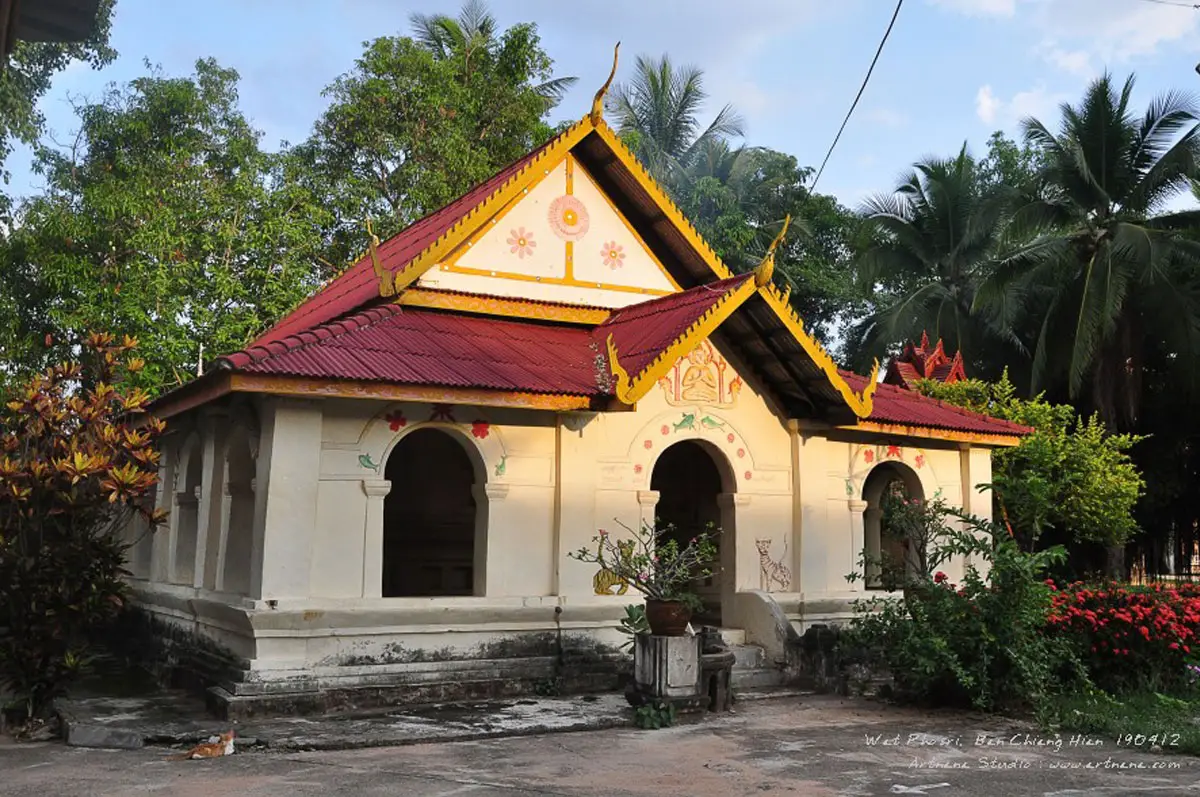
Wat Pho Si Chiang Hian is an important temple of Ban Chiang Hian and Khwao Subdistrict. Local people also call it Wat Ban Chiang Hian. The temple was founded in 1892, and its old sim, or ordination hall, began construction in 1924. This sim is one of the most important historical structures in the temple. It is a brick-and-plaster building influenced by Vietnamese craftsmanship in Isan. The villagers hired a Vietnamese craftsman named Thong, locally known as Kaeo Thong, who had moved from Ubon Ratchathani. Construction took about ten years and was completed in 1933 because the work depended on donations and community resources over time.
The old sim of Wat Pho Si Chiang Hian is valuable both artistically and historically. Its architecture reflects a mixture of local Isan craftsmanship and Vietnamese-influenced building techniques found in parts of northeastern Thailand during the later Rattanakosin period. The stucco decoration includes plant motifs, naga forms, sun imagery, geometric patterns, and other decorative details. The building remains in good condition and continues to be cared for by the temple and local community. It is therefore not only an old structure, but also a living religious space that remains connected to village life.
Pu Hai Museum was created to preserve and present ancient jars and archaeological objects found in the Ban Chiang Hian area, especially jars discovered during the widening of Chaeng Sanit Road between Maha Sarakham and Roi Et during 2005 – 2007. Local villagers respectfully call these jars “Pu Hai,” meaning ancestral jars or elder jars. They are regarded not only as archaeological objects, but also as symbolic ancestors and protectors of the community. The museum inside the temple therefore preserves both material heritage and local belief. It allows visitors to see how ancient objects become part of living community memory.
The opening ceremony of Pu Hai Museum on 6 March 2009 was an important moment for Ban Chiang Hian. It showed that the community wanted to keep its heritage in the local area rather than allowing objects to be scattered, lost, or removed from their context. Pu Hai Museum is a community museum in the strongest sense. It emerged from the temple, the villagers, local belief, and the recognition that ancient objects should remain connected with the place and people to which they belong. Each object in the museum therefore carries not only historical value, but also social and emotional meaning.
The temple gate with the Three-Boss Gong is another major symbol of Wat Pho Si and Ban Chiang Hian. The gong sculpture on the gate is a replica inspired by the legendary three-boss gong believed to remain in Sa Kaeo pond. Because the original could not be brought up, Ajarn Boonman Kham Sa-ard and local residents agreed to create a replica. Craftsman Sangiam Upachit made the gong form for the temple gate so that younger generations could see and remember the importance of Ban Chiang Hian as an old town. This gateway functions as a visual statement of local identity.
The legend of the Three-Boss Gong tells that the gong dates back to the time of Khmer rule and belonged to Phaya Chiang Hian, the ruler of Chiang Hian. When war came and the ruler believed the city could not withstand the attack, he took valuable objects and threw them into Sa Kaeo pond, including the three-boss gong. This type of story is common in ancient town traditions, where sacred objects or royal treasures are hidden in water during times of danger. Sa Kaeo is therefore remembered not as an ordinary pond, but as a sacred and historical place within the community’s imagination.
Another part of the legend says that in the time of the elders, Pho Yai On and Pho Sang Rattanaphonsaen went fishing at Sa Kaeo during the dry season. The water level was shallow, about half a shin deep. When Pho Yai On used a pointed tool to catch an eel, it struck the gong. Seeing that the gong was unusual because it had three bosses, he reported the discovery to the village headman and villagers. Since then, the story has been remembered and passed down. Although the original gong is believed to remain in the pond, the replica at the temple gate allows visitors and villagers to see the symbol of this story.
The belief in the Three-Boss Gong helps visitors understand how Ban Chiang Hian remembers its own past. The community does not preserve history only through documents and archaeological reports. It also preserves the past through legend, symbols, sacred objects, and shared memory. The gong replica at the temple gate is therefore more than decoration. It tells visitors that this is not an ordinary temple, but a temple of an ancient community with stories of an old town, a sacred pond, Pu Hai, and memories passed down through many generations.
The archaeological evidence of Ban Chiang Hian is highly significant for the study of Isan history. At least two major excavations have been carried out. The first was conducted during 1974 – 1975 by Chester Gorman and Pisit Charoenwong. That excavation proposed an early occupation date of around 3500 BC, or approximately 5,500 years ago, although that dating has not been widely accepted by all scholars. Nevertheless, the excavation uncovered many prehistoric objects, including human skeletons buried with bronze objects, and evidence of continuous occupation into the early historic period.
The second excavation was conducted in 1981 by archaeologists from the Archaeology Division of the Fine Arts Department, led by Ampan Kitngam. The excavation found cultural layers about six meters deep. The lowest layer indicated occupation in the late prehistoric period, dated around 3,300 to 2,000 years ago. Finds included bronze tools, iron tools, bone tools, glass beads, shell beads, and six burial pits. The middle layer belonged to the historic period, around 2,000 to 1,500 years ago, with coarse earthenware, hard-bodied pottery, and objects related to ancient Khmer cultural influence. The upper layer contained evidence of later and modern occupation.
This evidence makes Ban Chiang Hian an important archaeological site because it shows continuous occupation from the late prehistoric period into the historic period and down to the present community. Burial pits, metal tools, beads, pottery, and ancient jars all point to a community with ritual practices, craft knowledge, technology, exchange networks, and social development. A visit to Pu Hai Museum and Wat Pho Si should therefore be understood within this broader archaeological context, not merely as a visit to a small village temple.
The term “Pu Hai” carries deep meaning. The word “Pu” is used to show respect for something old and ancestral. The jars are therefore not treated as ordinary ceramic vessels. They are remembered as representatives of those who came before, as signs of the ancient town, and as memory buried beneath the earth. When the jars were brought into the temple museum, they moved from archaeological discovery into sacred and educational space. The community can now pay respect, learn, and tell its story through Pu Hai.
The main visitor zones at Wat Pho Si and Pu Hai Museum should begin with the Three-Boss Gong gate, which introduces the legend of old Chiang Hian. Visitors can then continue to the old sim to study its Vietnamese-influenced Isan craftsmanship. After that, Pu Hai Museum offers a chance to see ancient jars, archaeological objects, and the Pu Hai figure. The wider temple grounds should also be understood within the ancient town landscape. If time allows, visitors can connect the route with Sa Kaeo, nearby water bodies, and Ban Chiang Hian Museum to gain a fuller picture of the community.
Wat Pho Si and Pu Hai Museum are suitable for visitors interested in local history, archaeology, Isan temple architecture, folk legends, and community-based learning. General visitors may spend one to two hours seeing the temple, old sim, and museum. Those who want to understand the ancient town and visit Ban Chiang Hian Museum should plan a half-day trip. The story of this place includes objects, architecture, landscape, sacred belief, oral tradition, and archaeological evidence, so slow and attentive visiting is recommended.
One important point to observe is the close relationship between the temple and the ancient town. Wat Pho Si is not separated from village life. The old sim, Pu Hai Museum, Three-Boss Gong gate, sacred areas, and villagers’ homes are all part of the same landscape. This shows that local culture is not isolated in a formal museum. It remains in a place where people make merit, worship, meet, and continue to tell stories about their community.
Ban Chiang Hian is also connected with Isan folk literature and foundation legends, including Phadaeng-Nang Ai, Nong Han, Fa Daet Sung Yang, and other ancient towns remembered in oral traditions. These legends add literary and symbolic dimensions to the archaeological landscape. In Isan, legend does not replace history, but it preserves memory and explains relationships between people, towns, water, land, and sacred power. Ban Chiang Hian is therefore best understood through both archaeology and storytelling.
Interpreting Ban Chiang Hian requires a multi-layered approach. Archaeological evidence explains dates, soil layers, burials, tools, and artifacts. The legends of the Three-Boss Gong, Pu Hai, and Phaya Chiang Hian explain memory, identity, and faith. Wat Pho Si and Pu Hai Museum allow these two kinds of knowledge to coexist. Visitors who see both dimensions will understand the community more deeply than by treating it only as an archaeological site or only as a temple.
Getting There is convenient from Maha Sarakham city. From the clock tower roundabout, take National Highway 23, or Chaeng Sanit Road, eastward toward Roi Et for about 8.4 km. Wat Pho Si Chiang Hian is on the left side of the road. The temple is located within Ban Chiang Hian community. Travelers without a private car can reach Maha Sarakham city or the provincial bus terminal first, then continue by hired local transport to Ban Chiang Hian.
Visitors should prepare as they would for a temple and archaeological site. Dress respectfully, speak politely, do not touch ancient objects, jars, or architectural elements without permission, do not climb on the old sim, moats, or embankments, and contact the temple in advance if you wish to enter the sim. Respectful visiting helps preserve both the heritage objects and the relationship between visitors and the local community.
The best time to visit is from morning to mid-afternoon because the site is open until 16.30. Visiting in the morning gives enough time to see the old sim, Pu Hai Museum, and the surrounding temple area without rushing. For photography, softer light in the morning or late afternoon is preferable for the Three-Boss Gong gate, the old sim, and the temple atmosphere. Visitors who want detailed explanations should contact the temple or local community in advance.
Nearby attractions can be combined into the same route. These include the ancient Ban Chiang Hian community, Ban Chiang Hian Museum, local pottery or village product areas, Wat Pa Wang Nam Yen, Wat Mahachai Museum in the city, Maha Sarakham City Pillar Shrine, the night market, and Maha Sarakham Clock Tower. This route is suitable for travelers who want to understand Maha Sarakham from the level of an ancient community to the present city.
Food options near Ban Chiang Hian include local restaurants and restaurants in Maha Sarakham city. A nearby local stop is Kai Op Ong Ban Chiang Hian. In the city, visitors can choose In Mahasarakham, Oksang Food Food Station by Mum Aroi, Yaowarat, and Farmsook Cafe & Restaurant. Those who want to save time can eat near Ban Chiang Hian or on the return route, while those who want more choices can return to central Maha Sarakham.
Accommodation is mostly located in Maha Sarakham city because Ban Chiang Hian is only about 8 km from the urban area. Visitors can stay in the city and make a half-day visit to Wat Pho Si and Pu Hai Museum. Suitable accommodation options include Top Inn Hotel Mahasarakham, Taksila Hotel, Wichaya Place, Ketsara Hotel, and HOP INN Mahasarakham. Staying in the city also makes it easy to visit Wat Mahachai Museum, Mahasarakham City Museum, the night market, and central restaurants.
Overall, Wat Pho Si and Pu Hai Museum tell the story of Maha Sarakham in great depth. Many layers of history meet here: late prehistoric settlement, early historic occupation, Dvaravati-related town planning, ancient Khmer influence, the legend of Phaya Chiang Hian, the Three-Boss Gong, Pu Hai, the old sim, and the modern community museum. Visitors will see that the past is not far away. It remains present in the temple, gateway, pond, ancient jars, and the words of local people.
In conclusion, Wat Pho Si and Pu Hai Museum in Ban Chiang Hian are highly valuable cultural and archaeological destinations in Maha Sarakham Province. Within one site, visitors can see an old sim begun in 1924, Pu Hai Museum, the Three-Boss Gong gate, Pu Hai figures, the legend of Phaya Chiang Hian, Sa Kaeo pond, and the ancient Ban Chiang Hian town with its moats and embankments. This destination is suitable for travelers, students, researchers, art lovers, archaeology enthusiasts, and anyone who wants to understand the cultural roots of Ban Chiang Hian through a living community site.
| Name | Wat Pho Si And Pu Hai Museum, Ban Chiang Hian |
| Alternative Names | Wat Pho Si Chiang Hian, Wat Ban Chiang Hian, Pu Hai Museum |
| Location | Chaeng Sanit Road, Moo 3, Ban Chiang Hian, Khwao Subdistrict, Mueang Maha Sarakham District, Maha Sarakham Province |
| Address | Wat Pho Si Chiang Hian, Ban Chiang Hian, Khwao Subdistrict, Mueang Maha Sarakham District, Maha Sarakham 44000, Thailand |
| Coordinates | 16.155609, 103.372447 |
| Distance From Maha Sarakham City | About 8.4 km from Maha Sarakham Clock Tower roundabout via National Highway 23 or Chaeng Sanit Road toward Roi Et |
| Highlights | Pu Hai Museum, old sim of Wat Pho Si begun in 1924, Three-Boss Gong gate, Pu Hai figures, ancient Ban Chiang Hian town, legend of Phaya Chiang Hian, Sa Kaeo pond, and archaeological objects from the community |
| History / Importance | An important temple of Ban Chiang Hian located at the center of the ancient town, which has moats and embankments. The site preserves evidence from the late prehistoric period through the historic period and houses Pu Hai Museum, officially opened on 6 March 2009. |
| Name Origin | “Pu Hai” is the respectful local name for ancient jars found in the area, regarded as ancestral objects and sacred protectors of the community. |
| Temple History | Wat Pho Si Chiang Hian was founded in 1892, belongs to the Mahanikaya Buddhist order, received its consecrated boundary on 10 October 1914, and is locally known as Wat Ban Chiang Hian. |
| Old Sim | The old sim began construction in 1924 by a Vietnamese craftsman named Thong, locally known as Kaeo Thong. It took about ten years to complete and was finished in 1933, showing Vietnamese-influenced Isan craftsmanship. |
| Three-Boss Gong | A key symbol of Ban Chiang Hian connected with the legend of Phaya Chiang Hian and Sa Kaeo pond. The gong form on the temple gate is a replica created so later generations can remember the old town’s importance. |
| Archaeological Evidence | Excavations revealed cultural layers about six meters deep, six burial pits, bronze tools, iron tools, bone tools, glass beads, shell beads, pottery, and evidence of continuous occupation from the late prehistoric period into the historic period. |
| Travel Information | From Maha Sarakham city at the clock tower roundabout, take National Highway 23 or Chaeng Sanit Road toward Roi Et for about 8.4 km. Wat Pho Si Chiang Hian is on the left side of the road. |
| Current Status | Open as a community temple, cultural attraction, and learning site for the old sim, Pu Hai Museum, and ancient Ban Chiang Hian town. |
| Open Days | Daily |
| Opening Hours | 08.00 – 16.30. Visitors wishing to enter the old sim should contact the temple in advance. |
| Fees | No Admission Fee |
| Facilities | Temple area, parking area, toilets, worship area, old sim, Pu Hai Museum, Three-Boss Gong gate, and surrounding community area |
| Main Areas / Zones | Three-Boss Gong gate zone, old sim zone, Pu Hai Museum zone, Pu Hai figure zone, temple worship zone, ancient Ban Chiang Hian town zone, Sa Kaeo and surrounding pond zone, and Ban Chiang Hian community zone |
| Caretaker / Related Authorities | Wat Pho Si Chiang Hian, Ban Chiang Hian community, Khwao Subdistrict Administrative Organization, and related cultural and archaeological agencies |
| Abbot Of Wat Pho Si Chiang Hian | Phra Khru Phothithammanusak |
| Main Contact Number | Wat Pho Si Chiang Hian, Tel. 098-117-1722 Ban Chiang Hian Community Enterprise, Tel. 065-957-1648 Khwao Subdistrict Administrative Organization, Tel. 043-029-501 |
| Information Channels | Important Archaeological Sites Database by Princess Maha Chakri Sirindhorn Anthropology Centre, Ban Chiang Hian Wikicommunity, and local community information |
| Nearby Tourist Attractions | 1. Ancient Ban Chiang Hian Town, about 0.1 km 2. Ban Chiang Hian Museum, about 1 km 3. Pottery Village / Ban Chiang Hian Local Product Area, about 1 km 4. Wat Pa Wang Nam Yen, about 8 km 5. Wat Mahachai Museum, about 8 km 6. Maha Sarakham City Pillar Shrine, about 9 km 7. Maha Sarakham Night Market, about 9 km |
| Nearby Restaurants | 1. Kai Op Ong Ban Chiang Hian, about 1 km, Tel. 081-120-4248 2. In Mahasarakham, about 8 km, Tel. 083-265-6646, 095-624-6649 3. Oksang Food Food Station by Mum Aroi, about 8 km, Tel. 082-596-6544 4. Yaowarat, about 9 km, Tel. 089-571-6969 5. Farmsook Cafe & Restaurant Maha Sarakham, about 10 km, Tel. 064-996-6414 |
| Nearby Accommodations | 1. Top Inn Hotel Mahasarakham, about 8 km, Tel. 062-545-5622, 043-711-979 2. Taksila Hotel Maha Sarakham, about 8 km, Tel. 043-719-999 3. Wichaya Place, about 8 km, Tel. 043-712-355, 093-425-0808 4. Ketsara Hotel, about 9 km, Tel. 095-236-2395 5. HOP INN Mahasarakham, about 11 km, Tel. 065-950-4683, 02-080-2222 |
Frequently Asked Questions (FAQ)
Q: Where is Wat Pho Si And Pu Hai Museum located?
A: Wat Pho Si And Pu Hai Museum is located on Chaeng Sanit Road, Moo 3, Ban Chiang Hian, Khwao Subdistrict, Mueang Maha Sarakham District, Maha Sarakham Province, about 8.4 km from Maha Sarakham city.
Q: What are the opening hours?
A: The temple, old sim, sacred areas, and Pu Hai Museum can be visited daily from 08.00 to 16.30. Visitors who wish to enter the old sim should contact the temple in advance.
Q: Is there an admission fee?
A: No. There is no admission fee for visiting the temple, the old sim, and Pu Hai Museum.
Q: Why is Pu Hai Museum important?
A: Pu Hai Museum preserves ancient jars and objects found in Ban Chiang Hian. Local villagers respectfully call these jars “Pu Hai” and regard them as ancestral objects and sacred protectors of the community.
Q: When was the old sim of Wat Pho Si built?
A: The old sim began construction in 1924 by a Vietnamese craftsman named Thong, locally known as Kaeo Thong. It took about ten years to complete and was finished in 1933.
Q: What is the Three-Boss Gong?
A: The Three-Boss Gong is an important symbol of Ban Chiang Hian connected with the legend of Phaya Chiang Hian and Sa Kaeo pond. The gong form on the temple gate is a replica created for later generations to remember the old town’s heritage.
Q: Why is Ban Chiang Hian archaeologically important?
A: Ban Chiang Hian is an ancient town with moats and embankments. Excavations revealed evidence of continuous occupation from the late prehistoric period into the historic period, including burial pits, bronze tools, iron tools, beads, and pottery.
Q: What nearby places can visitors combine with Wat Pho Si And Pu Hai Museum?
A: Visitors can also explore the ancient Ban Chiang Hian town, Ban Chiang Hian Museum, local pottery and product areas, Wat Pa Wang Nam Yen, Wat Mahachai Museum, Maha Sarakham City Pillar Shrine, and Maha Sarakham Night Market.
 Category: ●Places of Worship
 Group: ●Temple
Last Update : 2 MonthAgo
 Last Update : 2 MonthAgo
 Click to Access the Navigation Map GPS
 Art, Culture and Heritage
 Historical Sites and Monuments(4)
 Art, Craft Centres, Tradition(5)
 Museums(3)
Temple(17)
Museums(3)
Temple(17)
 Other Sacred Sites(7)
 Research and Development
 Royal Project(2)
 Suburban Living
 Village, Community(5)
 Nature and Wildlife
 National Parks and Marine Reserves(3)
 Dam, Reservoir, Lake(10)
 River, Canal(2)
 Bays and Beaches(2)
 Other natural attractions(2)
 Entertainment and Agricultural
 Farms, Parks and Ecotourism(3)
 Travel Articles, Recipes
 Food Menu, Northeastern Recipes(1)


