
lovethailand home >Northeastern Travel Attractions >Maha Sarakham Travel Attractions >Na Chuak >Nong Mek > Dun Lam Phan Non-Hunting Area
TL;DR: Dun Lam Phan Non-Hunting Area is located at Na Chueak Subdistrict, Na Chueak District, Maha Sarakham Province, open Daily, hours 08.30 – 16.30.
Dun Lam Phan Non-Hunting Area
Open Days: Daily
Opening Hours: 08.30 – 16.30
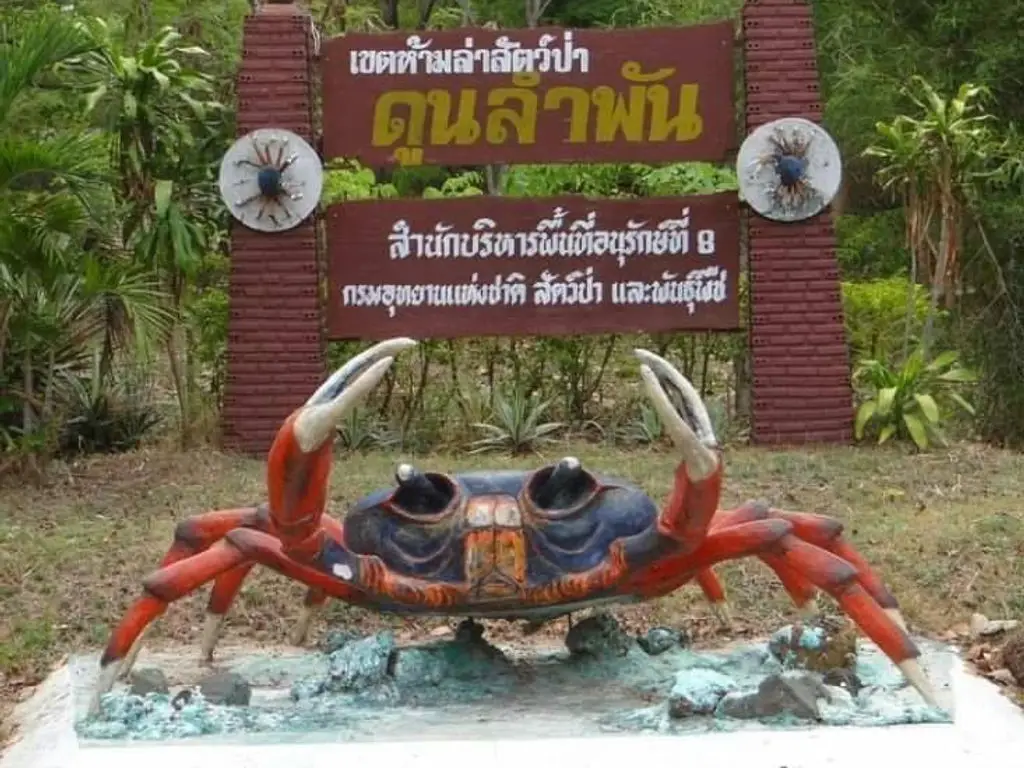
Dun Lam Phan Non-Hunting Area in Maha Sarakham Province is one of the most ecologically distinctive natural attractions in Na Chueak District. Located in Na Chueak Subdistrict, this protected area is a freshwater swamp forest and spring-fed wetland where water seeps naturally through the ground throughout the year. This unusual hydrological condition creates a moist habitat very different from the drier forest landscapes commonly associated with northeastern Thailand. The site is best known as the only natural home of the Princess Crab, locally called Pu Paeng and scientifically known as Thaipotamon chulabhorn. Because this crab is found only in Dun Lam Phan, the area has exceptional value for biodiversity, conservation, science, and responsible ecotourism.
The word “Dun” in the local Isan context refers to spring water or water rising naturally from the ground, while “Lam Phan” relates to local wetland vegetation associated with the area. Together, the name reflects the character of the place: a wet forest shaped by spring-fed water and freshwater swamp conditions. The constant moisture supports aquatic plants, wetland vegetation, small fish, crabs, insects, birds, and many other organisms. Although the protected area is not large, it is highly valuable because it preserves a rare wetland ecosystem within the Isan landscape.
The most famous species of Dun Lam Phan is the Princess Crab, or Pu Thun Kramom in Thai. Locally it is also known as Pu Paeng. This freshwater crab is larger than the common rice-field crab and has a striking body color pattern. Its shell is deep purple, while its legs and claws show shades of orange, yellow, and white. The crab is widely admired as one of the most colorful freshwater crabs in Thailand. Its most important feature, however, is not only its beauty but its extremely limited natural distribution. It is found only in the Dun Lam Phan area.
The Princess Crab was scientifically examined in 1993 and given the scientific name Thaipotamon chulabhorn. The Thai name reflects its national importance and its connection with the conservation identity of Maha Sarakham. Because the crab depends directly on the wetland, soil moisture, water quality, burrows, and surrounding vegetation, protecting the crab also means protecting the entire habitat. Visitors should therefore understand that this is not a place for handling wildlife. It is a site for learning how a small wetland can support a species found nowhere else.
Dun Lam Phan Non-Hunting Area covers about 343 rai. Its size is modest when compared with large national parks, but its conservation value is very high. It functions as a living natural laboratory where visitors can see the relationships among water, soil, plants, animals, and local knowledge. Wetland ecosystems of this type are sensitive to environmental change. Changes in water level, pollution, sedimentation, waste, or disturbance can directly affect the species that live there, especially the endemic Princess Crab.
Besides the Princess Crab, the area is known for several unusual plants and animals, including lam phan or cattail-like wetland plants, het lap mushrooms, local fish such as pla kho kang, reptiles such as ngu kha, birds, insects, aquatic animals, and many small organisms associated with freshwater swamp habitats. These species make the area an excellent learning site for visitors who want to understand the hidden diversity of Isan wetlands.
The spring-fed character of the forest makes the atmosphere different from dry dipterocarp or mixed deciduous forests. The area contains wet ground, ponds, aquatic plants, shaded forest, and soft moisture that remains even in drier periods. This creates a cool and quiet environment suitable for nature walking, birdwatching, environmental education, and careful photography. Visitors who walk slowly will notice that the value of the place lies in small details: water movement, plant texture, crab burrows, bird sounds, and the relationship between land and water.
The term “non-hunting area” is important. It means the site is protected for wildlife and habitat conservation. Visitors are welcome for learning and nature appreciation, but wildlife and plants must not be disturbed. The area is not intended for collecting animals, catching crabs, digging burrows, picking plants, or entering sensitive wetland zones without permission. Responsible behavior is essential because even small disturbances can affect fragile wetland life.
A typical visit should allow at least 1 to 2 hours. Visitors can begin at the contact point, learn about the Princess Crab, walk along the nature trail, observe the wetland vegetation, visit learning points, and enjoy the calm forest atmosphere. School groups, university groups, researchers, or organized ecotourism groups should contact the site in advance so that officers can provide proper guidance and help visitors understand the rules of the protected area.
The best time to visit is in the morning or early afternoon. The site is open daily from 08.30 to 16.30. Morning light is suitable for nature photography, and the temperature is more comfortable for walking. Visitors who hope to observe wildlife should remain quiet and patient. The Princess Crab should never be chased, touched, dug out, or disturbed for photographs. The most respectful way to experience the place is to observe the habitat and follow officer guidance.
Seasonality affects the experience. During the rainy season, the wetland becomes fresh and green, and many plants and aquatic organisms are more active. During the dry season, the importance of spring-fed water becomes clearer because the surrounding landscape may become drier while Dun Lam Phan still retains moisture. This contrast helps visitors understand why the site is so ecologically important.
For education, Dun Lam Phan is suitable for learning about wetland ecology, spring-fed forests, endemic species, protected wildlife, water quality, local biodiversity, and the relationship between communities and natural resources. It teaches an important lesson: a small area can have global conservation significance when it is the only home of a unique species. This makes Dun Lam Phan especially valuable for students, scientists, conservation workers, and international visitors interested in biodiversity.
Visitors should follow strict etiquette. Do not collect plants, catch aquatic animals, disturb crab burrows, leave waste, enter wetland zones without permission, bring pets into sensitive natural areas, or release non-native animals. Do not use loud sound or behave in a way that disturbs wildlife. The goal of visiting should be learning, not extraction. The survival of the Princess Crab depends on clean water, stable habitat, and respectful human behavior.
For international travelers, Dun Lam Phan can be described as a spring-fed freshwater swamp forest and non-hunting area in Maha Sarakham. Its most important species is the Princess Crab, or Mealy Crab, an endemic freshwater crab found only in this small wetland. This explanation helps foreign readers understand why the site is important even though it is not a large national park or a dramatic mountain destination. Its value lies in rarity, ecological sensitivity, and the uniqueness of its wildlife.
Getting There is most convenient by private car. Travel to Na Chueak District in Maha Sarakham Province, then continue along the Na Chueak – Phayakkhaphum Phisai route or local roads in Na Chueak Subdistrict to reach Dun Lam Phan Non-Hunting Area. The site is about 3 km from Na Chueak District center. Travelers coming from Maha Sarakham city can use routes via Borabue and Na Chueak, or connect from nearby districts using online maps and local road signs.
A half-day route can combine Dun Lam Phan with Saphan Mai Hug Na Chueak, Huai Kho Reservoir, and local restaurants in Na Chueak. A full-day route can continue to Phra That Na Dun, Walai Rukhavej Botanical Research Institute, Ku Santarat, or Ban Khok Kong Arts and Crafts Promotion Center. This allows travelers to experience nature, wetlands, Buddhist heritage, archaeology, and local craftsmanship in one journey.
Overall, Dun Lam Phan Non-Hunting Area is one of the most meaningful nature destinations in Maha Sarakham. It protects a rare spring-fed wetland, unusual plants and animals, and the only known natural habitat of the Princess Crab. Visitors who come with respect will gain more than photographs. They will learn how a small wetland can carry scientific value, conservation importance, and community pride. By following the rules and avoiding disturbance, every visitor helps keep Dun Lam Phan alive for future generations.
| Name | Dun Lam Phan Non-Hunting Area / Chulabhorn Forest Park |
| Location | Na Chueak Subdistrict, Na Chueak District, Maha Sarakham Province |
| Address | Na Chueak – Phayakkhaphum Phisai Road, Na Chueak Subdistrict, Na Chueak District, Maha Sarakham 44170, Thailand |
| Highlights | Spring-fed freshwater swamp forest and the only natural habitat of the Princess Crab, with rare wetland plants and wildlife |
| Area | About 343 rai |
| Ecosystem Features | Spring-fed wetland, freshwater swamp forest, ponds, moist soil, aquatic plants, shaded natural forest, and sensitive habitat for endemic species |
| Notable Wildlife | Princess Crab or Pu Paeng, scientific name Thaipotamon chulabhorn, an endemic colorful freshwater crab found only in Dun Lam Phan |
| Rare Plants And Animals | Lam phan or cattail-like wetland plants, het lap mushrooms, pla kho kang, ngu kha, Princess Crab, birds, insects, aquatic animals, and small wetland wildlife |
| Recommended Activities | Nature walking, birdwatching, wetland ecology learning, Princess Crab interpretation, responsible photography, and environmental education |
| Visitor Etiquette | Do not catch crabs, collect aquatic animals, pick plants, enter wetland zones without permission, leave waste, release non-native animals, or disturb wildlife and crab burrows |
| Travel Information | Travel by private car to Na Chueak District, then continue along the Na Chueak – Phayakkhaphum Phisai route or local roads to the site. It is about 3 km from Na Chueak District center. |
| Current Status | Open as a non-hunting area, nature learning site, and ecotourism destination in Na Chueak District |
| Open Days | Daily |
| Opening Hours | 08.30 – 16.30 |
| Facilities | Officer contact point, nature trail, Princess Crab learning area, wetland learning zones, rest areas, and ecology interpretation points |
| Main Areas / Zones | Nong Dun zone, spring-fed wetland zone, lam phan vegetation zone, Princess Crab habitat zone, nature trail zone, birdwatching zone, and officer contact zone |
| Caretaker / Related Authority | Dun Lam Phan Non-Hunting Area, Protected Area Regional Office 8 (Khon Kaen), Department of National Parks, Wildlife and Plant Conservation, and local agencies in Na Chueak District |
| Contact Number | Dun Lam Phan Non-Hunting Area, Tel. 086-631-5556 Additional Travel Information, Tel. 081-799-5795, 081-817-9441 |
| Official Website / Official Page | Dun Lam Phan Non-Hunting Area, Tourism Authority of Thailand, Thailand Tourism Directory, and wildlife conservation information networks |
| Nearby Tourist Attractions | 1. Na Chueak District Center, about 3 km 2. Saphan Mai Hug Na Chueak, about 6 km 3. Huai Kho Reservoir, about 10 km 4. Ban Khok Kong Arts And Crafts Promotion Center, about 25 km 5. Phra That Na Dun, about 35 km 6. Walai Rukhavej Botanical Research Institute, about 36 km 7. Ku Santarat, about 40 km 8. Wat Pa Kung or Wat Prachakhom Wanaram, about 45 km |
| Nearby Restaurants | 1. Jim Jum Indy Na Chueak, about 4 km, Tel. 064-337-8562 2. Shabu Thai Ban Na Chueak Branch, about 4 km, Tel. 065-686-6132 3. Krua Mae Tik At Mom Tik Camp Hotel, about 5 km, Tel. 065-119-1471 4. Avocado Cafe Na Chueak Branch, about 5 km, Tel. 065-886-6978 5. Mum Sabai Chai Thung, about 8 km, Tel. 088-887-9944 6. 4 NAKA CAFE 2465, about 25 km, Tel. 083-369-0694 |
| Nearby Accommodations | 1. Mom Tik Camp Hotel Na Chueak, about 5 km, Tel. 065-119-1471 2. Oslo Resort Na Chueak, about 5 km, Tel. 086-797-9504 3. Tantawan Resort Na Chueak, about 6 km 4. Lookkaew Resort Na Dun Branch, about 35 km, Tel. 043-020-442 5. Piang Fah Resort Na Dun, about 36 km, Tel. 081-617-1213, 043-797-051 6. INAKA Resort Na Dun, about 38 km, Tel. 089-518-7526 |
Frequently Asked Questions (FAQ)
Q: Where is Dun Lam Phan Non-Hunting Area located?
A: Dun Lam Phan Non-Hunting Area is located in Na Chueak Subdistrict, Na Chueak District, Maha Sarakham Province, about 3 km from Na Chueak District center.
Q: Why is Dun Lam Phan important?
A: It is a spring-fed freshwater swamp forest and the only natural habitat of the endemic Princess Crab, making it one of Maha Sarakham’s most important ecological learning sites.
Q: What is the Princess Crab?
A: The Princess Crab, locally called Pu Paeng, is a colorful freshwater crab with the scientific name Thaipotamon chulabhorn. It is found only in the Dun Lam Phan wetland area.
Q: What are the opening hours?
A: The site is open daily from 08.30 to 16.30.
Q: What can visitors see inside the area?
A: Visitors can see spring-fed wetland habitats, Nong Dun, lam phan wetland plants, het lap mushrooms, pla kho kang, ngu kha, Princess Crab learning points, nature trails, and birdwatching areas.
Q: Can visitors touch or catch the Princess Crab?
A: No. Visitors should not touch, catch, dig for, chase, or disturb the crab or its burrows. The species is endemic and its habitat is highly sensitive.
Q: How can travelers get there?
A: Private car is the most convenient option. Travel to Na Chueak District, then continue along the Na Chueak – Phayakkhaphum Phisai route or local roads to Dun Lam Phan Non-Hunting Area.
Q: What nearby places can travelers visit after Dun Lam Phan?
A: Travelers can continue to Saphan Mai Hug Na Chueak, Huai Kho Reservoir, Ban Khok Kong Arts and Crafts Promotion Center, Phra That Na Dun, Walai Rukhavej Botanical Research Institute, and Ku Santarat.
 Category: ●Nature and Wildlife
 Group: ●National Parks and Marine Reserves
Last Update : 2 MonthAgo
 Last Update : 2 MonthAgo
 Click to Access the Navigation Map GPS
Dun Lam Phan Non-Hunting Area Map

 Art, Culture and Heritage
 Historical Sites and Monuments(4)
 Art, Craft Centres, Tradition(5)
 Museums(3)
 Places of Worship
 Temple(17)
 Other Sacred Sites(7)
 Research and Development
 Royal Project(2)
 Suburban Living
 Village, Community(5)
National Parks and Marine Reserves(3)
Village, Community(5)
National Parks and Marine Reserves(3)
 Dam, Reservoir, Lake(10)
 River, Canal(2)
 Bays and Beaches(2)
 Other natural attractions(2)
 Entertainment and Agricultural
 Farms, Parks and Ecotourism(3)
 Travel Articles, Recipes
 Food Menu, Northeastern Recipes(1)


