
lovethailand home >Northeastern Travel Attractions >Maha Sarakham Travel Attractions >Muang Maha Sarakham >Talat > Wat Mahachai Museums
TL;DR: Wat Mahachai Museums is located at Wat Mahachai Royal Monastery, Talat Subdistrict, Mueang Maha Sarakham District, Maha Sarakham Province, open Daily, hours 09.00 – 16.00. Visitors should contact the museum in advance before visiting.
Wat Mahachai Museums
Open Days: Daily
Opening Hours: 09.00 – 16.00. Visitors should contact the museum in advance before visiting.
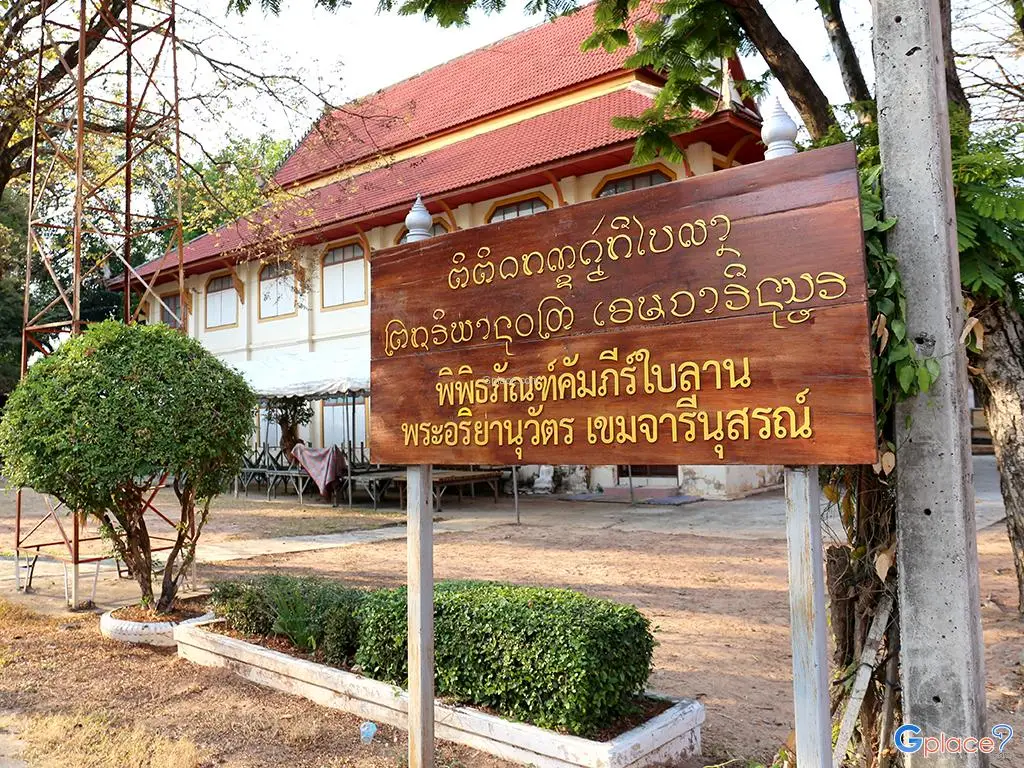
Wat Mahachai Museum, officially known as the Local Museum of Northeastern Thailand at Wat Mahachai, is one of the most important cultural learning sites in Maha Sarakham Province. Located inside Wat Mahachai Royal Monastery in Talat Subdistrict, Mueang Maha Sarakham District, the museum stands in the heart of the city and is closely connected with the history of Maha Sarakham itself. It is not simply a place where old objects are stored. It is a living archive of northeastern Thai archaeology, Buddhism, local literature, palm-leaf manuscripts, woodcarving, folk craftsmanship, and the cultural memory of Isan.
The museum preserves and displays a wide range of valuable objects from northeastern Thailand, including Dvaravati stone boundary markers, ancient Buddha images, carved wooden Buddha images, pottery, brown-glazed jars from the Buriram kiln tradition, deity figures, carved wooden architectural elements, gilded manuscript cabinets, ancient documents, palm-leaf scriptures, old temple doors, and carved wooden brackets that are approximately 100 to 200 years old. These objects allow visitors to understand Isan through real evidence, rather than through general descriptions alone.
Wat Mahachai is one of the most historically important temples in Maha Sarakham. It was originally known as Wat Nuea and was founded around the same time as the establishment of Maha Sarakham city in 1865. The temple was built by Phra Charoen Ratchadet, also known as Kuat, the first ruler of Maha Sarakham, together with local residents. It served as a principal temple of the new town. In 1929, Phra Sarakham Muni, the 18th abbot of the temple, changed the name from Wat Nuea to Wat Mahachai. On 27 February 1984, the temple was elevated to the status of a third-class royal monastery of the ordinary type. This long history makes Wat Mahachai both a religious center and a historical landmark of the province.
The origin of the museum is closely connected with Phra Ariyanuwat Khemachari, the 19th abbot of Wat Mahachai and one of the most important cultural figures in Maha Sarakham. He recognized that many local antiquities and cultural objects from Isan were being purchased and removed from the region. To prevent the loss of this heritage, he began collecting local antiquities in 1964. He later worked with Maha Sarakham Teachers College to establish a center for the conservation of local literature. In 1966, this effort developed into the Northeastern Local Cultural Center.
In 1982, the Department of Religious Affairs under the Ministry of Education formally established the site as the Local Museum of Northeastern Thailand. Maha Sarakham University and the former Rajabhat Institute supported the museum so that it could serve as a research and learning center for students, monks, scholars, and the general public. From the beginning, the museum has functioned as a place of preservation, study, and cultural transmission. It safeguards objects, manuscripts, and knowledge that help explain the long cultural history of Isan.
The museum building is located in Ho Sarakham Muni, a two-storey Thai applied-style building with a cruciform plan. It was built in 1966 and also functions as a memorial space dedicated to Phra Sarakham Muni, a former abbot of Wat Mahachai and former ecclesiastical governor of Maha Sarakham Province. The building was renovated from 2020 and reopened after restoration in August 2022. The improved exhibition space allows visitors to study the collections more clearly while preserving the atmosphere of a temple-based local museum.
What makes Wat Mahachai Museum especially valuable is that many of the displayed objects are rooted in local communities and the broader Isan region. They are not just old things in glass cases. They are historical witnesses from many periods, including the prehistoric era, the Dvaravati period, the ancient Khmer period, the Lan Xang cultural sphere, and the period when Siamese influence became stronger in northeastern Thailand. A visit to the museum is therefore like walking through layers of Isan history through pottery, boundary stones, Buddha images, manuscripts, jars, woodcarving, and ritual objects.
The Dvaravati stone boundary markers are among the most important objects. In Buddhist culture, boundary markers are associated with sacred space and ritual areas. Many parts of Isan have yielded stone sema that indicate early Buddhist communities, religious practice, and artistic development. Seeing these objects at Wat Mahachai Museum helps visitors understand that northeastern Thailand has a deep religious and cultural past. Isan was never an empty or peripheral region; it was a land of active communities, religious expression, and artistic production.
The museum’s ancient Buddha images and carved wooden Buddha figures are also significant. Each image reflects a particular artistic style, religious feeling, and local technique. Some figures show the simplicity of folk craftsmanship, while others reveal broader cultural influences that entered the region through religious and political connections. The carved wooden Buddha images are especially meaningful because they show how local artisans used available materials to create sacred objects of beauty and devotion. For visitors, these images are both objects of faith and documents of art history.
The pottery collection provides another view of ancient life. Some vessels date from the prehistoric period, while others belong to later historical periods. Brown-glazed jars from the Buriram kiln tradition, dating around the 16th to 17th Buddhist centuries, show the technological skill and regional exchange networks of the past. Pottery is often one of the most direct ways to understand everyday life. It tells us how people stored food, used water, traded goods, performed rituals, and interacted with other communities.
Palm-leaf manuscripts and ancient documents form one of the museum’s most important collections. Many palm-leaf manuscripts are carefully preserved in tall glass cabinets and wrapped in beautifully patterned manuscript cloths. These manuscripts are evidence of the written culture of Isan. They record Buddhist teachings, local literature, ritual knowledge, moral stories, traditional medicine, and community wisdom. For researchers interested in Isan literature, old scripts, Buddhist education, or local intellectual history, this collection has considerable value.
The old doors and carved wooden brackets, some approximately 100 to 200 years old, reveal another dimension of Isan temple art. Wooden brackets, known in Thai as khan thuai, are architectural support elements often carved with decorative and symbolic motifs. They may show floral patterns, mythical creatures, or local designs. These pieces demonstrate that temple art was not limited to Buddha images or murals. It also existed in the detailed wooden components of temple buildings, where local artisans expressed their skill, faith, and aesthetic sense.
Gilded manuscript cabinets are also important because they represent the traditional way temples protected sacred texts. Such cabinets were used to store Buddhist scriptures and palm-leaf manuscripts. Their decoration reflects respect for the Dhamma and the high value placed on religious knowledge. In earlier times, temples were centers of education, literacy, manuscript preservation, and moral instruction. The manuscript cabinets in the museum help visitors understand the role of the temple as a knowledge institution long before modern schools became widespread.
Wat Mahachai Museum is therefore an excellent place for travelers who want to understand Isan beyond food, music, or festivals. The objects answer important questions: How did people in this region live? What did they believe? What kinds of vessels did they use? How did they make Buddhist images? How did they preserve sacred texts? How was local literature transmitted? The museum brings together the memory of the city, the temple, scholars, monks, and local communities in one compact but meaningful space.
For general visitors, the best way to experience the museum is to begin with Wat Mahachai itself. Understanding the temple as a historic royal monastery and city temple gives context to the museum. Visitors can then enter the museum building and move through the exhibition areas. The lower floor includes important objects such as manuscript cabinets, pottery, glazed jars, palm-leaf manuscripts, and temple-related objects. The upper floor contains various display cases, including grinding stones, pottery, large shells, Buddha images, deity figures, and many glazed jars. Slow observation is recommended because small details often reveal the greatest value.
Visitors interested in history should pay attention to how the museum connects ancient settlement, Buddhism, and the development of Maha Sarakham as a city. The museum’s story extends from prehistoric communities to the founding of Maha Sarakham during the reign of King Rama IV and the later development of the province. When this history is read together with the story of Wat Mahachai, it becomes clear that the temple served as a religious center, an educational center, and a place of collective memory.
Visitors interested in language and literature should spend time with the palm-leaf manuscripts. Each manuscript reflects a complex process: preparing palm leaves, inscribing letters, preserving the leaves, wrapping them in cloth, and storing them in manuscript cabinets. The palm-leaf tradition was central to the transmission of Buddhist teachings, Jataka stories, local literature, ritual texts, medical knowledge, and community wisdom. Wat Mahachai Museum preserves this tradition in a form that can still be studied today.
Those interested in art should look closely at the carved doors, wooden brackets, wooden Buddha images, and local sculptures. Folk art is not always about perfect formal proportion. Its value lies in sincerity, material knowledge, local interpretation, and devotion. Many works in the museum carry the feeling of community craftsmanship. They show how local artisans expressed Buddhist faith through wood, clay, stone, and everyday materials.
The museum is also suitable for families and students. Children can see real objects connected with history, art, language, and social studies. Adults can explain the role of temples, palm-leaf manuscripts, and local museums in preserving community knowledge. Elderly visitors may find the atmosphere familiar because it reflects the older relationship between temples and community life. A visit does not require many hours, but it offers a deep and meaningful learning experience.
Getting There is straightforward because the museum is located in central Maha Sarakham. The site is inside Wat Mahachai Royal Monastery on Si Ratchawong Road, Talat Subdistrict, Mueang Maha Sarakham District. Travelers arriving by bus can continue from Maha Sarakham Bus Terminal by local taxi or hired vehicle. Those driving can navigate directly to Wat Mahachai. The location is convenient for a city itinerary that combines temple visits, museum learning, local food, and nearby landmarks.
Nearby attractions can easily be combined with the museum. Maha Sarakham Clock Tower, the night market, Maha Sarakham City Pillar Shrine, Phra Prathan Kantharawichai, Khlong Somthawin, Queen Sirikit Health Park, and Maha Sarakham City Museum are all in or near the municipal area. Visitors can begin at Wat Mahachai in the morning, continue to central city landmarks, have lunch nearby, and end the day at the night market or Khlong Somthawin.
The area around Wat Mahachai has restaurants and accommodations because it is located in the city center. Travelers can choose from local food shops, Thai restaurants, cafes, noodle shops, and the night market. Accommodation options include city hotels, daily apartments, budget hotels, and mid-range hotels. Staying in central Maha Sarakham makes it easy to visit the museum, temples, markets, restaurants, and public landmarks without long travel time.
Visitors should dress respectfully because the museum is located inside a temple. Contacting the museum in advance is recommended. Do not touch objects without permission, do not open display cases, avoid using flash on sensitive manuscripts or objects, and keep the exhibition area quiet. Proper conduct helps preserve the objects for future generations and respects the religious environment of Wat Mahachai.
Wat Mahachai Museum is a strong example of a local museum created from concern for cultural loss. It did not begin as a large state museum. It began with the effort of a monk and a community that wanted to protect local heritage from disappearance. Because of this origin, the museum has strong emotional value. Its objects are not only historical evidence; they are cultural memories deliberately saved for future study.
In conclusion, Wat Mahachai Museum in Maha Sarakham is a highly valuable cultural and historical destination. It preserves stone boundary markers, ancient Buddha images, wooden Buddha figures, pottery, glazed jars, palm-leaf manuscripts, manuscript cabinets, carved wooden doors, and architectural woodcarvings that tell the story of Isan in detail. It is suitable for travelers, students, scholars, Buddhist visitors, art lovers, and anyone who wants to understand Maha Sarakham through authentic cultural evidence preserved in one of the province’s most important temples.
| Name | Wat Mahachai Museum, officially the Local Museum of Northeastern Thailand at Wat Mahachai |
| Location | Wat Mahachai Royal Monastery, Talat Subdistrict, Mueang Maha Sarakham District, Maha Sarakham Province |
| Address | Wat Mahachai Royal Monastery, Si Ratchawong Road, Talat Subdistrict, Mueang Maha Sarakham District, Maha Sarakham 44000, Thailand |
| Coordinates | 16.184425403019, 103.30691216981 |
| Highlights | Dvaravati stone boundary markers, ancient Buddha images, carved wooden Buddha images, pottery, brown-glazed Buriram kiln jars, palm-leaf manuscripts, ancient documents, gilded manuscript cabinets, old doors, and carved wooden brackets |
| History / Importance | The collection began in 1964 under Phra Ariyanuwat Khemachari, developed into the Northeastern Local Cultural Center in 1966, and was established as the Local Museum of Northeastern Thailand in 1982. |
| Name Origin | The museum is named after Wat Mahachai Royal Monastery, formerly Wat Nuea, the historic city temple of Maha Sarakham. |
| Building Style | Two-storey Thai applied-style museum building with a cruciform plan inside Ho Sarakham Muni, built in 1966 and reopened after renovation in 2022 |
| Exhibition Categories | Archaeology, Buddhism, religious belief, ritual objects, important local figures, ancient documents, sacred objects, Buddha images, pottery, and traditional woodcarving |
| Travel Information | From Maha Sarakham Bus Terminal, take a local taxi or hired vehicle to Wat Mahachai on Si Ratchawong Road in central Maha Sarakham. Private cars can drive directly into the city center. |
| Current Status | Open as a local museum and cultural learning site inside Wat Mahachai Royal Monastery |
| Open Days | Daily |
| Opening Hours | 09.00 – 16.00. Visitors should contact the museum in advance before visiting. |
| Fees | No Admission Fee |
| Facilities | Temple area, nearby parking, toilets, worship areas, museum exhibition space, and visitor contact point before entry |
| Main Areas / Zones | Ho Sarakham Muni zone, lower-floor exhibition zone, upper-floor exhibition zone, palm-leaf manuscript and ancient document zone, Buddha image and sculpture zone, pottery and glazed jar zone, outdoor stone boundary marker zone, and temple worship zone |
| Caretaker / Related Authorities | Wat Mahachai Royal Monastery, with academic and cultural networks supporting preservation and museum information |
| Abbot Of Wat Mahachai | Phra Thamma Wacharachan (Noi Yanawuttho) |
| Main Contact Number | 084-654-1946, Phra Palat Thinphon Chayaphiphu |
| Official Information Channels | Museum Database in Thailand by Princess Maha Chakri Sirindhorn Anthropology Centre and Wat Mahachai Virtual Museum |
| Nearby Tourist Attractions | 1. Maha Sarakham Clock Tower, about 0.8 km 2. Maha Sarakham Night Market, about 1 km 3. Maha Sarakham City Pillar Shrine, about 1 km 4. Phra Prathan Kantharawichai, about 1.5 km 5. Khlong Somthawin, about 1.5 km 6. Queen Sirikit Health Park, about 2 km 7. Maha Sarakham City Museum, about 2 km |
| Nearby Restaurants | 1. Mahachai Cafe Chicken Rice, about 0.1 km, Tel. 095-185-2888, 083-456-7197 2. In Mahasarakham, about 1 km, Tel. 083-265-6646, 095-624-6649 3. Oksang & Coffee In Mind By Mum Aroi, about 1.3 km, Tel. 082-596-6544 4. Yaowarat, about 1.5 km, Tel. 089-571-6969 5. Farmsook Cafe & Restaurant Maha Sarakham, about 8 km, Tel. 064-996-6414 |
| Nearby Accommodations | 1. Wichaya Place, about 1 km, Tel. 043-712355, 093-4250808 2. Taksila Hotel Maha Sarakham, about 1.2 km, Tel. 043-719999 3. B&B Studio Room Hotel, about 2 km, Tel. 091-015-5115 4. Ketsara Hotel, about 2.5 km, Tel. 095-236-2395 5. HOP INN Mahasarakham, about 4 km, Tel. 02-080-2222 |
Frequently Asked Questions (FAQ)
Q: Where is Wat Mahachai Museum located?
A: Wat Mahachai Museum is located inside Wat Mahachai Royal Monastery on Si Ratchawong Road, Talat Subdistrict, Mueang Maha Sarakham District, Maha Sarakham Province.
Q: What are the opening hours of Wat Mahachai Museum?
A: The museum is open daily from 09.00 to 16.00. Visitors should contact the museum in advance before visiting.
Q: Is there an admission fee?
A: No. Wat Mahachai Museum does not charge an admission fee.
Q: What can visitors see inside the museum?
A: Visitors can see Dvaravati stone boundary markers, ancient Buddha images, carved wooden Buddha figures, pottery, brown-glazed Buriram kiln jars, palm-leaf manuscripts, ancient documents, gilded manuscript cabinets, old doors, and carved wooden brackets.
Q: Who should visit Wat Mahachai Museum?
A: The museum is suitable for cultural travelers, students, researchers, Buddhist visitors, art lovers, and anyone interested in Isan history, palm-leaf manuscripts, local literature, and regional archaeology.
Q: Why is Wat Mahachai important to Maha Sarakham?
A: Wat Mahachai is the historic city temple of Maha Sarakham. It was founded around the same time as the establishment of the city and later became a third-class royal monastery.
Q: Who initiated the museum collection?
A: Phra Ariyanuwat Khemachari, the 19th abbot of Wat Mahachai, began collecting local antiquities, Isan literature, and palm-leaf manuscripts before the collection developed into the Local Museum of Northeastern Thailand.
Q: What nearby places can visitors combine with the museum?
A: Visitors can also explore Maha Sarakham Clock Tower, the night market, Maha Sarakham City Pillar Shrine, Phra Prathan Kantharawichai, Khlong Somthawin, Queen Sirikit Health Park, and Maha Sarakham City Museum.
Tel : 043725786
 Tel : 043725786
Mobile : 0895740322
 Mobile : 0895740322
 Category: ●Art, Culture and Heritage
 Group: ●Museums
Last Update : 2 MonthAgo
 Last Update : 2 MonthAgo
 Click to Access the Navigation Map GPS
Wat Mahachai Museums Map

 Historical Sites and Monuments(4)
 Art, Craft Centres, Tradition(5)
Museums(3)
Art, Craft Centres, Tradition(5)
Museums(3)
 Places of Worship
 Temple(17)
 Other Sacred Sites(7)
 Research and Development
 Royal Project(2)
 Suburban Living
 Village, Community(5)
 Nature and Wildlife
 National Parks and Marine Reserves(3)
 Dam, Reservoir, Lake(10)
 River, Canal(2)
 Bays and Beaches(2)
 Other natural attractions(2)
 Entertainment and Agricultural
 Farms, Parks and Ecotourism(3)
 Travel Articles, Recipes
 Food Menu, Northeastern Recipes(1)


