
lovethailand home >Northeastern Travel Attractions >Loei Travel Attractions >Phu Rua >Nong Bua > Phu Ruea National Park
TL;DR: Phu Ruea National Park is located at Nong Bua Subdistrict, Phu Ruea District, Loei Province, with connected areas toward Tha Li District, open Daily, hours 05.00 – 20.00.
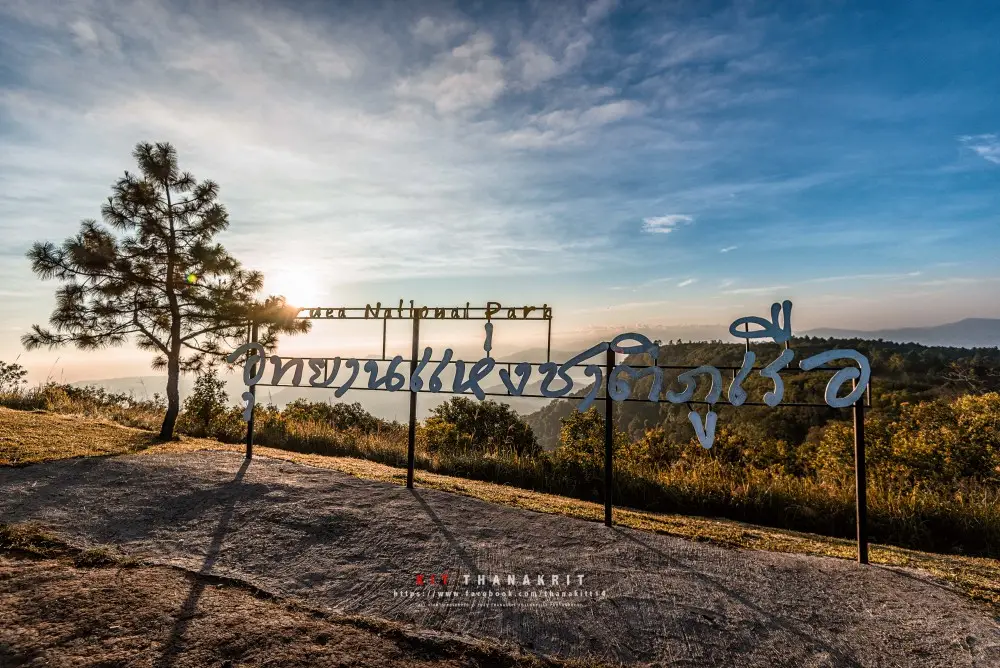
Phu Ruea National Park
Open Days: Daily
Opening Hours: 05.00 – 20.00
Phu Ruea National Park, Loei Province is one of the most important mountain destinations in northeastern Thailand. Located mainly in Nong Bua Subdistrict, Phu Ruea District, and extending toward Tha Li District, the park borders the Lao People’s Democratic Republic to the north. It is famous for its cool climate, pine forests, high mountain viewpoints, sunrise scenery, mist, waterfalls, strange rock formations, and the rare winter phenomenon known locally as “Mae Khaning”, when dew freezes into tiny ice crystals on grass and leaves. The mountain’s distinctive cliff form resembles the bow of a large junk boat, giving the park its name, Phu Ruea, meaning “boat mountain”.
Phu Ruea is more than a cold-weather viewpoint. It is a large mountain ecosystem with an area of about 75,525 rai, or around 121 square kilometers. The landscape consists of complex mountain ranges, sandstone and granite formations, high plateaus, pine forests, grasslands, cliffs, waterfalls, and natural stone fields. These features create a travel experience that combines scenery, climate, geology, wildlife, and seasonal beauty. For many Thai travelers, Phu Ruea is one of the classic places to experience winter in Thailand. For international visitors, it reveals a side of the country that is very different from beaches, islands, and urban attractions.
The most famous characteristic of Phu Ruea is its cool climate. The summit rises about 1,365 meters above sea level, making the temperature much lower than in the surrounding lowlands. During the cool season, especially from November to February, mornings can be very cold. On the coldest days, dew can freeze on grass and low plants, creating the white crystal-like frost that local people call Mae Khaning. This winter phenomenon is one of the reasons visitors travel to Phu Ruea before dawn, wrapped in jackets, hats, scarves, and gloves, waiting for sunrise over the mountain ranges.
The best travel period for Phu Ruea is from October to March. This season covers the transition from the rainy season into winter and the main cool season. Forests remain fresh, the air is clearer, and the chance of seeing mist or sunrise views is higher. From late November to February, the park is especially popular because the weather is cold and the atmosphere feels distinctly different from most parts of Thailand. Travelers who prefer quieter conditions may choose weekdays or the early part of the cool season, while those who enjoy a lively winter atmosphere often visit during weekends and holidays.
The shape of the mountain is central to the park’s identity. A part of the cliff projects outward like the prow of a large boat, which explains the name Phu Ruea. On the upper mountain, the landscape opens into broad stone and grass areas mixed with pine trees. Both naturally occurring two-needle pines and planted three-needle pines can be seen in the area. The combination of stone platforms, mountain grassland, pine forest, and cold air gives the summit a highland atmosphere that feels unusual for northeastern Thailand.
Phu Ruea is also a wildlife habitat. Animals recorded in the area include bears, barking deer, dholes, Siamese fireback pheasants, and big-headed turtles. Most visitors will not see these animals directly because wildlife usually stays away from busy visitor areas, but knowing that they live in the forest helps travelers understand the conservation value of the park. Visitors should not feed animals, leave food waste, make excessive noise, or enter restricted forest areas. Responsible behavior helps protect the wildlife that depends on the park’s forest habitat.
The summit of Phu Ruea is the heart of the park. It is the highest point and the main place for sunrise, mist, and wide mountain views. On clear days, visitors may see the Hueang River and the Mekong River, which mark parts of the natural border between Thailand and Laos. In the early morning, the atmosphere on the summit is cold and quiet. As the sun rises, light gradually spreads across layers of mountains, creating one of the most memorable views in Loei Province.
Reaching the summit is relatively convenient compared with many high mountain destinations. The park road is paved, and vehicles can drive up to the designated parking area. From there, visitors walk about 700 meters to the summit viewpoint. The walk is not very long, but some sections are sloped and the air can be cold, especially before sunrise. Comfortable walking shoes and warm clothing are strongly recommended. Visitors should also allow enough time to reach the viewpoint before the first light appears.
Decho Viewpoint is another important sunrise viewpoint inside the park. On a clear morning, it offers wide views over the mountains of Loei. The scene changes with the weather. Some mornings bring thick sea of mist. Other days reveal clear mountain ridges stretching into the distance. During sunrise, golden light passing through clouds can create dramatic colors over the landscape. This makes Decho Viewpoint a good place for photographers and travelers who want to experience the morning atmosphere of the park.
Pha Lon Noi is located about 3 kilometers from the park office and is known as one of the beautiful sunrise viewpoints in Phu Ruea. From this point, visitors can see Phu Luang, Phu Pha Sat, Phu Khrang, and layers of mountain scenery. The view is especially impressive during the late rainy season and cool season when mist settles in the valleys. Pha Lon Noi is suitable for travelers who enjoy quiet viewpoints and a broad mountain panorama.
Pha Sap Thong, also known as Pha Kulap, is located about 2.5 kilometers from the park office. It is a steep cliff and seepage area where yellowish aquatic plants and lichens grow, creating a golden appearance across the moist rock surface. This feature gives the place its name, which means “golden seepage cliff”. The area is not only scenic but also ecologically delicate. Visitors should walk only on permitted paths and avoid stepping on wet rock surfaces or small plants that grow in the seepage zone.
Huai Phai Waterfall is located about 2 kilometers from the park office. The waterfall flows down from a steep cliff and is about 30 meters high. It is also an important water source for the Phu Ruea area. Unlike the open summit and pine forest, Huai Phai Waterfall gives visitors a cooler and more humid forest atmosphere. The waterfall is usually most attractive during the rainy season and the transition into the cool season, when the water volume is stronger. During the dry season, the water level may naturally decrease.
The park also contains many unusual rock formations, including Tham Hin Taek, Hin Khang Mo, Hin Wua Non, Hin Phan Khan Mak, Hin Phra Shiva, Suan Hin Tao, and Thung Hin Lek Fai. These formations are named after the shapes they resemble. They stand among grasslands, stone fields, and forested areas, creating a natural sculpture landscape. Travelers who enjoy geology and landscape observation will find these sites interesting because they show how long-term weathering and erosion shape sandstone and granite into recognizable forms.
During the late rainy season and early cool season, small wildflowers often appear among grasslands and stone areas. These flowers are not as large as cultivated garden flowers, but their natural charm adds color and life to the highland landscape. Visitors should avoid stepping on flower areas or collecting plants. The beauty of Phu Ruea comes from allowing the natural seasonal cycle to continue undisturbed.
Phu Ruea National Park provides visitor facilities including a visitor center, parking areas, toilets, welfare shops, camping grounds, and park accommodation. This makes it suitable for both day trips and overnight stays. Staying overnight inside the park allows travelers to experience the cold evening air, the quiet mountain atmosphere, and the early morning sunrise without rushing from outside accommodation. However, accommodation and camping areas should be reserved in advance, especially during weekends, public holidays, and the cool season.
Visitors who plan to camp or stay in the park should prepare carefully. Warm jackets, socks, hats, scarves, blankets or sleeping bags, flashlights, personal medicine, and suitable footwear are important. Even though Thailand is generally warm, Phu Ruea can become unexpectedly cold at night and before sunrise. Campers should be especially prepared because mountain wind and low temperature can make the night feel much colder than daytime conditions.
Driving inside the park requires caution. The road is paved, but it is a mountain road with slopes and curves. Drivers should use low gear when going uphill and downhill, avoid continuous braking, and check vehicle condition before the trip. Brakes, tires, lights, and engine condition should be ready for mountain driving. During fog, rain, or early morning darkness, driving should be slower and more careful.
Getting There from Loei city is straightforward by private car, rental car, or tour vehicle. Take Highway 203 on the Loei-Phu Ruea route for about 54 kilometers. Turn right around kilometer markers 49-50 near Phu Ruea District Office, then continue for about 4 kilometers to the national park office. From the summit parking area, walk about 700 meters to reach Phu Ruea Peak. Travelers coming from Phetchabun, Lom Sak, or Dan Sai can also use Highway 203 toward Phu Ruea. The park entrance is near the district office area.
Phu Ruea can be combined with several nearby attractions. A one-day route may start with sunrise at Phu Ruea Peak, followed by Decho Viewpoint, Pha Sap Thong, Huai Phai Waterfall, Wat Somdet Phu Ruea Ming Mueang, and Ban Nong Bong Flower and Ornamental Plant Market. With two days and one night, travelers can stay in the park or in a resort nearby, then add Wat Pa Huai Lat, Phu Ruea Highland Agricultural Station, Pla Ba Waterfall, cafes, and winter flower areas.
Ban Nong Bong Flower and Ornamental Plant Market is one of the most suitable stops after visiting the park. Phu Ruea is well known for cool-climate flowers and seasonal ornamental plants. During the cool season, poinsettias, roses, petunias, and colorful potted flowers are widely available. In the rainy season, seasonal flowers and fresh greenery create a different atmosphere. Visitors can buy plants, take photographs, and see the agricultural side of Phu Ruea.
Wat Somdet Phu Ruea Ming Mueang and Wat Pa Huai Lat add a cultural and spiritual dimension to a Phu Ruea trip. These temples are peaceful places for visitors who want to experience local faith, Buddhist art, and mountain temple atmosphere. Combining the national park, local temples, flower markets, cafes, and restaurants creates a more complete travel experience than visiting the summit alone.
Food options in Phu Ruea include local restaurants, grilled chicken restaurants, Thai food shops, cafes, and restaurants with mountain or field views. Popular nearby options include Phu Ruea Phochana, Phu Ruea Kai Yang, Cafe De Meena, and Khram Keeree Cafe. These places are convenient before or after visiting the park. Travelers who wake early for sunrise should plan breakfast or lunch carefully because the morning schedule can be cold and tiring.
Accommodation around Phu Ruea ranges from national park bungalows and campsites to resorts, boutique hotels, and countryside stays. Those who want the closest contact with cold mountain air may stay in the park. Those who prefer private rooms, parking, and easier meal arrangements can choose resorts or hotels in Phu Ruea District. Advance booking is important during the year-end and cool-season travel period because rooms often fill quickly.
For international travelers, Phu Ruea National Park is a valuable destination because it shows the climatic and geographic diversity of Thailand. It offers highland air, pine forests, frost, mist, Thai-Laos border views, waterfalls, and unusual rock formations. Foreign visitors should bring warm clothing during the cool season, even if they are traveling in Thailand, because the temperature at the summit before sunrise can be much colder than expected.
Responsible travel is essential. Visitors should not leave trash, collect plants, disturb wildlife, feed animals, make loud noise, light fires outside permitted areas, or enter restricted trails. Natural areas such as cliffs, seepage zones, waterfalls, and wildflower fields should be treated carefully. Following park rules helps preserve Phu Ruea as a clean, safe, and beautiful mountain destination for future visitors.
In summary, Phu Ruea National Park is one of Loei Province’s most iconic natural attractions. Its highlights include Phu Ruea Peak, Decho Viewpoint, Pha Lon Noi, Pha Sap Thong, Huai Phai Waterfall, pine forests, frost, sunrise, strange rock formations, camping areas, and sweeping views toward Laos. It is an ideal destination for travelers who want to experience Thailand’s cool highland atmosphere, mountain scenery, and peaceful nature in a well-known but still deeply scenic national park.
| Name | Phu Ruea National Park |
| Location | Nong Bua Subdistrict, Phu Ruea District, Loei Province, with connected areas toward Tha Li District |
| Address | Phu Ruea National Park, Nong Bua Subdistrict, Phu Ruea District, Loei 42160, Thailand |
| Coordinates / Plus Code | G87V+MXF, Nong Bua Subdistrict, Phu Ruea District, Loei 42160 |
| Highlights | Phu Ruea Peak, Decho Viewpoint, Pha Lon Noi, Pha Sap Thong or Pha Kulap, Huai Phai Waterfall, pine forests, Mae Khaning frost, rock formations, sunrise views, and Thai-Laos border scenery. |
| History | A major national park in Loei Province covering about 75,525 rai, or around 121 square kilometers. It is known for its boat-shaped cliff, high mountain plateau, cold climate, and conservation value. |
| Name Origin | The name Phu Ruea means “boat mountain” and comes from a cliff formation that projects outward like the bow of a large junk boat. |
| Distinctive Features | A high mountain landscape of sandstone and granite ranges, with a summit at about 1,365 meters above sea level, pine forest, grassland, waterfalls, stone fields, and a cool climate throughout the year. |
| Travel Information | From Loei city, take Highway 203 on the Loei-Phu Ruea route for about 54 km. Turn near kilometer markers 49-50 by Phu Ruea District Office and continue about 4 km to the park office. From the summit parking area, walk about 700 meters to Phu Ruea Peak. |
| Current Status | Open as a national park, nature attraction, viewpoint area, camping destination, park accommodation area, and nature learning site. |
| Open Days | Daily |
| Opening Hours | 05.00 – 20.00 |
| Fees | Thai Visitors: Adult 40 Baht, Child 20 Baht Foreign Visitors: Adult 200 Baht, Child 100 Baht Motorcycle 20 Baht, Car 30 Baht |
| Facilities | Visitor center, park accommodation, camping grounds, toilets, welfare shop, parking areas, summit walking trail, viewpoints, and rest areas designated by the park. |
| Main Areas / Zones | Park Office And Visitor Center Zone Park Accommodation And Camping Zone Phu Ruea Peak And Sunrise Viewpoint Zone Decho Viewpoint Zone Pha Lon Noi Zone Pha Sap Thong Or Pha Kulap Zone Huai Phai Waterfall Zone Rock Formation Zone, Including Hin Khang Mo, Hin Wua Non, Hin Phan Khan Mak, Hin Phra Shiva, Suan Hin Tao, And Thung Hin Lek Fai |
| Caretaker / Responsible Agency | Phu Ruea National Park, Department of National Parks, Wildlife and Plant Conservation |
| Main Contact Number | 0-4281-0965, 088-5095299 |
| Accommodation / Camping Booking | National Park accommodation booking system at nps.dnp.go.th and Phu Ruea National Park Office. |
| Important Note | Roads inside the park are mountain roads with steep and curved sections. Drivers should use low gear and drive carefully, especially in fog, early morning, or after rain. |
| Recommended Season | October to March, especially the cool season, is best for sunrise, sea of mist, pine forest scenery, and Mae Khaning frost. |
| Nearby Tourist Attractions | 1. Phu Ruea Peak, inside the park, Tel. 0-4281-0965, 088-5095299 2. Huai Phai Waterfall, about 2 km from the park office, Tel. 0-4281-0965, 088-5095299 3. Pha Sap Thong Or Pha Kulap, about 2.5 km from the park office, Tel. 0-4281-0965, 088-5095299 4. Pha Lon Noi, about 3 km from the park office, Tel. 0-4281-0965, 088-5095299 5. Wat Somdet Phu Ruea Ming Mueang, about 5 km, Tel. 042-812812 6. Ban Nong Bong Flower And Ornamental Plant Market, about 9 km, Tel. 095-5966411 7. Wat Pa Huai Lat, about 12 km, Tel. 042-810664 |
| Nearby Restaurants | 1. Phu Ruea National Park Welfare Shop, about 0 km, Tel. 0-4281-0965, 088-5095299 2. Phu Ruea Kai Yang, about 4 km, Tel. 042-899149, 095-6571444 3. Phu Ruea Phochana, about 5 km, Tel. 042-899159 4. Cafe De Meena, about 6 km, Tel. 042-899096, 081-9542915 5. Khram Keeree Cafe, about 8 km, Tel. 042-899464 6. Restaurants And Cafes In Phu Ruea Town Area, about 5–8 km |
| Nearby Accommodations | 1. Phu Ruea National Park Accommodation And Campsite, about 0 km, Tel. 0-4281-0965, 088-5095299 2. Phu Ruea Resort, about 3 km, Tel. 091-0683157, 042-899048 3. Phu Ruea Bussaba Resort & Spa, about 4 km, Tel. 042-899299, 042-899330, 082-3942619 4. Be Cool Boutique @ Phu Ruea, about 4 km, Tel. 091-8671191 5. Phuruarounmai Resort, about 6 km, Tel. 081-9542915 6. Rayong-Phu Ruea Resort, about 8 km, Tel. 080-4137999 |
Frequently Asked Questions (FAQ)
Q: Where is Phu Ruea National Park located?
A: Phu Ruea National Park is located in Nong Bua Subdistrict, Phu Ruea District, Loei Province, with connected areas toward Tha Li District. It is about 54 km from Loei city.
Q: What is Phu Ruea National Park famous for?
A: It is famous for its 1,365-meter summit, cool climate, pine forests, sunrise views, sea of mist, Mae Khaning frost, Huai Phai Waterfall, Pha Lon Noi, Pha Sap Thong, and unusual rock formations.
Q: What are the opening hours?
A: The park is open daily from 05.00 to 20.00. Travelers who want to watch sunrise should allow enough time to reach the summit before dawn.
Q: What is the entrance fee?
A: Thai visitors pay 40 Baht for adults and 20 Baht for children. Foreign visitors pay 200 Baht for adults and 100 Baht for children. Motorcycle fee is 20 Baht and car fee is 30 Baht.
Q: When is the best time to visit Phu Ruea?
A: October to March is the best period, especially the cool season, because the weather is cold and visitors have a good chance to see mist, sunrise, pine forests, and Mae Khaning frost.
Q: Can visitors stay overnight inside the park?
A: Yes. The park provides accommodation and camping areas. Advance booking or direct contact with the park is recommended, especially during the cool season and public holidays.
Q: How can travelers get to Phu Ruea National Park from Loei city?
A: Take Highway 203 on the Loei-Phu Ruea route for about 54 km. Turn near kilometer markers 49-50 by Phu Ruea District Office and continue about 4 km to the park office.
Q: What should drivers be careful about inside the park?
A: The road inside the park is a mountain road with steep and curved sections. Drivers should use low gear, avoid continuous braking, and drive carefully, especially in fog, early morning, or after rain.
 Category: ●Nature and Wildlife
 Group: ●National Parks and Marine Reserves
Last Update : 3 MonthAgo
 Last Update : 3 MonthAgo
 Click to Access the Navigation Map GPS
Phu Ruea National Park Map
Gellery
Recommend

 Art, Culture and Heritage
 Historical Sites and Monuments(2)
 Landmarks and Memorials(3)
 Art, Craft Centres, Tradition(2)
 Museums(4)
 Art Gallery(1)
 Educational Places
 Educational Gardens, Farm(2)
 Places of Worship
 Temple(16)
 Other Sacred Sites(8)
 Research and Development
 Royal Project(3)
 Suburban Living
 Village, Community(3)
 Local Market(1)
National Parks and Marine Reserves(5)
Local Market(1)
National Parks and Marine Reserves(5)
 Mountain (Doi)(10)
 Dam, Reservoir, Lake(7)
 Waterfalls(21)
 Caves(3)
 River, Canal(5)
 Bays and Beaches(1)
 Other natural attractions(1)
 Entertainment and Agricultural
 Farms, Parks and Ecotourism(8)
 Waterpark(1)
 Outdoor and Adventure Activities(2)
 Travel Articles, Recipes
 Travel Review, Food Review(1)


