
lovethailand home >Northeastern Travel Attractions >Loei Travel Attractions >Phu Rua >Pla Ba > Pla Ba Waterfall (Tat San Waterfall)
TL;DR: Pla Ba Waterfall (Tat San Waterfall) is located at Pla Ba Subdistrict, Phu Ruea District, Loei Province, in the Ban Tad San / Ban Pla Ba area, open Daily, hours 08.00 – 17.00.

Pla Ba Waterfall (Tat San Waterfall)
Open Days: Daily
Opening Hours: 08.00 – 17.00
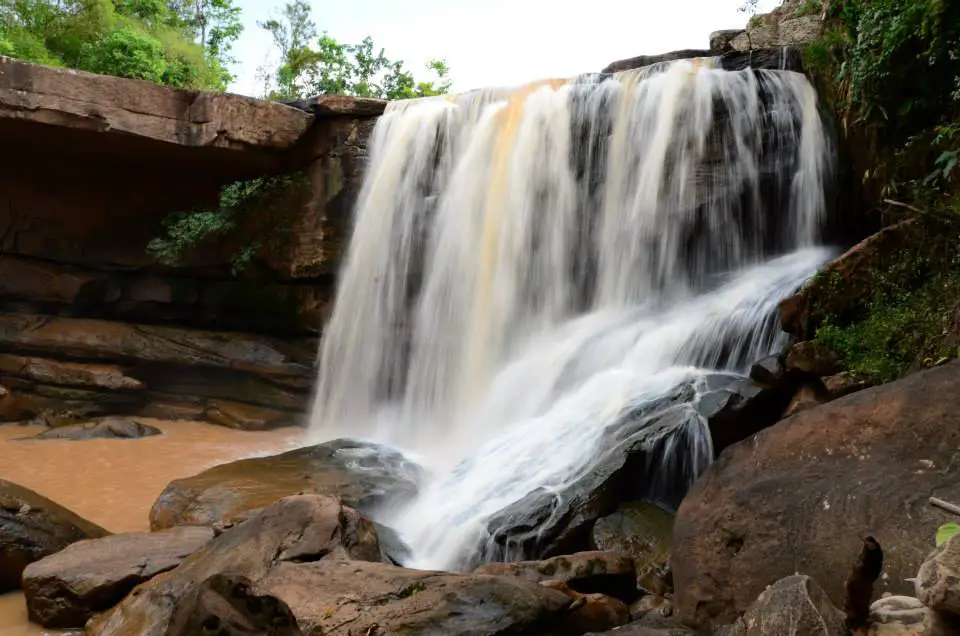
Pla Ba Waterfall in Loei Province, also known as Tad San Waterfall, is a natural waterfall in Pla Ba Subdistrict, Phu Ruea District, Loei. It is associated with Ban Tad San and Ban Pla Ba, mountain communities in the Phu Ruea area. The waterfall is formed by the difference in rock levels along Lam Nam San. Water flows over a large rock slab, spreads across a wide natural stone surface, and drops into a pool below. The lower pool is the most suitable area for safe water play, while the upper waterfall area should be avoided because the current can be strong and the rocks may be slippery.
Pla Ba Waterfall is different from many cliff-style waterfalls because its beauty comes from a broad rock platform and a natural pool rather than one narrow vertical drop. The water moves across the large rock sheet before descending into the lower basin. This creates an open and refreshing waterfall landscape that is suitable for relaxing, sitting by the water, taking photographs, and enjoying a simple nature break with family or friends.
The name Pla Ba comes from the local subdistrict, while Tad San is closely connected to Ban Tad San and Lam Nam San. In local northeastern Thai usage, the word “tad” often refers to a waterfall or rocky cascade. The word “San” is linked to the local stream that passes through the village area. Because of this, both names refer to the same waterfall and reflect the relationship between the community, the stream, and the natural rock landscape.
The waterfall’s main feature is the large rock slab where the water spreads before falling into the pool below. In periods of higher water flow, the water covers more of the rock surface, becomes louder, and creates visible spray. In lower water periods, the shape of the rock layers becomes clearer. This seasonal change makes the waterfall interesting throughout the year, although the experience will vary depending on rainfall and water volume.
The lower pool is the area most suitable for water play. Visitors should avoid the upper part of the waterfall because water flows strongly over the rock surface and may cause slipping. Even when the rock looks dry, moisture or algae can make it dangerous. Visitors should choose shallow and safe areas, check the water before entering, and avoid swimming when the water is muddy, strong, or rising after rain.
The waterfall area is suitable for resting and eating simple packed food, but there are no restaurants directly at the waterfall. Visitors should prepare drinking water and food in advance or eat in Phu Ruea town before visiting. If bringing food into the waterfall area, all rubbish must be taken back out. Plastic bottles, food containers, snack wrappers, and leftover food should never be left near the stream or rocks.
Pla Ba Waterfall works well as a half-day stop or as part of a wider Phu Ruea itinerary. It can be combined with Phu Ruea National Park, Wat Somdet Phu Ruea Ming Mueang, Wat Pa Huai Lat, Phu Ruea Highland Agricultural Experiment Station, Ban Tad San, Ban Pla Ba, and cafés or viewpoints around Phu Ruea. The area offers a combination of waterfalls, mountain scenery, cool weather, community life, farming landscapes, temples, and local food.
Ban Tad San and Pla Ba Subdistrict are located in a mountainous part of Phu Ruea. The community is associated with cool weather, highland agriculture, and natural surroundings connected to the Phu Luang Wildlife Sanctuary landscape. Travelers visiting the waterfall may also see local farming areas, mountain slopes, and village scenery along the way. This gives the trip a stronger local character than visiting a waterfall alone.
The rainy season is the most powerful time to see the waterfall. During this period, water volume increases, the stream spreads across the rock slab, and the surrounding vegetation becomes lush. The waterfall looks more dramatic and photogenic. However, this is also the season that requires the most caution. If the water becomes muddy or unusually strong, visitors should stay out of the water and remain in safe areas.
The early post-rainy season and the beginning of the cool season are often the most comfortable times for general visitors. The waterfall usually still has enough water to look attractive, while the weather becomes cooler and travel conditions are easier. This period is suitable for families, casual travelers, and visitors who want both good water flow and safer conditions.
The cool season is one of the busiest travel periods in Phu Ruea because the district is known for cold weather, flowers, and mountain views. Pla Ba Waterfall may have less water than in the rainy season, but it remains a pleasant place for a nature break. Visitors traveling during long holidays should plan accommodation and meals in advance because Phu Ruea can become busy during peak cold-season travel.
The hot season is suitable for relaxing by the lower pool if water levels are adequate. The shaded stream area and cool water help make the visit pleasant. Visitors should bring enough drinking water, avoid long exposure to direct sunlight, and visit during the morning or early afternoon for a more comfortable experience.
Getting There is convenient by private car or motorcycle. From Mueang Loei, travel on the Loei – Dan Sai road toward Phu Ruea District. Around Phu Ruea Community School, turn left onto Route 3008 toward Pla Ba Subdistrict, then follow local signs to Pla Ba Waterfall. Another route uses the Phu Ruea – Dan Sai road around kilometer markers 57 – 58, turning toward Ban Kok Pho and continuing into Pla Ba Subdistrict. The distance from Phu Ruea town is about 17 – 18 kilometers, depending on the route.
The access road is easier than many remote waterfalls, but drivers should still be careful, especially during the rainy season. Road surfaces near rural communities and waterfall entrances may become wet or slippery. Visitors should travel during daylight, drive slowly in village areas, and respect local road users, including residents, farm vehicles, and other tourists.
Upon arrival, park in a suitable area without blocking local access. Walk carefully near the rock platform and the lower pool. Wet rock can be slippery even when it appears safe. Do not run on the rocks, climb the upper waterfall area, or stand near strong current for photographs. The safest way to enjoy the waterfall is to remain near the lower pool and use caution at all times.
Recommended activities include safe water play in the lower pool, relaxing by the stream, eating packed food responsibly, photographing the rock slab and flowing water, walking around the nearby natural area, and enjoying the quiet atmosphere of the Pla Ba community landscape. Families with children should supervise them closely and keep them away from the upper waterfall section.
For photographers, Pla Ba Waterfall offers several good compositions: water dropping from the large rock slab, the wide rock platform, the lower pool, water spray during high-flow periods, and the shaded green surroundings. Morning and late afternoon light are usually softer than harsh midday light. A waterproof pouch or dry cloth is useful because the waterfall area can be humid and wet.
The waterfall is best enjoyed with simple preparation. Bring drinking water, snacks or packed food, a personal trash bag, shoes with good grip, a towel, a change of clothes, and waterproof protection for phones or cameras. During the rainy season, a small raincoat or foldable umbrella may be useful. Visitors should avoid bringing excessive disposable packaging because there are no restaurants or developed food services at the waterfall itself.
The most important safety rule is to avoid the upper waterfall area. The rock surface may look attractive for photographs, but the water can be strong and slippery. Visitors should play only in the safer lower pool and should leave the water immediately if rain starts, the water becomes muddy, or the current increases.
Because Lam Nam San is a natural stream, water conditions can change after rainfall in the upper catchment. Even if the weather at the waterfall is calm, rain upstream may increase water volume. If the water becomes louder, faster, or carries debris, move away from the stream and return to higher ground. This is a basic safety rule for all natural waterfalls.
Ban Tad San is also interesting as a community landscape. The village is in Pla Ba Subdistrict, an area with mountains, cool climate, and highland farming. A visit to the waterfall can therefore include local scenery, agricultural routes, and mountain-community atmosphere. Visitors should respect private farmland, avoid blocking roads, keep noise low, and take all rubbish out of the area.
Pla Ba Waterfall can be combined with several attractions around Phu Ruea. Wat Somdet Phu Ruea Ming Mueang and Wat Pa Huai Lat are well-known religious sites. Phu Ruea National Park offers mountain views and cool weather. Phu Ruea Highland Agricultural Experiment Station provides highland plant and flower scenery. Ban Tad San and Ban Pla Ba add a local community dimension to the trip.
For families, the waterfall is a good place for children to learn about how water flows over rock layers, why slippery surfaces require caution, and why natural areas should be kept clean. Adults should keep children away from the upper waterfall and choose only safe shallow areas for water play.
Elderly visitors can enjoy the waterfall if they choose stable resting areas and avoid walking on wet rock. The visit should focus on viewing, resting, and enjoying the stream rather than climbing or moving across the rock platform. Comfortable footwear and a slow pace are important.
Nearby restaurants are mostly in Phu Ruea town or along the Phu Ruea – Dan Sai road, not at the waterfall. Options include Phu Ruea Phochana, Phu Ruea Kai Yang, Katak Restaurant, Khram Khiri Cafe, Cafe De Meena, Coffee De Haitak, and local eateries around Phu Ruea. Visitors should eat before or after visiting the waterfall or bring simple packed food that creates minimal waste.
Accommodation options are mainly in Phu Ruea District and along the main travel route. Nearby choices include Phu Ruea Resort, Phu Ruea Ruean Mai Resort, Phu Ruea Bussaba Resort, Rayong Phu Ruea Resort, Rai Phu Thai Loei Coffee Cake & Resort, local homestays in Pla Ba and Ban Tad San, and small resorts near Phu Ruea National Park. Staying in Phu Ruea makes it easy to combine the waterfall with temples, cafés, mountain viewpoints, and national park travel.
A simple one-day itinerary can begin with Phu Ruea National Park or Wat Somdet Phu Ruea Ming Mueang in the morning, followed by lunch in Phu Ruea town, then a visit to Pla Ba Waterfall in the afternoon. After resting or playing safely in the lower pool, visitors can return to a café or restaurant along the route. This plan suits families and casual travelers.
A two-day trip can include Wat Pa Huai Lat, Phu Ruea Highland Agricultural Experiment Station, Pla Ba Waterfall, Phu Ruea National Park, Phu Bak Dai, and scenic cafés around Phu Ruea. Staying overnight allows travelers to enjoy the cool climate without rushing and provides more time for both nature and community-based travel.
Responsible travel is essential at Pla Ba Waterfall. Since the waterfall has no restaurant service directly on site, visitors must manage their own food and waste carefully. No rubbish should be left behind. Do not use soap or shampoo in the stream, do not damage plants, and do not make loud noise that disturbs other visitors or the local community.
The charm of Pla Ba Waterfall is not only the water itself but the combination of Lam Nam San, the wide rock slab, the lower pool, the shaded natural setting, and the nearby mountain community. It is an accessible waterfall with a simple and local atmosphere. Travelers who slow down and use the area respectfully will appreciate its quiet beauty.
In summary, Pla Ba Waterfall, also called Tad San Waterfall, is a natural waterfall in Pla Ba Subdistrict, Phu Ruea District, Loei Province. It is formed by water flowing over a large rock slab into a lower pool. The waterfall is about 10 meters high and is suitable for safe water play in the lower basin, relaxation, photography, and simple packed-food picnics. There are no restaurants directly at the waterfall, so visitors should prepare food and water in advance and carry all rubbish back out. With careful travel and respect for the local environment, Pla Ba Waterfall remains one of Phu Ruea’s refreshing natural stops.
| Name | Pla Ba Waterfall |
| Alternative Name | Tad San Waterfall |
| Location | Pla Ba Subdistrict, Phu Ruea District, Loei Province, in the Ban Tad San / Ban Pla Ba area |
| Address | Pla Ba Subdistrict, Phu Ruea District, Loei 42160, Thailand |
| Highlights | Waterfall flowing from a large rock slab into a lower pool, suitable for safe water play, relaxing, and eating packed food in a natural setting |
| Distinctive Features | Formed by rock-level differences in Lam Nam San, about 10 meters high, with water spreading across a wide rock platform before dropping into the pool below |
| Water Source / Natural Area | Lam Nam San in Pla Ba Subdistrict, Phu Ruea District, connected to the mountain-community landscape of Ban Tad San |
| Name Origin | Pla Ba refers to the subdistrict name, while Tad San comes from “tad” meaning waterfall and “San” referring to the local stream and Ban Tad San community |
| Travel Information | From Mueang Loei, take the Loei – Dan Sai road toward Phu Ruea. Around Phu Ruea Community School, turn onto Route 3008 toward Pla Ba. Another route uses the Phu Ruea – Dan Sai road around km 57 – 58, turning toward Ban Kok Pho and continuing to the waterfall. Distance from Phu Ruea town is about 17 – 18 km. |
| Current Status | Natural attraction and recreation area in Pla Ba Subdistrict, Phu Ruea District, Loei Province |
| Open Days | Daily |
| Opening Hours | 08.00 – 17.00 |
| Fees | No specific entrance fee for Pla Ba Waterfall is listed in main tourism information |
| Facilities | Natural rock platform, lower pool, streamside resting area, safe water-play area, parking depending on local conditions, toilets and rest pavilion according to recent visitor information, and no restaurant directly at the waterfall |
| Main Areas / Zones | Entrance and parking zone Upper rock-slab waterfall zone Main water drop from the large rock surface Lower pool zone for safe water play Resting and packed-food picnic zone Waterfall, rock, stream, and forest photography zone Ban Tad San and Ban Pla Ba community zone nearby |
| Caretaker | Pla Ba Subdistrict Administrative Organization, Phu Ruea District, Loei Province, and related local community agencies in Ban Tad San |
| Main Contact Number | Pla Ba Subdistrict Administrative Organization Tel. 0-4203-0299; TAT Loei Office Tel. 042-812-812 |
| Official Website / Official Page | Pla Ba Subdistrict Administrative Organization / Loei Provincial Administrative Organization / Tourism Authority of Thailand |
| Nearby Tourist Attractions | 1. Ban Tad San, Moo 5, Pla Ba Subdistrict, about 2 km, Tel. Pla Ba SAO 0-4203-0299 2. Phu Ruea Highland Agricultural Experiment Station, about 8 km 3. Ban Pla Ba Community, about 8 km, Tel. Pla Ba SAO 0-4203-0299 4. Wat Somdet Phu Ruea Ming Mueang, about 16 km 5. Wat Pa Huai Lat, about 18 km 6. Phu Ruea National Park, about 20 km 7. Haitak Scenic Route, about 22 km 8. Phu Bak Dai, about 35 km |
| Nearby Restaurants | 1. No restaurant directly inside the waterfall area 2. Phu Ruea Phochana, about 17 km, Tel. 042-899-159 3. Phu Ruea Kai Yang, about 17 km 4. Katak Restaurant, about 18 km 5. Khram Khiri Cafe, about 18 km 6. Cafe De Meena, about 20 km 7. Coffee De Haitak, about 22 km 8. Local eateries in Phu Ruea town, about 17 – 20 km |
| Nearby Accommodations | 1. Local homestays in Pla Ba and Ban Tad San, about 2 – 8 km 2. Phu Ruea Resort, about 18 km, Tel. 042-899-048, 042-899-042 3. Phu Ruea Ruean Mai Resort, about 17 km 4. Rayong Phu Ruea Resort, about 18 km 5. Phu Ruea Bussaba Resort, about 18 km 6. Rai Phu Thai Loei Coffee Cake & Resort, about 20 km 7. Baan Rabiang Mao, about 22 km |
Frequently Asked Questions (FAQ)
Q: Where is Pla Ba Waterfall located?
A: Pla Ba Waterfall is located in Pla Ba Subdistrict, Phu Ruea District, Loei Province, in the Ban Tad San and Ban Pla Ba area.
Q: Are Pla Ba Waterfall and Tad San Waterfall the same place?
A: Yes. Pla Ba Waterfall and Tad San Waterfall refer to the same waterfall. Pla Ba refers to the subdistrict, while Tad San is linked to Ban Tad San and Lam Nam San.
Q: What makes Pla Ba Waterfall special?
A: The waterfall flows from a large rock slab into a lower pool. It has a wide natural rock platform, a lower basin suitable for safe water play, and a relaxing forest-stream atmosphere.
Q: What are the opening hours of Pla Ba Waterfall?
A: Pla Ba Waterfall is open daily from 08.00 to 17.00. Daytime visits are recommended, especially during the rainy season.
Q: Is there an entrance fee for Pla Ba Waterfall?
A: No specific entrance fee for Pla Ba Waterfall is listed in main tourism information. Visitors should bring some cash for food, drinks, or local expenses.
Q: Is Pla Ba Waterfall suitable for swimming?
A: The lower pool is suitable for safe water play when the current is not strong. Visitors should avoid the upper waterfall area because the water can flow strongly over slippery rocks.
Q: Are there restaurants at Pla Ba Waterfall?
A: There are no restaurants directly at the waterfall. Visitors should bring food and drinking water or eat in Phu Ruea town before or after visiting.
Q: What should visitors bring to Pla Ba Waterfall?
A: Visitors should bring drinking water, light food, a personal trash bag, footwear with good grip, a towel, a change of clothes, waterproof protection for phones or cameras, and should take all rubbish back out.
 Category: ●Nature and Wildlife
 Group: ●Waterfalls
Last Update : 2 MonthAgo
 Last Update : 2 MonthAgo
 Click to Access the Navigation Map GPS
Pla Ba Waterfall (Tat San Waterfall) Map
Recommend

 Art, Culture and Heritage
 Historical Sites and Monuments(2)
 Landmarks and Memorials(3)
 Art, Craft Centres, Tradition(2)
 Museums(4)
 Art Gallery(1)
 Educational Places
 Educational Gardens, Farm(2)
 Places of Worship
 Temple(16)
 Other Sacred Sites(8)
 Research and Development
 Royal Project(3)
 Suburban Living
 Village, Community(3)
 Local Market(1)
 National Parks and Marine Reserves(5)
 Mountain (Doi)(10)
 Dam, Reservoir, Lake(7)
Waterfalls(21)
Dam, Reservoir, Lake(7)
Waterfalls(21)
 Caves(3)
 River, Canal(5)
 Bays and Beaches(1)
 Other natural attractions(1)
 Entertainment and Agricultural
 Farms, Parks and Ecotourism(8)
 Waterpark(1)
 Outdoor and Adventure Activities(2)


