
lovethailand home >Northeastern Travel Attractions >Chaiyaphum Travel Attractions >Khon San >Thung Phra > Chulabhorn Dam (Nam Phrom Dam)
TL;DR: Chulabhorn Dam (Nam Phrom Dam) is located at Thung Phra Subdistrict, Khon San District, Chaiyaphum Province, open Daily, hours 08.30 – 16.30.

Chulabhorn Dam (Nam Phrom Dam)
Open Days: Daily
Opening Hours: 08.30 – 16.30
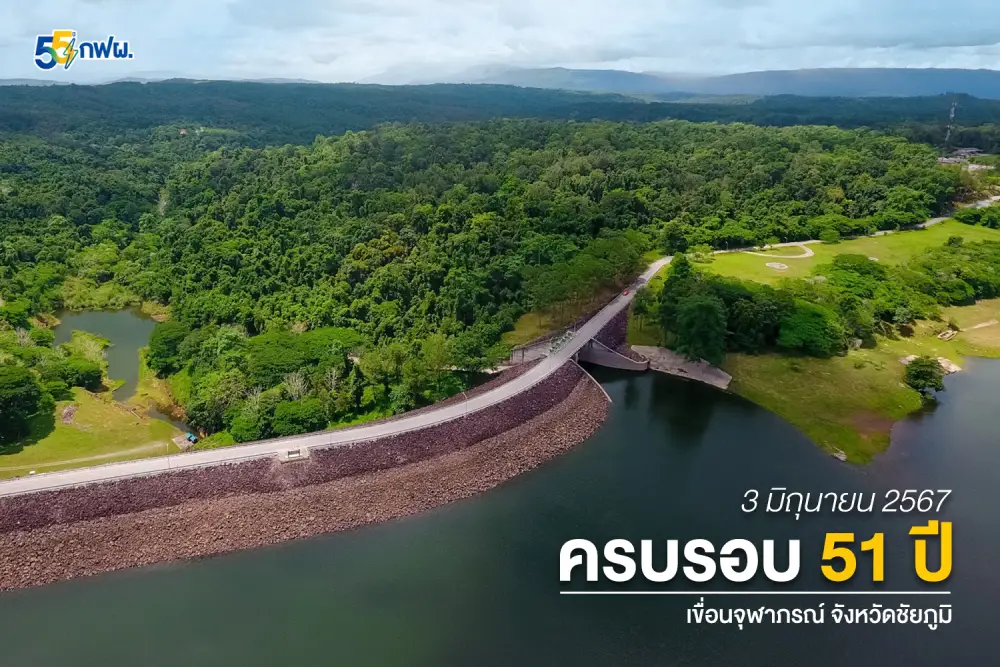
Chulabhorn Dam, formerly known as Nam Phrom Dam, is one of the most important multipurpose dams in Chaiyaphum Province. It is located in Thung Phra Subdistrict, Khon San District, where it blocks the Nam Phrom River on the Khun Phai Mountain Range in an area known as Phu Yuak. The dam is a rockfill dam with a compacted clay core, covered with rock and gravel. Its crest is 700 meters long, 70 meters high from the foundation, and 8 meters wide. Managed by the Electricity Generating Authority of Thailand, Chulabhorn Dam is used for hydropower generation, irrigation support, freshwater fish breeding, environmental learning, and nature-based tourism.
The dam stands in a highland landscape surrounded by mountains, forests, and a large reservoir. This gives Chulabhorn Dam a cool and refreshing atmosphere throughout the year, making it one of Chaiyaphum’s most attractive mountain destinations. From the dam crest and viewpoints, visitors can see a wide sheet of water framed by green hills. The combination of reservoir, mountain scenery, clean air, and well-managed facilities makes the dam suitable for sightseeing, photography, boating, family travel, learning trips, and overnight stays.
The history of Chulabhorn Dam is closely connected with hydropower development in northeastern Thailand. The dam was originally called Nam Phrom Dam and formed part of the Northeastern Hydropower Development Project. Construction began in 1970, and the dam was completed and began commercial operation in October 1972. It was later named Chulabhorn Dam in honor of Her Royal Highness Princess Chulabhorn. For this reason, the dam carries significance not only as infrastructure but also as part of Thailand’s regional development history.
In engineering terms, Chulabhorn Dam is a major water infrastructure site. Its reservoir storage capacity is 163.75 million cubic meters, and the reservoir area covers about 12 square kilometers. The hydropower plant is a reinforced concrete structure with an installed capacity of 40 megawatts and an average annual electricity generation of around 57 million kilowatt-hours. These figures show that Chulabhorn Dam is more than a scenic reservoir. It is a working hydropower and water management system that supports communities, agriculture, energy supply, and local livelihoods.
The water stored at Chulabhorn Dam supports agriculture during the dry season, especially in areas along the Nam Phrom and Nam Chern river systems. It helps farmers manage water more reliably when rainfall is insufficient and strengthens water security for downstream communities. The reservoir is also an important freshwater fish breeding area in the Northeast. This gives the dam multiple roles: generating electricity, supporting agriculture, providing fish resources, preserving a highland water ecosystem, and serving as a public recreation space.
For travelers, the main appeal of Chulabhorn Dam is the diversity of places to visit within the dam area. Key attractions include the dam crest, the reservoir viewpoints, Phra Phuttha Sirisakkharat replica or Luang Pho Chet Kasat, Chulabhorn Dam Garden, the 325-million-year-old ancient plants, Lup Khuan Viewpoint Pavilion, the waterside lawn near the royal residence, cold-climate plant experimental areas, an observatory, guesthouses, restaurants, coffee shops, a golf course, and boat trips on the reservoir. This variety makes the dam a complete destination rather than a short photo stop.
Phra Phuttha Sirisakkharat replica, widely known as Luang Pho Chet Kasat, is an important sacred point inside the dam area. It is enshrined near the left side of the dam head, opposite Chulabhorn Dam Garden. Many visitors stop here to pay respect before walking through the garden or visiting the scenic areas. This gives the trip a spiritual dimension. Chulabhorn Dam is therefore not only a place of mountains and water, but also a place where local faith and peaceful travel meet.
Chulabhorn Dam Garden is another key attraction. Covering approximately 41 rai, it is designed as a conservation forest with many forest plant species, a natural-stone walking path, and Phrom Phisamai Pavilion for resting. The garden offers a shaded and quiet experience that contrasts with the open reservoir scenery. Visitors can walk slowly, observe plants, sit in the pavilion, and enjoy the cooler highland air. For families and nature lovers, the garden adds depth to the visit by combining recreation with conservation.
The 325-million-year-old ancient plants are one of the most distinctive learning features of the dam area. These grass-family ancient plants include two types: Son Sam Roi Yot and Son Hang Ma, also known as horsetail or ya thot plong. Their presence gives the area botanical and natural-history value. Visitors interested in plants, evolution, geology, or highland ecosystems will find this point especially meaningful because it is not a common feature at most dams.
Lup Khuan Viewpoint Pavilion is one of the most memorable viewpoints at Chulabhorn Dam. Located at an elevation of more than 800 meters above sea level, the viewpoint offers a broad view over the surrounding mountains and reservoir landscape. In some seasons, visitors may see mist floating across the valleys. The local term “khuan” refers to mist-like smoke drifting over the hills. Early morning is the best time for a chance to see this atmosphere, while late afternoon is ideal for softer light and wide landscape photography.
The waterside lawn near the royal residence is another peaceful area where visitors can see the dam crest and the reservoir landscape. It is suitable for walking, sitting quietly, and enjoying the view without rushing. The feeling here is calm and shaded, making it a good place for travelers who prefer quiet nature to crowded attractions. This area reflects the overall character of Chulabhorn Dam: spacious, cool, dignified, and closely connected with water and forest.
Boat trips on the reservoir allow visitors to experience the dam from a different perspective. From the water, the dam crest, forested hills, and wide reservoir can be seen more clearly as one connected landscape. Boating is suitable for families, photographers, and travelers who want to spend more time in the reservoir environment. Before using a boat service, visitors should ask local operators about price, route, duration, passenger capacity, and safety equipment.
Accommodation inside the dam area is a strong advantage for travelers who want to experience the morning and evening atmosphere. Khun Saichol Villa at Chulabhorn Dam offers guesthouses surrounded by nature and forested hills. Facilities include accommodation, restaurant, coffee shop, shops, golf course, meeting rooms, seminar spaces, and recreational services. Staying overnight allows visitors to see the dam at sunrise, sunset, and in the cooler hours when the atmosphere is very different from a short daytime visit.
Ruean Nam Phrom Restaurant inside the dam area is a convenient dining option for visitors. It serves single-dish meals, breakfast, and catering for group events. Recommended dishes include banana blossom salad, salted fried chicken, three-flavor tilapia, fried pork belly with herbs, fresh shrimp in spicy fish sauce, tofu with gravy, and minced pork with salted egg. There is also a coffee shop serving drinks, snacks, and bakery items in a scenic setting. These facilities make it easier for travelers to spend a full day inside the dam area.
The observatory and cold-climate plant experimental areas make Chulabhorn Dam different from ordinary nature viewpoints. Because the area has a cooler climate and highland conditions, it is suitable for plant experimentation and scientific learning. For families, students, and foreign travelers interested in education-based tourism, the dam offers opportunities to learn about hydropower, water management, plants, climate, astronomy, and highland ecology in one destination.
The main route from Chaiyaphum town follows Highway 201 on the Chaiyaphum – Chum Phae route. At Nong Song Hong Junction, turn left onto Highway 2055 toward Khon San District. The total distance from Chaiyaphum town is about 120 km. Another route follows Highway 12 on the Lom Sak – Chum Phae route. When reaching the Khon San area, turn onto the road toward Chulabhorn Dam for about 40 km. The route passes through rural and mountain scenery, so travelers should plan driving time carefully.
Getting There is most convenient by private car or rental car. From Chaiyaphum town, drive toward Chum Phae on Highway 201, then turn at Nong Song Hong Junction toward Khon San on Highway 2055. From the Lom Sak – Chum Phae route, turn toward Chulabhorn Dam near Khon San. Visitors should travel during the day, especially on their first visit, because some sections pass through mountain roads and local communities. Fuel, drinking water, and route planning are recommended before departure.
Upon arrival, visitors should begin at the dam crest or main viewpoint to understand the overall landscape. After that, pay respect to Luang Pho Chet Kasat, walk through Chulabhorn Dam Garden, see the ancient plants, visit Lup Khuan Viewpoint Pavilion, and stop at the restaurant or coffee shop. Visitors with more time can stay overnight at Khun Saichol Villa and enjoy the reservoir during sunrise or sunset, when the landscape is especially beautiful.
Chulabhorn Dam is suitable for many types of travelers. Families can combine sightseeing with educational activities. Groups of friends can stay overnight, take photos, and enjoy the cool mountain atmosphere. Couples can visit for sunrise or sunset views. Students can learn about hydropower, irrigation, ancient plants, and water ecosystems. Foreign travelers can experience a Thai multipurpose dam that combines engineering, nature, local faith, and community tourism.
The best time to visit is in the morning or late afternoon, when the weather is more pleasant and the natural light is better for photography. The cool season is especially attractive for mist, cool air, and clearer mountain views. The rainy season gives the forest a greener appearance and makes the reservoir landscape feel more alive. However, travelers should check weather conditions before visiting, especially when driving through mountain roads during rain or fog.
Visitors should respect EGAT operational areas and reservoir safety rules. Stay within areas open to the public, do not enter restricted zones, do not climb dam structures, and do not swim in unauthorized areas. Since the reservoir is used for power generation, irrigation, fish breeding, and public recreation, visitors should also avoid littering and should keep the area clean. Responsible behavior helps protect both the environment and the function of the dam.
Nearby attractions can be combined into a longer route. Pang Muang Viewpoint is about 7 km from the dam. Phu Khiao Wildlife Breeding Station is about 8 km away. Nam Phut Thap Lao Arboretum is about 10 km away. Thung Kamang in Phu Khiao Wildlife Sanctuary is about 32 km away. Huai Kum Dam, Nam Nao National Park, Phu Pha Man, and other attractions in the Khon San – Chum Phae – Lom Sak route can also be added depending on travel time.
Food options inside the dam area are convenient, especially Ruean Nam Phrom Restaurant and the EGAT coffee shop. Travelers who continue into Khon San District can also find local restaurants and cafés such as Khrua Khun Jaew and Montra House Bar & Restaurant. For travelers who want the most direct dam experience, eating inside the dam area is the best option because it connects the meal with the reservoir scenery and allows more time for sightseeing.
Accommodation options include Khun Saichol Villa and other guesthouses inside the dam area, as well as stays in nearby districts. Travelers who want to be closest to the reservoir should stay at Khun Saichol Villa. Those planning to connect with Phu Pha Man, Phu Khiao, Chum Phae, or other attractions may choose accommodation along the route, such as Ban Rai Kanok Nuan Farmstay, Bander Hotel, Jamsai Resort, or Phusuay Namsai Resort. The best choice depends on whether the trip focuses on the dam, wildlife routes, or onward travel to nearby provinces.
Overall, Chulabhorn Dam is one of Chaiyaphum’s most complete nature-based destinations. It combines hydropower, irrigation, fish breeding, highland ecology, scenic viewpoints, Buddhist faith, ancient plants, garden walks, accommodation, food, and boating in one place. Its value is not only in the beauty of the reservoir but also in how water supports energy, agriculture, local communities, and tourism.
For travelers who want to understand Chaiyaphum beyond famous flower fields and rock formations, Chulabhorn Dam is an essential destination. It tells the story of mountains, water, electricity, agriculture, conservation, and local recreation in a direct and memorable way. A good visit should be slow, safe, and respectful: enjoy the view, learn from the landscape, use the facilities responsibly, and help keep this important reservoir clean for future visitors.
| Name | Chulabhorn Dam Or Nam Phrom Dam |
| Location | Thung Phra Subdistrict, Khon San District, Chaiyaphum Province |
| Address | Thung Phra / Thung Lui Lai Area, Khon San District, Chaiyaphum 36180, Thailand |
| Coordinates | Approx. 16.535000, 101.650000 |
| Highlights | A highland rockfill dam with a clay core, large reservoir, cool mountain air, scenic dam crest, Lup Khuan Viewpoint, Chulabhorn Dam Garden, 325-million-year-old ancient plants, accommodation, restaurant, coffee shop, and boat trips |
| History / Local Role | Formerly called Nam Phrom Dam, it was part of the Northeastern Hydropower Development Project. Construction began in 1970, and the dam was completed and began commercial operation in October 1972. It supports hydropower, irrigation, agriculture, and freshwater fish breeding |
| Dam Information | Rockfill dam with clay core; reservoir storage capacity 163.75 million cubic meters; reservoir area 12 square kilometers; crest width 8 meters; crest length 700 meters; height 70 meters |
| Power Plant Information | Reinforced concrete hydropower plant with installed capacity of 40 MW and average annual electricity generation of around 57 million kWh |
| Name Origin | Originally named Nam Phrom Dam after the Nam Phrom River, then renamed Chulabhorn Dam in honor of Her Royal Highness Princess Chulabhorn |
| Distinctive Features | Large highland reservoir, forested mountain scenery, cool weather, dam crest viewpoint, garden walk, ancient plants, sacred Buddha image, boating, accommodation, restaurant, coffee shop, and golf course |
| Travel Information | From Chaiyaphum town, take Highway 201 toward Chum Phae, turn left at Nong Song Hong Junction onto Highway 2055 toward Khon San, about 120 km in total. From the Lom Sak – Chum Phae route on Highway 12, turn toward Chulabhorn Dam near Khon San for about 40 km |
| Current Status | A multipurpose dam managed by the Electricity Generating Authority of Thailand, used for hydropower generation, irrigation support, freshwater fish breeding, and tourism |
| Open Days | Daily |
| Opening Hours | 08.30 – 16.30 |
| Fees | No general admission fee for the dam area. Accommodation, restaurant, boating, golf, and specific services should be checked directly with local operators |
| Best Visiting Time | Morning and late afternoon are best for scenic views, photography, and cool weather. Midday is suitable for garden walks, meals, coffee, and learning areas |
| Facilities | Khun Saichol Villa accommodation, Ruean Nam Phrom Restaurant, coffee shop, shop, golf course, meeting rooms, seminar facilities, viewpoints, garden paths, and parking areas |
| Main Areas / Zones | 1. Dam Crest And Reservoir Viewpoint Zone 2. Phra Phuttha Sirisakkharat / Luang Pho Chet Kasat Zone 3. Chulabhorn Dam Garden And Phrom Phisamai Pavilion Zone 4. 325-Million-Year-Old Ancient Plant Zone 5. Lup Khuan Viewpoint Pavilion Zone 6. Waterside Lawn Near The Royal Residence Zone 7. Khun Saichol Villa, Restaurant, Coffee Shop, And Golf Course Zone 8. Boat Trip And Hydropower Learning Zone |
| Caretaker / Related Authority | Electricity Generating Authority of Thailand, Chulabhorn Dam; Thung Lui Lai Subdistrict Municipality as the local authority contact in Khon San District |
| Main Contact Number | Chulabhorn Dam, Tel. 044-861669 Ext. 2580 Khun Saichol Villa Chulabhorn Dam, Tel. 085-419-4464, 087-951-8308 Ruean Nam Phrom Restaurant / Coffee Shop, Tel. 043-446-409, 085-419-4464, 087-951-8308 Thung Lui Lai Subdistrict Municipality, Tel. 044-056-034-35 |
| Official Website / Official Page | egat.co.th, khunsaicholvilla.egat.co.th/clbdam, tourismthailand.org, Thung Lui Lai Subdistrict Municipality |
| Nearby Tourist Attractions | 1. Pang Muang Viewpoint, about 7 km 2. Phu Khiao Wildlife Breeding Station, about 8 km 3. Nam Phut Thap Lao Arboretum, about 10 km 4. Thung Kamang, Phu Khiao Wildlife Sanctuary, about 32 km, Tel. 084-334-0043, 044-213-030 5. Huai Kum Dam, about 40 km, Tel. 044-861669 6. Nam Nao National Park, about 55 km, Tel. 056-810724 |
| Nearby Restaurants | 1. Ruean Nam Phrom Restaurant, inside the dam area, about 0 km, Tel. 043-446-409, 085-419-4464, 087-951-8308 2. EGAT Coffee Shop, Chulabhorn Dam, about 0 km, Tel. 043-446-409 3. Khrua Khun Jaew 1, Khon San District, about 38 km, Tel. 094-675-9898 4. Montra House Bar & Restaurant, Khon San District, about 40 km, Tel. 095-650-5893 5. Local Restaurants In Khon San And On The Khon San – Chulabhorn Dam Route, about 35 – 45 km |
| Nearby Accommodations | 1. Khun Saichol Villa Chulabhorn Dam, about 0 km, Tel. 085-419-4464, 087-951-8308 2. Chulabhorn Dam Experimental And Training Station Guesthouse, Khon Kaen University, about 0 km, Tel. 043-384-969 Ext. 2787 3. Ban Rai Kanok Nuan Farmstay, Phu Pha Man, about 18 km, Tel. 086-619-3128 4. Bander Hotel Phu Khiao, about 55 km, Tel. 044-862-332, 081-068-3563 5. Jamsai Resort Phu Khiao, about 55 km, Tel. 089-667-8072 6. Phusuay Namsai Resort Phu Khiao, about 56 km, Tel. 083-222-7744 |
Frequently Asked Questions (FAQ)
Q: Where is Chulabhorn Dam located?
A: Chulabhorn Dam is located in Thung Phra Subdistrict, Khon San District, Chaiyaphum Province. It blocks the Nam Phrom River on the Khun Phai Mountain Range in the Phu Yuak area.
Q: What was Chulabhorn Dam originally called?
A: Chulabhorn Dam was originally called Nam Phrom Dam because it was built across the Nam Phrom River. It was later renamed Chulabhorn Dam.
Q: What are the highlights of Chulabhorn Dam?
A: Highlights include the highland reservoir, scenic dam crest, Lup Khuan Viewpoint, Chulabhorn Dam Garden, 325-million-year-old ancient plants, Luang Pho Chet Kasat, guesthouses, restaurants, coffee shop, and boat trips.
Q: What is Chulabhorn Dam used for?
A: It is used for hydropower generation, irrigation support during the dry season, agricultural water management, freshwater fish breeding, and tourism.
Q: How can travelers get to Chulabhorn Dam from Chaiyaphum town?
A: Take Highway 201 from Chaiyaphum toward Chum Phae, then turn left at Nong Song Hong Junction onto Highway 2055 toward Khon San. The total distance is about 120 km.
Q: Is accommodation available inside Chulabhorn Dam?
A: Yes. Accommodation is available at Khun Saichol Villa Chulabhorn Dam and at the Chulabhorn Dam Experimental and Training Station Guesthouse operated by Khon Kaen University.
Q: Is there an admission fee for Chulabhorn Dam?
A: There is no general admission fee for the dam area. Accommodation, restaurant, boating, golf, and other specific services should be checked directly with local operators.
Q: What nearby attractions can be combined with Chulabhorn Dam?
A: Nearby attractions include Pang Muang Viewpoint, Phu Khiao Wildlife Breeding Station, Nam Phut Thap Lao Arboretum, Thung Kamang, Huai Kum Dam, and Nam Nao National Park.
 Category: ●Nature and Wildlife
 Group: ●Dam, Reservoir, Lake
Last Update : 4 MonthAgo
 Last Update : 4 MonthAgo
 Click to Access the Navigation Map GPS
Chulabhorn Dam (Nam Phrom Dam) Map
Recommend

 Art, Culture and Heritage
 Historical Sites and Monuments(1)
 Landmarks and Memorials(3)
 Royal Palace(1)
 Art, Craft Centres, Tradition(3)
 Educational Places
 Educational Gardens, Farm(1)
 Places of Worship
 Temple(141)
 Other Sacred Sites(8)
 Suburban Living
 Village, Community(4)
 National Parks and Marine Reserves(7)
 Mountain (Doi)(5)
Dam, Reservoir, Lake(10)
Mountain (Doi)(5)
Dam, Reservoir, Lake(10)
 Waterfalls(15)
 Caves(5)
 River, Canal(4)
 Other natural attractions(1)
 Entertainment and Agricultural
 Farms, Parks and Ecotourism(2)
 Waterpark(2)
 Travel Articles, Recipes
 Travel Review, Food Review(1)


