
lovethailand home >Northeastern Travel Attractions >Chaiyaphum Travel Attractions >Muang Chaiyaphum >Na Fai > Tat Ton National Park
TL;DR: Tat Ton National Park is located at Na Fai Subdistrict, Mueang Chaiyaphum District, Chaiyaphum Province, open Daily, hours 08.00 – 18.00.

Tat Ton National Park
Open Days: Daily
Opening Hours: 08.00 – 18.00
Tat Ton National Park in Chaiyaphum Province is one of the most accessible and rewarding nature destinations in northeastern Thailand. Located on the Phu Laen Kha mountain range, the park is best known for Tat Ton Waterfall, a wide and scenic waterfall flowing over broad sandstone terraces before dropping into a natural pool below. The park is ideal for travelers who want to enjoy waterfalls, forest scenery, shaded picnic areas, short nature walks, local spiritual sites, camping, and stargazing without traveling far from Chaiyaphum city. With its combination of water, forest, rock formations, visitor facilities, and nearby attractions, Tat Ton National Park is suitable for families, road trippers, nature photographers, and foreign travelers seeking a relaxed outdoor experience in Isan.
Tat Ton National Park covers areas in Na Fai, Tha Hin Ngom, Huai Ton, and Na Siao subdistricts of Mueang Chaiyaphum District, Chaiyaphum Province. The park covers 135,737.50 rai, or about 217.18 square kilometers, within the southern section of the Phu Laen Kha forest area. It was officially declared Thailand’s 23rd national park on 31 December 1980. Beyond its tourism value, the park plays an important ecological role as a watershed area connected with Lam Pathao and the upper Chi River system, helping support forests, streams, wildlife, and local communities in the surrounding region.
The landscape of Tat Ton National Park consists of complex mountain terrain, forested slopes, sandstone rock platforms, streams, and seasonal drainage channels. Although parts of the area are located in a rain-shadow zone and can be hot during certain months, the waterfall zone remains pleasantly shaded by large trees. The atmosphere around the stream and waterfall is noticeably cooler than the city, especially in the morning and after rainfall. This makes the park a popular escape for local residents and visitors who want to rest near flowing water, sit under the trees, and enjoy a natural setting that is easy to reach.
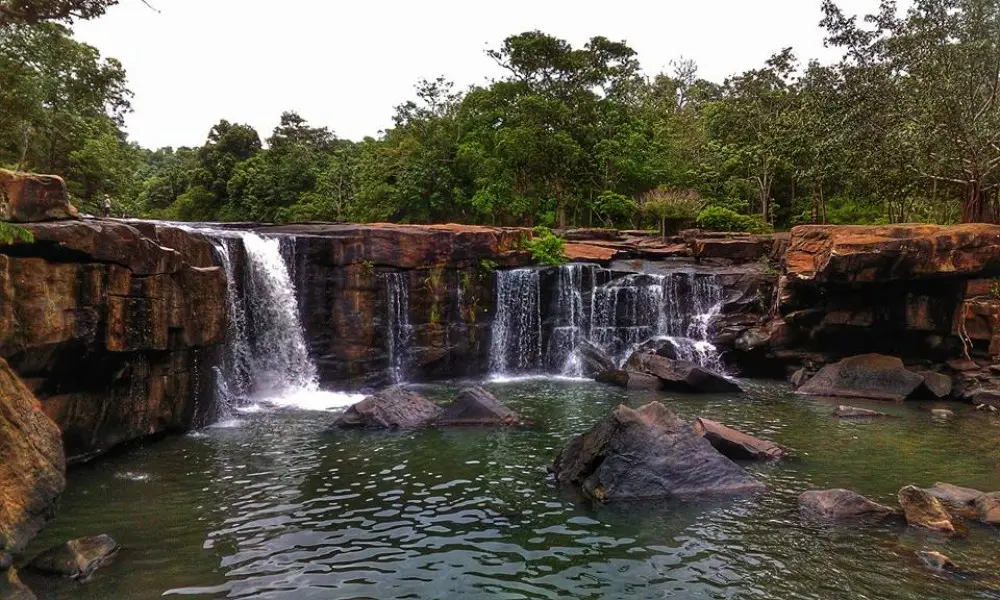
The name “Tat Ton” reflects the physical character of the waterfall. In many parts of northeastern Thailand, the word “tat” refers to a rocky terrace or rock platform with water flowing across it, while “ton” suggests water dropping from a higher level. Tat Ton Waterfall therefore describes a stream flowing across a broad rock surface before falling down a cliff into a pool below. This is the defining image of the park: water moving across a wide stone terrace, shaded banks on both sides, and a waterfall face about 6 meters high and roughly 50 meters wide.
Tat Ton Waterfall is the main attraction and is located close to the park headquarters. The walking route from the parking area and visitor zone is short and convenient, making the waterfall suitable for travelers of different ages. The upper section features a wide rocky stream, while the lower section opens into a waterfall and natural pool. Visitors can relax in designated areas, take photographs, enjoy the sound of the water, and swim only in safe areas permitted by park officers. During the rainy season, the water volume increases and the waterfall becomes more powerful, so visitors should avoid the cliff edge and follow safety signs carefully.
The best time to visit Tat Ton National Park is from the rainy season through the early cool season. From around May to October, the waterfall usually has a strong flow and the surrounding forest becomes lush and green. This is the most beautiful period for waterfall photography, although visitors should be alert to slippery rocks and stronger currents. The early cool season is comfortable for picnics, short walks, camping, and stargazing. In the hot season, the waterfall still has water, but the flow is lighter and visitors should plan their trip in the morning or late afternoon to avoid the strongest heat on exposed rock surfaces.
Besides Tat Ton Waterfall, the park also contains other natural attractions such as Tat Fa Waterfall and Pha Iang Waterfall. Tat Fa offers a quieter forest atmosphere, while Pha Iang is known for a sloping cliff formation where water flows at an unusual angle. These sites add variety to a nature trip in the park, especially for visitors who enjoy exploring beyond the main waterfall. Before visiting these secondary waterfall areas, travelers should check route conditions with park officers, particularly during the rainy season or after heavy rainfall.
The suspension bridge near the entrance to the waterfall area is another popular photo spot. Surrounded by trees and stream scenery, the bridge gives visitors a gentle transition from the visitor zone into the forested waterfall area. It is a good place for casual photography and for enjoying the atmosphere before reaching the broad rock terrace of Tat Ton Waterfall. Visitors should walk calmly, avoid shaking the bridge, and supervise children closely.
Within the waterfall area, visitors can also find the shrine of Chao Pho Tat Ton, locally known as San Pu Duang. This shrine reflects the relationship between local belief, nature, and community life in Chaiyaphum. Many Thai visitors stop to pay respect before or after enjoying the waterfall. Foreign travelers are welcome to observe the site respectfully by dressing modestly, keeping voices low, and maintaining cleanliness around the shrine area.
The park’s forest includes dry dipterocarp forest and dry evergreen forest. Important tree species include teng, rang, phluang, krabok, kradon, phayom, rak, pradu, makha, yang, krabak, takhian, and other native trees. The forest floor includes many local grasses and understory plants, especially in dry dipterocarp areas. These forests help retain moisture, reduce soil erosion, protect the watershed, and provide food and habitat for wildlife.
Wildlife found in the park includes barking deer, wild boar, mongoose, hare, squirrels, tree shrews, jungle fowl, and many kinds of birds. Most animals avoid busy visitor areas, but the deeper forest and stream corridors remain important habitats. Visitors can help protect this ecosystem by not feeding wildlife, not leaving food waste, not collecting plants, and not disturbing animals or birds. Quiet and responsible travel keeps the park safe for both visitors and wildlife.
Tat Ton National Park also has a special identity as a dark-sky destination. The helicopter landing ground area, known locally as Lan Ho, is an open space suitable for stargazing, youth astronomy camps, and night-sky photography. It is located near the camping ground, youth camp, and restrooms, making it practical for group activities. The park has been registered as a dark-sky park for the 2024–2026 period, giving Tat Ton another dimension beyond its famous waterfall. Travelers who stay overnight can experience both the waterfall by day and the night sky above Phu Laen Kha after dark.
Visitor facilities include a tourist service center, welfare shops, restrooms, toilets, camping ground, park accommodation, youth camp, meeting rooms, parking areas, and rest areas near the waterfall. The tourist service center is the best first stop for checking trail conditions, water levels, safe swimming zones, accommodation, and park regulations. Travelers planning to stay overnight should make accommodation or camping arrangements in advance, especially during long weekends and holidays.
For families, Tat Ton Waterfall is one of the more convenient waterfall destinations in Chaiyaphum because the access route is short, the visitor facilities are practical, and the shaded areas make it easy to rest between activities. Parents should still pay close attention to children near wet rocks, pools, and flowing water. Natural rock surfaces can be slippery, and water levels can change quickly after rain. Swimming should be limited to safe areas supervised or recommended by park staff.
Travel photographers will find several attractive angles in the park, including the waterfall from below, the upper rock terrace, the stream under the trees, the suspension bridge, the shrine area, and the forest paths. Morning light is soft and the area is usually quieter, while the afternoon provides brighter water and rock textures. A pair of non-slip shoes, a hat, drinking water, and a waterproof phone pouch will make the visit more comfortable.
Safety should remain the main priority when visiting Tat Ton Waterfall. Although the waterfall is a popular recreation site, it is still a natural environment where water volume, current strength, and rock conditions can change. Visitors should follow warning signs, avoid restricted zones, stay away from the waterfall edge, and avoid swimming after alcohol consumption. During the rainy season, extra caution is essential because currents can become stronger and rocks can become more slippery.
Getting There from Chaiyaphum city is straightforward. Drive along Highway 2159, then turn onto Highway 2051 toward the park. The distance from the city to the park headquarters is about 21 km, and the road is paved. Another route is to use Highway 201 toward Phu Khiao, then take the side road leading to Tat Ton Waterfall. Travelers using public transport can take the Chaiyaphum–Tha Hin Ngom local songthaew, get off near the fee checkpoint, and continue on foot into the park area.
Travelers coming from Bangkok can drive toward Chaiyaphum through the central and northeastern highway network, then continue from Chaiyaphum city to the park. A day trip from the city is easy, but travelers who want to enjoy the waterfall, suspension bridge, shrine, camping ground, and dark-sky experience should consider staying overnight either inside the park or at nearby accommodation. This allows more time to enjoy the park without rushing and avoids late-night driving.
Tat Ton National Park can also be combined with nearby attractions such as Phra That Chaiyaphum, Wat Tha Hin Ngom, Mor Hin Khao, Pha Hua Nak, and Phu Laen Kha National Park. A one-day route should focus on two or three stops to keep the trip relaxed, while a two-day trip allows visitors to enjoy the waterfall, stone formations, viewpoints, temples, and night sky more comfortably. This makes Tat Ton a strong base for exploring the natural and cultural side of Chaiyaphum.
The park entrance fee follows Thailand’s national park rate for this site: Thai adults 40 baht, Thai children 20 baht, foreign adults 200 baht, foreign children 100 baht, and a vehicle fee of 30 baht. The fee helps support park management, safety, waste control, visitor facilities, and nature conservation. Visitors should prepare some cash because mobile payment or internet signal may not always be reliable in every part of the park.
One of the most valuable aspects of Tat Ton National Park is the way it helps visitors understand a watershed forest. In one trip, travelers can see mountains, forest, streams, broad rock terraces, a waterfall, and local recreation areas connected in a single landscape. Rainwater falling on Phu Laen Kha flows through forested slopes and small streams before becoming the waterfall that people enjoy. When the forest remains healthy, the waterfall continues to flow and the surrounding environment stays alive. This makes a visit to Tat Ton more meaningful than a simple swimming trip.
Responsible travel is essential in Tat Ton National Park. Visitors should keep the area clean, take rubbish back or use designated bins, avoid glass containers near the waterfall, refrain from writing on rocks, avoid damaging trees or plants, and respect wildlife. Keeping noise levels low also improves the experience for other visitors and reduces disturbance to animals. These simple practices help preserve the park for future generations.
Overall, Tat Ton National Park is one of Chaiyaphum’s most practical and enjoyable nature destinations. It is close to the city, easy to access, rich in natural scenery, and suitable for both short visits and overnight stays. First-time visitors will enjoy the wide waterfall and shaded stream, while returning visitors can appreciate how the park changes with the seasons. For foreign travelers, Tat Ton offers an accessible introduction to Isan’s forests, waterfalls, local beliefs, and quiet mountain landscapes.
| Name | Tat Ton National Park |
| Location | Na Fai Subdistrict, Mueang Chaiyaphum District, Chaiyaphum Province |
| Address | Highway 2051, Na Fai Subdistrict, Mueang Chaiyaphum District, Chaiyaphum 36000, Thailand |
| Coordinates | 15.98778, 102.04139 |
| Area | 135,737.50 rai, or about 217.18 sq km |
| Highlights | Tat Ton Waterfall, broad rock terraces, shaded stream, suspension bridge, Tat Fa Waterfall, Pha Iang Waterfall, camping ground, and dark-sky area |
| History | Declared a national park on 31 December 1980 as Thailand’s 23rd national park |
| Name Origin | The name reflects a waterfall flowing across a broad rock terrace before dropping from a higher level into a pool below |
| Distinctive Features | The main waterfall is about 6 meters high and 50 meters wide, with a shaded upper stream and broad sandstone terrace suitable for resting and photography |
| Travel Information | From Chaiyaphum city, take Highway 2159 and turn onto Highway 2051 for about 21 km to the park. Public transport travelers can use the Chaiyaphum–Tha Hin Ngom songthaew and continue on foot from the fee checkpoint |
| Current Status | Open to visitors and remains one of Chaiyaphum’s major natural attractions |
| Open Days | Daily |
| Opening Hours | 08.00 – 18.00 |
| Fees | Thai Adults: 40 Baht, Thai Children: 20 Baht Foreign Adults: 200 Baht, Foreign Children: 100 Baht Vehicle Fee: 30 Baht |
| Facilities | Tourist service center, welfare shops, restrooms, toilets, camping ground, park accommodation, youth camp, meeting rooms, parking area, and rest areas near the waterfall |
| Main Areas / Zones | Tat Ton Waterfall Tat Fa Waterfall Pha Iang Waterfall Suspension Bridge Chao Pho Tat Ton Shrine / San Pu Duang Tourist Service Center Camping Ground And Park Accommodation Lan Ho Stargazing Area In The Dark-Sky Park Zone |
| Caretaker | Mr. Woraphon Deepasai, Chief Of Tat Ton National Park |
| Main Contact Number | 0 4485 3293, 0 4485 3333 |
| tatton_np@hotmail.com | |
| Official Website / Official Page | Tat Ton National Park - Tatton National Park |
| Nearby Tourist Attractions | 1. Arun Thammasathan / Phra That Chaiyaphum, about 6 km 2. Wat Tha Hin Ngom, about 8 km 3. Mor Hin Khao, about 12 km 4. Pha Hua Nak, Phu Laen Kha National Park, about 13 km 5. Phu Laen Kha National Park, about 15 km |
| Nearby Restaurants | 1. Pu Som Tam Hi-So, about 3 km 2. Ban Phat Thai Dessert Chaiyaphum, about 6 km, Tel. 095-609-3465 3. Ahan Suan Khonphon, about 6 km, Tel. 081-074-6840 4. Rim Nam Restaurant, about 9 km 5. Farm Promma, about 9 km, Tel. 088-565-2654 |
| Nearby Accommodations | 1. On The Rock Chaiyaphum, about 6 km, Tel. 081-300-3399 2. Ban Rai Phu Phailin, about 6 km, Tel. 081-790-1692 3. Farm Promma, about 9 km, Tel. 088-565-2654 4. Phusuay Park View Hotel, about 16 km, Tel. 044-854-111 5. Lertnimit Hotel Chaiyaphum, about 19 km, Tel. 044-811-522, 080-165-9494 |
Frequently Asked Questions (FAQ)
Q: Where is Tat Ton National Park located?
A: Tat Ton National Park is located in Na Fai Subdistrict, Mueang Chaiyaphum District, Chaiyaphum Province, about 21 km from Chaiyaphum city.
Q: Does Tat Ton Waterfall have water all year round?
A: Yes. Tat Ton Waterfall flows throughout the year, with the most impressive water volume during the rainy season and early cool season.
Q: What are the opening hours of Tat Ton National Park?
A: The park is open daily from 08.00 to 18.00.
Q: How much is the entrance fee?
A: Thai adults pay 40 baht and Thai children pay 20 baht. Foreign adults pay 200 baht and foreign children pay 100 baht. The vehicle fee is 30 baht.
Q: Can travelers visit Tat Ton National Park without a private car?
A: Yes. Travelers can take the Chaiyaphum–Tha Hin Ngom local songthaew, get off near the fee checkpoint, and continue on foot into the park area.
Q: Is there accommodation inside Tat Ton National Park?
A: Yes. The park has accommodation, a camping ground, and youth camp facilities. Advance booking or direct contact with the tourist service center is recommended.
Q: What should visitors bring to Tat Ton Waterfall?
A: Non-slip shoes, a change of clothes, drinking water, a hat, mosquito repellent, a waterproof phone pouch, and some cash are useful for a comfortable visit.
Q: Is Tat Ton National Park suitable for families?
A: Yes. The park is suitable for families because it is easy to reach, has practical facilities, and offers shaded areas near the waterfall. Children should be supervised closely around wet rocks and natural pools.
 Category: ●Nature and Wildlife
 Group: ●National Parks and Marine Reserves
Last Update : 3 MonthAgo
 Last Update : 3 MonthAgo
 Click to Access the Navigation Map GPS
Tat Ton National Park Map
Recommend

 Art, Culture and Heritage
 Historical Sites and Monuments(1)
 Landmarks and Memorials(3)
 Royal Palace(1)
 Art, Craft Centres, Tradition(3)
 Educational Places
 Educational Gardens, Farm(1)
 Places of Worship
 Temple(141)
 Other Sacred Sites(7)
 Suburban Living
 Village, Community(4)
National Parks and Marine Reserves(7)
Village, Community(4)
National Parks and Marine Reserves(7)
 Mountain (Doi)(5)
 Dam, Reservoir, Lake(10)
 Waterfalls(15)
 Caves(5)
 River, Canal(4)
 Other natural attractions(1)
 Entertainment and Agricultural
 Farms, Parks and Ecotourism(2)


