
lovethailand home >Northeastern Travel Attractions >Buri Ram Travel Attractions >Muang Buri Ram >Nai Muang > Buriram Rajabhat University
TL;DR: Buriram Rajabhat University is located at Nai Mueang Subdistrict, Mueang Buriram District, Buriram Province, Thailand, open Monday – Sunday (Except Public Holidays), hours 08:30 – 16:30.
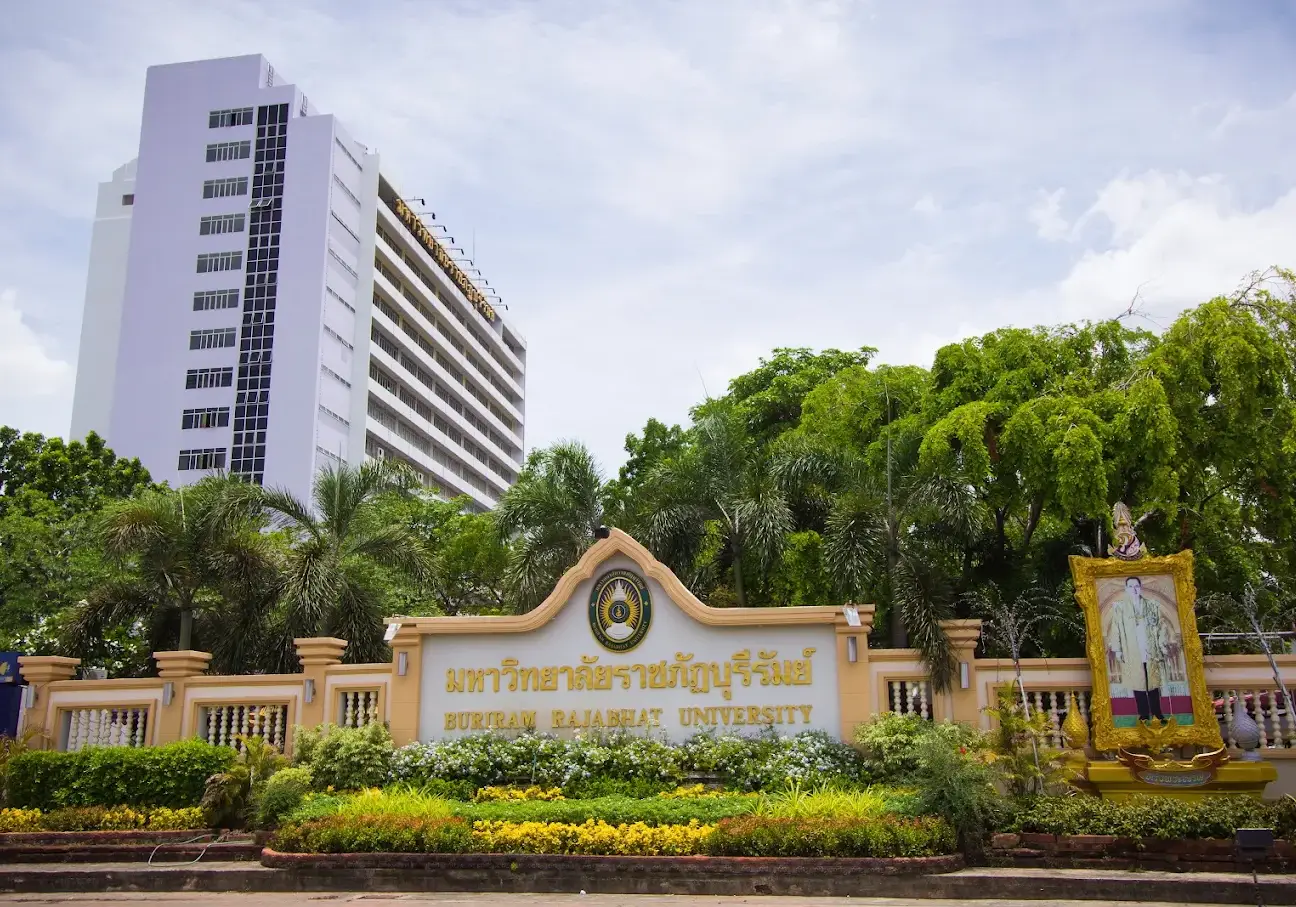
Buriram Rajabhat University
Open Days: Monday – Sunday (Except Public Holidays)
Opening Hours: 08:30 – 16:30
Buriram Rajabhat University (BRU) is a public university in Buriram Province, northeastern Thailand, located at 439 Jira Road, Nai Mueang Subdistrict, Mueang Buriram District, Buriram Province 31000. Its history began with Buriram Teachers College, where construction commenced on October 6, 1971, in response to the growing demand for qualified teachers in the region. The institution later became Buriram Rajabhat Institute in 1995 and was elevated to university status on June 14, 2004. Today, Buriram Rajabhat University offers education in teacher education, humanities and social sciences, science, management, industrial technology, agricultural technology, and nursing, together with postgraduate programs. The university plays an important role in preparing graduates, supporting local development, conducting research, providing academic services, and preserving the cultural heritage of southern Isan. One of its notable visitor attractions is the Southern Isan Cultural Center, an educational facility dedicated to the history, traditions, and local knowledge of the region.
Buriram Rajabhat University occupies a central location in Buriram City, opposite the former Buriram Provincial Hall. This position makes it accessible to students, parents, researchers, and visitors attending academic or administrative appointments. The main campus covers 297 rai, 1 ngan, and 27 square wah. Its facilities include academic buildings, laboratories, administrative offices, auditoriums, a library and information technology center, student residences, sports grounds, a demonstration school, and cultural learning spaces. The university's urban location also connects it with the everyday life of Buriram through education, employment, public services, and community activities.
Buriram Province has a distinctive identity shaped by Khmer-influenced historical heritage, southern Isan traditions, local craftsmanship, and modern sports tourism. Its landscape includes agricultural plains, rural communities, and ancient volcanic formations that have become prominent local landmarks. The development of Buriram Rajabhat University took place within this regional setting, responding initially to the need for teachers and later to the demand for a broader range of professional and academic skills. The province's cultural and natural resources have also provided valuable subjects for teaching, research, and community-based learning.
Before Buriram Teachers College was founded, Thailand faced a shortage of qualified teachers and the challenge of expanding education into rural areas. Schools throughout the northeastern region required trained teaching personnel, while access to advanced education remained limited for many provincial families. Establishing a teachers college in Buriram was part of a broader effort to improve teacher education and make professional qualifications more accessible to people living outside the country's principal educational centers.
The initiative to establish Buriram Teachers College was supported by provincial government representatives and local residents. An important figure was Surawut Bunyanusat, the Governor of Buriram Province at the time, who worked alongside members of parliament representing the province. Their efforts reflected the recognition that a local teacher-training institution could improve the quality of education in Buriram, prepare personnel for schools, and contribute to the province's long-term development.
The original campus land has an unusual history. It had previously been used by the Royal Thai Air Force as an airfield. After the airfield was no longer needed, part of the land was allocated to the provincial authorities for educational purposes. The eastern section became the site of Buriram Teachers College, while other portions were assigned to government agencies. Transforming former airfield land into a higher education institution represented the use of public resources to support an important social need.
Construction of Buriram Teachers College began on October 6, 1971. A budget of 9 million baht was allocated for fiscal year 1972 to construct the first teaching building and essential infrastructure, including roads, electricity, and water supply systems. These early investments provided the physical foundation for the institution's teaching and administrative operations. Over subsequent decades, the campus expanded to accommodate new academic departments and educational facilities.
Several educators played significant roles during the college's formative period. These included Witthaya Attasat, who later served as headmaster, director, and the college's first rector, together with Dr. Phon Khapang, Narong Wichathep, and Chenwit Phasuk. Their work helped establish the institution's academic administration, prepare instructional facilities, and organize the teaching required to welcome its first students.
Buriram Teachers College admitted its first students in the 1972 academic year, offering the Certificate in Education program, known in Thai as Por Kor Sor. In 1973, it introduced the Higher Certificate in Education, with both regular and evening study arrangements. Providing more than one study schedule helped accommodate different groups of learners and demonstrated an early commitment to educational accessibility.
In 1976, the college's administration and academic organization were adjusted under the Teachers College Act of 1975. Changes included the development of academic divisions and administrative offices and the adoption of revised teacher education curricula. The academic calendar was also reorganized into two semesters. These structural changes enabled the college to broaden its academic responsibilities and prepare for future growth.
In the 1978 academic year, Buriram Teachers College introduced its first two-year post-diploma Bachelor of Education programs. Teaching specializations included English, Thai, physical education, social studies, art education, and general science. The college also offered opportunities for teachers already working in schools to obtain higher qualifications through in-service teacher education programs held on weekends. This model allowed practicing teachers to improve their professional knowledge while continuing their employment.
In the 1981 academic year, the college introduced its first four-year Bachelor of Education programs, initially in Thai and general science. At the same time, it expanded higher certificate studies into areas such as library science, community development, and cooperatives. These developments reflected the college's gradual transition from a narrowly focused teacher-training institution toward a broader educational organization capable of supporting different aspects of community development.
Another major turning point came in 1984, when changes to Thailand's teachers college legislation enabled these institutions to provide education beyond traditional teacher training. Buriram Teachers College developed programs related to food preparation, construction, agriculture, visual arts, animal production, cooperative economics, and community development. The expansion created the foundations for academic units that would later develop into the faculties of the present university.
On February 14, 1992, King Bhumibol Adulyadej graciously bestowed the name “Rajabhat Institute” upon Thailand's teachers colleges and granted permission for the use of the royal emblem as their institutional symbol. The word “Rajabhat” is associated with the idea of serving the monarchy and the nation. It became a shared identity among institutions dedicated to education and local development throughout Thailand.
In 1995, the Rajabhat Institutes Act came into effect, and Buriram Teachers College became Buriram Rajabhat Institute. The new legal framework introduced a university-oriented administrative structure and allowed the institution to expand academic programs, including postgraduate education. The institution continued to follow the philosophy of serving regional communities while developing a more comprehensive range of academic responsibilities.
Postgraduate education became an increasingly important part of the institution's activities from the 1998 academic year, when master's-level studies in educational administration were introduced. Social sciences for development followed in 1999, with further fields subsequently added in curriculum and instruction, business administration, research and local development, and public administration. These programs created opportunities for teachers, government personnel, and graduates to pursue advanced qualifications without leaving the region.
On June 14, 2004, Buriram Rajabhat Institute was elevated to Buriram Rajabhat University under the Rajabhat University Act B.E. 2547 (2004). The change granted the institution university status and a legal framework supporting its educational and administrative responsibilities. It also provided a basis for further development in graduate education, research, academic services, cultural preservation, and community engagement.
Following the transition to university status, Buriram Rajabhat University continued to strengthen its faculties and academic services. Its established disciplines included education, humanities and social sciences, science, management, agricultural technology, and industrial technology. The university also developed supporting organizations, including the Research and Development Institute, Office of Art and Culture, Office of Academic Resources and Information Technology, and Office of Academic Promotion and Registration. The later development of nursing education further broadened the university's professional training role.
The university has also undertaken initiatives involving educational and research sites beyond its principal campus in Buriram City. Historical plans include land in the Khok Nong Khwang area of Khu Mueang District and government land in Pakham District. Such projects have been associated with opportunities for practical education, research, and future regional development. They demonstrate the university's recognition that some forms of teaching and applied research require space and facilities beyond an urban campus.
In 2026, Buriram Rajabhat University marked 55 years since the beginning of Buriram Teachers College in 1971 and 22 years since becoming a university in 2004. On October 3, 2026, the university organized commemorative activities celebrating the 55th anniversary of the institution's founding. The program included a charity run, merit-making ceremonies, and an alumni homecoming event. These activities recalled the institution's transformation from a teachers college into a university serving regional communities and brought together alumni, staff, students, and supporters from different generations.
As of October 2026, Associate Professor Dr. Siranee Juthopama serves as President of Buriram Rajabhat University. Her appointment was announced in an Office of the Prime Minister notice dated January 14, 2026. Under its current leadership, the university continues to develop academic programs, research activities, student services, cultural initiatives, and cooperation with local organizations.
The official emblem of Buriram Rajabhat University is based on the royal seal of King Rama IX. Its design includes the Atthit throne, a circular symbol, and ceremonial elements associated with royal authority and the coronation tradition. The use of this royal emblem reflects the historical relationship between Rajabhat institutions and the Thai monarchy. It also serves as a symbol of pride for students, staff, and graduates.
The university emblem incorporates five symbolic colors. Blue represents the monarchy and its role in granting the Rajabhat name. Green represents natural surroundings and environmental beauty. Gold expresses the advancement of wisdom. Orange symbolizes the flourishing of local arts and culture, while white represents the purity of scholarly thought. Separately, the university's official institutional colors are purple and yellow, which appear in university identity materials and student activities.
The university's symbolic flower is the Ratchaphruek, also known as the golden shower flower or Dok Khun in northeastern Thailand. Its hanging clusters of yellow flowers are widely associated with Thai landscapes and local seasonal traditions. The university uses the flower as an expression of shared identity and belonging. For example, new students in the 2026 academic year were welcomed as the 55th cluster of Dok Khun, linking the incoming cohort to the institution's anniversary.
The university's moral maxim is “Suvijjo Jane Suto Hoti,” commonly expressed in Thai as “ผู้มีความรู้ดี ย่อมเป็นเด่นในหมู่ชน,” meaning that a person possessing sound knowledge is distinguished among people. The maxim emphasizes learning, intellectual development, and the responsibility to apply knowledge for the benefit of society. It reflects the university's commitment to preparing graduates with academic competence and ethical awareness.
The university's principal Buddha image is Phra Phuttha Sapphanyu Sukhato. It represents a spiritual and cultural element within the university community. The presence of a designated Buddha image reflects the traditional relationship between education and moral values in Thai society, while university life also encompasses students and personnel from different cultural and religious backgrounds.
The Royal Emblem Procession is among the most distinctive traditions of Buriram Rajabhat University. In the 2026 academic year, more than 3,000 students and university personnel participated in the ceremony. The procession helps introduce students to the history of Rajabhat institutions and the significance of the royal emblem. It also encourages a sense of belonging and a commitment to the university's role in local development.
Rajabhat Day is observed annually on February 14, commemorating the royal granting of the Rajabhat name to Thailand's teachers colleges. In 2026, Buriram Rajabhat University organized royal tribute activities and ceremonies associated with the university's emblem. The occasion encouraged students and staff to reflect on the institution's history and express gratitude for the royal support that shaped the development of the Rajabhat university system.
From February 14 to 16, 2026, Buriram Rajabhat University hosted the 9th Buriram Rajabhat Conference and Cultural Festival, known as BRICC Festival 2026. The event combined academic presentations, research activities, exhibitions, and cultural performances involving institutions and networks from Thailand and abroad. It provided an opportunity for researchers, students, cultural performers, and the public to exchange knowledge and engage in educational and artistic activities.
Performances at BRICC Festival 2026 included Thai classical music and dance by university students, alongside international cultural presentations involving networks from China, Laos, Vietnam, and Myanmar, as well as participating Thai universities. These activities created opportunities for students to demonstrate artistic skills, appreciate cultural diversity, and strengthen connections with people from different educational and cultural backgrounds.
The university also promotes physical activity and community participation through sporting events. One example was the 9th Buriram Rajabhat Mini Marathon, organized on February 14, 2026, with the BRU Dome area serving as an event starting point. The activity brought together members of the university and wider community while encouraging exercise, health awareness, and the use of campus facilities for public engagement.
Welcoming first-year students is another important aspect of university culture. On May 7, 2026, Buriram Rajabhat University organized an orientation program for the new academic year. The event introduced students to academic procedures, campus life, student regulations, and opportunities to participate in university activities. Orientation also allows new students to meet lecturers, administrators, and classmates, helping them become familiar with higher education and the campus environment.
Bai Sri Su Khwan welcoming ceremonies and Buddhist merit-making activities are connected with traditional cultural expressions in northeastern Thailand. Bai Sri Su Khwan is associated with encouragement, welcoming, and strengthening interpersonal relationships, while merit-making provides an opportunity for religious reflection and charitable action. By incorporating such traditions into student activities, the university connects contemporary higher education with the cultural heritage of its local communities.
The Wai Khru ceremony, in which students express gratitude and respect to their teachers, remains an important university tradition. In the 2026 academic year, Buriram Rajabhat University held its regular undergraduate Wai Khru ceremony on July 9 at Malinee Juthopama Auditorium. Another ceremony for special-program and postgraduate students was scheduled for July 26 in the Fueang Fa Conference Room of the university's commemorative building. The ceremonies reinforce respect for educators, appreciation of learning, and professional ethical values.
The Office of Art and Culture plays a central role in conserving, promoting, and sharing southern Isan cultural heritage. One of its principal educational facilities is the Southern Isan Cultural Center, a learning site devoted to regional history, artifacts, traditional crafts, and local knowledge. The center helps visitors understand cultural practices associated with northeastern Thailand, including the historical influence of Khmer civilization and the development of local communities.
The history of the Southern Isan Cultural Center can be traced to the cultural preservation activities established during the Buriram Teachers College period. These activities gradually developed into a more systematic institutional responsibility for collecting and interpreting local heritage. In 1993, Princess Maha Chakri Sirindhorn presided over the official opening ceremony of the Southern Isan Cultural Center building, marking an important milestone in the university's development as a regional center for cultural learning.
The center's exhibitions present cultural and historical materials such as stone tools, pottery, traditional woven textiles, and religious images. These objects provide insights into everyday life, craftsmanship, belief systems, and cultural exchange in southern Isan. They also help explain connections between local communities, Khmer-influenced artistic traditions, and Buddhism. For students and visitors, the collections make regional history more tangible by connecting written knowledge with actual objects.
Additional exhibitions explore traditional arts, handicrafts, clothing, local customs, and knowledge preserved within southern Isan communities. These displays encourage visitors to appreciate the region's cultural diversity and the historical development of its settlements. They also provide a foundation for school visits, university study tours, and educational activities intended to strengthen understanding of local heritage.
The Southern Isan Cultural Center welcomes visitors to its exhibition areas according to its own service schedule. Published exhibition hours are Monday to Friday, 09:00–16:20, and admission is free. Groups wishing to arrange guided learning activities or workshops should contact the Office of Art and Culture before visiting so that appropriate arrangements can be made.
In March 2026, the university's Office of Art and Culture participated in discussions with Buriram's cultural and tourism authorities about developing the Southern Isan Cultural Center into a Buriram City Museum. The initiative reflects interest in strengthening the role of the center as a venue for cultural education, research, and tourism. It also highlights the importance of presenting local history in ways that are accessible and meaningful to a wider public audience.
The Office of Academic Resources and Information Technology is another important university institution. Its origins go back to the library established when Buriram Teachers College opened in 1971. The original library was housed on the ground floor of the administrative building before moving to a dedicated library building in 1975. The service later developed in response to changes in academic information and digital technology. Today, the university's library and information services support classroom learning, independent study, research, and access to educational resources.
The 50th Birthday Anniversary of Maha Vajiralongkorn Building, commonly known as Building 15, is an important administrative landmark. It houses the Office of the President and several supporting offices. The building also contains meeting facilities and provides space for official university business. Its central administrative role makes it a relevant destination for visitors attending meetings or contacting the university's management offices.
Malinee Juthopama Auditorium is one of the university's main venues for major ceremonies and large gatherings. During 2026, it accommodated Wai Khru ceremonies, events associated with the royal emblem, student activities, and graduation rehearsal programs. A large auditorium enables students, staff, alumni, and invited guests to participate together in events that strengthen the university community.
The BRU Dome and the main sports facilities contribute to student development and community engagement. They provide venues for exercise, sports, and outdoor activities, including events attended by significant numbers of participants. The university also operates student accommodation and support facilities that assist learners arriving from districts and provinces beyond Buriram City.
Academically, Buriram Rajabhat University has seven faculties: the Faculty of Education, Faculty of Humanities and Social Sciences, Faculty of Science, Faculty of Management Science, Faculty of Industrial Technology, Faculty of Agricultural Technology, and Faculty of Nursing. Graduate education is supported by the Graduate School. Together, these units provide academic and professional programs relevant to the needs of public institutions, private businesses, and communities.
The Faculty of Education maintains the university's historical foundation in teacher preparation. It develops professional teachers and educators with subject knowledge, teaching skills, and an understanding of educational ethics. Its academic fields include early childhood education, Thai, English, mathematics, social studies, general science, physical education, music education, Thai performing arts, and educational technology and computer education. This range of specializations supports the development of teachers for local schools and educational institutions.
The Faculty of Humanities and Social Sciences provides education in languages, literature, law, public administration, society, and culture. Fields associated with its academic provision include Thai, English, business English, social development, library and information science, law, and public administration. These disciplines help students develop communication, analytical, legal, and social understanding relevant to government service, private employment, and community development.
The Faculty of Science offers education in fundamental and applied sciences. Its academic structure includes mathematics, applied chemistry and product development, biology, computer science, information technology, geoinformatics, sports science, statistics and information science, environmental science, and public health. These fields develop the analytical, experimental, and technical skills needed to address problems involving health, natural resources, information systems, and scientific innovation.
The Faculty of Management Science prepares students for careers in business, accounting, economics, communication, and the service sector. Its academic fields include management, marketing, human resource management, finance and investment, business computing, mass communication, tourism and hospitality, and business economics. These studies are particularly relevant to organizations and businesses operating within Buriram's changing regional economy.
The Faculty of Industrial Technology focuses on technical and applied professional education. Its academic areas include architectural technology, civil engineering technology, electrical engineering technology, electrical and electronics technology, industrial management engineering, and art and design. Knowledge from these disciplines supports activities in construction, electricity, industrial production, product development, and infrastructure improvement.
The Faculty of Agricultural Technology is particularly relevant to Buriram Province because agriculture and food production remain important aspects of the local economy. The faculty offers education connected with agricultural science, animal science, aquaculture technology, and food technology and innovation. It also participates in agricultural education through cooperation with the Faculty of Education. These fields contribute to agricultural productivity, food processing, and the development of products based on regional resources.
The Faculty of Nursing prepares qualified nursing personnel to support healthcare services. Its Bachelor of Nursing Science program combines academic learning with professional skills related to patient care, health promotion, and disease prevention. The faculty's development represents an expansion of the university's contribution to professional education and responds to the need for healthcare personnel within Thai society.
The Graduate School coordinates and supports postgraduate education. Academic fields associated with its programs include educational administration, curriculum innovation and learning management, educational technology and computer education, music education, educational research and assessment, public administration, and information technology. In 2026, the university conducted admissions examinations for special-program master's and doctoral study, demonstrating its continuing role in preparing advanced professionals and researchers.
Research and innovation are important responsibilities of Buriram Rajabhat University. The institution applies knowledge from its faculties to issues relevant to local communities. Research in agriculture, technology, the environment, business administration, education, and culture can support practical improvements in livelihoods and regional development. Cooperation with communities creates opportunities for academic findings to be tested and applied in real-world situations.
Plant conservation and agricultural learning projects illustrate the relationship between the university and the natural resources of northeastern Thailand. Research involving plants, animals, and food processing can improve understanding of resource management, production efficiency, and value-added agricultural products. These activities are relevant to local producers, community enterprises, and students seeking opportunities to apply academic knowledge to professional activities.
The university also engages with Buriram's economy and cultural identity through academic events, traditional performances, and cooperation with government agencies and community organizations. Studies related to southern Isan culture, tourism, hospitality, and business development can prepare graduates who understand their region's distinct characteristics and can use that knowledge in employment and local enterprise.
Professional training remains an important element of the university's educational approach. In the second semester of the 2026 academic year, students in Civil Engineering Technology began their professional internships, providing an opportunity to gain experience in actual workplaces. Such placements help students apply classroom knowledge, develop problem-solving and teamwork skills, and understand professional responsibilities before graduation.
Buriram Rajabhat University is also an appealing destination for educational tourism because the Southern Isan Cultural Center allows the public to learn about regional history and traditional knowledge. Visitors interested in archaeology, local textiles, handicrafts, and the customs of southern Isan can explore its exhibitions before continuing to other cultural and historical attractions in Buriram.
Important attractions in Buriram City include the Buriram City Pillar Shrine, Wat Klang Phra Aram Luang, and the King Rama I Monument. Beyond the city center, Khao Kradong Forest Park offers a volcanic landscape and elevated viewpoints, while Chang Arena and Chang International Circuit represent Buriram's modern reputation as a destination for football and motorsport tourism. A university visit can therefore form part of a wider journey exploring the province's religious, historical, natural, and contemporary attractions.
Groups planning to visit the Southern Isan Cultural Center should contact the Office of Art and Culture in advance, particularly if they require educational guidance or wish to participate in a workshop. Access to teaching buildings, laboratories, and specialized academic spaces must follow university regulations. Confirming the purpose and timing of a visit helps ensure that appropriate facilities and personnel are available.
Getting There: Buriram Rajabhat University can be reached by private car, interprovincial bus, train, and air travel. The campus is located at 439 Jira Road in central Buriram, opposite the former Provincial Hall. Travelers arriving by road can follow the main highways toward Buriram City before continuing along Jira Road. Entering the university's name into a navigation application provides a practical way to identify the campus entrance.
Rail travelers can take the Northeastern Railway Line to Buriram Railway Station and continue to the university using local hired transport. Those arriving by interprovincial bus can use Buriram Bus Terminal before traveling to the campus. Air travelers can fly to Buriram Airport and arrange onward transport by car. Choosing a suitable route depends on the visitor's timetable, destination building, and luggage.
The university has numerous buildings serving different academic and administrative functions. Visitors attending appointments with the Office of the President should proceed to Building 15, the 50th Birthday Anniversary of Maha Vajiralongkorn Building. Admissions and registration matters are handled through the Office of Academic Promotion and Registration. Confirming the correct office and building is particularly useful on examination days, during admissions, and when large university events are taking place.
Buriram Rajabhat University's location in the city center also provides access to restaurants, hotels, and other services. The Jira Road area and surrounding neighborhoods offer Thai and northeastern cuisine, international dining, guest accommodation, and budget hotels. These facilities are convenient for students, parents, alumni, researchers, and visitors attending conferences or staying overnight for university activities.
Since its origins in 1971 as an institution established to address the shortage of qualified teachers, Buriram Rajabhat University has developed into a multidisciplinary university with responsibilities across education, research, professional preparation, and public service. Its transformation from Buriram Teachers College to Buriram Rajabhat Institute and finally to a university reflects the broader expansion of higher education in Thailand and the importance of improving educational access across the provinces.
Buriram Rajabhat University remains an institution of considerable educational and cultural significance. As it marks 55 years of institutional history in 2026, it continues to prepare graduates, support local development, and preserve the heritage of southern Isan. Through academic learning, applied research, public services, and cultural engagement, the university demonstrates the role that higher education can play in strengthening communities and improving opportunities for future generations.
| University Name | Buriram Rajabhat University |
| Thai Name | มหาวิทยาลัยราชภัฏบุรีรัมย์ |
| Abbreviation | BRU / มรภ.บร. |
| Institution Type | Public University in the Rajabhat University System |
| Location | Nai Mueang Subdistrict, Mueang Buriram District, Buriram Province, Thailand |
| Address | 439 Jira Road, Nai Mueang Subdistrict, Mueang Buriram District, Buriram Province 31000, Thailand |
| Approximate Coordinates | 14.9913632, 103.1022496 |
| Main Campus Area | 297 Rai, 1 Ngan, 27 Square Wah |
| Original Construction Began | October 6, 1971 |
| University Status Granted | June 14, 2004 |
| Institutional Age in 2026 | 55 Years Since the Founding of Buriram Teachers College and 22 Years as a University |
| Former Names | 1. Buriram Teachers College 2. Buriram Rajabhat Institute 3. Buriram Rajabhat University |
| Important Founding Figures | Surawut Bunyanusat, Witthaya Attasat, Dr. Phon Khapang, Narong Wichathep, and Chenwit Phasuk |
| University President as of October 2026 | Associate Professor Dr. Siranee Juthopama |
| University Colors | Purple and Yellow |
| Symbolic Flower | Ratchaphruek or Golden Shower Flower (Dok Khun) |
| University Moral Maxim | Suvijjo Jane Suto Hoti — A Person with Sound Knowledge Is Distinguished Among People |
| Principal Buddha Image | Phra Phuttha Sapphanyu Sukhato |
| Faculties and Main Academic Units | 1. Faculty of Education 2. Faculty of Humanities and Social Sciences 3. Faculty of Science 4. Faculty of Management Science 5. Faculty of Industrial Technology 6. Faculty of Agricultural Technology 7. Faculty of Nursing 8. Graduate School |
| Academic Strengths | Teacher Education, Regional Development, Science, Technology, Agriculture, Management, Nursing, and Southern Isan Cultural Preservation |
| Important Campus Facilities | 1. Southern Isan Cultural Center 2. Office of Art and Culture 3. Office of Academic Resources and Information Technology 4. 50th Birthday Anniversary of Maha Vajiralongkorn Building (Building 15) 5. Malinee Juthopama Auditorium 6. Witthaya Attasat Auditorium 7. BRU Dome 8. Main Sports Grounds and Student Dormitories |
| Important Traditions and Events | 1. Rajabhat Day, February 14 2. Royal Emblem Procession 3. Wai Khru Ceremony 4. Bai Sri Su Khwan for New Students 5. Buriram Rajabhat Conference and Cultural Festival 6. Alumni Homecoming Activities 7. Buriram Rajabhat Mini Marathon |
| University Open Days | Monday – Sunday, Except Public Holidays |
| University Opening Hours | 08:30 – 16:30 |
| Southern Isan Cultural Center Exhibition Hours | Monday – Friday, 09:00 – 16:20 |
| Cultural Center Admission Fee | Free Admission |
| Facilities | Teaching Buildings, Laboratories, Library, Conference Facilities, Student Dormitories, Sports Grounds, Cultural Center, and Student Services |
| Getting There | Travel via Jira Road into Central Buriram by Private Car or Bus, or Arrive at Buriram Railway Station or Buriram Airport and Continue by Local Transport |
| Attractions in and Around Buriram City | 1. Buriram City Pillar Shrine 2. Wat Klang Phra Aram Luang 3. King Rama I Monument 4. Khao Kradong Forest Park 5. Chang Arena |
| Restaurants in Central Buriram | 1. Isan Pratu Nam Chai, Tel. +66 84 825 2558 2. London Steak Buriram, Tel. +66 44 115 213 3. Rim Nam Moo Krata, Tel. +66 83 858 8646 4. Miles Cafe' Buriram, Tel. +66 63 803 9365 5. Siam Jaew Nuea, Tel. +66 87 770 5687 |
| Accommodations in Central Buriram | 1. Snow House Buriram, Tel. +66 90 258 3030 2. The Circle Hotel, Tel. +66 44 602 222 3. B2 Buriram Boutique and Budget Hotel, Tel. +66 44 110 866 4. Prajan Residence, Tel. +66 64 954 3805 5. HOP INN Buriram, Tel. +66 2 080 2222 |
| University Telephone | +66 44 611 221 |
| Fax | +66 44 612 858 |
| saraban@bru.ac.th | |
| Official Website | https://www.bru.ac.th/ |
| Academic Affairs and Registration | https://oapr.bru.ac.th/ |
| Current Status | Operating as a Public University in 2026 |
Academic Programs and Fields of Study at Buriram Rajabhat University – Academic Year 2026 The university offers undergraduate and postgraduate education across seven faculties and its Graduate School. The following table summarizes fields documented in current faculty information and academic program materials. A listed field does not necessarily represent a separate degree program or confirm that new students are being admitted to that field during every admissions round. Applicants should review official program titles, specializations, and admissions announcements before applying.
| Faculty / Academic Unit | Degree Programs and Fields of Study |
| Faculty of Education | Bachelor's Level — Education Programs 1. Early Childhood Education 2. Thai Language Education 3. English Language Education 4. Mathematics Education 5. Social Studies Education 6. General Science Education 7. Physical Education 8. Music Education 9. Thai Performing Arts Education 10. Art Education 11. Educational Technology and Computer Education 12. Physics Education |
| Faculty of Humanities and Social Sciences | Bachelor's Level 1. Thai Language 2. English Language 3. Business English 4. Social Development 5. Library and Information Science 6. Law 7. Public Administration 8. Western Music 9. Computer Art and Design 10. Geoinformatics |
| Faculty of Science | Bachelor's Level — Science and Applied Science Fields 1. Mathematics 2. Applied Chemistry and Product Development 3. Biology 4. Computer Science 5. Information Technology 6. Geoinformatics 7. Sports Science 8. Statistics and Information Science 9. Environmental Science 10. Public Health |
| Faculty of Management Science | Bachelor's Level — Business, Accounting, Communication, and Economics 1. Management 2. Marketing 3. Human Resource Management 4. Finance and Investment 5. Accounting 6. Business Computing 7. Mass Communication 8. Tourism and Hospitality 9. Business Management Economics 10. Modern Trade Business Economics |
| Faculty of Industrial Technology | Bachelor's Level 1. Art and Design 2. Architectural Technology 3. Electrical Engineering Technology 4. Civil Engineering Technology 5. Electrical and Electronics Technology 6. Industrial Management Engineering |
| Faculty of Agricultural Technology | Bachelor's Level 1. Bachelor of Science in Animal Science 2. Bachelor of Science in Agriculture — Innovative Crop Production Concentration 3. Bachelor of Science in Agriculture — Aquaculture Technology Concentration 4. Bachelor of Science in Food Technology and Innovation 5. Bachelor of Education in Agricultural Education — Joint Program with the Faculty of Education |
| Faculty of Nursing | Bachelor's Degree 1. Bachelor of Nursing Science Professional Certificate Program 1. Practical Nursing Certificate |
| Graduate School — Master's Degrees | Programs Appearing in Graduate School Information 1. Master of Education in Educational Administration 2. Master of Education in Music Education 3. Master of Education in Educational Technology and Computer Education 4. Master of Education in Educational Research and Evaluation 5. Master of Education in Curriculum Innovation and Learning Management 6. Master of Science in Information Technology 7. Master of Public Administration in Public Administration 8. Master of Economics in Digital Economics |
| Graduate School — Doctoral Degrees | Programs with Documented Academic Activities in 2026 1. Doctor of Philosophy in Educational Administration 2. Doctor of Education in Music Education 3. Doctor of Philosophy in Teaching English |
Frequently Asked Questions (FAQ)
Q: Where is Buriram Rajabhat University located?
A: Buriram Rajabhat University is located at 439 Jira Road, Nai Mueang Subdistrict, Mueang Buriram District, Buriram Province 31000, Thailand, near the former Buriram Provincial Hall.
Q: What are the opening days and hours of Buriram Rajabhat University?
A: The university lists opening days as Monday through Sunday, from 08:30 to 16:30, excluding public holidays. Individual offices and visitor facilities may follow different service schedules.
Q: When was Buriram Rajabhat University established?
A: Construction of Buriram Teachers College began on October 6, 1971. The institution was elevated to Buriram Rajabhat University on June 14, 2004.
Q: What faculties does Buriram Rajabhat University have?
A: The university has seven faculties: Education, Humanities and Social Sciences, Science, Management Science, Industrial Technology, Agricultural Technology, and Nursing. Postgraduate education is coordinated through the Graduate School.
Q: What is Buriram Rajabhat University known for academically?
A: The university has a historical strength in teacher education and local development. It also provides education in science, technology, agriculture, management, nursing, and humanities and social sciences.
Q: Can members of the public visit the Southern Isan Cultural Center?
A: Yes. The center's exhibition areas list visiting hours from Monday to Friday, 09:00–16:20, with free admission. Groups arranging educational visits should contact the Office of Art and Culture in advance.
Q: What important traditions are celebrated at Buriram Rajabhat University?
A: Significant events include Rajabhat Day, the Royal Emblem Procession, Wai Khru ceremonies, Bai Sri Su Khwan welcoming activities, the Buriram Rajabhat Conference and Cultural Festival, and alumni homecoming events.
Q: How do I get to Buriram Rajabhat University?
A: Travel to central Buriram and follow Jira Road to the university. Visitors can arrive by private car, bus, train through Buriram Railway Station, or air travel through Buriram Airport followed by local transport.
 Category: ●University
 Group: ●Rajabhat University
Last Update : 1 WeekAgo
 Last Update : 1 WeekAgo

 Click to Access the Navigation Map GPS
Buriram Rajabhat University Map
Recommend

 Art, Culture and Heritage
 Historical Sites and Monuments(14)
 Landmarks and Memorials(2)
 Art, Craft Centres, Tradition(6)
 Museums(3)
 Educational Places
 Museum for Study(1)
 Public university(1)
Rajabhat University(1)
 Private University(1)
 Places of Worship
 Temple(74)
 Other Sacred Sites(5)
 Research and Development
 Royal Project(1)
 Suburban Living
 Village, Community(3)
 Nature and Wildlife
 National Parks and Marine Reserves(2)
 Mountain (Doi)(1)
 Dam, Reservoir, Lake(14)
 River, Canal(1)
 Bays and Beaches(1)
 Other natural attractions(2)
 Entertainment and Agricultural
 Animal camps and shows(1)
 Stadium(2)
 Farms, Parks and Ecotourism(2)
 Waterpark(2)
 Travel Articles, Recipes
 Travel Review, Food Review(1)


