
lovethailand home >North Travel Attractions >Uthai Thani Travel Attractions >Lan Sak >Thung Na Ngam > Traditional Khanom Chin Making Tradition
TL;DR: Traditional Khanom Chin Making Tradition, Uthai Thani attractions : Art, Culture and Heritage, Art, Craft Centres, Tradition.

Traditional Khanom Chin Making Tradition
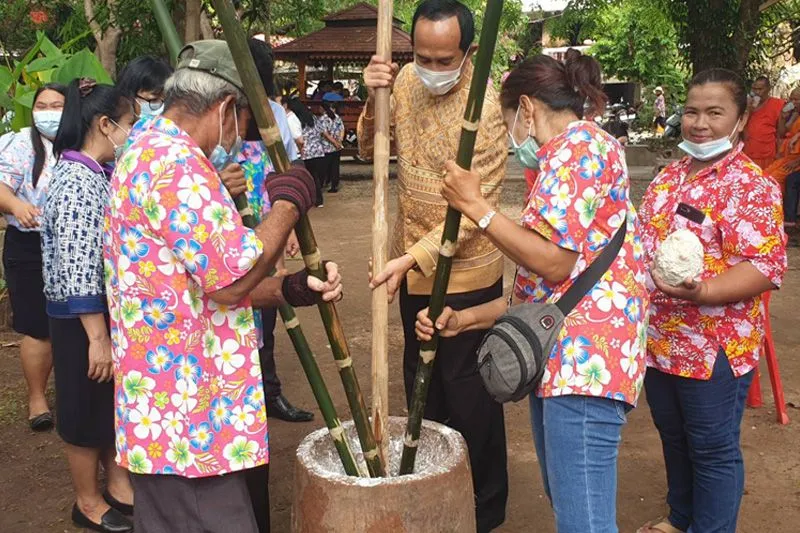
Open Days: Held Annually In April, According To The Announcement Of Thung Na Ngam Community And Subdistrict Administrative Organization
Opening Hours: Main Activities Are Held During The Day; Visitors Should Check The Schedule Before Traveling
The Traditional Khanom Chin Making Tradition Of Thung Na Ngam in Lan Sak District, Uthai Thani Province, is a valuable local food heritage that has been passed down through many generations. This community tradition centers on making khanom chin, Thai fermented rice noodles, using an old method that requires time, patience, skill, and cooperation. The process includes soaking rice, washing and fermenting the flour, boiling the dough, pounding it until smooth, pressing the dough into boiling water to form noodles, cooling the noodles, and arranging them into small portions by hand. For foreign travelers, this tradition offers a rare chance to understand Thai food not only as something to eat, but as a cultural practice that connects family, religion, community, and local memory.
The importance of this tradition lies in the fact that khanom chin is made through a slow and careful process. Unlike modern noodle production, the old method depends on community knowledge and direct experience. The people of Thung Na Ngam know how long rice should be soaked, when water should be changed, how fermented flour should smell, how the dough should feel, and how to press noodles so that they come out soft, long, and even. Much of this knowledge is learned through practice rather than written instruction. The annual event helps keep this knowledge alive.
Thung Na Ngam Subdistrict is located in Lan Sak District, an area of Uthai Thani known for rural communities, farming landscapes, and nearby natural attractions such as Hup Pa Tat and Khao Pla Ra. Local food traditions are strongly connected with agricultural life and temple-based merit-making. The traditional khanom chin event is therefore not only a cooking activity. It is also a community gathering, a religious occasion, and a celebration of local identity.
Wat Thung Na Ngam serves as the main community space for the tradition. In Thai rural society, temples are often more than religious places. They are centers for gatherings, ceremonies, education, and shared community activities. When villagers come together at the temple to make khanom chin, the work becomes part of a merit-making culture. The noodles are prepared, shared, offered, and eaten together, turning food into a symbol of generosity and unity.
The first step in making traditional khanom chin is soaking rice flour for about 5 nights. Rice is first soaked and the water is changed in the morning and evening during the first period of about 2 nights. The soaked rice is then crushed into a flour mixture. After that, the mixture is placed in a jar and soaked for another 3 nights. The soaking water is drained, and the flour is placed in a basket and shaped into dough balls. This step is essential because the flavor, aroma, and texture of khanom chin depend on properly fermented rice flour.
The fermentation stage shows the deep practical knowledge of local food makers. Villagers understand that rice changes when soaked and fermented correctly. The flour develops a special aroma and texture that cannot be rushed. The use of jars, baskets, and traditional containers reflects the rural way of life and the wisdom of earlier generations. Time is an ingredient in this tradition. Without enough time, the noodles will not have the same character.
The second step is boiling the dough balls in a large pan of strongly boiling water for about half an hour. After the dough is cooked, it is washed in cool water. This helps prepare the dough for pounding. Boiling changes the texture of the flour and makes it suitable for the next stage. The timing must be controlled carefully. If the dough is undercooked, the texture will not be smooth. If it is overcooked, it may lose the right balance.
The third step is pounding the cooked dough until it becomes smooth and unified. A small amount of tapioca starch mixed with water is added, and the dough is pounded again until it becomes soft and elastic. This is one of the most physically demanding stages. The dough must be smooth, with no hard lumps remaining. The moisture must also be balanced. If the dough is too stiff, it will be hard to press into noodles. If it is too runny, the noodles may break or lose their shape.
The mortar and pestle used for pounding the dough are important traditional tools. The sound of pounding is part of the atmosphere of the event. One person may pound while another turns the dough, another prepares water, and another watches the boiling pan. Traditional khanom chin cannot easily be made alone. It depends on cooperation. This is why the event is not only about food but also about community unity.
The fourth step is making the dough liquid enough to pass through a noodle press. The dough is placed in a cylinder or pressing tool and pressed into a pan of boiling water. The dough forms long strands of noodles as it cooks. The noodles are then lifted out, washed in cool water, and arranged into small bundles. This pressing stage requires skill. The person pressing the dough must control pressure, speed, and distance so that the noodles come out long, smooth, and even.
Arranging the noodles into small bundles is another delicate step. The cooled noodles are carefully gathered by hand into neat portions. This makes them easy to serve, share, and offer. The finished khanom chin is often placed in baskets and eaten with curry sauces, chili-based sauces, fresh vegetables, or local side dishes. The beauty of the food comes not only from its taste but also from the care shown in every stage of preparation.
The special flavor of Thung Na Ngam traditional khanom chin comes from fermented rice flour and careful handmade preparation. The noodles are soft, lightly chewy, and fragrant. When served with curry sauce and fresh vegetables, they become a complete local dish. However, the taste is only part of the experience. The deeper meaning comes from knowing that many hands worked together to make the food.
The tradition also plays an important educational role. Elderly villagers pass knowledge to younger generations: how to soak rice, how to change the water, how to tell when flour is ready, how to pound the dough, how to press the noodles, and how to arrange them beautifully. These skills are difficult to preserve if they are not practiced. The annual event gives younger people a reason to learn and participate.
In addition to the noodle-making demonstration, the event may include community activities such as shared cooking, merit-making, tasting khanom chin, and in some years, eating contests or local performances. These activities make the tradition lively and accessible to children, youth, adults, and elderly people. The event becomes a community reunion and a cultural celebration.
Khanom chin has long been associated with Thai merit-making and temple events because it can be prepared in large quantities and shared easily. It is suitable for communal meals and can be served with many types of sauces. In Thung Na Ngam, khanom chin becomes a food of generosity. People gather to make it, offer it, share it, and eat it together. This transforms a simple noodle dish into a symbol of kindness and social connection.
For travelers, the tradition offers a meaningful cultural experience. Watching the process from flour preparation to noodle pressing helps visitors understand the amount of work behind a familiar Thai dish. It also shows how food can carry history and identity. Visitors should not see the event only as a food festival, but as a living example of community heritage.
Because the event is held only once a year in April, visitors should check the schedule before traveling. The exact date may vary according to announcements from Wat Thung Na Ngam and Thung Na Ngam Subdistrict Administrative Organization. Checking official local information is especially important for those traveling from other provinces. It helps visitors arrive on the correct date and join the activities fully.
Getting There is convenient by private car, rental car, or local transport in Lan Sak District. From Lan Sak District, travel toward Thung Na Ngam Subdistrict and Wat Thung Na Ngam, the main community venue for the event. Travelers coming from Uthai Thani town should allow enough travel time. The area can also be combined with nearby attractions such as Hup Pa Tat, Khao Pla Ra, Tham Prathun Wildlife Non-Hunting Area, Wat Tham Khao Wong, and Pha Rom Yen Waterfall.
Visitors should dress respectfully because the event is held in a temple and community setting. If taking photographs, especially of people making noodles or working in the community kitchen area, permission should be requested. Respectful behavior helps protect the dignity of the tradition and creates a better relationship between visitors and the local community.
Visitors should allow at least half a day for the event. The process has several stages, and each stage is interesting in a different way. Arriving early may allow visitors to see preparation and pounding. Later in the day, visitors may see noodle pressing, noodle arranging, tasting, and community activities. A slow visit gives a much richer understanding than arriving only at the end to eat the finished noodles.
The surrounding area of Thung Na Ngam has several natural attractions. Hup Pa Tat is famous for its unusual landscape and ancient-looking vegetation. Khao Pla Ra is known for nature and prehistoric rock paintings. The wider Lan Sak area offers rural scenery, caves, hills, and quiet community life. A visit to the khanom chin tradition can therefore become part of a larger cultural and nature route in Uthai Thani.
The tradition is also suitable for families and students. Children can learn where food comes from and how much work is required before a dish reaches the table. Students can study food heritage, local wisdom, fermentation, community cooperation, and temple-based culture. This makes the event an outdoor classroom as well as a cultural festival.
The event also supports the local economy. Restaurants, homestays, local shops, and nearby attractions benefit from visitors who come to the community. When travelers eat local food, buy local products, and stay in the area, income circulates within the community. Cultural tourism therefore helps sustain both tradition and livelihood.
In summary, the Traditional Khanom Chin Making Tradition of Thung Na Ngam is a valuable food heritage of Lan Sak District, Uthai Thani Province. It preserves the knowledge of fermented rice noodles, handmade flour preparation, dough pounding, noodle pressing, merit-making, and community sharing. The noodles are delicious, but their deeper value lies in the cooperation, memory, and cultural identity of the people who make them. A visit to this event allows travelers to taste local food and understand the living heritage behind it.
| Name | Traditional Khanom Chin Making Tradition Of Thung Na Ngam |
| Venue | Wat Thung Na Ngam, Thung Na Ngam Subdistrict, Lan Sak District, Uthai Thani Province |
| Location | Thung Na Ngam Subdistrict, Lan Sak District, Uthai Thani 61160, Thailand |
| Festival Period | Held annually in April, according to announcements from Wat Thung Na Ngam and Thung Na Ngam Subdistrict Administrative Organization |
| Highlights | Traditional handmade fermented rice noodle demonstration, including soaking, boiling, pounding, pressing, cooling, and arranging khanom chin by hand |
| Importance | A local food heritage tradition passed down through generations, reflecting fermented rice noodle wisdom and community unity in Thung Na Ngam |
| Main Steps | 1. Soak and ferment rice for about 5 nights 2. Shape the flour into dough balls and boil them 3. Pound the dough until smooth and mix with a small amount of tapioca starch 4. Press the dough into boiling water, rinse the noodles in cool water, and arrange them into small bundles |
| Activities | Watch traditional khanom chin making, learn fermented rice noodle techniques, join merit-making, taste local khanom chin, and enjoy community activities according to the annual program |
| Travel Information | From Lan Sak District, travel to Thung Na Ngam Subdistrict and Wat Thung Na Ngam by private car, rental car, or local transport. |
| Current Status | An active community tradition preserved by Wat Thung Na Ngam, Thung Na Ngam Subdistrict Administrative Organization, and local residents |
| Open Days | Held annually in April, according to the announcement of the community and local authority |
| Opening Hours | Main activities are held during the day; visitors should check the schedule before traveling |
| Fees | No official admission fee information listed |
| Facilities | Temple grounds, community activity area, traditional khanom chin demonstration area, merit-making area, and local services available during the event |
| Main Areas / Zones | Wat Thung Na Ngam area, flour soaking and pounding zone, noodle pressing zone, noodle arranging zone, merit-making area, and community activity zone |
| Caretaker / Main Contact | Wat Thung Na Ngam and Thung Na Ngam Subdistrict Administrative Organization, Tel. 056-510-981 |
| Nearby Tourist Attractions | 1. Hup Pa Tat, about 8 km 2. Khao Pla Ra, about 14 km 3. Tham Prathun Wildlife Non-Hunting Area, about 16 km, Tel. 056-989-127 4. Wat Tham Khao Wong, about 38 km 5. Pha Rom Yen Waterfall, about 42 km 6. Saw Hai Market Ban Rai, about 36 km |
| Nearby Restaurants | 1. At The Mountain Café And Restaurant Hup Pa Tat, about 8 km, Tel. 087-784-2525 2. Restaurants And Cafés Around Hup Pa Tat Area, about 8 km 3. Local Restaurants In Lan Sak District, about 18 km 4. Baan Suan Restaurant Ban Rai, about 36 km, Tel. 056-539-061 5. Lemone Cafe & Resort Ban Rai, about 36 km |
| Nearby Accommodations | 1. Baan Chai Khao Homestay, Thung Na Ngam, about 6 km, Tel. 096-008-9949 2. At The Mountain Hup Pa Tat, about 8 km, Tel. 087-784-2525 3. 101 Space Station, Lan Sak District, about 18 km 4. Nub Dao 168 Homestay, Lan Sak District, about 18 km 5. Baan Chai Khao Village Home Stay, about 6 km, Tel. 096-008-9949 |
Frequently Asked Questions (FAQ)
Q: Where is the Traditional Khanom Chin Making Tradition of Thung Na Ngam held?
A: It is held at Wat Thung Na Ngam in Thung Na Ngam Subdistrict, Lan Sak District, Uthai Thani Province.
Q: When is the event held?
A: The event is held annually in April. Visitors should check announcements from Wat Thung Na Ngam and Thung Na Ngam Subdistrict Administrative Organization each year.
Q: What makes Thung Na Ngam traditional khanom chin special?
A: It is made from fermented rice flour using an old handmade method. The noodles are soaked, boiled, pounded, pressed into boiling water, cooled, and arranged by hand, giving them a soft texture and distinctive aroma.
Q: What are the main steps in making traditional khanom chin?
A: The main steps are soaking and fermenting rice, boiling dough balls, pounding the dough until smooth, pressing the dough into boiling water, rinsing the noodles, and arranging them into small bundles.
Q: Can visitors join the event?
A: Visitors can observe and learn according to the annual program. They should dress respectfully, ask permission before close photography, and follow instructions from local caretakers.
Q: Who should visit this tradition?
A: It is suitable for travelers interested in local food, Thai traditions, community culture, families, students, and anyone who wants to learn from real food heritage practices.
Q: What nearby attractions can visitors visit after the event?
A: Nearby attractions include Hup Pa Tat, Khao Pla Ra, Tham Prathun Wildlife Non-Hunting Area, Wat Tham Khao Wong, Pha Rom Yen Waterfall, and Saw Hai Market in Ban Rai.
Q: What should visitors prepare before going?
A: Visitors should check the event date in advance, allow at least half a day, dress respectfully, bring sun protection, and respect the temple and community areas during the event.
 Category: ●Art, Culture and Heritage
 Group: ●Art, Craft Centres, Tradition
Last Update : 4 MonthAgo
 Last Update : 4 MonthAgo
Recommend

 Historical Sites and Monuments(3)
 Landmarks and Memorials(1)
Art, Craft Centres, Tradition(5)
Landmarks and Memorials(1)
Art, Craft Centres, Tradition(5)
 Museums(1)
 Places of Worship
 Temple(31)
 Other Sacred Sites(3)
 Suburban Living
 Village, Community(4)
 Local Market(1)
 Nature and Wildlife
 National Parks and Marine Reserves(2)
 Mountain (Doi)(7)
 Dam, Reservoir, Lake(5)
 Waterfalls(5)
 Hot Springs(1)
 Caves(9)
 Flower Field(2)
 River, Canal(2)
 Islands(1)
 Other natural attractions(1)
 Entertainment and Agricultural
 Farms, Parks and Ecotourism(2)
 Shopping
 Shopping and Night Market(1)


