
lovethailand home >North Travel Attractions >Uthai Thani Travel Attractions >Nong Chang >Nong Yang > Wat Huai Kha Nang
TL;DR: Wat Huai Kha Nang is located at Ban Huai Kha Nang, Nong Yang Subdistrict, Nong Chang District, Uthai Thani Province, open Daily, hours 08.00 – 17.00.
Wat Huai Kha Nang
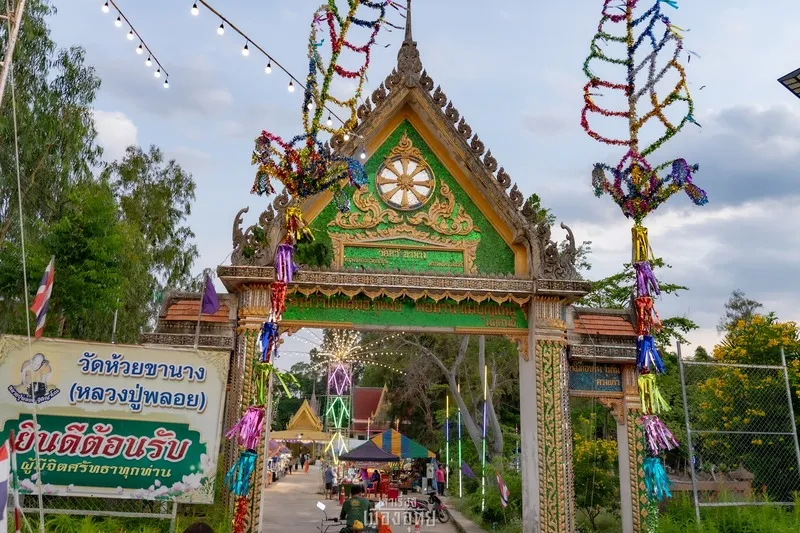
Open Days: Daily
Opening Hours: 08.00 – 17.00
Wat Huai Kha Nang in Uthai Thani Province is a local Buddhist temple under the Mahanikaya order, located at 101 Ban Huai Kha Nang, Moo 1, Nong Yang Subdistrict, Nong Chang District. It is an old community temple surrounded by rice fields, farmland, and canals, giving the temple a calm, rural, and naturally shaded atmosphere. For travelers who want to experience a quiet Thai village temple rather than a crowded tourist attraction, Wat Huai Kha Nang offers a meaningful look into local Buddhism, community life, and the peaceful countryside of Nong Chang District.
The temple is especially suitable for visitors who want to pay respect to the principal Buddha image, make merit, observe a rural temple environment, and learn how Buddhism remains closely connected with local communities in provincial Thailand. Wat Huai Kha Nang is not a large commercial destination, and that simplicity is its strongest appeal. The temple’s value lies in its calm environment, its long-standing relationship with Ban Huai Kha Nang, and its role as a spiritual center for local people.
Wat Huai Kha Nang covers an area of approximately 15 rai, 1 ngan, and 32 square wah. The temple stands on lowland surrounded by agricultural land and waterways. To the north, the temple borders local farmland; to the south and west, it is close to canals; and to the east, it borders cultivated land. This geographical setting gives the temple an open and peaceful atmosphere. The surrounding fields and canals also show how closely the temple is connected with the agricultural life of the community.
In addition to the main temple land, Wat Huai Kha Nang also has one plot of monastic land measuring approximately 12 rai, 1 ngan, and 28 square wah. This monastic land supports the temple’s religious and community functions. In rural Thai temples, such land is important because it helps sustain temple activities, maintain buildings, and support religious work for monks and local Buddhists. It also reflects the community’s long-term commitment to preserving Buddhism in the area.
Wat Huai Kha Nang was officially established as a temple on July 10, 1941. Its name comes from Ban Huai Kha Nang, the village where it is located. Naming a temple after the village reflects the close relationship between the temple and local people. The temple was created not as an isolated religious site but as a spiritual center for the community. It allowed villagers to make merit, listen to sermons, organize ordinations, hold funerals, celebrate Buddhist festivals, and maintain traditional customs close to home.
The temple received its royal boundary grant, known in Thai as Wisungkhamsima, on January 4, 1986. The boundary area measures 7 meters wide and 22 meters long. In Thai Buddhism, a Wisungkhamsima is important because it defines the sacred boundary of the ordination hall where formal monastic ceremonies can be performed. This confirms that Wat Huai Kha Nang has a complete religious function and is able to support important Buddhist rites according to monastic tradition.
The main structures inside Wat Huai Kha Nang include the ordination hall, sermon hall, chanting hall, and monks’ residences. The ordination hall is 6 meters wide and 22 meters long and serves as the sacred space for important religious ceremonies. Inside the ordination hall is the principal Buddha image, the main sacred object of the temple. Visitors often begin their visit here by paying respect, calming the mind, and reflecting on Buddhist teachings.
The sermon hall measures 16 meters wide and 20 meters long and was built in 1957. In a rural Thai temple, the sermon hall is more than a meeting building. It is where local people gather for merit-making, sermons, temple meetings, festival preparation, and community activities. The building shows the social role of the temple as a public space where Buddhism and community life come together.
The chanting hall measures 12 meters wide and 20 meters long and was built in 1974. It is used for chanting, meditation, and the daily religious routines of monks. The presence of a chanting hall gives the temple a steady spiritual rhythm. Morning and evening chanting are part of the living atmosphere of Thai Buddhist temples and help maintain the calm character of Wat Huai Kha Nang.
The temple has three monks’ residences for resident monks. Wat Huai Kha Nang has monks staying at the temple and is currently under the care of Phra Khru Uthit Satsanakit, the abbot. The abbot plays an important role in maintaining the temple, guiding religious activities, supporting local Buddhist practice, and serving as a spiritual adviser for the community. In a village temple, the relationship between monks and local residents is essential to the temple’s continuing role.
The atmosphere of Wat Huai Kha Nang is one of its most important qualities. Because the temple is surrounded by fields, cultivated land, and canals, visitors experience a calm and naturally refreshing environment. The temple is suitable for quiet walking, making merit, sitting in the shade, and spending time away from the noise of busier areas. It is a place for visitors who appreciate silence, simplicity, and the gentle rhythm of rural life.
Wat Huai Kha Nang is also important as a community center. Local people use the temple for merit-making, Buddhist festivals, religious ceremonies, and social gatherings. In rural Thailand, a temple often functions as the heart of the village. It is a place where people gather during important moments in life, from ordinations and funerals to annual festivals and communal merit-making. Wat Huai Kha Nang continues to perform this role for Ban Huai Kha Nang and nearby communities.
A visit to Wat Huai Kha Nang is therefore also a way to learn about local life in Uthai Thani. Visitors can see how Buddhism is woven into everyday community life, how temple buildings support religious activities, and how a rural temple remains connected with fields, canals, and village rhythms. The temple’s simplicity helps foreign travelers understand the authentic character of a local Thai temple without heavy tourism development.
Inside the temple, visitors should begin at the ordination hall and pay respect to the principal Buddha image. After that, they can walk around the temple grounds to observe the sermon hall, chanting hall, monks’ residences, and shaded areas. Each building has a specific role in Thai temple life: the ordination hall is used for formal monastic ceremonies, the sermon hall is a community gathering space, the chanting hall supports daily religious practice, and the monks’ residences house the monastic community.
Wat Huai Kha Nang is suitable for a half-day visit and can be combined with other attractions in Nong Chang District. Travelers can visit the temple, continue to Nong Chang Market, Wat Nong Khun Chat, Wat Luang Pho Khleap, or travel further to natural attractions such as Khao Pathawi and Hup Pa Tat. This makes the temple a useful stop for travelers who want to explore Uthai Thani slowly and understand the province beyond its best-known destinations.
Getting There is most convenient by private car or rental car. From Uthai Thani town, drive toward Nong Chang District, then continue to Nong Yang Subdistrict and Ban Huai Kha Nang. Using a navigation map together with local road signs is recommended. Travelers using public transport should first travel to Nong Chang District or Nong Chang Market, then arrange local transport to the temple, because village routes may not have frequent public transport throughout the day.
The best time to visit Wat Huai Kha Nang is in the morning or late afternoon. Morning is suitable for merit-making, paying respect, and enjoying the fresh rural atmosphere. Late afternoon is comfortable for walking around the temple and taking photographs of the surrounding village environment. During the rainy season, the nearby fields become especially green, but visitors should wear comfortable shoes and be careful on wet ground.
Visitors should dress politely when visiting Wat Huai Kha Nang. Shoulders and knees should be covered, voices should be kept low, and sacred areas should be treated with respect. Visitors should not enter monks’ private areas without permission. If taking photographs of monks, ceremonies, or private activities, it is polite to ask first. Respectful behavior helps preserve the peaceful atmosphere of the temple and supports its role as a spiritual place for the community.
For travelers interested in local culture, Wat Huai Kha Nang is a good place to understand the relationship between a Thai village temple and rural life. The temple’s surroundings of fields and canals reflect the agricultural setting of the community, while its ordination hall, sermon hall, chanting hall, and monks’ residences show how temple spaces support religious and social life. This combination makes the temple meaningful even without grand monuments or large-scale tourism facilities.
Wat Huai Kha Nang is also suitable for families and young travelers. Children can learn about the main parts of a Thai temple, including the ordination hall, sermon hall, chanting hall, monks’ residences, and principal Buddha image. They can also learn basic temple manners, such as dressing respectfully, removing shoes before entering sacred spaces, speaking softly, and showing respect to monks and worshippers. Learning in a real temple setting helps young visitors understand Thai culture naturally.
Although Wat Huai Kha Nang is not a major tourist site, its quiet and authentic character is precisely what makes it valuable. It is a temple with a clear history, established religious functions, important temple buildings, resident monks, and a close relationship with the local community. Visitors who appreciate peaceful places, village temples, and cultural context will find that Wat Huai Kha Nang offers a sincere and memorable experience in Nong Chang District.
Overall, Wat Huai Kha Nang is an important local temple in Nong Yang Subdistrict, Nong Chang District, Uthai Thani Province. Established in 1941 and granted Wisungkhamsima in 1986, the temple continues to serve as a center of Buddhist practice, community life, and local culture. With its ordination hall, sermon hall, chanting hall, monks’ residences, principal Buddha image, and peaceful lowland surroundings, it is a worthwhile stop for travelers who want to experience the quieter and more authentic side of Uthai Thani.
| Name | Wat Huai Kha Nang |
| Location | Ban Huai Kha Nang, Nong Yang Subdistrict, Nong Chang District, Uthai Thani Province |
| Address | 101 Ban Huai Kha Nang, Moo 1, Nong Yang Subdistrict, Nong Chang District, Uthai Thani Province, Thailand |
| Highlights | Old local Buddhist temple surrounded by rice fields, farmland, and canals; suitable for merit-making, quiet temple visits, and learning about rural community life |
| History | Established as a temple on July 10, 1941, and granted Wisungkhamsima on January 4, 1986 |
| Name Origin | The temple is named after Ban Huai Kha Nang, the village where it is located and where it serves as a spiritual center |
| Distinctive Features | Temple area of approximately 15 rai, 1 ngan, and 32 square wah, located on lowland surrounded by agricultural fields and canals |
| Travel Information | Best reached by private car. From Uthai Thani town, drive toward Nong Chang District, then continue to Nong Yang Subdistrict and Ban Huai Kha Nang. Travelers using public transport should arrange local transport from Nong Chang District |
| Current Status | Active local Buddhist temple under the Mahanikaya order with resident monks and community religious activities |
| Open Days | Daily |
| Opening Hours | 08.00 – 17.00 |
| Facilities | Ordination hall, sermon hall, chanting hall, monks’ residences, worship area, merit-making area, and shaded quiet spaces |
| Main Areas / Zones | Ordination Hall And Principal Buddha Image Sermon Hall Chanting Hall Monks’ Residences Merit-Making And Community Activity Area Shaded Canal-Side And Rural Surrounding Area |
| Abbot / Caretaker | Phra Khru Uthit Satsanakit |
| Nearby Tourist Attractions | 1. Wat Nong Khun Chat, about 7 km 2. Nong Chang Market, about 8 km 3. Wat Luang Pho Khleap, Nong Chang District, about 13 km 4. Khao Pathawi, Thap Than District, about 25 km 5. Hup Pa Tat, Lan Sak District, about 34 km 6. Ban Chai Khao Viewpoint, about 35 km 7. Trok Rong Ya Walking Street, Mueang Uthai Thani District, about 38 km |
| Nearby Restaurants | 1. Kuay Tiao Phi Kai Rom Makham, Ban Nong Chik Junction, Nong Yang Subdistrict, about 2 km 2. Banja Cafe, about 7 km 3. The Winner Cafe Nong Chang, about 8 km 4. Traditional Noodle Shop Nong Suang, about 8 km 5. 88Cafe & Bistro, about 8 km 6. Star Coffee Nong Suang, about 8 km |
| Nearby Accommodations | 1. Cheng Resort, Nong Chang District, about 9 km, Tel. 093-050-5282, 081-745-9552 2. Ai Aoon Resort, Nong Chang District, about 13 km, Tel. 081-887-6717, 064-539-2920 3. The Khun, Nong Chang District, about 24 km, Tel. 094-669-9935 4. Namhom Resort, Thap Than District, about 28 km 5. BN Organic Farm Resort, about 31 km 6. C2U Boutique Hotel Uthai Thani, about 36 km |
Frequently Asked Questions (FAQ)
Q: Where is Wat Huai Kha Nang located?
A: Wat Huai Kha Nang is located at 101 Ban Huai Kha Nang, Moo 1, Nong Yang Subdistrict, Nong Chang District, Uthai Thani Province.
Q: What is the history of Wat Huai Kha Nang?
A: The temple was established on July 10, 1941, and received its Wisungkhamsima on January 4, 1986.
Q: What makes Wat Huai Kha Nang special?
A: It is a quiet rural temple surrounded by fields, farmland, and canals, with an ordination hall, sermon hall, chanting hall, monks’ residences, and a principal Buddha image as the spiritual center.
Q: Who should visit Wat Huai Kha Nang?
A: It is suitable for visitors who want to make merit, pay respect to Buddha images, experience a peaceful village temple, and learn about local Buddhist culture in Nong Chang District.
Q: Who is the abbot of Wat Huai Kha Nang?
A: The abbot of Wat Huai Kha Nang is Phra Khru Uthit Satsanakit.
Q: What are the opening hours of Wat Huai Kha Nang?
A: The temple is open daily from 08.00 to 17.00. Visitors should dress respectfully and behave appropriately in the temple area.
Q: How can travelers get to Wat Huai Kha Nang?
A: The easiest way is by private car from Uthai Thani town to Nong Chang District, then onward to Nong Yang Subdistrict and Ban Huai Kha Nang.
Q: What nearby attractions can be visited after Wat Huai Kha Nang?
A: Nearby places include Wat Nong Khun Chat, Nong Chang Market, Wat Luang Pho Khleap, Khao Pathawi, Hup Pa Tat, Ban Chai Khao Viewpoint, and Trok Rong Ya Walking Street.
 Category: ●Places of Worship
 Group: ●Temple
Last Update : 3 MonthAgo
 Last Update : 3 MonthAgo
 Click to Access the Navigation Map GPS
Wat Huai Kha Nang Map
Recommend

 Art, Culture and Heritage
 Historical Sites and Monuments(3)
 Landmarks and Memorials(1)
 Art, Craft Centres, Tradition(5)
 Museums(1)
Temple(31)
Museums(1)
Temple(31)
 Other Sacred Sites(3)
 Suburban Living
 Village, Community(4)
 Local Market(1)
 Nature and Wildlife
 National Parks and Marine Reserves(2)
 Mountain (Doi)(7)
 Dam, Reservoir, Lake(5)
 Waterfalls(5)
 Hot Springs(1)
 Caves(9)
 Flower Field(2)
 River, Canal(2)
 Islands(1)
 Other natural attractions(1)
 Entertainment and Agricultural
 Farms, Parks and Ecotourism(2)
 Shopping
 Shopping and Night Market(1)


