
lovethailand home >North Travel Attractions >Uthai Thani Travel Attractions >Ban Rai >Huai Haeng > Wat Pha Thang
TL;DR: Wat Pha Thang is located at Ban Pha Thang, Huai Haeng Subdistrict, Ban Rai District, Uthai Thani Province, open Daily, hours 06.00 AM–06.00 PM.
Wat Pha Thang
Open Days: Daily
Opening Hours: 06.00 AM–06.00 PM
Wat Pha Thang in Uthai Thani Province is an important Buddhist temple located in Ban Pha Thang community, Huai Haeng Subdistrict, Ban Rai District. The temple is best known for its enormous Luang Pho To Buddha image, a major spiritual landmark for local people and visitors. Set in a peaceful rural environment, Wat Pha Thang offers a meaningful visit for travelers who want to make merit, pay respect to a large Buddha image, learn about local culture, and experience the quiet atmosphere of Ban Rai District.
The temple is closely connected with the life and identity of Ban Pha Thang community. It is not only a place for Buddhist ceremonies, but also a community center where local people gather for merit-making, chanting, religious activities, and cultural events. Visitors can feel the calm and sincere atmosphere of a local Thai temple where faith remains part of everyday life.
A visit to Wat Pha Thang can be combined with the Ban Pha Thang Ancient Textile Weaving Center, which is located nearby. Many travelers begin at the weaving center to learn about traditional local textiles and ancient patterns, then continue for about 1 kilometer to Wat Pha Thang. This route allows visitors to experience both local craftsmanship and Buddhist devotion within the same community.
Getting There is easiest by private car or rental car. From Uthai Thani town, travel toward Ban Rai District, then continue to Huai Haeng Subdistrict and Ban Pha Thang community. From the Ban Pha Thang Ancient Textile Weaving Center, turn left and continue for about 1 kilometer to reach the temple. The route passes rural scenery, community areas, and the natural landscape of Ban Rai District. Daytime travel is recommended for easier navigation.
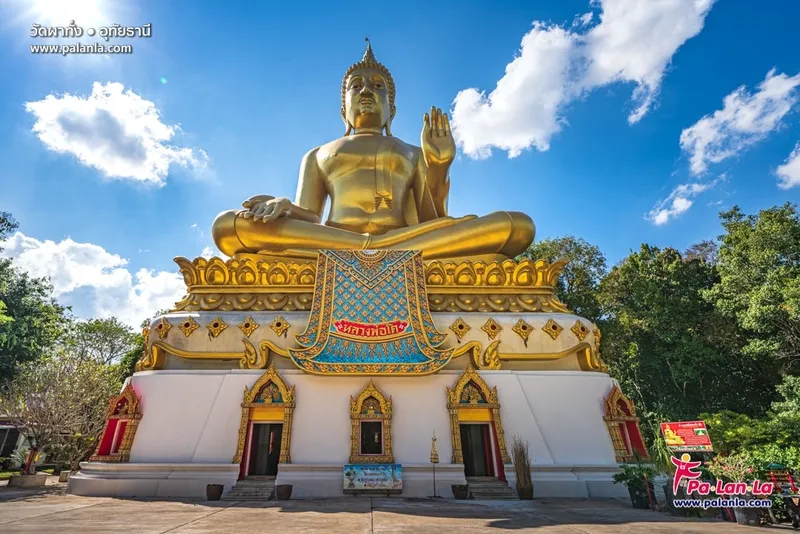
The main highlight of Wat Pha Thang is the large Luang Pho To Buddha image in the blessing posture. The image has a lap width of 23 meters and a height of 52 meters. It was built through the faith of disciples of Somdet Phra Phutthachan To Phrommarangsi in B.E. 2532. The size and presence of the Buddha image make it one of the most impressive Buddhist landmarks in the area.
Luang Pho To at Wat Pha Thang is important not only because of its size, but also because it represents faith, unity, and community effort. Building such a large Buddha image required dedication, resources, craftsmanship, and long-term support from devotees. For local people, the image serves as a spiritual anchor and a visible symbol of collective Buddhist faith.
The blessing posture of the Buddha image carries a gentle religious meaning. It is associated with compassion, protection, and auspiciousness. Visitors often come to pay respect, make merit, and pray for peace, success, safety, and strength in life. Standing before the large image creates a feeling of humility and calm, reminding visitors of the importance of faith and inner balance.
The Buddha image is placed as the central feature of the temple grounds. Its large scale can be appreciated from different angles, while its serene expression gives the area a peaceful character. Visitors can walk around the temple area, observe the proportions of the image, and reflect on how Buddhist art communicates devotion and moral meaning through form, posture, and setting.
Behind the Buddha image stands a sala tree about 3 to 4 meters high. In Buddhist tradition, the sala tree is associated with important events in the life of the Buddha, and its presence adds symbolic and natural value to the area. Visitors may rest in the shade, sit quietly, or spend time in reflection after paying respect to Luang Pho To.
The temple grounds are calm and shaded, with large trees, open spaces, and areas suitable for walking and resting. The quiet atmosphere makes Wat Pha Thang appropriate for families, elderly visitors, students, cultural travelers, and anyone looking for a peaceful stop in Ban Rai District. The temple is simple but meaningful, offering a local experience rather than a crowded tourist atmosphere.
Wat Pha Thang continues to serve as a community temple for religious activities such as almsgiving, chanting, sermons, and Buddhist observances. Important Buddhist holy days such as Visakha Bucha Day, Asalha Bucha Day, Buddhist Lent, and the end of Buddhist Lent bring villagers together for merit-making and community participation. These events show how the temple remains connected with local life.
The temple is also a place where social relationships are maintained. Villagers gather for ceremonies, support temple activities, and pass Buddhist values to younger generations. For foreign visitors, this community role is important because it shows that Thai temples are not only architectural sites; they are living social and spiritual spaces.
From an artistic perspective, Wat Pha Thang is useful for understanding large-scale contemporary Buddhist sculpture. The creation of a Buddha image 23 meters wide and 52 meters high required structural planning, artistic proportion, and religious symbolism. Visitors interested in Thai Buddhist art can study the image as an example of modern devotional art rooted in traditional faith.
The details of the Buddha image can be observed slowly, including the face, hand gesture, seated posture, and overall balance of the form. The image is not simply a photo spot; it is a religious artwork designed to communicate compassion, serenity, and spiritual strength. Taking time to observe these details helps visitors appreciate the deeper meaning of the site.
One of the unique aspects of Wat Pha Thang is its connection with local textile culture. The nearby weaving center preserves ancient local patterns and traditional weaving knowledge. Visiting both the weaving center and the temple gives travelers a fuller understanding of Ban Pha Thang community, where faith, craft, patience, and cultural memory are closely linked.
Traditional weaving is a form of local wisdom that requires skill, concentration, and continuity across generations. Seeing the textile culture before visiting Wat Pha Thang helps visitors understand the community more deeply. The temple and weaving center together show that Ban Pha Thang is not only a religious destination, but also a cultural learning area.
For photography, Wat Pha Thang offers several good viewpoints: the large Luang Pho To image, the sala tree behind it, the open temple grounds, and the surrounding greenery. Morning and late afternoon are suitable times because the light is softer and the weather is usually more comfortable. Visitors should photograph respectfully and avoid disturbing people who are praying or making merit.
Wat Pha Thang is also suitable for quiet reflection. Visitors can sit under the trees, chant softly, meditate, or simply spend time in silence. The combination of the large Buddha image and natural surroundings creates a stable and peaceful atmosphere. This makes the temple a good place for travelers who want a calm stop rather than a rushed sightseeing visit.
Wat Pha Thang can be included in a broader Ban Rai cultural route. Nearby places include the Ban Pha Thang Ancient Textile Weaving Center, Ban Rai town, Wat Tham Khao Wong, Wat Khao Tham Taphap, Pha Rom Yen Waterfall, Ban Chai Khao, Khao Pla Ra, and other natural attractions in western Uthai Thani. A full-day plan allows visitors to experience temples, local crafts, mountain scenery, and community life in the same trip.
Visitors should allow at least 45 minutes to 1 hour for Wat Pha Thang. This is enough time to pay respect to Luang Pho To, walk around the temple grounds, take photographs, and rest quietly. More time is recommended if the visit is combined with the weaving center or if visitors want to participate in temple activities.
Visitors should dress modestly, speak quietly, avoid littering, and respect worshippers. Climbing on restricted areas, behaving loudly near the Buddha image, or treating sacred spaces only as photo backdrops should be avoided. Respectful behavior helps preserve the dignity of the temple and the peaceful experience for everyone.
In summary, Wat Pha Thang is a meaningful temple in Uthai Thani that brings together Buddhist devotion, large-scale religious art, local community life, and cultural learning. Its 52-meter-high Luang Pho To image, the sala tree behind the Buddha, the calm temple grounds, and the nearby Ban Pha Thang textile weaving center make it a valuable destination for travelers who want to experience faith, art, and community culture in Ban Rai District.
| Name | Wat Pha Thang, Uthai Thani |
| Location | Ban Pha Thang, Huai Haeng Subdistrict, Ban Rai District, Uthai Thani Province |
| Address | Huai Haeng Subdistrict, Ban Rai District, Uthai Thani 61140, Thailand |
| Highlights | Large Luang Pho To Buddha image in the blessing posture, 23 meters wide and 52 meters high, built in B.E. 2532 by disciples of Somdet Phra Phutthachan To Phrommarangsi |
| Distinctive Features | Community temple in Ban Pha Thang with a large Buddha image, peaceful grounds, sala tree, religious activity space, and strong connection with local textile culture |
| Important Features | Luang Pho To Buddha image, sala tree behind the image, worship area, religious activity ground, preaching hall, and resting areas within the temple grounds |
| Related Devotees | Disciples of Somdet Phra Phutthachan To Phrommarangsi, who played an important role in building the large Luang Pho To image |
| Abbot / Caretaker | Phra Maha Sompong Kittipanyo |
| Rituals And Local Beliefs | Merit-making, almsgiving, chanting, sermons, Buddhist worship, Visakha Bucha Day, Asalha Bucha Day, Buddhist Lent, and end-of-Lent activities |
| Main Areas / Zones | Luang Pho To worship area, open ground in front of the Buddha image, sala tree area, preaching hall, merit-making area, resting area, and surrounding temple grounds |
| Travel Information | From Uthai Thani town, travel toward Ban Rai District and continue to Huai Haeng Subdistrict and Ban Pha Thang. From the Ban Pha Thang Ancient Textile Weaving Center, turn left and continue for about 1 km. Best reached by private car, rental car, or local hired vehicle |
| Current Status | Active Buddhist temple open for worship, merit-making, and visits to the large Luang Pho To Buddha image |
| Open Days | Daily |
| Opening Hours | 06.00 AM–06.00 PM |
| Admission Fee | No Admission Fee |
| Facilities | Parking area, worship area, open ground, preaching hall, resting areas, and walking areas within the temple grounds |
| Visitor Guidelines | Dress modestly, keep quiet, do not climb on restricted areas, keep the temple clean, and photograph respectfully |
| Nearby Tourist Attractions | 1. Ban Pha Thang Ancient Textile Weaving Center, about 1 km 2. Ban Rai District Town, about 18 km 3. Wat Tham Khao Wong, about 22 km 4. Wat Khao Tham Taphap, about 25 km 5. Pha Rom Yen Waterfall, about 30 km 6. Ban Chai Khao, about 32 km 7. Khao Pla Ra, about 45 km |
| Nearby Restaurants | 1. Nicha House, about 18 km 2. GoodView CafeHouse, about 19 km 3. Lemone Cafe & Resort Ban Rai, about 20 km, Tel. 095-487-6000, 089-761-9449 4. Baan Suan Restaurant Ban Rai, about 21 km, Tel. 056-539-061 5. Suan Ahan Nopparat, about 26 km, Tel. 080-115-6224, 082-228-9828 |
| Nearby Accommodations | 1. Ban Rai Nai Suan Resort, about 18 km, Tel. 089-267-6174 2. Baan Suan Resort Ban Rai, about 20 km, Tel. 056-539-060, 098-864-1258 3. Watthana Resort Ban Rai, about 21 km, Tel. 056-539-133, 081-886-6042 4. Lemone Cafe & Resort Ban Rai, about 20 km, Tel. 095-487-6000, 089-761-9449 5. Huai Kha Khaeng Country Home Resort, about 25 km |
Frequently Asked Questions (FAQ)
Q: Where is Wat Pha Thang located?
A: Wat Pha Thang is located in Ban Pha Thang community, Huai Haeng Subdistrict, Ban Rai District, Uthai Thani Province.
Q: What is the main highlight of Wat Pha Thang?
A: The main highlight is the large Luang Pho To Buddha image in the blessing posture, with a lap width of 23 meters and a height of 52 meters.
Q: Is there an admission fee for Wat Pha Thang?
A: There is no admission fee. Visitors can enter the temple to pay respect, make merit, and visit the large Buddha image during opening hours.
Q: What are the opening hours of Wat Pha Thang?
A: Wat Pha Thang is open daily from 06.00 AM to 06.00 PM.
Q: How can travelers get to Wat Pha Thang?
A: From Uthai Thani town, travel toward Ban Rai District and continue to Huai Haeng Subdistrict and Ban Pha Thang. From the Ban Pha Thang Ancient Textile Weaving Center, continue about 1 km to the temple.
Q: What type of visit is Wat Pha Thang suitable for?
A: It is suitable for Buddhist worship, merit-making, photography, cultural learning, Thai Buddhist art appreciation, and visits combined with the local textile weaving center.
Q: What nearby places can be visited with Wat Pha Thang?
A: Nearby places include Ban Pha Thang Ancient Textile Weaving Center, Ban Rai District town, Wat Tham Khao Wong, Wat Khao Tham Taphap, Pha Rom Yen Waterfall, Ban Chai Khao, and Khao Pla Ra.
Q: What should visitors prepare before visiting Wat Pha Thang?
A: Visitors should dress modestly, bring drinking water in hot weather, plan the route in advance, and take photographs respectfully in the temple area.
 Category: ●Places of Worship
 Group: ●Temple
Last Update : 6 MonthAgo
 Last Update : 6 MonthAgo
 Click to Access the Navigation Map GPS
Wat Pha Thang Map
Recommend

 Art, Culture and Heritage
 Historical Sites and Monuments(3)
 Landmarks and Memorials(1)
 Art, Craft Centres, Tradition(5)
 Museums(1)
 University
 Public university(1)
Temple(31)
 Other Sacred Sites(3)
 Suburban Living
 Village, Community(4)
 Local Market(1)
 Nature and Wildlife
 National Parks and Marine Reserves(2)
 Mountain (Doi)(7)
 Dam, Reservoir, Lake(5)
 Waterfalls(5)
 Hot Springs(1)
 Caves(9)
 Flower Field(2)
 River, Canal(2)
 Islands(1)
 Other natural attractions(1)
 Entertainment and Agricultural
 Farms, Parks and Ecotourism(2)
 Shopping
 Shopping and Night Market(1)
 Travel Articles, Recipes
 Travel Review, Food Review(1)


