
lovethailand home >Central Travel Attractions >Suphan Buri Travel Attractions >U Thong >U Thong > Kam Fa Tradition
TL;DR: Kam Fa Tradition, open The 3rd Waxing Day of the 3rd Lunar Month Every Year, With Preparation Rituals, hours According to the Annual Schedule of Each Thai Phuan Community.
Kam Fa Tradition
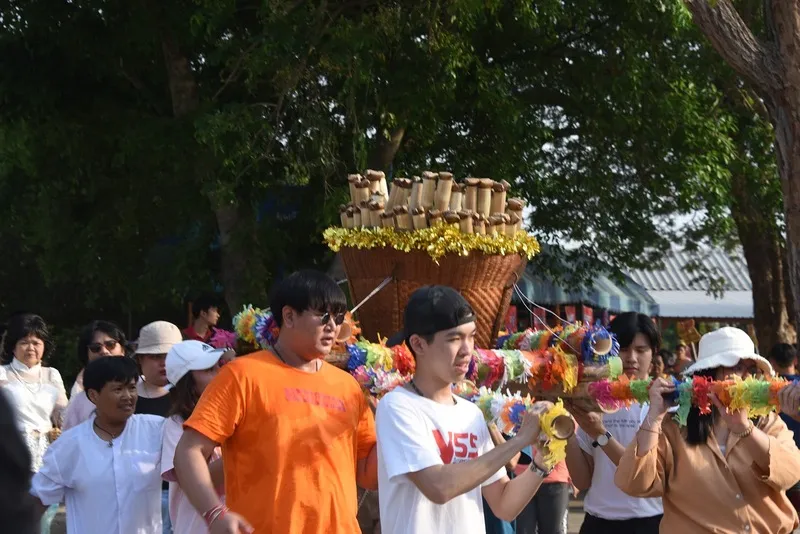
Open Days: The 3rd Waxing Day of the 3rd Lunar Month Every Year, With Preparation Rituals on the 2nd Waxing Day of the 3rd Lunar Month
Opening Hours: According to the Annual Schedule of Each Thai Phuan Community
Kam Fa Tradition is one of the most important annual traditions of the Thai Phuan people. In Suphan Buri Province, it is strongly associated with Thai Phuan communities in Bang Pla Ma District, especially around Makham Lom, Wat Bot, and Pho Si areas. The tradition is held on the 3rd waxing day of the 3rd lunar month, which is regarded as the Thai Phuan New Year. The phrase “Kam Fa” means paying respect to the sky, worshipping the heavens, or honoring the divine powers believed to protect the sky. For an agricultural community, the sky is closely connected with rain, seasons, rice farming, prosperity, and the wellbeing of people, animals, homes, and fields.
Kam Fa is a tradition that clearly reflects the worldview of a farming society. In the past, the life of Thai Phuan communities depended heavily on rice cultivation and seasonal rain. Worshipping the sky was therefore not only a religious or symbolic practice. It was an expression of respect toward nature and unseen powers that influenced agricultural success. On Kam Fa day, villagers traditionally stop working in the fields, avoid heavy labor, make merit, offer food to monks, gather with relatives, and perform rituals to ask for proper rainfall, abundant crops, prosperous work, and happiness in the community.
The heart of Kam Fa lies in gratitude to the sky, respect for nature, and community unity. It is not a private family ceremony, but a collective festival that brings together relatives, neighbors, elders, young people, and children. Elders transmit knowledge to younger generations. Young people meet and join traditional games. Children see local food, ritual language, and village practices that may no longer appear in everyday life. Kam Fa is therefore a merit-making event, a New Year celebration, a sky-worship ritual, and a cultural classroom for Thai Phuan identity at the same time.
In Suphan Buri, Kam Fa is well known among Thai Phuan communities in Bang Pla Ma District. These communities have preserved their ethnic identity through language, food, rituals, kinship networks, and temple-centered activities. The festival is usually connected with local temples, community halls, village gathering spaces, or areas where villagers traditionally hold collective events. The exact venue may vary from year to year depending on the local community schedule.
In the Phuan language, the word “kam” carries the meaning of reverence or worship, while “fa” refers to the sky, heavenly beings, rulers, or powers regarded as being high above human life. The term therefore does not refer only to the physical sky. It also refers to sacred power that protects people, animals, houses, fields, and crops. By performing Kam Fa, the community symbolically informs the heavens that people are grateful, respectful, and ready to ask for blessing.
The preparation day, known as the “suk dip” day, falls on the 2nd waxing day of the 3rd lunar month. On this day, household members help prepare food and ritual offerings. Traditionally, families make khao pun or rice noodles, chili paste, curry sauces, and other local dishes. In the past, khao chi, or grilled sticky rice, was an important food of the festival. In many communities today, khao lam, or sticky rice cooked in bamboo tubes, has become more common because it is convenient to offer to monks and share with relatives. Khao lam has therefore become one of the memorable foods associated with Kam Fa in the present day.
In the afternoon of the preparation day, usually around 3 p.m., monks are invited to chant Buddhist prayers. After the chanting, a ritual specialist or Brahmin-style officiant performs a ceremony to worship the heavenly beings, opens the bai si offering, and recites an announcement inviting the deities to receive the offerings. This ritual shows the blending of Buddhism, local belief, and Thai Phuan spiritual practice. It is a good example of how Thai rural traditions often combine religious merit-making with older beliefs about nature and divine protection.
At night on the preparation day, elders in the household traditionally take a piece of wood and knock on the cooking hearth while speaking auspicious words. These words ask the heavenly powers to protect the house, fields, family members, cattle, buffaloes, pigs, dogs, ducks, chickens, and all household possessions. The hearth is the center of domestic life. It represents food, warmth, survival, and family continuity. Knocking on the hearth is therefore a deeply meaningful household ritual that connects the blessing of the sky with everyday life inside the home.
On Kam Fa day, the 3rd waxing day of the 3rd lunar month, everyone wakes up early to prepare sweet and savory food for offering to monks. Khao lam and khao chi are among the most important foods. Khao lam is made from sticky rice, coconut milk, and other ingredients cooked inside bamboo tubes. Khao chi is grilled sticky rice, sometimes coated with egg or seasoning before grilling. These foods are not just dishes. They represent the rice-based life of the community and the labor of families who prepare offerings together.
After offering food to monks, villagers eat together. This shared meal is one of the most important social moments of the festival. Relatives meet, elders talk with younger family members, and people who work away from the village may return home. In this way, Kam Fa functions almost like a family reunion for Thai Phuan communities. It gives people time to reconnect with home, kinship, local food, and shared memory.
Traditional games and folk activities are also part of Kam Fa. Communities may organize local games such as Mon Son Pha, Chuang Chai, and other village sports or playful activities. These games add liveliness to the event and make it suitable for all generations. Children can play, young people can meet, adults can watch, and elders can enjoy seeing their descendants continue the joyful atmosphere of the festival. Kam Fa is therefore not a solemn ritual only; it is also a community celebration.
One of the most distinctive beliefs in Kam Fa is listening to thunder in order to predict rainfall and agricultural conditions. Elders listen carefully to the direction of thunder. If thunder comes from the north or northeast, it is interpreted as a sign of good rainfall and successful rice farming. If thunder comes from the south or west, it is interpreted as a sign of drought and agricultural difficulty. If thunder comes from the east, it suggests moderate rainfall, with lowland fields doing well while upland fields may suffer. This belief reflects the wisdom of farmers who observed natural signs, winds, clouds, and seasonal rhythms long before modern weather forecasts became available.
Even though modern society now has scientific weather forecasts, the thunder-listening tradition remains culturally valuable. It shows how earlier generations read the environment and linked natural signs with agricultural planning. Listening to thunder was not merely fortune-telling. It was a way of paying attention to nature, seasons, and the uncertainty of farming life. This makes Kam Fa an important example of local ecological knowledge embedded in ritual practice.
Socially, Kam Fa helps preserve Thai Phuan identity. Thai Phuan communities have their own language, foodways, ritual expressions, games, songs, and customs. By holding Kam Fa every year, younger generations encounter the culture of their ancestors through real practice rather than abstract description. They hear Phuan words, see offerings, taste khao lam and khao chi, join games, and observe elders performing rituals. These experiences allow Thai Phuan identity to remain alive within the community.
For Suphan Buri Province, Kam Fa adds another important cultural layer to the province’s identity. Suphan Buri is widely known for historical sites, temples, old markets, literature, and local legends, but it is also home to ethnic communities that have preserved distinctive traditions. The Kam Fa tradition of Bang Pla Ma District shows that Suphan Buri’s heritage is not limited to monuments and ancient towns. It also lives in village rituals, food, family gatherings, and the annual calendar of local people.
Visitors who wish to experience Kam Fa should remember that this is a community tradition, not a large commercial tourism event. Respectful behavior is essential. Visitors should dress politely when entering temples or ritual spaces, avoid disturbing ceremonies, refrain from mocking beliefs about thunder or hearth rituals, and take photographs carefully. Approaching the festival as a learner will make the experience more meaningful than treating it only as something unusual to watch.
Getting There to the Thai Phuan Kam Fa communities in Bang Pla Ma District is most convenient by private car or rental vehicle. From Bangkok, take Highway 340 toward Suphan Buri and continue into Bang Pla Ma District, then proceed to the Thai Phuan community areas around Makham Lom, Wat Bot, or Pho Si according to the annual event venue. From Suphan Buri town, the distance to Bang Pla Ma is about 15 to 20 km, depending on the exact location. A private vehicle is recommended because visitors can also combine the trip with nearby attractions such as Kao Hong Market, Wat Phai Rong Wua, Wat Pa Lelai Worawihan, Dragon Descendants Museum, and Suphan Buri town.
A cultural travel route can begin with the Kam Fa ceremony in the morning, followed by a visit to Kao Hong Market to experience an old riverside market and local food. Travelers can then continue to Wat Pa Lelai Worawihan, Suphan Buri City Pillar Shrine, Dragon Descendants Museum, or Banharn-Jamsai Tower. This route allows visitors to experience Suphan Buri through ethnic tradition, community life, Buddhism, local markets, and urban landmarks in one trip.
Kam Fa should be preserved because it is more than an annual merit-making event. It is a knowledge system of an agricultural society, a rain-invoking ritual, the Thai Phuan New Year, a family reunion, a space for transmitting language and food culture, a stage for folk games, and a reminder of the relationship between humans and the sky. Even in the modern world, Kam Fa continues to bring people back to the foundations of rural life: sky, land, water, rice, family, and community.
| Tradition Name | Kam Fa Tradition |
| Main Area | Thai Phuan Communities in Bang Pla Ma District, Suphan Buri Province, Especially Around Makham Lom, Wat Bot, and Pho Si Areas |
| Event Period | The 3rd Waxing Day of the 3rd Lunar Month Every Year, With Preparation Rituals on the 2nd Waxing Day of the 3rd Lunar Month |
| Importance | The Thai Phuan New Year and a sky-worship ritual asking for seasonal rain, prosperity, agricultural abundance, and auspiciousness |
| Name Origin | “Kam” Means Reverence or Worship, While “Fa” Means the Sky, Heavenly Beings, or Sacred Powers Above Human Life |
| Distinctive Features | Merit-making, deity worship, bai si ritual, hearth-knocking ritual, thunder-listening belief, shared meals, and folk games |
| Important Foods | Khao Pun or Rice Noodles, Chili Paste, Curry Sauce, Khao Chi, and Khao Lam Used for Monk Offerings and Community Meals |
| Travel Information | From Bangkok, take Highway 340 toward Suphan Buri and continue to Bang Pla Ma District. The event venue may be in Thai Phuan community areas around Makham Lom, Wat Bot, or Pho Si, depending on the annual schedule. |
| Current Status | Still practiced as an important Thai Phuan tradition in Bang Pla Ma District and a local cultural heritage of Suphan Buri Province |
| Fees | No Admission Fee for Community Festival Areas |
| Main Areas / Zones | 1. Temple or Community Merit-Making Area 2. Local Food Preparation Area for Khao Pun, Khao Chi, and Khao Lam 3. Deity Worship and Bai Si Ritual Area 4. Family and Community Meal Area 5. Folk Games and Community Sports Area 6. Thai Phuan Community Areas in Makham Lom, Wat Bot, and Pho Si |
| Caretaker / Related Organizations | Thai Phuan Communities in Bang Pla Ma District, Local Temples, Local Administrative Organizations, and Suphan Buri Cultural Agencies |
| Nearby Tourist Attractions | 1. Kao Hong Market, about 7 km 2. Wat Phai Rong Wua, about 16 km 3. Wat Pa Lelai Worawihan, about 17 km 4. Suphan Buri City Pillar Shrine and Dragon Descendants Museum, about 18 km 5. Banharn-Jamsai Tower, about 19 km 6. Suphan Buri National Museum, about 21 km 7. Sam Chuk 100-Year Market, about 35 km |
| Nearby Restaurants | 1. Mae Thong Kham Pla Phao, Bang Pla Ma District, about 8 km, Tel. 064-593-6524 2. Kui Mong Bang Pla Ma, about 10 km 3. Mae Buai Bang Pla Ma, about 10 km 4. Local Food Shops Around Kao Hong Market, about 7 km 5. Nopparatana Restaurant in Suphan Buri Town, about 20 km, Tel. 035-555-333, 081-587-6154 6. Surachai Pla Phao, about 22 km, Tel. 081-763-6102, 081-942-4654 |
| Nearby Accommodations | 1. The Bo House Resort, Bang Pla Ma District, about 8 km, Tel. 081-007-6852 2. Vasidtee City Hotel Suphan Buri, about 20 km, Tel. 035-526-111, 035-526-123 3. Songphanburi Hotel, about 20 km 4. Hop Inn Suphan Buri, about 22 km, Tel. 02-080-2222 5. B2 Suphan Buri Premier Hotel, about 22 km 6. Hotels and Resorts in Mueang Suphan Buri District, about 20 km |
Frequently Asked Questions (FAQ)
Q: What is the Kam Fa Tradition?
A: Kam Fa is a Thai Phuan merit-making and sky-worship tradition held to ask for seasonal rain, prosperity, agricultural abundance, and auspiciousness for families and communities.
Q: When is Kam Fa held?
A: It is held on the 3rd waxing day of the 3rd lunar month every year, with preparation rituals on the 2nd waxing day of the 3rd lunar month.
Q: Where can visitors experience Kam Fa in Suphan Buri?
A: Visitors can experience it in Thai Phuan communities in Bang Pla Ma District, especially around Makham Lom, Wat Bot, and Pho Si areas.
Q: What happens on the preparation day?
A: Families prepare food such as khao pun, chili paste, curry sauce, khao chi, or khao lam. In the afternoon, monks chant prayers, followed by rituals to invite heavenly beings to receive offerings.
Q: Why do elders listen to thunder during Kam Fa?
A: Thai Phuan elders believe the direction of thunder can predict rainfall and farming conditions for the year, reflecting traditional agricultural wisdom.
Q: What foods are important in Kam Fa?
A: Important foods include khao pun or rice noodles, chili paste, curry sauce, khao chi, and khao lam, which are used for monk offerings and shared meals.
Q: Is there an admission fee for Kam Fa?
A: No. It is a community tradition, but visitors should check the annual venue and attend respectfully.
Q: What nearby attractions can be visited with Kam Fa?
A: Nearby attractions include Kao Hong Market, Wat Phai Rong Wua, Wat Pa Lelai Worawihan, Suphan Buri City Pillar Shrine, Dragon Descendants Museum, and Banharn-Jamsai Tower.
 Category: ●Art, Culture and Heritage
 Group: ●Art, Craft Centres, Tradition
Last Update : 4 MonthAgo
 Last Update : 4 MonthAgo
 Click to Access the Navigation Map GPS
 Historical Sites and Monuments(2)
 Landmarks and Memorials(4)
Art, Craft Centres, Tradition(2)
Landmarks and Memorials(4)
Art, Craft Centres, Tradition(2)
 Museums(5)
 Educational Places
 Educational Gardens, Farm(4)
 Training Center(2)
 Places of Worship
 Temple(36)
 Other Sacred Sites(4)
 Suburban Living
 Village, Community(6)
 Local Market(7)
 Floating Market(1)
 Nature and Wildlife
 National Parks and Marine Reserves(4)
 Mountain (Doi)(2)
 Dam, Reservoir, Lake(3)
 Caves(1)
 Bays and Beaches(1)
 Entertainment and Agricultural
 Farms, Parks and Ecotourism(6)
 Theater(1)


