
lovethailand home >Central Travel Attractions >Suphan Buri Travel Attractions >Muang Suphan Buri >Phihan Daeng > Wat No Phutthangkun (Wat Makham No)
TL;DR: Wat No Phutthangkun (Wat Makham No) is located at Moo 1, Phihan Daeng Subdistrict, Mueang Suphan Buri District, Suphan Buri Province, open Daily, hours 08.00 – 17.00.
Wat No Phutthangkun (Wat Makham No)
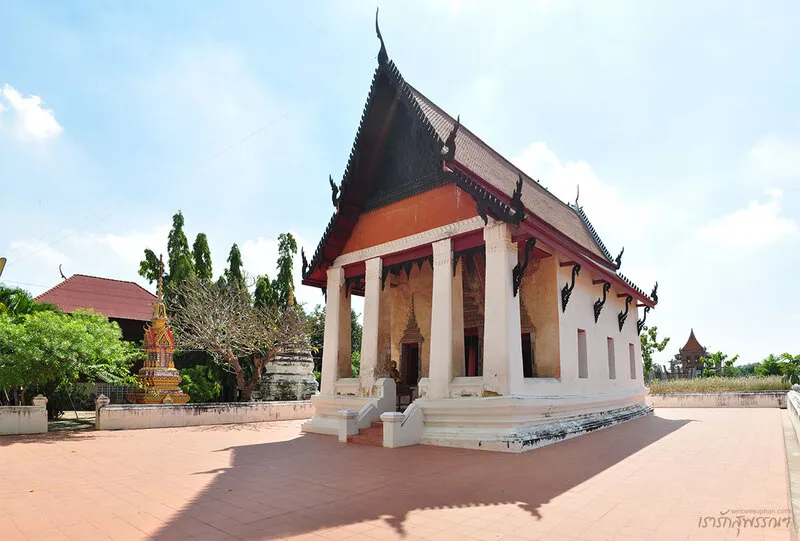
Open Days: Daily
Opening Hours: 08.00 – 17.00
Wat No Phutthangkun, also known as Wat Makham No, in Suphan Buri Province is a quiet old Buddhist temple in Phihan Daeng Subdistrict, Mueang Suphan Buri District. It is located on the western side of the Suphan River, about 2 km north of Wat Phra Loi, along Highway 3507 near kilometer marker 3. The temple was built in the early Rattanakosin period and is especially important for its old ordination hall, where well-preserved mural paintings depicting the life of the Buddha can still be seen. These murals were painted around B.E. 2391, during the reign of King Rama III, and remain one of the most valuable cultural features of the temple.
Wat No Phutthangkun is ideal for travelers who want to experience a quieter and more meaningful side of Suphan Buri. It is not a crowded tourist landmark, and it does not rely on large monuments or dramatic architecture. Its value lies in the calm temple atmosphere, the old murals, the relationship with the local riverside community, and the sense of cultural continuity that can still be felt inside the temple grounds. For foreign travelers interested in Thai Buddhist art, early Rattanakosin murals, and local temples outside the main tourist route, this temple is a rewarding stop.
The temple was originally known as Wat Makham No. Later, during the time of Phra Khru Suwan Warakhun, also known as Luang Pho Kham Chanthachoto, the name was changed to Wat No Phutthangkun. The older name reflects local memory and the original identity of the temple, while the current name carries a more formal Buddhist meaning. This change of name also reflects how temples in Thailand often evolve through the leadership of abbots, community devotion, restoration work, and changing local identity.
The old ordination hall is the most important part of Wat No Phutthangkun. Inside, visitors can see mural paintings related to the life of the Buddha. These paintings were not made only for decoration. In traditional Thai temples, murals served as visual teaching tools. Before modern education and printed media became widely available, temple murals helped local people learn Buddhist stories, moral lessons, cosmology, and cultural values through images. The murals at Wat No Phutthangkun therefore function as both sacred art and a historical record of local religious education.
The murals are important because many details remain relatively clear. They depict episodes from the Buddha’s life and reflect the artistic language of early Rattanakosin temple painting. The style combines local craftsmanship with elements associated with court-influenced Buddhist art. This combination gives the murals both refinement and a lively local character. Visitors who look carefully can appreciate not only the religious narrative but also the composition, colors, architectural scenes, clothing, gestures, and social details included by the artists.
One of the most fascinating aspects of Thai mural painting is that it often preserves images of everyday life within sacred narratives. Scenes may include buildings, costumes, processions, domestic objects, and cultural details that reflect the world known to the painters and their community. The murals at Wat No Phutthangkun allow visitors to see how Buddhist stories were interpreted through the visual imagination of local artists in the reign of King Rama III. This makes the temple especially valuable for anyone interested in art history and social history.
The date of the murals, around B.E. 2391, places them in an important artistic period. During the reign of King Rama III, Thai art often showed rich detail, narrative density, and cultural influences from Chinese art and architecture. Many temple murals from this period include both Buddhist themes and scenes of worldly life. At Wat No Phutthangkun, the murals stand as a local expression of this broader artistic world, showing how central Thai Buddhist art was adapted in a community temple in Suphan Buri.
In the newer ordination hall, visitors can also pay respect to Phra Sing Sam San Chana Man, known as the woven bamboo Buddha image. This contemporary sacred image adds another layer to the temple experience. Unlike Buddha images made from metal, stucco, or stone, this image is associated with woven bamboo craftsmanship. It connects Buddhist devotion with local craft wisdom and natural material. The temple therefore brings together old mural heritage and modern devotional creativity in the same compound.
The presence of both an old ordination hall and a newer worship space makes Wat No Phutthangkun especially meaningful. The old hall preserves the artistic and devotional world of the past, while the new hall and the woven bamboo Buddha image show how faith continues in the present. Visitors should see both areas in order to understand the temple as a living place rather than only a historical site.
The atmosphere of Wat No Phutthangkun is peaceful and local. It stands in Phihan Daeng Subdistrict, an area connected with temples along the western side of the Suphan River. The temple does not feel heavily commercialized. Instead, it offers the atmosphere of a community temple where visitors can slow down, pay respect, observe art carefully, and appreciate a quieter landscape of Suphan Buri. This makes it suitable for travelers who prefer authentic cultural experiences.
For those interested in Suphan Buri history, Wat No Phutthangkun is valuable as an early Rattanakosin temple that still preserves important artistic evidence. It may not have a large ancient prang like Wat Phra Si Rattana Mahathat, but its murals provide a direct view into the beliefs, artistic taste, and social imagination of people in the 19th century. The temple is therefore an important complement to the province’s better-known archaeological sites.
Visitors should view the murals with care. The paintings are old and fragile, and they can be damaged by touch, moisture, dust, and strong light. Visitors should not touch the walls, lean against painted surfaces, or use harsh flash photography. If photography is allowed, it should be done respectfully and without disturbing the space. Careful behavior helps preserve the murals for future generations.
Wat No Phutthangkun is also a good place to learn how Thai temple murals tell stories. A single wall painting can include many events, figures, buildings, emotions, and moral ideas. For families, students, and cultural travelers, the murals can become a starting point for learning about the Buddha’s life, Thai painting, temple education, and local history. This makes the temple suitable not only for worship but also for meaningful educational travel.
Wat No Phutthangkun can easily be included in a temple route around Phihan Daeng and nearby areas. Visitors can begin at Wat Phra Loi to see the floating Buddha legend and fish sanctuary, continue to Wat No Phutthangkun for the murals and woven bamboo Buddha image, and then visit Wat Phra Non to see the unusual supine reclining Buddha and riverside fish sanctuary. This half-day route is suitable for travelers who want to experience quieter temples along the Suphan River.
Getting There is convenient by private car or local hired transport. From downtown Suphan Buri, travel toward Phihan Daeng Subdistrict on the western side of the Suphan River. Use Highway 3507 and continue to around kilometer marker 3. The temple is about 2 km north of Wat Phra Loi. Travelers without a private vehicle can first reach Suphan Buri town by bus or van and then continue by local transport. A private car or hired local vehicle is the most practical option for visiting several temples in one trip.
The best time to visit is in the morning or late afternoon, when the weather is more comfortable and the temple atmosphere is quiet. Visitors who want to study the murals should allow at least 45 minutes to 1.5 hours. Art lovers may want to bring a camera or notebook, but they should use them carefully and respectfully. A slow visit will reveal much more than a quick stop.
Temple etiquette is important. Visitors should dress modestly, speak softly inside the ordination hall, avoid touching the murals, and respect monks and local worshippers. Old murals are fragile cultural heritage, and their preservation depends partly on responsible visitor behavior. Keeping the area clean and calm helps maintain the temple as both a sacred place and a learning site.
Wat No Phutthangkun is suitable for many types of travelers. Art history enthusiasts can study early Rattanakosin murals. Buddhist visitors can pay respect in a peaceful temple. Families and students can learn about the life of the Buddha through real mural paintings. Cultural travelers can combine the temple with Wat Phra Loi, Wat Phra Non, Wat Khae, Wat Phra Rup, and Wat Phra Si Rattana Mahathat. The temple offers a calm and thoughtful experience in Suphan Buri.
Overall, Wat No Phutthangkun is one of Suphan Buri’s valuable but quieter cultural sites. Its old ordination hall preserves beautiful Buddhist murals from the reign of King Rama III, while its newer hall houses the distinctive woven bamboo Buddha image. The temple shows how local faith, mural art, craft tradition, and community memory continue to exist together. Travelers who want to see a deeper and more peaceful side of Suphan Buri should include Wat No Phutthangkun in their itinerary.
| Name | Wat No Phutthangkun / Wat Makham No |
| Location | Moo 1, Phihan Daeng Subdistrict, Mueang Suphan Buri District, Suphan Buri Province |
| Address | Phihan Daeng Subdistrict, Mueang Suphan Buri District, Suphan Buri Province, Thailand |
| Highlights | Old ordination hall with Buddhist mural paintings from the reign of King Rama III and Phra Sing Sam San Chana Man, the woven bamboo Buddha image in the new ordination hall |
| History | Built in the early Rattanakosin period. Formerly known as Wat Makham No, later renamed Wat No Phutthangkun during the time of Phra Khru Suwan Warakhun, or Luang Pho Kham Chanthachoto. |
| Distinctive Features | Well-preserved mural paintings inside the old ordination hall depicting the life of the Buddha, painted around B.E. 2391 during the reign of King Rama III |
| Travel Information | Located on the western side of the Suphan River along Highway 3507 near kilometer marker 3, about 2 km north of Wat Phra Loi |
| Current Status | Open to visitors as a quiet temple in Phihan Daeng, with an old mural hall and contemporary worship areas |
| Open Days | Daily |
| Opening Hours | 08.00 – 17.00 |
| Facilities | Temple grounds, old ordination hall, new ordination hall, worship areas, temple courtyard, and parking area around the temple |
| Main Areas / Zones | 1. Old ordination hall with mural paintings 2. New ordination hall 3. Area housing Phra Sing Sam San Chana Man, the woven bamboo Buddha image 4. Worship and merit-making area 5. Peaceful temple courtyard 6. Route connecting Wat Phra Loi and Wat Phra Non |
| Nearby Tourist Attractions | 1. Wat Phra Loi, about 2 km 2. Wat Phra Non, about 2 km 3. Wat Phra Non Fish Sanctuary, about 2 km 4. Wat Khae and Khum Khun Phaen, about 4 km 5. Wat Phra Rup, about 5 km 6. Wat Phra Si Rattana Mahathat, about 5 km 7. Dragon Descendants Museum and Suphan Buri City Pillar Shrine, about 6 km |
| Nearby Restaurants | 1. Krua Ban Rak beside Wat No Phutthangkun, about 0.1 km 2. Ruean Phae Krua Suphan, about 2.5 km 3. Muek Man Kai Suphan Buri, about 3.5 km 4. U DOM, Coffee Slow Bar, about 4 km 5. Kc Coffee Espersso Bar, about 4 km 6. Tom Yum Hua Pla Rot Jep Branch 2, about 4 km 7. Chaana Suphan Buri, about 4.5 km |
| Nearby Accommodations | 1. Quicky Stay Hotel Suphanburi, about 3.5 km 2. B2 Suphan Buri Premier Hotel, about 4.5 km 3. The Scene Suphan Buri, about 5 km 4. Hop Inn Suphan Buri, about 5 km 5. K2 Green Suphan Buri Hotel, about 5.5 km 6. Lert Sri Hotel, about 6 km 7. Watthanasap Mansion, about 6 km |
Frequently Asked Questions (FAQ)
Q: Where is Wat No Phutthangkun located?
A: Wat No Phutthangkun is located in Moo 1, Phihan Daeng Subdistrict, Mueang Suphan Buri District, on the western side of the Suphan River, about 2 km north of Wat Phra Loi.
Q: What was the former name of Wat No Phutthangkun?
A: The temple was formerly known as Wat Makham No. It was later renamed Wat No Phutthangkun during the time of Phra Khru Suwan Warakhun, or Luang Pho Kham Chanthachoto.
Q: What is Wat No Phutthangkun famous for?
A: The temple is famous for its old ordination hall with Buddhist mural paintings from the reign of King Rama III, painted around B.E. 2391.
Q: Why are the murals at Wat No Phutthangkun important?
A: The murals are valuable examples of early Rattanakosin Buddhist art. They depict the life of the Buddha and preserve cultural details of local society in that period.
Q: Is there a woven bamboo Buddha image at Wat No Phutthangkun?
A: Yes. The new ordination hall houses Phra Sing Sam San Chana Man, a distinctive woven bamboo Buddha image.
Q: What are the opening hours of Wat No Phutthangkun?
A: The temple is open daily from 08.00 to 17.00.
Q: How can visitors get to Wat No Phutthangkun?
A: Use Highway 3507 toward Phihan Daeng Subdistrict. The temple is near kilometer marker 3 and about 2 km north of Wat Phra Loi.
Q: What nearby attractions can be visited with Wat No Phutthangkun?
A: Nearby attractions include Wat Phra Loi, Wat Phra Non, Wat Khae, Wat Phra Rup, Wat Phra Si Rattana Mahathat, and the Dragon Descendants Museum.
 Category: ●Places of Worship
 Group: ●Temple
Last Update : 3 MonthAgo
 Last Update : 3 MonthAgo
 Click to Access the Navigation Map GPS
Wat No Phutthangkun (Wat Makham No) Map
Recommend

 Art, Culture and Heritage
 Historical Sites and Monuments(2)
 Landmarks and Memorials(4)
 Art, Craft Centres, Tradition(2)
 Museums(5)
 Educational Places
 Educational Gardens, Farm(4)
 Training Center(2)
Temple(36)
Training Center(2)
Temple(36)
 Other Sacred Sites(4)
 Suburban Living
 Village, Community(6)
 Local Market(7)
 Floating Market(1)
 Nature and Wildlife
 National Parks and Marine Reserves(4)
 Mountain (Doi)(2)
 Dam, Reservoir, Lake(3)
 Caves(1)
 Bays and Beaches(1)
 Entertainment and Agricultural
 Farms, Parks and Ecotourism(6)
 Theater(1)


