
lovethailand home >Central Travel Attractions >Suphan Buri Travel Attractions >Sam Chuk >Ban Sa > Wat Lat Singh
TL;DR: Wat Lat Singh is located at Moo 5, Irrigation Canal Road, Ban Sa Subdistrict, Sam Chuk District, Suphan Buri Province 72130, Thailand, open Daily, hours Morning – Evening.
Wat Lat Singh

Open Days: Daily
Opening Hours: Morning – Evening
Wat Lat Singh in Suphan Buri Province is an old Buddhist temple in Ban Sa Subdistrict, Sam Chuk District. Located along an irrigation canal road about 7 kilometers from the junction off Highway 3038, the temple lies in a rural area connected with Don Chedi, Si Prachan, and Sam Chuk. Formerly known as Wat Ratchasing, the temple is closely associated with local memory of King Naresuan the Great, King Ekathotsarot, and Princess Suphankanlaya. Its most important sacred object is Luang Pho Dam, an ancient laterite Buddha image in the Mara-Vijaya posture with a lotus-bud finial, believed to be about 500 years old.
Wat Lat Singh is a meaningful destination for travelers who want to understand Suphan Buri beyond markets and well-known city temples. The temple is not large or crowded, but it carries strong historical and devotional significance. Local tradition says that King Naresuan the Great founded the temple after his victory in the Yutthahatthi elephant-back duel. After learning that Princess Suphankanlaya, who had been held in Burma, had been executed in revenge for the death of the Burmese Crown Prince, King Naresuan is said to have built this temple to dedicate merit to her.
This story gives Wat Lat Singh a deep emotional meaning. It connects victory in battle with grief, royal duty, Buddhist merit-making, and remembrance of a woman whose sacrifice remains important in Thai historical memory. Princess Suphankanlaya is remembered by many Thai people as a royal woman who endured hardship for the sake of the kingdom. Wat Lat Singh therefore stands not only as a temple, but also as a place of remembrance and gratitude.
The heart of the temple is Luang Pho Dam, a laterite Buddha image in the Mara-Vijaya posture. The image is believed to be about 500 years old and is one of the most important pieces of evidence for the temple’s antiquity. Laterite gives the image a dark, solemn, and powerful presence. For worshippers, Luang Pho Dam is a sacred image for merit-making and blessings. For cultural travelers, the image is also an important historical object that reflects the continuity of Buddhism in the Ban Sa and Sam Chuk area.
The Mara-Vijaya posture, often translated as “subduing Mara,” represents the moment when the Buddha overcame temptation and attained enlightenment. This posture has deep symbolic meaning. It reminds visitors of inner strength, moral determination, and victory over obstacles. At Wat Lat Singh, this meaning resonates strongly with the temple’s historical memory of King Naresuan, war, sacrifice, and spiritual dedication.
Another important area within the temple is the monument group of three royal figures: King Naresuan the Great, King Ekathotsarot, and Princess Suphankanlaya. These monuments allow visitors to pay respect to the figures connected with the temple’s legend. King Naresuan is remembered as the king who restored Siamese independence, King Ekathotsarot as his royal brother and close companion in national affairs, and Princess Suphankanlaya as a symbol of sacrifice and loyalty.
To understand Wat Lat Singh properly, visitors should see it through three connected layers: religion, history, and local memory. As a temple, it is a place for worship and merit-making. As a historical site, it is connected with stories of the late Ayutthaya period and the Yutthahatthi campaign. As a local memory site, it preserves the community’s way of remembering Princess Suphankanlaya and the royal figures of that period.
The former name, Wat Ratchasing, also carries historical weight. “Ratcha” refers to royalty, while “Singh” suggests a lion, courage, and power. Although the name later became Wat Lat Singh in local usage, the word “Singh” remains, preserving part of the older identity. The name itself therefore acts as a small historical trace linking the present temple with its remembered past.
The temple is located in Ban Sa Subdistrict, a quiet rural area of Sam Chuk District. The surroundings include irrigation canals, fields, local roads, and small communities. This setting gives the temple a calm and local atmosphere. It is not a commercial tourist site, which makes it suitable for travelers who prefer quiet temples with historical meaning. Visitors can worship, reflect, and walk through the temple grounds at a slower pace.
The route to Wat Lat Singh also reveals a more local side of Suphan Buri. Instead of staying only on major highways, visitors travel along smaller roads and irrigation canal routes. This helps them see the agricultural landscape and rural communities that have shaped the province. The temple can be combined with Don Chedi, Si Prachan Old Market, Wat Ban Krang, and Sam Chuk 100-Year Market for a fuller historical and cultural itinerary.
For travelers interested in King Naresuan, Wat Lat Singh should be visited together with the Don Chedi Monument. Don Chedi is strongly associated with the victory of the Yutthahatthi campaign, while Wat Lat Singh tells a more reflective story of dedication to Princess Suphankanlaya. Visiting both places gives a broader understanding of the historical memory: victory, loss, gratitude, and Buddhist merit-making.
In Thai Buddhist culture, building a temple or supporting a sacred site is a major act of merit. The story of Wat Lat Singh reflects the belief that merit can be dedicated to the deceased. If read through this cultural lens, the temple becomes a place where grief is transformed into faith. This makes Wat Lat Singh especially meaningful, because it links royal history with Buddhist practice and local devotion.
A good visit to the temple should begin with paying respect to Luang Pho Dam. Visitors can then move to the monument area of the three royal figures and walk quietly around the temple grounds. The temple’s value is not in spectacle, but in meaning. Taking time to observe the Buddha image, the monuments, and the quiet rural setting will make the visit more rewarding.
Wat Lat Singh is also useful as a learning site for families and students. The temple is connected with figures often studied in Thai history: King Naresuan, King Ekathotsarot, and Princess Suphankanlaya. Seeing a place linked with these stories makes history more tangible. It helps visitors understand that historical memory in Thailand is preserved not only in textbooks and monuments, but also in local temples.
For foreign travelers, Wat Lat Singh offers a concise introduction to how Thai temples can function as places of worship, remembrance, and historical storytelling. The temple shows that Thai history is not only about battles and kingship. It also includes sacrifice, grief, royal family bonds, and Buddhist acts of dedication. Even if visitors are unfamiliar with Princess Suphankanlaya, the story of the temple helps explain why she remains important in Thai cultural memory.
Getting there is easiest by private car. From Highway 3038, turn onto the irrigation canal road and continue for about 7 kilometers to Ban Sa Subdistrict, Sam Chuk District. The temple lies on a rural route connected with Don Chedi, Si Prachan, and Sam Chuk. From Suphan Buri town, travelers can drive toward Si Prachan or Sam Chuk, then continue through local roads to the temple.
Travelers without private transport can first reach Suphan Buri town, Sam Chuk, or Si Prachan and then continue by local transport or hired vehicle. However, a private car is more convenient because nearby attractions are spread across several districts. With a car, visitors can combine Wat Lat Singh with Don Chedi Monument, Wat Ban Krang, Si Prachan Old Market, Sam Chuk 100-Year Market, and Buffalo Village.
The best time to visit is in the morning or late afternoon, when the weather is more comfortable. During the rainy season, visitors should be careful on smaller canal-side roads. Dress modestly, speak quietly in worship areas, avoid climbing on monuments or sacred objects, and help keep the temple clean. Although the temple is quiet, it remains an active sacred site and should be treated respectfully.
In summary, Wat Lat Singh is an old and meaningful temple in Suphan Buri Province. Its highlights include Luang Pho Dam, a 500-year-old laterite Buddha image, the monuments of King Naresuan the Great, King Ekathotsarot, and Princess Suphankanlaya, and the local legend that the temple was founded to dedicate merit to Princess Suphankanlaya after the Yutthahatthi campaign. For travelers interested in Thai history, Ayutthaya memory, Buddhist devotion, and quiet rural temples, Wat Lat Singh is worth including in a Suphan Buri itinerary.
| Name | Wat Lat Singh / Wat Ratchasing |
| Location | Moo 5, Irrigation Canal Road, Ban Sa Subdistrict, Sam Chuk District, Suphan Buri Province 72130, Thailand |
| Highlights | Old temple formerly known as Wat Ratchasing, Luang Pho Dam laterite Buddha image about 500 years old, and monuments of King Naresuan the Great, King Ekathotsarot, and Princess Suphankanlaya |
| History | Local tradition says King Naresuan the Great founded the temple after the Yutthahatthi victory to dedicate merit to Princess Suphankanlaya after learning of her execution in Burma. |
| Name Origin | The temple was formerly called Wat Ratchasing. The current name, Wat Lat Singh, preserves part of the older name and local historical memory. |
| Distinctive Features | A quiet local temple of about 35 rai in Ban Sa Subdistrict, suitable for worship, historical reflection, and learning about Ayutthaya-era memory connected with King Naresuan and Princess Suphankanlaya |
| Important Objects And Areas | Luang Pho Dam, a laterite Buddha image in the Mara-Vijaya posture with a lotus-bud finial, about 500 years old; monument area of King Naresuan, King Ekathotsarot, and Princess Suphankanlaya; worship and merit-making areas |
| Important Figures / Stories | King Naresuan the Great, King Ekathotsarot, Princess Suphankanlaya, the Yutthahatthi campaign, and the story of dedicating merit to Princess Suphankanlaya |
| Travel Information | From Highway 3038, turn onto the irrigation canal road and continue about 7 km to Ban Sa Subdistrict. The temple is on a rural route connecting Don Chedi, Si Prachan, and Sam Chuk. |
| Current Status | Open for merit-making, worship at Luang Pho Dam, and paying respect to the three royal monuments according to the temple’s visiting hours |
| Open Days | Daily |
| Opening Hours | Morning – Evening |
| Fees | No admission fee |
| Facilities | Parking area, worship area, Luang Pho Dam shrine area, monument courtyard, merit-making area, and walking areas inside the temple |
| Main Areas / Zones | Luang Pho Dam Worship Zone King Naresuan Monument Zone King Ekathotsarot Monument Zone Princess Suphankanlaya Monument Zone Buddhist Worship And Merit-Making Zone Quiet Walking Area Inside The Temple |
| Tourism Information Contact | TAT Suphan Buri Office, Tel. 035-525-800, 035-525-867 |
| Nearby Tourist Attractions | 1. Don Chedi Monument, about 10 km 2. Wat Ban Krang, about 14 km 3. Si Prachan Old Market, about 15 km 4. Sam Chuk 100-Year Market, about 18 km 5. Buffalo Village Suphan Buri, about 20 km |
| Nearby Restaurants | 1. Local Restaurants In Ban Sa Subdistrict, about 2 km 2. Restaurants Around Don Chedi District, about 10 km 3. Restaurants Around Si Prachan Old Market, about 15 km 4. Restaurants Around Sam Chuk 100-Year Market, about 18 km 5. Kung Pen Sam Chuk, about 20 km |
| Nearby Accommodations | 1. Accommodations In Don Chedi District, about 10 km 2. Accommodations In Si Prachan District, about 15 km 3. Accommodations Around Sam Chuk 100-Year Market, about 18 km 4. Hotels In Suphan Buri Town, about 30 km 5. Resorts And Homestays Along The Sam Chuk-Si Prachan Route, about 15–25 km |
Frequently Asked Questions (FAQ)
Q: Where is Wat Lat Singh located?
A: Wat Lat Singh is located at Moo 5, Irrigation Canal Road, Ban Sa Subdistrict, Sam Chuk District, Suphan Buri Province, about 7 km from the junction off Highway 3038.
Q: What was Wat Lat Singh formerly called?
A: Wat Lat Singh was formerly known as Wat Ratchasing, an old name connected with local historical memory.
Q: What is Wat Lat Singh famous for?
A: The temple is famous for Luang Pho Dam, a laterite Buddha image about 500 years old, and the monuments of King Naresuan the Great, King Ekathotsarot, and Princess Suphankanlaya.
Q: How is Wat Lat Singh connected with Princess Suphankanlaya?
A: Local tradition says King Naresuan the Great built the temple to dedicate merit to Princess Suphankanlaya after learning of her execution in Burma.
Q: What type of Buddha image is Luang Pho Dam?
A: Luang Pho Dam is a laterite Buddha image in the Mara-Vijaya posture, with a lotus-bud finial, believed to be about 500 years old.
Q: Is there an admission fee for Wat Lat Singh?
A: No. Wat Lat Singh does not charge an admission fee for general visits.
Q: What nearby attractions can be visited with Wat Lat Singh?
A: Nearby attractions include Don Chedi Monument, Wat Ban Krang, Si Prachan Old Market, Sam Chuk 100-Year Market, and Buffalo Village Suphan Buri.
Q: Who should visit Wat Lat Singh?
A: The temple is suitable for travelers interested in quiet old temples, King Naresuan history, Princess Suphankanlaya, Ayutthaya-period memory, and Buddhist worship in rural Suphan Buri.
 Category: ●Places of Worship
 Group: ●Temple
Last Update : 3 MonthAgo
 Last Update : 3 MonthAgo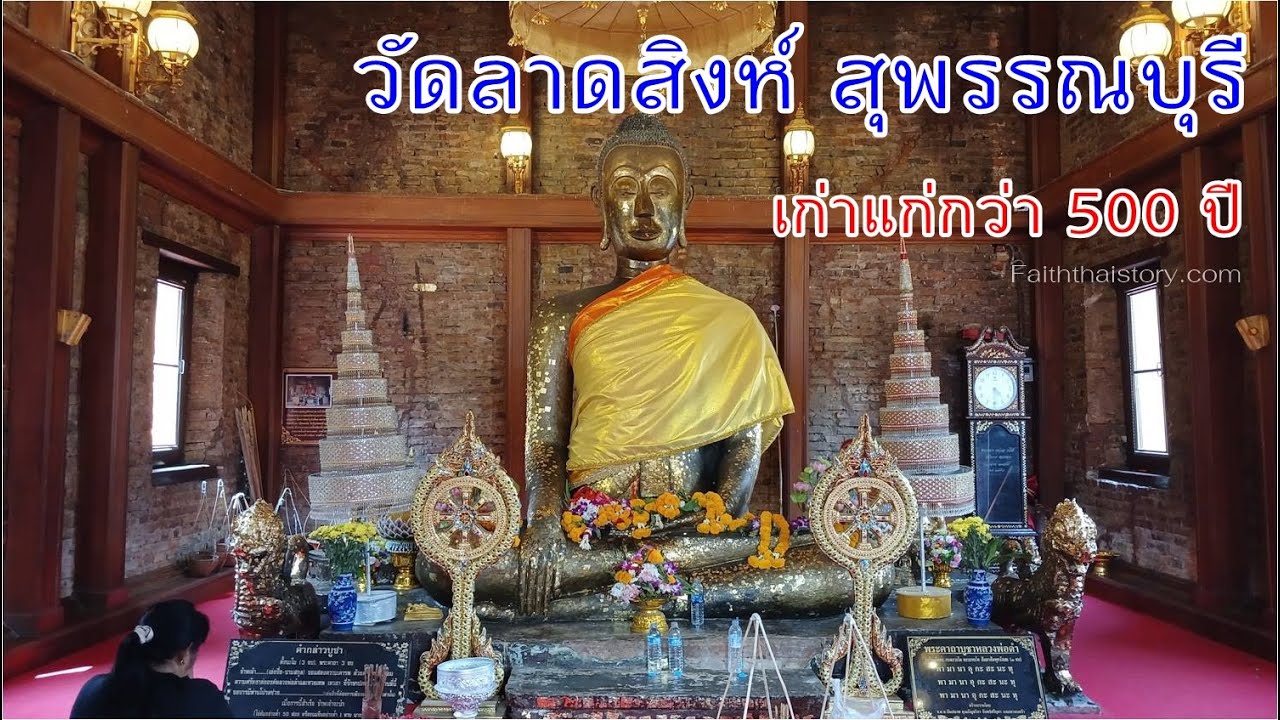
 Click to Access the Navigation Map GPS
Wat Lat Singh Map
Recommend

 Art, Culture and Heritage
 Historical Sites and Monuments(2)
 Landmarks and Memorials(4)
 Art, Craft Centres, Tradition(2)
 Museums(5)
 Educational Places
 Educational Gardens, Farm(4)
 Training Center(2)
Temple(36)
Training Center(2)
Temple(36)
 Other Sacred Sites(4)
 Suburban Living
 Village, Community(6)
 Local Market(7)
 Floating Market(1)
 Nature and Wildlife
 National Parks and Marine Reserves(4)
 Mountain (Doi)(2)
 Dam, Reservoir, Lake(3)
 Caves(1)
 Bays and Beaches(1)
 Entertainment and Agricultural
 Farms, Parks and Ecotourism(6)
 Theater(1)


