
lovethailand home >Central Travel Attractions >Suphan Buri Travel Attractions >Si Prachan >Ban Krang > Wat Ban Krang
TL;DR: Wat Ban Krang is located at Ban Krang Subdistrict, Si Prachan District, Suphan Buri Province 72140, Thailand, open Daily, hours 09.00 – 17.00.
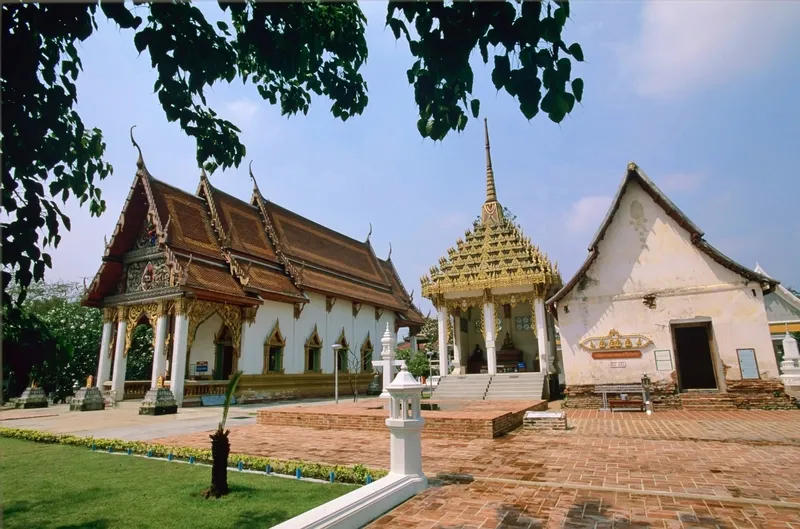
Wat Ban Krang
Open Days: Daily
Opening Hours: 09.00 – 17.00
Wat Ban Krang in Suphan Buri Province is an ancient riverside temple in Ban Krang Subdistrict, Si Prachan District, located on the bank of the Suphan River, also known as the Tha Chin River. The temple is about 20 kilometers from Suphan Buri town and is widely recognized as one of the most important temples in the province for those interested in Ayutthaya-period history, Thai amulets, Buddhist art, riverside communities, and the legacy of King Naresuan the Great. Wat Ban Krang is especially famous as the source of Phra Khun Phaen Ban Krang, a group of clay amulets in Ayutthaya style that hold a special place in Thai amulet history.
The most famous identity of Wat Ban Krang is its connection with the Phra Khun Phaen Ban Krang amulet chamber. These amulets are made of fired clay and are associated with Ayutthaya art. Local tradition links their creation to the period after the elephant-back duel, or Yutthahatthi, between King Naresuan the Great and the Burmese Crown Prince. According to the story, when the Thai army returned through the area of present-day Si Prachan District and rested by the Suphan River, King Naresuan ordered soldiers to create a large number of amulets to dedicate merit to soldiers who had died in battle.
The traditional account says that as many as 84,000 amulets were made and placed in the chamber at Wat Ban Krang. Whether read as history, local memory, or sacred legend, the story gives the temple a powerful cultural meaning. It connects Wat Ban Krang with warfare, kingship, sacrifice, Buddhist merit-making, and the practice of creating sacred objects to honor the dead. For Thai visitors, this makes the temple more than a place of worship. It is a site of remembrance.
Among the amulets associated with Wat Ban Krang, the paired Ban Krang type is especially meaningful. Its mold shows two Buddha-like figures standing together, traditionally interpreted as representing King Naresuan the Great and King Ekathotsarot. This paired format is rare among Thai amulet chambers, which makes it highly significant both artistically and symbolically. The image of two figures together reflects brotherhood, shared duty, royal unity, and the memory of defending the kingdom.
Phra Khun Phaen Ban Krang is one of the best-known clay amulet groups from Suphan Buri. Devotees and collectors often associate it with charm, protection, courage, invulnerability, and auspiciousness. For visitors who are not familiar with Thai amulet culture, Wat Ban Krang offers a useful introduction to how amulets in Thailand are not only collectible objects. They are also devotional objects connected with temples, legends, kings, battles, and community memory.
Wat Ban Krang should not be viewed only through the lens of amulets. It is also an important old temple with several historic structures. The ordination hall and viharn are ancient religious buildings from the Ayutthaya period. Inside, visitors can pay respect to a large principal Buddha image in U Thong style. This artistic style reflects the long history of Buddhist art in the Suphan Buri region and the temple’s deep connection with older central Thai religious culture.
The ordination hall is especially distinctive because of its boundary stones. The sema stones around the ubosot were inspired by the large Song Phon Phim-style Ban Krang amulet, enlarged into the size of boundary markers. This makes the temple’s sema stones different from those of other temples. They are not only functional markers of the sacred ordination area, but also architectural expressions of the temple’s own amulet identity.
In Thai Buddhism, sema stones define the consecrated boundary of an ordination hall. Important monastic rites, including ordination, are performed within this sacred space. At Wat Ban Krang, the use of amulet-inspired sema designs creates a meaningful link between sacred space, Buddhist ritual, and the temple’s amulet tradition. Visitors should walk around the ubosot slowly and observe these details, because they are among the temple’s most unique visual features.
The old viharn of Wat Ban Krang is believed to be about 450 years old. It enshrines Luang Pho Kaeo and a principal Buddha image. The atmosphere inside and around the viharn gives visitors a clear sense of an old riverside temple that has been preserved through generations. The viharn is important not only as a place of worship, but also as a reminder of the temple’s Ayutthaya-period roots and its long-standing role in local Buddhist life.
Next to the viharn is a mondop housing a replica Buddha footprint. The mondop was built in 1933. In Thai Buddhist culture, a Buddha footprint symbolizes the presence and teaching of the Buddha and is an important object of devotion. Visitors who come to Wat Ban Krang can therefore pay respect not only to Buddha images but also to the Buddha footprint, adding another layer of spiritual meaning to the visit.
Behind the viharn stands a restored chedi built on the site of an older Ayutthaya-period structure. The chedi measures about 5.70 meters from base to top and is historically important because it was used to contain the Wat Ban Krang amulet family, including Phra Khun Phaen. Bronze Buddha images, about 20 to 30 in number, and green glass-like amulets were also found inside. This makes the chedi one of the most important areas for understanding the temple’s amulet history.
The chedi behind the viharn should be viewed with respect because it is not merely an architectural feature. It is connected with the discovery of the amulet chamber and the temple’s sacred memory. When visitors understand the legend of the 84,000 amulets and the dedication of merit to fallen soldiers, the chedi becomes a site of historical and spiritual reflection rather than just a structure in the temple grounds.
Along the river stands another important feature: the water chedi. This chedi was built during the reign of King Rama IV and is about 150 years old. It has an indented-corner form known in Thai as yo mum mai sip song. Originally, the chedi stood in the middle of the Tha Chin River and was used as an object of worship during the Loy Krathong festival. Over time, the river current shifted, and the chedi is now near the riverbank. This change shows how river landscapes can transform over time.
The water chedi is also historically important because King Chulalongkorn, Rama V, visited and paid homage to it during his trip to Suphan Buri on 19 October 1908. He also set up a temporary royal pavilion at Ban Krang. This royal connection adds another layer of significance to the temple. Wat Ban Krang is therefore not only connected with Ayutthaya memory and King Naresuan, but also with the later royal travel history of King Rama V.
The riverside area in front of the temple is home to many fish, and the temple has built a large Thai-style covered raft where visitors can make merit by feeding fish. This area functions as a fish sanctuary and is one of the most relaxing parts of the temple. Feeding fish in a Thai temple is connected with compassion, generosity, and merit-making. It is also a family-friendly activity that links Buddhist practice with the riverside environment.
The fish sanctuary makes the relationship between Wat Ban Krang and the Tha Chin River easy to understand. The river is not only a landscape feature; it is part of the temple’s living identity. The water chedi, fish-feeding raft, old riverside atmosphere, and nearby community all show how central Thai temples developed together with rivers. Visitors should take time to sit by the water and observe this connection.
Near the temple entrance, old two-storey wooden row houses can still be seen. These buildings create a quiet and nostalgic atmosphere. They reflect the simple older lifestyle of people in Ban Krang and Si Prachan. The combination of wooden houses, an old temple, the river, and nearby local markets makes a visit to Wat Ban Krang feel like a journey into the cultural landscape of old Suphan Buri.
Another meaningful feature is the Agricultural Museum of Wat Ban Krang, which preserves local farming tools such as wooden yokes, ploughs, and traditional water-lifting devices. These objects explain the farming life of central Thai communities and the relationship between temples and agricultural society. Although the objects are simple, they are important because they show how people lived, worked, and depended on water, fields, animals, and local craftsmanship.
The museum gives Wat Ban Krang another role beyond worship. It turns the temple into a community learning space. Visitors can see how religion, agriculture, and local life are connected in Thai society. Temples often served as repositories of knowledge and memory, and Wat Ban Krang is a good example of this function.
Today, Wat Ban Krang remains an active local temple. The current abbot is Phra Khru Sunthon Sila Samban. Visitors come to pay respect to Luang Pho Kaeo, see the ancient ubosot and viharn, learn about Phra Khun Phaen Ban Krang, feed fish by the river, and experience the calm atmosphere of a historic riverside temple. The temple is not frozen in the past; it continues to serve both local residents and cultural travelers.
For those interested in King Naresuan, Wat Ban Krang offers a deeper perspective on the memory of the Yutthahatthi campaign. The temple’s amulet legend focuses not only on victory but also on merit-making for those who died in battle. This gives the temple a more reflective meaning. The creation of amulets becomes a sacred act of remembrance, compassion, and dedication to the dead.
For amulet enthusiasts, visiting Wat Ban Krang helps place Phra Khun Phaen Ban Krang in its original landscape. The amulets are connected with the temple, the chedi, the river, local legend, and the broader memory of Ayutthaya-era warfare. Seeing the place itself gives the amulets context beyond the world of collecting. It helps visitors understand why they remain so meaningful in Thai religious culture.
For general travelers, Wat Ban Krang is suitable for families and cultural visitors. The temple offers worship areas, ancient buildings, a riverside fish sanctuary, a small museum, and a quiet local atmosphere. Visitors should allow about 1 to 2 hours to see the main areas properly. The temple can also be combined with Si Prachan Old Market, Buffalo Village, Wat Worachan, Wat Phra Si Rattana Mahathat, and Suphan Buri town.
The best time to visit is in the morning or late afternoon, when the weather is more comfortable and the riverside light is softer. These times are also good for photography. Visitors should dress modestly, speak quietly in sacred areas, avoid touching old objects without permission, and keep the riverside area clean. Respectful travel is important because Wat Ban Krang remains both a sacred site and an active community temple.
Getting there is easiest by private car. From Highway 340, pass through Si Prachan District and enter Highway 3038 around kilometer markers 14–15. The temple is on the bank of the Suphan River or Tha Chin River, on the opposite side from the Si Prachan District Office. It is about 20 kilometers from Suphan Buri town. From Bangkok, travelers can use either the Bang Bua Thong–Suphan Buri route or the Nakhon Pathom–Suphan Buri route before continuing to Si Prachan.
Travelers without a private car can first reach Suphan Buri town or Si Prachan District, then continue by local transport or hired vehicle. However, private transport is more convenient for combining Wat Ban Krang with nearby attractions in one day, especially Si Prachan Old Market, Buffalo Village, Wat Phra Si Rattana Mahathat, and the main town area of Suphan Buri.
For foreign travelers, Wat Ban Krang is an excellent place to understand several layers of Thai culture at once: an Ayutthaya-period temple, sacred amulets, royal history, the memory of King Naresuan, the Tha Chin River, local farming life, and fish-feeding merit-making. Phra Khun Phaen Ban Krang shows that Thai amulets are not merely collectibles; they are objects of faith tied to history, legend, and community identity.
In summary, Wat Ban Krang is one of the most important cultural temples in Suphan Buri Province. Its highlights include its Ayutthaya-period history, the Phra Khun Phaen Ban Krang amulet chamber, the legend of merit-making after the Yutthahatthi campaign, the ancient ubosot and viharn, unique sema stones, the Buddha-footprint mondop, the restored chedi behind the viharn, the water chedi, the fish sanctuary, and the old riverside community atmosphere. For travelers interested in Thai history, amulet culture, Buddhist art, and riverside life, Wat Ban Krang is a destination worth adding to a Suphan Buri itinerary.
| Name | Wat Ban Krang |
| Location | Ban Krang Subdistrict, Si Prachan District, Suphan Buri Province 72140, Thailand |
| Address | No. 252, Moo 2, Ban Krang Subdistrict, Si Prachan District, Suphan Buri Province 72140, Thailand |
| Highlights | Ayutthaya-period temple, Phra Khun Phaen Ban Krang amulet chamber, ancient ubosot and viharn, unique sema stones, Buddha-footprint mondop, water chedi, fish sanctuary, and Tha Chin riverside atmosphere |
| History | An old temple from the Ayutthaya period, believed to be about 400 years old. Local tradition links the creation of its amulets with merit-making after the Yutthahatthi campaign of King Naresuan the Great. |
| Distinctive Features | A local Buddhist temple on the Tha Chin River and one of the most important sources of the Wat Ban Krang amulet family, especially Phra Khun Phaen Ban Krang |
| Important Objects And Areas | Ancient ubosot, old viharn, Luang Pho Kaeo, U Thong-style principal Buddha image, amulet-inspired sema stones, Buddha-footprint mondop, chedi behind the viharn, water chedi, fish sanctuary, and Wat Ban Krang Agricultural Museum |
| Important Figures / Stories | King Naresuan the Great, King Ekathotsarot, the Yutthahatthi campaign, the legend of creating 84,000 amulets, and King Rama V’s visit to the water chedi on 19 October 1908 |
| Travel Information | From Highway 340, pass Si Prachan District and enter Highway 3038 around kilometer markers 14–15. The temple is on the Tha Chin River, opposite the Si Prachan District Office side, about 20 km from Suphan Buri town. |
| Current Status | Open for worship, merit-making, ancient temple visits, fish feeding, and learning about Phra Khun Phaen Ban Krang during opening hours |
| Open Days | Daily |
| Opening Hours | 09.00 – 17.00 |
| Fees | No admission fee |
| Facilities | Parking area, worship areas, ubosot, viharn, mondop, fish-feeding raft, riverside area, agricultural museum, and walking areas inside the temple |
| Main Areas / Zones | Ubosot And Unique Sema Stone Zone Luang Pho Kaeo Viharn Zone Buddha-Footprint Mondop Zone Chedi And Phra Khun Phaen Ban Krang Amulet Chamber Zone Water Chedi By The Tha Chin River Zone Fish Sanctuary And Fish-Feeding Raft Zone Wat Ban Krang Agricultural Museum Zone |
| Abbot / Caretaker | Phra Khru Sunthon Sila Samban |
| Main Contact Number | 035-581-234, 086-560-8110 |
| Nearby Tourist Attractions | 1. Si Prachan Old Market, about 1 km 2. Buffalo Village Suphan Buri, about 5 km 3. Wat Worachan, about 10 km 4. Wat Phra Si Rattana Mahathat Suphan Buri, about 17 km 5. Suphan Buri City Pillar Shrine And Dragon Paradise Park, about 18 km |
| Nearby Restaurants | 1. Ruean Pha Pa Soi, Si Prachan Old Market, about 1 km 2. Local Restaurants Around Si Prachan Old Market, about 1 km 3. Local Noodle And Thai Food Shops In Si Prachan, about 2 km 4. Restaurants Around Buffalo Village Suphan Buri, about 5 km 5. Restaurants In Suphan Buri Town, about 17 km |
| Nearby Accommodations | 1. Bamboo Resort Si Prachan, about 1 km, Tel. 098-493-2465, 098-291-4682 2. Baan Thai Resort, about 4 km 3. Ing Nam Tha Chin / Tha Chin Resort, about 7 km 4. Baan Amon Resort, about 8 km 5. Darapura @ Wangyang Resort, about 5 km |
Frequently Asked Questions (FAQ)
Q: Where is Wat Ban Krang located?
A: Wat Ban Krang is located at No. 252, Moo 2, Ban Krang Subdistrict, Si Prachan District, Suphan Buri Province, on the bank of the Suphan River or Tha Chin River, about 20 km from Suphan Buri town.
Q: What is Wat Ban Krang famous for?
A: Wat Ban Krang is famous as an Ayutthaya-period temple and the source of Phra Khun Phaen Ban Krang, one of the most important clay amulet groups from Suphan Buri.
Q: Why is Phra Khun Phaen Ban Krang important?
A: Phra Khun Phaen Ban Krang is a fired-clay amulet in Ayutthaya style, traditionally linked with King Naresuan the Great and merit-making after the Yutthahatthi campaign.
Q: What does the paired Ban Krang amulet represent?
A: The paired Ban Krang amulet shows two figures together, traditionally interpreted as representing King Naresuan the Great and King Ekathotsarot. This rare format carries strong historical and symbolic meaning.
Q: Does Wat Ban Krang have a water chedi?
A: Yes. The temple has a water chedi by the Tha Chin River. It was built during the reign of King Rama IV, and King Rama V visited it on 19 October 1908.
Q: Is there an admission fee for Wat Ban Krang?
A: No. Wat Ban Krang has no admission fee for general visits.
Q: What nearby attractions can be visited with Wat Ban Krang?
A: Nearby attractions include Si Prachan Old Market, Buffalo Village Suphan Buri, Wat Worachan, Wat Phra Si Rattana Mahathat, Suphan Buri City Pillar Shrine, and Dragon Paradise Park.
Q: How can travelers get to Wat Ban Krang?
A: From Highway 340, pass Si Prachan District and enter Highway 3038 around kilometer markers 14–15. The temple is on the Tha Chin River, opposite the Si Prachan District Office side.
 Category: ●Places of Worship
 Group: ●Temple
Last Update : 6 MonthAgo
 Last Update : 6 MonthAgo

 Click to Access the Navigation Map GPS
Wat Ban Krang Map
Recommend

 Art, Culture and Heritage
 Historical Sites and Monuments(2)
 Landmarks and Memorials(4)
 Art, Craft Centres, Tradition(2)
 Museums(5)
 Educational Places
 Educational Gardens, Farm(4)
 Training Center(2)
 University
 Public university(1)
 Rajamangala University of Technology(1)
Temple(36)
 Other Sacred Sites(4)
 Suburban Living
 Village, Community(6)
 Local Market(7)
 Floating Market(1)
 Nature and Wildlife
 National Parks and Marine Reserves(4)
 Mountain (Doi)(2)
 Dam, Reservoir, Lake(3)
 Caves(1)
 Bays and Beaches(1)
 Entertainment and Agricultural
 Farms, Parks and Ecotourism(6)
 Theater(1)
 Shopping
 Department Store(1)
 Travel Articles, Recipes
 Travel Review, Food Review(1)


