
lovethailand home >Central Travel Attractions >Suphan Buri Travel Attractions >Doem Bang Nang Buat >Pa Sakae > Wat Khwang Weruwan
TL;DR: Wat Khwang Weruwan is located at Ban Thung Kan Lueang, Moo 5, Pa Sakae Subdistrict, Doem Bang Nang Buat District, Suphan Buri Province 72120, Thailand, open Daily, hours 08.00 – 17.00.
Wat Khwang Weruwan
Open Days: Daily
Opening Hours: 08.00 – 17.00
Wat Khwang Weruwan in Suphan Buri Province is an old local Buddhist temple in Pa Sakae Subdistrict, Doem Bang Nang Buat District. Located at 131 Ban Thung Kan Lueang, Moo 5, the temple is a community religious site under the Mahanikaya order and occupies an area of 25 rai, 1 ngan, and 40 square wah. Although it is not one of the most commercialized tourist attractions in Suphan Buri, Wat Khwang Weruwan is meaningful for travelers who want to discover a quieter side of the province through old Buddha images, local temple history, community memory, and rural cultural landscapes.
The most important highlight of Wat Khwang Weruwan is its ancient Buddha image, described as being connected with the Dvaravati period or “Mueang Naret” in local terminology, with an age of about 400 years. The Buddha image is deeply respected by local devotees and is regarded as a sacred object of the temple. In addition, the temple area is associated with ancient bricks and older religious remains, making it a place of interest for visitors who appreciate Buddhist art, local archaeology, and lesser-known temples in Suphan Buri.
For travelers planning a route through Doem Bang Nang Buat, Wat Khwang Weruwan can be combined with Bueng Chawak, Wat Khao Nang Buat, Wat Doem Bang, Tha Chang Market, and other local attractions along the upper part of Suphan Buri Province. The temple offers a different atmosphere from large tourist temples. It is quiet, modest, and still closely tied to the daily life of the surrounding community. This makes it a suitable stop for visitors who prefer meaningful local experiences rather than crowded sightseeing sites.
The temple was originally known as Wat Khwang. The name “Khwang,” meaning “crosswise,” is linked to an old Ayutthaya-period ordination hall that was built across the direction of the sun. Later, the word “Weruwan” was added to create a more graceful and Buddhist-sounding name. “Weruwan” refers to a bamboo grove and recalls Veluvana in Buddhist tradition. The present name, Wat Khwang Weruwan, therefore combines a local memory of the temple’s old architectural orientation with a sacred Buddhist meaning.
Wat Khwang Weruwan was officially established in B.E. 2474, or 1931, and has been restored and developed continuously. It received its consecrated boundary on 25 August B.E. 2541, or 1998. The consecrated boundary measures 24 meters wide and 36 meters long. These details show how the temple developed from a local community temple with older religious roots into a fully functioning Buddhist temple used for monastic activities, merit-making, and local ceremonies.
The temple’s location also reflects the geography of the surrounding community. The northern boundary adjoins a local road, the southern boundary reaches Khlong Krasiao, and the eastern and western boundaries connect with public roads. This setting makes the temple part of the everyday landscape of Ban Thung Kan Lueang and Pa Sakae Subdistrict. Like many temples in rural central Thailand, Wat Khwang Weruwan is not isolated from local life. It is connected with roads, canals, agriculture, ceremonies, and community movement.
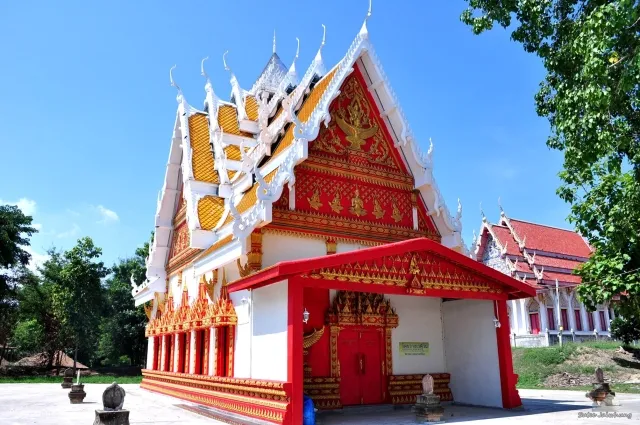
The main buildings within the temple include an ordination hall, sermon hall, chanting hall, monks’ residences, and a crematorium. The present ordination hall is a reinforced-concrete building measuring 6.50 meters wide and 18.30 meters long, built in 1991. The sermon hall measures 15 meters wide and 32 meters long and was built in 1997. The chanting hall measures 11.50 meters wide and 17.50 meters long and was built in 1994. The temple also has seven monks’ residences, including three wooden buildings and four concrete buildings.
The principal Buddha image inside the ordination hall is one of the temple’s key sacred objects. It is accompanied by images of Phra Moggallana and Phra Sariputta, two of the Buddha’s chief disciples. The temple also preserves three stucco Buddha images: one with a lap width of 29 inches and two with lap widths of 27 inches. These images are believed to date back to the Ayutthaya period. Together, they add historical and artistic value to the temple and make Wat Khwang Weruwan more than an ordinary community temple.
The ancient Buddha images at Wat Khwang Weruwan are central to the temple’s devotional identity. They may not be monumental in size, but their value lies in continuity of faith. Local people have respected and preserved them for generations, turning them into spiritual anchors for the community. For visitors, these images reveal how sacred objects in rural temples often carry deep meaning through long-term local devotion rather than through size or fame.
The ancient bricks and older remains inside the temple grounds are also worth noting. In Thai temple contexts, ancient bricks are often linked to older religious structures such as ordination halls, viharns, chedis, or building foundations. Their presence suggests that the temple area contains layers of history beyond the visible modern structures. Visitors interested in local history should walk slowly around the temple and observe the relationship between newer buildings and older religious traces.
Beyond its religious value, Wat Khwang Weruwan stands within a broader cultural landscape of Pa Sakae and Doem Bang Nang Buat. The area is associated with local memories, folk stories, and cultural figures from Suphan Buri. Stories about figures such as Suea Dam Sarakham, Suea Bai, and Suea Fai are part of the social memory of Suphan Buri’s past. These stories should be understood as historical and cultural context, not as praise for criminal behavior. They reflect the complexity of rural society, conflict, hardship, local justice, and state authority in earlier periods.
Pa Sakae and the wider Doem Bang Nang Buat area are also associated with Thai luk thung culture. Sayun Sanya, one of Thailand’s best-known luk thung singers, is connected with the Suphan Buri countryside and the cultural world of rural central Thailand. His songs express the emotions of farming communities, love, loss, hardship, and hope. Placing Wat Khwang Weruwan within this broader cultural landscape helps visitors understand that the temple is surrounded not only by religious heritage, but also by music, memory, and local identity.
In this sense, Wat Khwang Weruwan connects several themes: ancient Buddha images, community temple architecture, the origin of a temple name, Khlong Krasiao, local memory of Mueang Naret, stories of Suphan Buri’s legendary figures, and the cultural world of Pa Sakae. A visit here is best enjoyed slowly. Rather than treating the temple as a quick photo stop, visitors should use it as a place to read the landscape and understand how small temples preserve community identity.
The atmosphere inside the temple is calm and suitable for merit-making, prayer, photography, and quiet reflection. Visitors can begin by paying respect to the principal Buddha image in the ordination hall, then continue to see the older Buddha images, the sermon hall, the chanting hall, and the surrounding temple grounds. The area near Khlong Krasiao and the village setting adds to the temple’s rural charm. Morning and late afternoon are the most comfortable times to visit, especially during Thailand’s hot season.
Wat Khwang Weruwan is also a suitable stop for travelers planning a multi-temple route in Doem Bang Nang Buat District. It can be combined with Wat Doem Bang, Wat Khao Nang Buat, Wat Tha Chang, Wat Hua Khao, and other nearby temples. For families, it can also be paired with Bueng Chawak, where children can enjoy aquarium and wildlife learning activities, while older visitors can enjoy temple visits and local food stops.
For those interested in Thai temple history, Wat Khwang Weruwan is a good example of how written records and oral memory work together. Official information confirms the temple’s establishment date, consecrated boundary, buildings, and list of abbots. Local stories add cultural depth by connecting the temple with older landscapes, cultural figures, and community identity. Reading both layers together gives visitors a better understanding of rural Thai temples.
The known abbots include Phra Phuang, Phra Kae, Phra Pan, Phra Mot, Phra Hom, and Phra Khru Anurak Weruwan. These names show continuity in the temple’s administration and development. In a local temple, the abbot plays a role not only in monastic discipline and religious ceremonies, but also in community coordination, temple preservation, and maintaining the temple as a local spiritual center.
As a travel destination, Wat Khwang Weruwan is especially suitable for visitors who prefer quiet places, local temples, and authentic rural surroundings. While Mueang Suphan Buri is known for Wat Pa Lelai, Wat Khae, and Dragon Paradise Park, Doem Bang Nang Buat offers another side of the province through nature, canals, community markets, and temples connected with local identity. Wat Khwang Weruwan adds depth to this route by offering an old Buddha image and community history in a peaceful setting.
Getting there is easiest by private car. From Suphan Buri town, drive toward Doem Bang Nang Buat District on the Suphan Buri–Chai Nat route, then continue to Pa Sakae Subdistrict and Ban Thung Kan Lueang. From Bangkok, travelers can use the Bang Bua Thong–Suphan Buri route or the Nakhon Pathom–Suphan Buri route before continuing north to Doem Bang Nang Buat. Travel time from Bangkok is usually around 2.5 to 3.5 hours depending on traffic.
Public transport travelers can reach Doem Bang Nang Buat or Suphan Buri town first, then continue by local transport or taxi to Pa Sakae. However, if the plan includes multiple attractions such as Wat Khwang Weruwan, Bueng Chawak, Wat Khao Nang Buat, Wat Doem Bang, and Tha Chang Market, traveling by private car is more practical because the attractions are spread across the district.
The best time to visit is in the morning or late afternoon. Visitors should dress modestly, speak quietly inside sacred areas, avoid climbing on or touching religious objects unnecessarily, and respect monks, worshippers, and local residents. Wat Khwang Weruwan remains an active temple for the community, so a respectful attitude is important.
A good one-day route can begin with Wat Khwang Weruwan in the morning, followed by Bueng Chawak for aquarium and wildlife activities, then Wat Khao Nang Buat or Wat Doem Bang, and finally Tha Chang Market or a local restaurant in Doem Bang Nang Buat. This route is suitable for families, temple travelers, local culture enthusiasts, and visitors who want to experience upper Suphan Buri at a slower pace.
For foreign travelers, Wat Khwang Weruwan can be described as a small but meaningful rural Thai temple. It is not a large commercial attraction, but it offers insight into how Buddhist temples preserve sacred images, local stories, and community memory. A visit here helps travelers understand that temples in Thailand function not only as places of worship, but also as cultural archives and social centers.
In summary, Wat Khwang Weruwan is a worthwhile stop in Doem Bang Nang Buat District, Suphan Buri Province. Its highlights include the ancient Buddha image associated with the Dvaravati period or Mueang Naret, ancient bricks, the origin of the temple name from an old crosswise ordination hall, its peaceful community atmosphere, and the wider cultural context of Pa Sakae. It is best suited for travelers who want to explore Suphan Buri more deeply and discover a quiet local temple with meaningful stories beyond the usual tourist route.
| Name | Wat Khwang Weruwan |
| Location | Ban Thung Kan Lueang, Moo 5, Pa Sakae Subdistrict, Doem Bang Nang Buat District, Suphan Buri Province 72120, Thailand |
| Address | No. 131, Ban Thung Kan Lueang, Moo 5, Pa Sakae Subdistrict, Doem Bang Nang Buat District, Suphan Buri Province, Thailand |
| Highlights | Ancient Buddha image associated with the Dvaravati period or Mueang Naret, ancient bricks, peaceful local temple atmosphere, and cultural memory of Pa Sakae |
| History | Established in 1931. The temple was originally called Wat Khwang because an old Ayutthaya-period ordination hall was built crosswise to the sun. The word Weruwan was later added. The temple received its consecrated boundary on 25 August 1998. |
| Name Origin | The original name was Wat Khwang, referring to the crosswise orientation of the old ordination hall. The present name is Wat Khwang Weruwan. |
| Distinctive Features | A Mahanikaya community temple covering 25 rai, 1 ngan, and 40 square wah, with an ordination hall, sermon hall, chanting hall, monks’ residences, and crematorium |
| Important Objects And Areas | Ancient Buddha image, principal Buddha image in the ordination hall, Phra Moggallana, Phra Sariputta, three stucco Buddha images, ancient bricks, ordination hall, sermon hall, and chanting hall |
| Travel Information | Travel by private car from Suphan Buri town toward Doem Bang Nang Buat District on the Suphan Buri–Chai Nat route, then continue to Pa Sakae Subdistrict. From Bangkok, use the Bang Bua Thong–Suphan Buri or Nakhon Pathom–Suphan Buri route and continue north to Doem Bang Nang Buat. |
| Current Status | Open for merit-making, worship, and general temple visits during opening hours |
| Open Days | Daily |
| Opening Hours | 08.00 – 17.00 |
| Facilities | Parking area, ordination hall, sermon hall, chanting hall, merit-making areas, and walking areas inside the temple |
| Main Areas / Zones | Ordination Hall And Principal Buddha Image Zone Ancient Buddha Image And Sacred Objects Zone Sermon Hall Zone Chanting Hall Zone Monks’ Residence And Community Temple Zone Khlong Krasiao Area |
| Abbot / Caretaker | Phra Khru Anurak Weruwan |
| Main Contact Number | 035-525-867, 035-525-880 |
| Nearby Tourist Attractions | 1. Bueng Chawak, about 14 km 2. Wat Khao Nang Buat, about 16 km 3. Wat Doem Bang, about 16 km 4. Tha Chang Market, about 18 km 5. Sam Chuk 100-Year Market, about 28 km |
| Nearby Restaurants | 1. Krua Mai Ngam, about 14 km, Tel. 098-414-8405 2. Lek Siao Hong Riverside Restaurant, about 17 km 3. Restaurants around Bueng Chawak, about 14 km 4. Restaurants around Tha Chang Market, about 18 km 5. Restaurants around Sam Chuk 100-Year Market, about 28 km |
| Nearby Accommodations | 1. Bungchawak Resort, about 16 km, Tel. 035-430-099, 080-583-8388 2. Doem Bang Villa, about 18 km, Tel. 083-316-9557 3. Ban Phanthira Resort Doem Bang Nang Buat, about 20 km, Tel. 080-658-8566 4. Than Ra Rin Villa, about 18 km 5. Tha Chin River Home, about 22 km |
Frequently Asked Questions (FAQ)
Q: Where is Wat Khwang Weruwan located?
A: Wat Khwang Weruwan is located at 131 Ban Thung Kan Lueang, Moo 5, Pa Sakae Subdistrict, Doem Bang Nang Buat District, Suphan Buri Province, Thailand.
Q: What is the main highlight of Wat Khwang Weruwan?
A: The main highlight is the ancient Buddha image associated with the Dvaravati period or Mueang Naret, along with ancient bricks and the peaceful atmosphere of a local community temple.
Q: What was the original name of Wat Khwang Weruwan?
A: The temple was originally called Wat Khwang because an old Ayutthaya-period ordination hall was built crosswise to the sun. The word Weruwan was later added.
Q: What are the opening hours of Wat Khwang Weruwan?
A: Wat Khwang Weruwan is open daily from 08.00 to 17.00.
Q: Who should visit Wat Khwang Weruwan?
A: The temple is suitable for travelers interested in quiet local temples, Buddhist worship, ancient Buddha images, community history, and cultural routes in Doem Bang Nang Buat District.
Q: What nearby attractions can be visited with Wat Khwang Weruwan?
A: Nearby attractions include Bueng Chawak, Wat Khao Nang Buat, Wat Doem Bang, Tha Chang Market, and Sam Chuk 100-Year Market.
Q: How is Wat Khwang Weruwan connected with Sayun Sanya?
A: The temple is located in the Pa Sakae and Doem Bang Nang Buat cultural area, which is associated with the rural Suphan Buri background connected to Sayun Sanya, one of Thailand’s best-known luk thung singers.
Q: How can travelers get to Wat Khwang Weruwan from Suphan Buri town?
A: Travel by private car toward Doem Bang Nang Buat District on the Suphan Buri–Chai Nat route, then continue to Pa Sakae Subdistrict. Public transport travelers can reach Doem Bang Nang Buat first and then continue by local transport or taxi.
 Category: ●Places of Worship
 Group: ●Temple
Last Update : 4 MonthAgo
 Last Update : 4 MonthAgo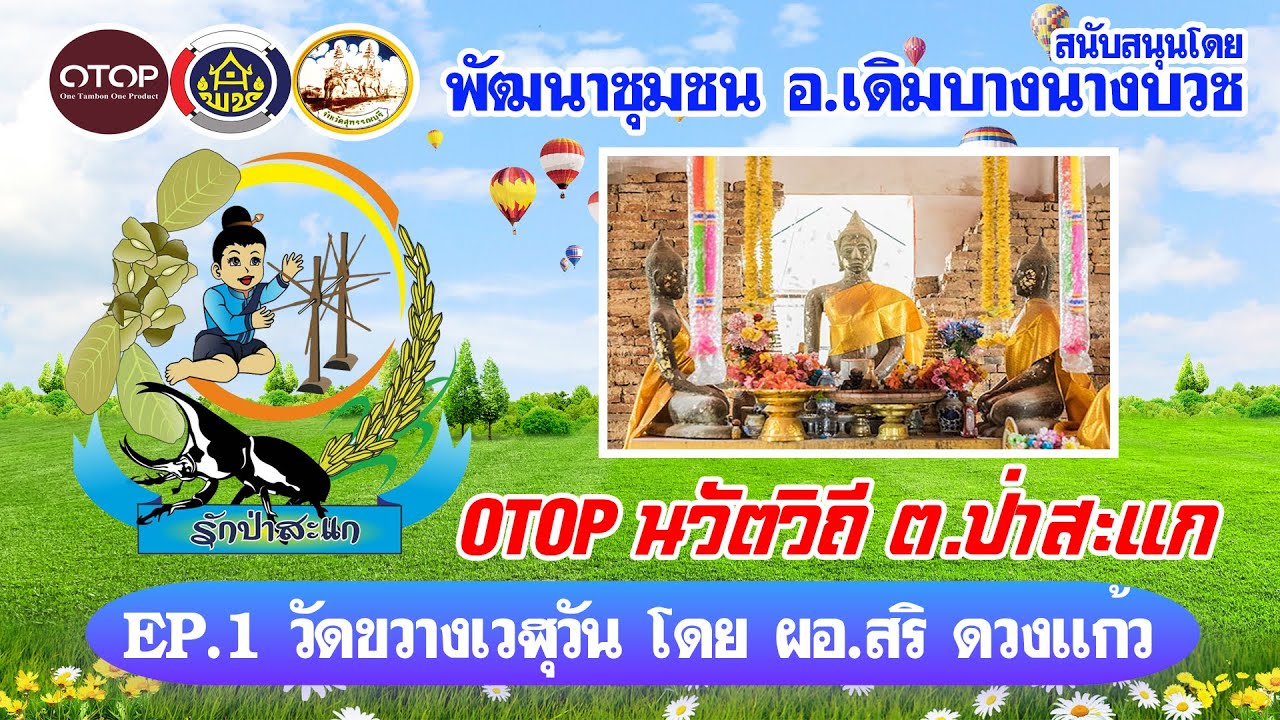
 Click to Access the Navigation Map GPS
Wat Khwang Weruwan Map
Recommend

 Art, Culture and Heritage
 Historical Sites and Monuments(2)
 Landmarks and Memorials(4)
 Art, Craft Centres, Tradition(2)
 Museums(5)
 Educational Places
 Educational Gardens, Farm(4)
 Training Center(2)
Temple(36)
Training Center(2)
Temple(36)
 Other Sacred Sites(4)
 Suburban Living
 Village, Community(6)
 Local Market(7)
 Floating Market(1)
 Nature and Wildlife
 National Parks and Marine Reserves(4)
 Mountain (Doi)(2)
 Dam, Reservoir, Lake(3)
 Caves(1)
 Bays and Beaches(1)
 Entertainment and Agricultural
 Farms, Parks and Ecotourism(6)
 Theater(1)


